Question
DETERMINANTS: A determinant is a square array of numbers (written within a pair of vertical lines) which represents a certain sum of We can solve a system of equations using determinants, but it becomes very tedious for large systems. We will only do 2 × 2 and 3 × 3 systems using determinants. Using the properties of determinants solve the problem given below and answer the questions that follow:
Three shopkeepers Ram Lal, Shyam Lal, and Ghansham are using polythene bags, handmade bags (prepared by prisoners), and newspaper's envelope as carry bags. It is found that the shopkeepers Ram Lal, Shyam Lal, and Ghansham are using (20, 30, 40), (30, 40, 20), and (40, 20, 30) polythene bags, handmade bags, and newspapers envelopes respectively. The shopkeepers Ram Lal, Shyam Lal, and Ghansham spent ₹250, ₹270, and ₹200 on these carry bags respectively.
  1. What is the cost of one polythene bag?
  1. ₹ 1
  2. ₹ 2
  3. ₹ 3
  4. ₹ 5
  1. What is the cost of one handmade bag?
  1. ₹1
  2. ₹2
  3. ₹3
  4. ₹5
  1. What is the cost of one newspaper bag?
  1. ₹1
  2. ₹2
  3. ₹3
  4. ₹5
  1. Keeping in mind the social conditions, which shopkeeper is better?
  1. Ram Lal
  2. Shyam Lal
  3. Ghansham
  4. None of these
  1. Keeping in mind the environmental conditions, which shopkeeper is better?
  1. Ram Lal
  2. Shyam Lal
  3. Ghansham
  4. None of these

Answer

  1. (a) ₹1
  2. (b) ₹2
  3. (d) ₹5
  4. (b) Shyam Lal
  5. (a) Ram Lal

Need a full question paper?

Generate a complete, print-ready paper with questions like this in minutes — across 16+ boards, with answer keys.

Start Generating Free

Similar questions

Let x = f(t) and y = g(t) be parametric forms with t as a parameter, then
$\frac{\text{dy}}{\text{dx}}=\frac{\text{dy}}{\text{dt}}\times\frac{\text{dt}}{\text{dx}}=\frac{\text{g}'(\text{t})}{\text{f}'(\text{t})},$ where $\text{f}'(\text{t})\neq0.$
On the basis of above information, answer the following questions.
  1. The derivative of $\text{f}(\tan\text{x})\text{w.r.t.}\text{ g}(\sec\text{x})\text{ at}\text{ x}=\frac{\pi}{4},$ where f'(1) = 2 and $\text{g}'(\sqrt{2})=4,$ is:
  1. $\frac{1}{\sqrt{2}}$
  2. ${\sqrt{2}}$
  3. 1
  4. 0
  1. The derivative of $\sin^{-1}\Big(\frac{2\text{x}}{1+\text{x}^2}\Big)$ with respect to $\cos^{-1}\Big(\frac{1-\text{x}^2}{1+\text{x}^2}\Big)$ is:
  1. -1
  2. 1
  3. 2
  4. 4
  1. The derivative of $\text{e}^{\text{x}^3}$ with respect to log x is:
  1. $\text{e}^{\text{x}^3}$
  2. $3\text{x}^22\text{e}^{\text{x}^3}$
  3. $3\text{x}^3\text{e}^{\text{x}^3}$
  4. $3\text{x}^2\text{e}^{\text{x}^3}+3\text{x}$
  1. The derivative of $\cos^{-1}(2\text{x}^2-1)\text{w.r.t.}\cos^{-1}\text{x}$ is:
  1. $2$
  2. $\frac{-1}{2\sqrt{1-\text{x}^2}}$
  3. $\frac{2}{\text{x}}$
  4. $1-\text{x}^2$
  1. If $\text{y}=\frac{1}{4}\mu^4$ and $\mu=\frac{2}{3}\text{x}^3+5,$ then $\frac{\text{dy}}{\text{dx}}=$
  1. $\frac{2}{27}\text{x}^2(2\text{x}^3+15)^3$
  2. $\frac{2}{7}\text{x}^2(2\text{x}^3+15)^3$
  3. $\frac{2}{27}\text{x}(2\text{x}^3+5)^3$
  4. $\frac{2}{7}(2\text{x}^3+15)^3$
If the equation is of the form $\frac{\text{dy}}{\text{dx}}=\text{py}=\text{Q},$ where P, Q are functions of x, then the solution of the differential equation is given by $\text{ye}^{\int\text{pdx}}=\int\text{Q e}^{\int\text{pdx}}\text{dx}+\text{c},$ where $\text{e}^{\int\text{pdx}}$ is called the integrating factor (I.F.).
Based on the above information, answer the following questions.
  1. The integrating factor of the differential equation $\sin\text{x}\frac{\text{dy}}{\text{dx}}+2\text{y}\cos\text{x}=1$ is $(\sin\text{x})^\lambda,$ where $\lambda=$
  1. 0
  2. 1
  3. 2
  4. 3
  1. Integrating factor of the differential equation $(1-\text{x}^2)\frac{\text{dy}}{\text{dx}}-\text{xy}=1$ is:
  1. $-\text{x}$
  2. $\frac{\text{x}}{1+\text{x}^2}$
  3. $\sqrt{1-\text{x}^2}$
  4. $\frac{1}{2}\log(1-\text{x}^2)$
  1. The solution of $\frac{\text{dy}}{\text{dx}}+\text{y}=\text{e}^{-\text{x}},\text{ y}(0)=0,$ is:
  1. $\text{y}=\text{e}^\text{x}(\text{x}-1)$
  2. $\text{y}=\text{xe}^{-\text{x}}$
  3. $\text{y}=\text{xe}^{-\text{x}}+1$
  4. $\text{y}=(\text{x}+1)\text{e}^{-\text{x}}$
  1. General solution of $\frac{\text{dy}}{\text{dx}}+\text{y}\tan\text{x}=\sec\text{x}$ is:
  1. $\text{y}\sec\text{y}=\tan\text{x}+\text{c}$
  2. $\text{y}\tan\text{x}=\sec\text{x}+\text{c}$
  3. $\tan\text{x}=\text{y}\tan\text{x}+\text{c}$
  4. $\text{x}\sec\text{x}=\tan\text{y}+\text{c}$
  1. The integrating factor of differential equation $\frac{\text{dy}}{\text{dx}}-3\text{y}=\sin2\text{x}$ is:
  1. $\text{e}^{3\text{x}}$
  2. $\text{e}^{-2\text{x}}$
  3. $\text{e}^{-3\text{x}}$
  4. $\text{xe}^{-3\text{x}}$
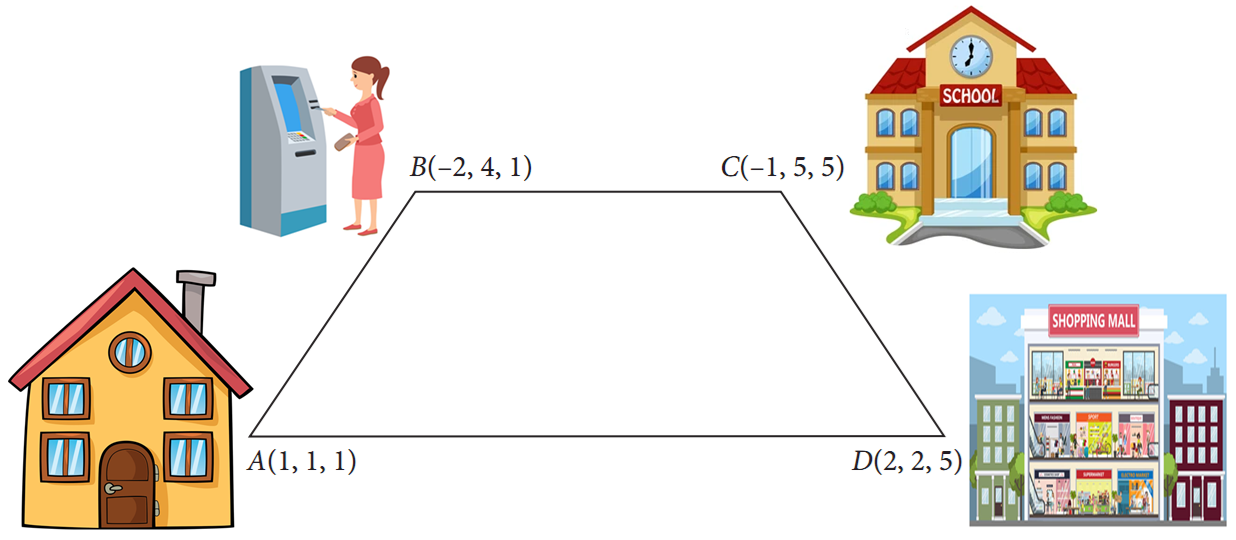
Ritika starts walking from his house to shopping mall. Instead of going to the mall directly, she first goes to a ATM, from there to her daughter's school and then reaches the mall. ln the diagram, A, B, C, and D represent the coordinates of House, ATM, School and Mall respectively.

Based on the above information, answer the following questions.
  1. Distance between House (A) and ATM (B) is:
  1. $3\text{ units}$
  2. $3\sqrt{2}\text{ units}$
  3. $\sqrt{2}\text{ units}$
  4. $4\sqrt{2}\text{ units}$
  1. Distance between ATM (B) and School (C) is:
  1. $\sqrt{2}\text{ units}$
  2. $2\sqrt{2}\text{ units}$
  3. $3\sqrt{2}\text{ units}$
  4. $4\sqrt{2}\text{ units}$
  1. Distance between School (C) and Shopping mall (D) is:
  1. $3\sqrt{2}\text{ units}$
  2. $5\sqrt{2}\text{ units}$
  3. $7\sqrt{2}\text{ units}$
  4. $10\sqrt{2}\text{ units}$
  1. What is the total distance travelled by Ritika:
  1. $4\sqrt{2}\text{ units}$
  2. $6\sqrt{2}\text{ units}$
  3. $8\sqrt{2}\text{ units}$
  4. $9\sqrt{2}\text{ units}$
  1. What is the extra distance travelled by Ritika in reaching the shopping mall?
  1. $3\sqrt{2}\text{ units}$
  2. $5\sqrt{2}\text{ units}$
  3. $6\sqrt{2}\text{ units}$
  4. $7\sqrt{2}\text{ units}$
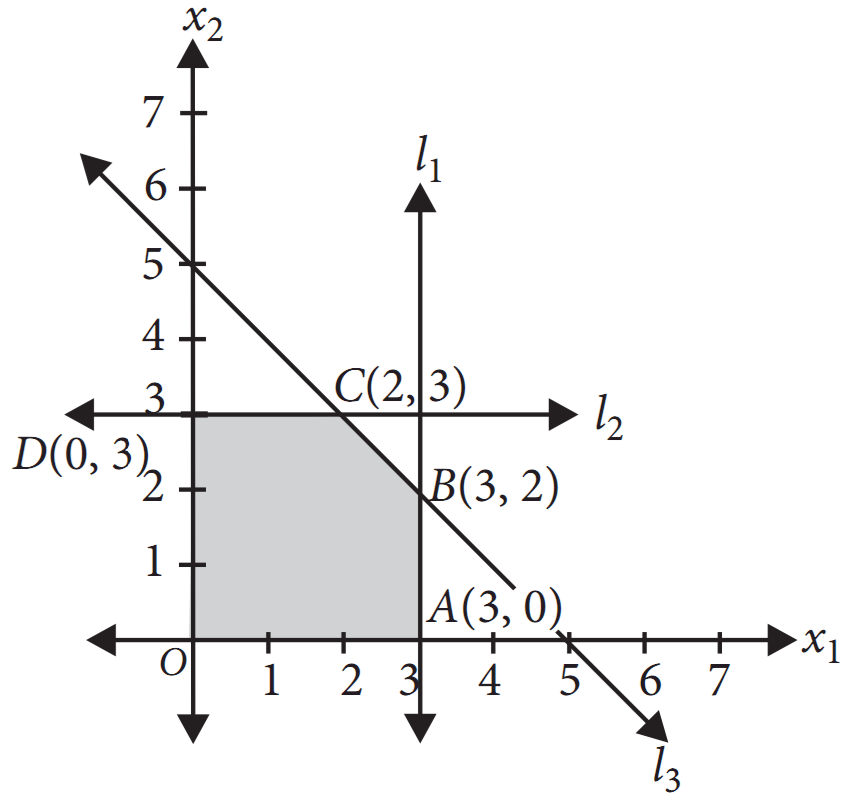
Corner points of the feasible region for an LPP are (0, 3), (5, 0), (6, 8), (0, 8). Let Z = 4x - 6y be the objective function. Based on the above information, answer the following questions.
  1. The minimum value of Z occurs at:
  1. (6, 8)
  2. (5, 0)
  3. (0, 3)
  4. (0, 8)
  1. Maximum value of Z occurs at:
  1. (5, 0)
  2. (0, 8)
  3. (0, 3)
  4. (6, 8)
  1. Maximum of Z - Minimum of Z =
  1. 58
  2. 68
  3. 78
  4. 88
  1. The corner points of the feasible region determined by the system of linear inequalities are:
  1. (0, 0), (-3, 0), (3, 2). (2, 3)
  2. (3, 0), (3, 2), (2, 3), (0, -3)
  3. (0, 0), (3, 0), (3, 2), (2, 3), (0, 3)
  4. None of these
  1. The feasible solution of LPP belongs to:
  1. First and second quadrant.
  2. First and third quadrant.
  3. Only second quadrant.
  4. Only first quadrant.
A factory has three machines $A, B$ and $C$ to manufacture bolts. Machine $A$ manufacture $30\%,$ machine $B$ manufacture $20\%$ and machine $C$ manufacture $50\%$ of the bolts respectively. Out of their respective outputs $5\%, 2\%$ and $4\%$ are defective. $A$ bolt is drawn at random from total production and it is found to be defective.
Based on the above information, answer the following questions.
  1. Probability that defective bolt drawn is manufactured by machine $A,$ is:
  1. $\frac{4}{13}$
  2. $\frac{5}{13}$
  3. $\frac{6}{13}$
  4. $\frac{9}{13}$
  1. Probability that defective bolt drawn is manufactured by machine $B,$ is:
  1. $0.3$
  2. $0.1$
  3. $0.2$
  4. $0.4$
  1. Probability that defective bolt drawn is manufactured by machine $C,$ is:
  1. $\frac{16}{39}$
  2. $\frac{17}{39}$
  3. $\frac{20}{39}$
  4. $\frac{15}{39}$
  1. Probability that defective bolt is not manufactured by machine $B,$ is:
  1. $\frac{35}{39}$
  2. $\frac{61}{39}$
  3. $\frac{41}{39}$
  4. None of these.
  1. Probability that defective bolt is not manufactured by machine $C,$ is:
  1. $0.03$
  2. $0.09$
  3. $0.5$
  4. $0.9 $
Let f(x) be a real valued function, then its
  • Left Hand Derivative (L.H.D.) : $\text{Lf}'(\text{a})=\lim_\limits{\text{h}\rightarrow0}\frac{\text{f}(\text{a}-\text{h})-\text{f}(\text{a})}{-\text{h}}$
  • Right Hand Derivative (R.H.D.) : $\text{Rf}'(\text{a})=\lim_\limits{\text{h}\rightarrow0}\frac{\text{f}(\text{a}+\text{h})-\text{f}(\text{a})}{\text{h}}$
Also, a function f(x) is said to be differentiable at x = a if its L.H.D. and R.H.D. at x = a exist and are equal.
For the function $\text{f}(\text{x})=\begin{cases}|\text{x}-3|,\text{x}\geq1\\\\\frac{\text{x}^2}{4}-\frac{3\text{x}}{2}+\frac{13}{4},\text{x}<1\end{cases},$ answer the following questions.
  1. R.H.D. of f(x) at x = 1 is:
  1. 1
  2. -1
  3. 0
  4. 2
  1. L.H.D. of f(x) at x = 1 is:
  1. 1
  2. -1
  3. 0
  4. 2
  1. f(x) is non-differentiable at:
  1. x = 1
  2. x = 2
  3. x = 3
  4. x = 4
  1. Find the value of f'(2).
  1. 1
  2. 2
  3. 3
  4. -1
  1. The value of f'(-1) is:
  1. 2
  2. 1
  3. -2
  4. -1
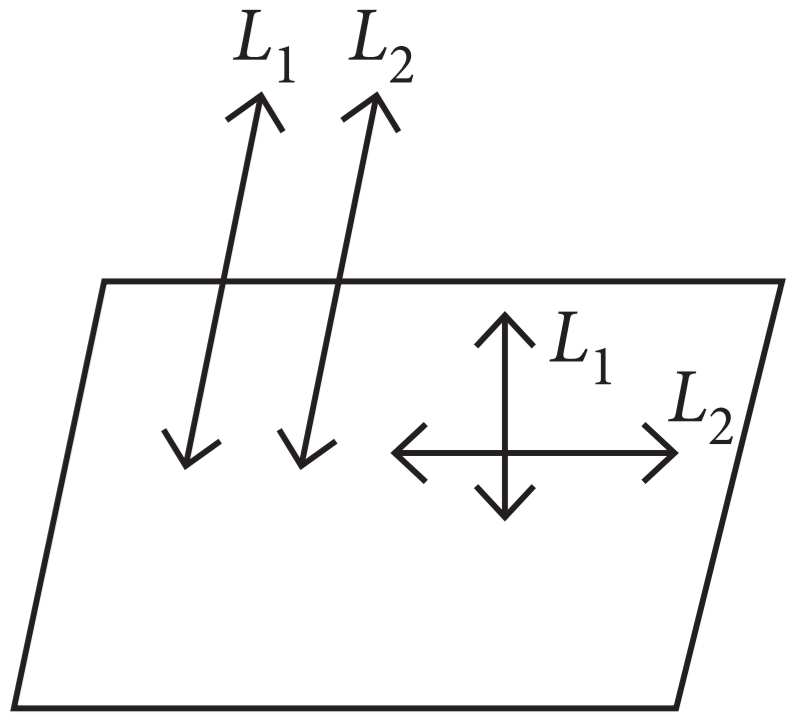
If $a_{1,} b_{1,} c_{1,}$ and $a_{2, }b_{2,} c_2$ are direction ratios of two lines say $L_1$ and $L_2$ respectively. Then $L_1 \| L_2$ iff $\frac{\text{a}_1}{\text{a}_2}=\frac{\text{b}_1}{\text{b}_2}=\frac{\text{c}_1}{\text{c}_2}$ and $\text{L}_1\perp\text{L}_2$ iff $a_1a_2 + b_1b_2 + c_1c_2 = 0.$
Based on the above information, answer the following questions.
  1. If $l_{1,} m_1, n_{1,}$ and $l_2, m_2, n_2$ are the direction cosines of $L_1​​​​​​​$ and $L_2​​​​​​​$ respectively, then $L_1​​​​​​​$​​​​​​​ will be perpendicular to $L_2,$ iff:
  1. $l_1l_2 + m_1m_2 + n_1n_2 = 0$
  2. $l_1m_2 + m_1l_2 + n_1n_2 = 0$
  3. $\frac{\text{l}_1}{\text{l}_2}=\frac{\text{m}_1}{\text{m}_2}=\frac{\text{n}_1}{\text{n}_2}$
  4. None of these
  1. If $l_1, m_1, n_1$ and $l_2, m_2, n_2$​​​​​​​ are direction cosines of $L_1​​​​​​​$ and $L_2$ respectively, then $L_1$ will be parallel to $L_2,$ iff:
  1. $l_1l_2 + m_1m_2 + n_1n_2 = 0$
  2. $l_1m_2 + m_1l_2 + n_1n_2 = 0$
  3. $\frac{\text{l}_1}{\text{l}_2}=\frac{\text{m}_1}{\text{m}_2}=\frac{\text{n}_1}{\text{n}_2}$
  4. $m_1n_2 + m_2n_2 + l_1l_2 = 0$
  1. The coordinates of the foot of the perpendicular drawn from the point $A(1, 2, 1)$ to the line joining $B(1, 4, 6)$ and $C(5, 4, 4),$ are:
  1. $(1, 2, 1)$
  2. $(2, 4, 5)$
  3. $(3, 4, 5)$
  4. $(3, 4, 5)$
  1. The direction ratios of the line which is perpendicular to the lines with direction ratios proportional to $(1, -2, -2)$ and $(0, 2, 1)$ are:
  1. $< 1, 2, 1 >$
  2. $< 2,-1, 2 >$
  3. $< -1,2, 2 >$
  4. None of these
  1. The lines $\frac{\text{x}-2}{3}=\frac{\text{y}+1}{-2}=\frac{\text{z}-2}{0}$ and $\frac{\text{x}-1}{1}=\frac{\frac{\text{y}+3}{2}}{\frac{3}{2}}=\frac{\text{z}+5}{2}$ are:
  1. Parallel.
  2. Perpendicular.
  3. Skew lines.
  4. Non-intersecting.
Let $\text{A}=\begin{bmatrix}1&0\\2&1\end{bmatrix},$ and $U_1, U_2$ are e first and second columns respectively of a $2 \times 2$ matrix $U.$ Also, let the column matrices $U_1$ and $U_2$ satisfying $\text{AU}_1=\begin{bmatrix}1\\0\end{bmatrix}$ and $\text{AU}_2=\begin{bmatrix}2\\3\end{bmatrix}.$ Based on the above information, answer the following questions.
  1. The matrix $U_1 + U_2$​​​​​​​ is equal to:
  1. $\begin{bmatrix}1\\-1\end{bmatrix}$
  2. $\begin{bmatrix}2\\-2\end{bmatrix}$
  3. $\begin{bmatrix}3\\-3\end{bmatrix}$
  4. $\begin{bmatrix}4\\-4\end{bmatrix}$
  1. The value of $|U|$ is:
  1. $2$
  2. $-2$
  3. $3$
  4. $-3$
  1. If $\text{X}=\begin{bmatrix}3&2\end{bmatrix}\text{U}\begin{bmatrix}3\\2\end{bmatrix},$ then the value of $|X| =$
  1. $3$
  2. $-3$
  3. $-5$
  4. $5$
  1. The minor of element at the position $a_{22}$ in $U$ is:
  1. $1$
  2. $2$
  3. $-2$
  4. $-1$
  1. If $\text{U}=[\text{a}_\text{ij}]_{2\times2},$ then the value of $a_{11}A_{11 }+ a_{12}A_{12},$ where $A_{ij}$ denotes the cofactor of $a_{ij},$ is:
  1. $1$
  2. $2$
  3. $-3$
  4. $3$
If y = f(u) is a differentiable function of u and u = g(x) is a differentiable function of x, then y = f(g(x)] is a differentiable function of x and $\frac{\text{dy}}{\text{dx}}=\frac{\text{dy}}{\text{du}}\times\frac{\text{du}}{\text{dx}}.$ This rule is also known as CHAIN RULE.
Based on the above information, find the derivative of functions w.r.t. x in the following questions.
  1. $\cos\sqrt{\text{x}}$
  1. $\frac{-\sin\sqrt{\text{x}}}{2\sqrt{\text{x}}}$
  2. $\frac{\sin\sqrt{\text{x}}}{2\sqrt{\text{x}}}$
  3. $\sin\sqrt{\text{x}}$
  4. $-\sin\sqrt{\text{x}}$
  1. $7^{\text{x}+\frac{1}{\text{x}}}$
  1. $\Big(\frac{\text{x}^2-1}{\text{x}^2}\Big)\cdot7^{\text{x}+\frac{1}{\text{x}}}\cdot\log7$
  2. $\Big(\frac{\text{x}^2+1}{\text{x}^2}\Big)\cdot7^{\text{x}+\frac{1}{\text{x}}}\cdot\log7$
  3. $\Big(\frac{\text{x}^2-1}{\text{x}^2}\Big)\cdot7^{\text{x}-\frac{1}{\text{x}}}\cdot\log7$
  4. $\Big(\frac{\text{x}^2+1}{\text{x}^2}\Big)\cdot7^{\text{x}-\frac{1}{\text{x}}}\cdot\log7$
  1. $\sqrt\frac{{1-\cos\text{x}}}{1+\cos\text{x}}$
  1. $\frac{1}{2}\sec^2\frac{\text{x}}{2}$
  2. $-\frac{1}{2}\sec^2\frac{\text{x}}{2}$
  3. $\sec^2\frac{\text{x}}{2}$
  4. $-\sec^2\frac{\text{x}}{2}$
  1. $\frac{1}{\text{b}}\tan^{-1}\Big(\frac{\text{x}}{\text{b}}\Big)+\frac{1}{\text{a}}\tan^{-1}\Big(\frac{\text{x}}{\text{a}}\Big)$
  1. $\frac{-1}{\text{x}^2+\text{b}^2}+\frac{1}{\text{x}^2+\text{a}^2}$
  2. $\frac{1}{\text{x}^2+\text{b}^2}+\frac{1}{\text{x}^2+\text{a}^2}$
  3. $\frac{1}{\text{x}^2+\text{b}^2}-\frac{1}{\text{x}^2+\text{a}^2}$
  4. None of these.
  1. $\sec^{-1}\text{x}+\text{cosec}^{-1}\frac{\text{x}}{\sqrt{\text{x}^2-1}}$
  1. $\frac{2}{\sqrt{\text{x}^2-1}}$
  2. $\frac{-2}{\sqrt{\text{x}^2-1}}$
  3. $\frac{1}{|\text{x}|\sqrt{\text{x}^2-1}}$
  4. $\frac{2}{|\text{x}|\sqrt{\text{x}^2-1}}$
Read the following passage and answer the questions given below. 

Image

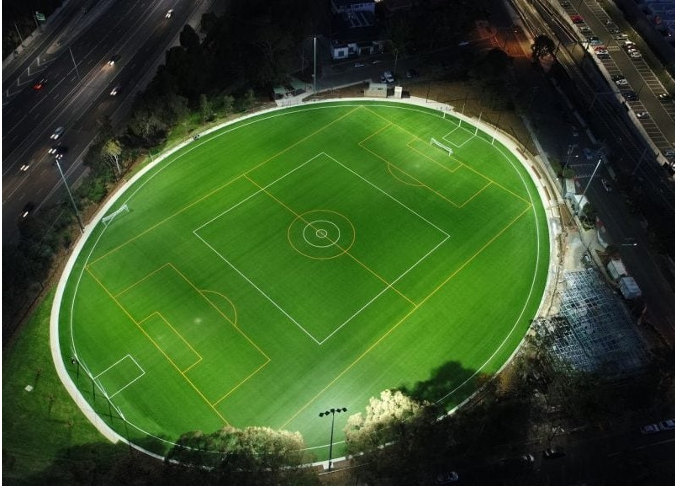
In an elliptical sport field the authority wants to design a rectangular soccer field with the maximum possible area. The sport field is given by the graph of $\frac{x^2}{a^2}+\frac{y^2}{b^2}=1$

(i) If the length and the breadth of the rectangular field be $2 x$ and $2 y$ respectively, then find the area function in terms of $x$.

(ii) Find the critical point of the function.

(iii) Use First derivative Test to find the length $2 x$ and width $2 y$ of the soccer field (in terms of $a$ and b) that maximize its area.

OR

(iii) Use Second Derivative Test to find the length $2 x$ and width $2 y$ of the soccer field (in terms of $a$ and $b$ ) that maximize its area.