- Obtain lens makers formula using the expression
Here the ray of light propagating from a rare medium of refractive index $(n_1)$ to a denser medium of refractive index $(n_2)$ is incident on the convex side of spherical refracting surface of radius of curvature R.
- Draw a ray diagram to show the image formation by a concave mirror when the object is kept between its focus and the pole. Using this diagram, derive the magnification formula for the image formed.
CBSE DELHI - SET 1 2011
Download our app for free and get started
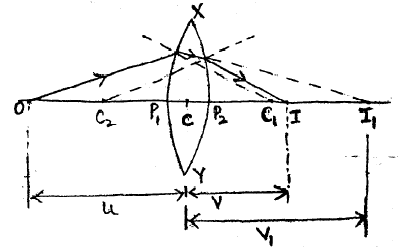
For refraction at the first surface
$\frac{\text{n}_{2}}{\text{v}_{1}} - \frac{\text{n}_{1}}{\text{u}} = \frac{\text{n}_{2} - \text{n}_{1}}{\text{R}_{1}}$
For the second surface, $I_1$ acts as a virtual object (located in the denser medium) whose final real image is formed in the rarer medium at I.
So for refraction at this surface, we have
$\frac{\text{n}_{1}}{\text{v}} - \frac{\text{n}_{2}}{\text{v}_{1}} = \frac{\text{n}_{1} - \text{n}_{2}}{\text{R}_{2}}$
From above two equations, $\frac{1}{\text{v}} - \frac{1}{\text{u}} = \bigg(\frac{\text{n}_{2}}{\text{n}_{1}} - 1\bigg)\bigg (\frac{1}{\text{R}_{1}} - \frac{1}{\text{R}_{2}}\bigg)$
The point, where image of an object, located at intinity is formed, is called the focus F, of the lens and the distance f gives its focal length.
So for u = $\propto,\text{v} = + \text{ f}$
$\Rightarrow\frac{1}{\text{f}} = \bigg(\frac{\text{n}_{2}}{\text{n}_{1}} - 1 \bigg)\bigg(\frac{1}{\text{R}_{1}} - \frac{1}{\text{R}_{2}}\bigg)$
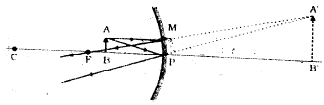
$\Delta$ABP is similar to $\Delta$A'B'P
So $\frac{\text{A}'\text{B}'}{\text{AB}} = \frac{\text{B}'\text{P}}{\text{BP}}$
Now A' B' = I, AB = O, B'P = + v and BP = - u
So magnification $\text{m} = \frac{\text{I}}{\text{O}} = - \frac{\text{v}}{\text{u}}.$

Download our appand get started for free
Experience the future of education. Simply download our apps or reach out to us for more information. Let's shape the future of learning together!No signup needed.*
Similar Questions
- 1View SolutionA lady uses +1.5D glasses to have normal vision from 25cm onwards. She uses a 20D lens as a simple microscope to see an object. Find the maximum magnifying power if she uses then microscope
- Together with her glass
- Without the glass. Do the answers suggest that an object can be more clearly seen through a microscope without using the correcting glasses?
- 2View Solution
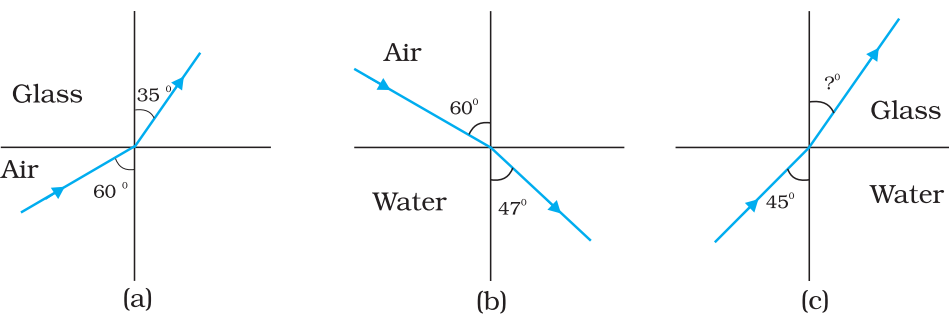
(a) and (b) show refraction of a ray in air incident at 60° with the normal to a glass-air and water-air interface, respectively. Predict the angle of refraction in glass when the angle of incidence in water is 45º with the normal to a water - glass interface.
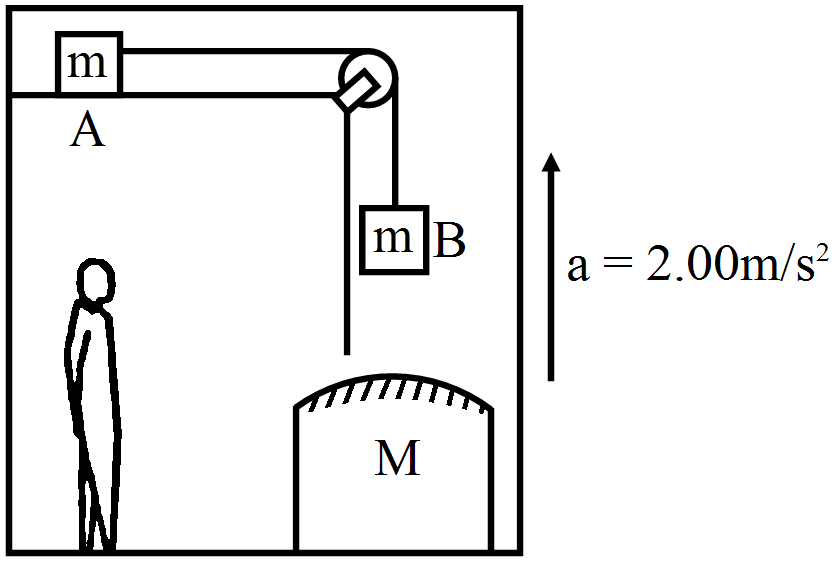
- 3Consider the situation shown in figure. The elevator is going up with an acceleration of $2.00m/s^2$ and the focal length of the mirror is 12.0cm. All the surfaces are smooth and the pulley is light. The mass-pulley system is released from rest (with respect to the elevator) at t = 0 when the distance of B from the mirror is 42.0cm. Find the distance between the image of the block B and the mirror at $t = 0.200s$. Take $g = 10m/s^2$.View Solution
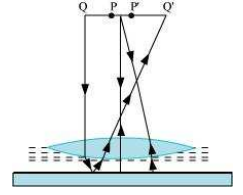
- 4View Solutionequiconvex lens (of refractive index 1.50) in contact with a liquid layer on top of a plane mirror. A small needle with its tip on the principal axis is moved along the axis until its inverted image is found at the position of the needle. The distance of the needle from the lens is measured to be 45.0 cm. The liquid is removed and the experiment is repeated. The new distance is measured to be 30.0 cm. What is the refractive index of the liquid?
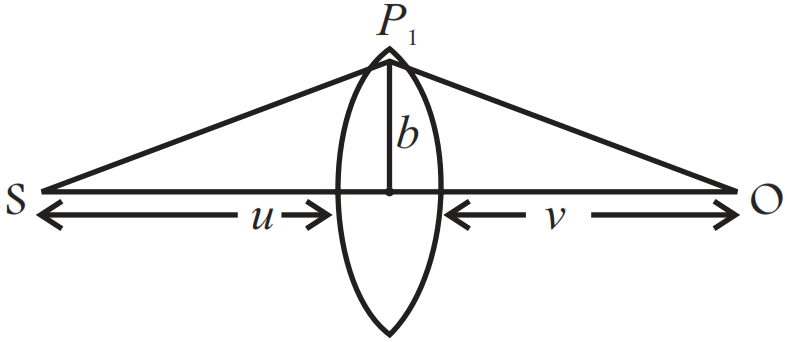
- 5Consider a thin lens placed between a source (S) and an observer (O) (Fig). Let the thickness of the lens vary as $\text{w}\text{(b)}=\text{w}_0-\frac{\text{b}^2}{\alpha}$, where b is the verticle distance from the pole. $w_0$ is a constant. Using Fermat’s principle i.e. the time of transit for a ray between the source and observer is an extremum, find the condition that all paraxial rays starting from the source will converge at a point O on the axis. Find the focal length.View Solution
- 6View Solution
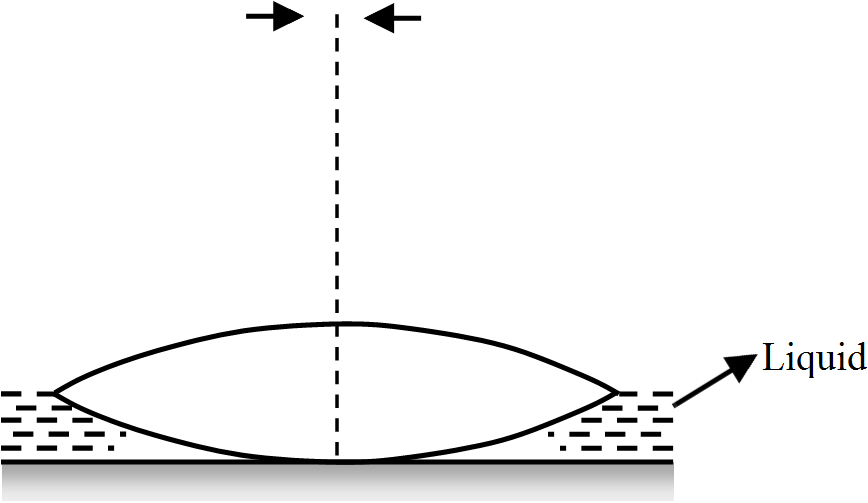
- An equiconvex lens with radii of curvature of magnitude r each, is put over a liquid layer poured on top of a plane mirror. A small needle, with its tip on the principal axis of the lens, is moved along the axis until its inverted real image coincides with the needle itself. The distance of the needle from the lens is measured to be 'a'. On removing the liquid layer and repeating the experiment the distance is found to be 'b'.
- If r = 10cm, a = 15cm, b = 10cm, find the refractive index of the liquid.
- 7View SolutionFind the maximum magnifying power of a compound Microscope having a 25 diopter lens as the objective, a 5 diopter lens as the eyepiece and the separation 30cm between the two lenses. The least distance for clear vision is 25cm.
- 8View SolutionA pin of length 2.00cm is placed perpendicular to the principal axis of a converging lens. An inverted image of size 1.00cm is formed at a distance of 40.0cm from the pin. Find the focal length of the lens and its distance from the pin.
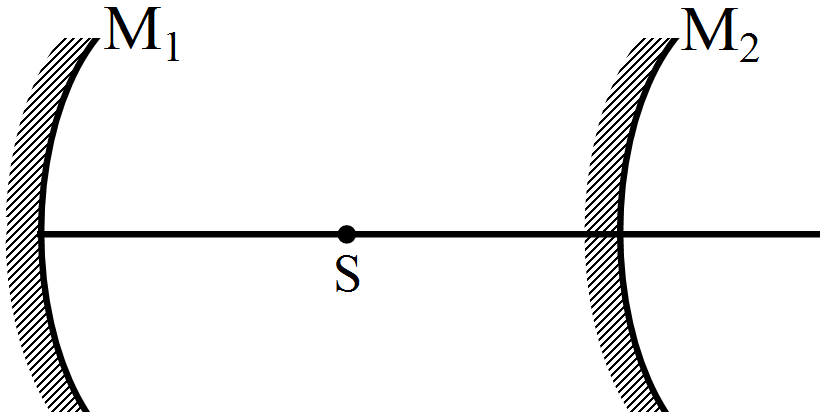
- 9A converging mirror $\mathrm{M}_1$, a point source S and a diverging mirror $\mathrm{M}_2$ are arranged as shown in figure. The source is placed at a distance of 30 cm from $\mathrm{M}_1$. The focal length of each of the mirrors is 20 cm . Consider only the images formed by a maximum of two reflections. It is found that one image is formed on the source itself.View Solution
- Find the distance between the two mirrors.
- Find the location of the image formed by the single reflection from $\mathrm{M}_2$.
- 10View SolutionAn angular magnification (magnifying power) of 30X is desired using an objective of focal length 1.25 cm and an eyepiece of focal length 5 cm. How will you set up the compound microscope?