In many experimental set-ups the source and screen are fixed at a distance say D and the lens is movable. Show that there are two positions for the lens for which an image is formed on the screen. Find the distance between these points and the ratio of the image sizes for these two points.
Download our app for free and get started
According to prinicipal of reversibility, the position of object and image ate interchangeable. According to lens maker's formula, We have $\frac{1}{\text{f}}=\frac{1}{\text{v}}-\frac{1}{\text{u}}\ .....(1)$ Hence, there are two positions for which there shall be an image. Let us suppose the first position be when the lens is at O. Finding u and v ans substituting in lens formula. According to the question, we have -u + v = D ⇒ u = -(D - v) Substituting u = -(D - v) in (1), we get $\frac{1}{\text{v}}+\frac{1}{\text{D}-\text{v}}=\frac{1}{\text{f}}$ $\Rightarrow\ \frac{\text{D}-\text{v}+\text{v}}{(\text{D}-\text{v})\text{v}}=\frac{1}{\text{f}}$ $\Rightarrow\ \text{v}^2-\text{Dv}+\text{Df}=0$ $\Rightarrow\ \text{v}=\frac{\text{D}}{2}\pm\frac{\sqrt{\text{D}^2-4\text{Df}}}{2}$ $\therefore\ \text{u}=-(\text{D}-\text{v})=-\Big(=\frac{\text{D}}{2}\pm\frac{\sqrt{\text{D}^2-4\text{Df}}}{2}\Big)$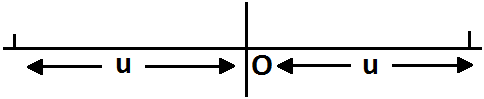
When, the object distance is $\frac{\text{D}}{2}+\frac{\sqrt{\text{D}^2-4\text{Df}}}{2}$, then the image forms at $=\frac{\text{D}}{2}-\frac{\sqrt{\text{D}^2-4\text{Df}}}{2}$ Similarly, when the object distance is $=\frac{\text{D}}{2}-\frac{\sqrt{\text{D}^2-4\text{Df}}}{2}$, then the image forms at $=\frac{\text{D}}{2}+\frac{\sqrt{\text{D}^2-4\text{Df}}}{2}$ The distance between the poles for these two object distance is given by v - u $=\frac{\text{D}}{2}+\frac{\sqrt{\text{D}^2-4\text{Df}}}{2}-\bigg(\frac{\text{D}}{2}-\frac{\sqrt{\text{D}^2-4\text{Df}}}{2}\bigg)$ $=\sqrt{\text{D}^2-4\text{Df}}$ Let us suppose $\text{d}=\sqrt{\text{D}^2-4\text{Df}}$ if $\text{u}=\frac{\text{D}}{2}+\frac{\text{d}}{2}$, then the image is at $\text{v}=\frac{\text{D}}{2}-\frac{\text{d}}{2}$,then the magnification is given by $\text{m}_1=\frac{\text{v}}{\text{u}}=\frac{\text{D}-\text{d}}{\text{D}+\text{d}}$ If $\text{u}=\frac{\text{D}-\text{d}}{2}$, then $\text{v}=\frac{\text{D}+\text{d}}{2}$, then the magnification is given by $\text{m}_2=\frac{\text{v}}{\text{u}}=\frac{\text{D}+\text{d}}{\text{D}-\text{d}}$ Thus, the ration of the images sizes is given by $\frac{\text{m}_2}{\text{m}_1}=\frac{\frac{\text{D}+\text{d}}{\text{D}-\text{d}}}{\frac{\text{D}+\text{d}}{\text{D}-\text{d}}}=\Big({\frac{\text{D}+\text{d}}{\text{D}-\text{d}}}\Big)^2$
When, the object distance is $\frac{\text{D}}{2}+\frac{\sqrt{\text{D}^2-4\text{Df}}}{2}$, then the image forms at $=\frac{\text{D}}{2}-\frac{\sqrt{\text{D}^2-4\text{Df}}}{2}$ Similarly, when the object distance is $=\frac{\text{D}}{2}-\frac{\sqrt{\text{D}^2-4\text{Df}}}{2}$, then the image forms at $=\frac{\text{D}}{2}+\frac{\sqrt{\text{D}^2-4\text{Df}}}{2}$ The distance between the poles for these two object distance is given by v - u $=\frac{\text{D}}{2}+\frac{\sqrt{\text{D}^2-4\text{Df}}}{2}-\bigg(\frac{\text{D}}{2}-\frac{\sqrt{\text{D}^2-4\text{Df}}}{2}\bigg)$ $=\sqrt{\text{D}^2-4\text{Df}}$ Let us suppose $\text{d}=\sqrt{\text{D}^2-4\text{Df}}$ if $\text{u}=\frac{\text{D}}{2}+\frac{\text{d}}{2}$, then the image is at $\text{v}=\frac{\text{D}}{2}-\frac{\text{d}}{2}$,then the magnification is given by $\text{m}_1=\frac{\text{v}}{\text{u}}=\frac{\text{D}-\text{d}}{\text{D}+\text{d}}$ If $\text{u}=\frac{\text{D}-\text{d}}{2}$, then $\text{v}=\frac{\text{D}+\text{d}}{2}$, then the magnification is given by $\text{m}_2=\frac{\text{v}}{\text{u}}=\frac{\text{D}+\text{d}}{\text{D}-\text{d}}$ Thus, the ration of the images sizes is given by $\frac{\text{m}_2}{\text{m}_1}=\frac{\frac{\text{D}+\text{d}}{\text{D}-\text{d}}}{\frac{\text{D}+\text{d}}{\text{D}-\text{d}}}=\Big({\frac{\text{D}+\text{d}}{\text{D}-\text{d}}}\Big)^2$

Download our appand get started for free
Experience the future of education. Simply download our apps or reach out to us for more information. Let's shape the future of learning together!No signup needed.*
Similar Questions
- 1The radii of curvature of a lens are +20cm and +30cm. The material of the lens has a refracting index 1.6. Find the focal length of the lens.View Solution
- If it is placed in air.
- If it is placed in water $(\mu=1.33).$
- 2View Solution
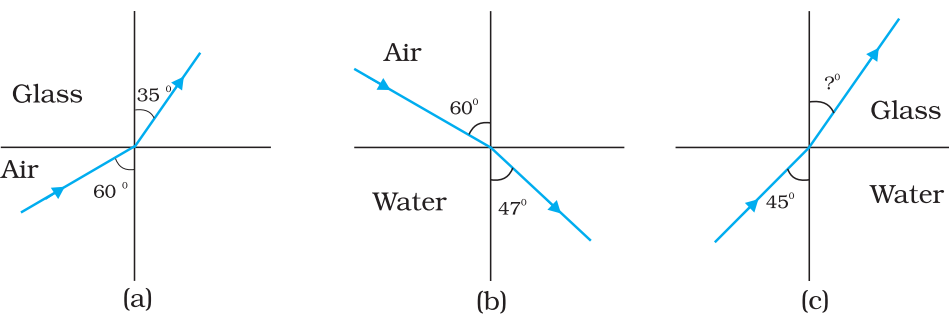
(a) and (b) show refraction of a ray in air incident at 60° with the normal to a glass-air and water-air interface, respectively. Predict the angle of refraction in glass when the angle of incidence in water is 45º with the normal to a water - glass interface.
- 3Trace the rays of light showing the formation of an image due to a point object placed on the axis of a spherical surface separating the two media of refractive indices $n_1$ and $n_2$. Establish the relation between the distances of the object, the image and the radius of curvature from the central point of the spherical surface. Hence derive the expression of the lens maker’s formula.View Solution
- 4View SolutionA small bulb is placed at the bottom of a tank containing water to a depth of 80cm. What is the area of the surface of water through which light from the bulb can emerge out? Refractive index of water is 1.33. (Consider the bulb to be a point source).
- 5For a glass prism $(\mu=\sqrt{3})$ the angle of minimum deviation is equal to the angle of the prism. Find the angle of the prism.View Solution
- 6Derive the lens formula $\frac{1}{\text{f}}=\frac{1}{\text{v}}-\frac{1}{\text{u}}$ for a thin concave lens, using the necessary ray diagram.View Solution
- 7A point object 'O' is kept in a medium of refractive index $n_1$ in front of a convex spherical surface of radius of curvature R which separates the second medium of refractive index $n_2$ from the first one, as shown in the figure. Draw the ray diagram showing the image formation and deduce the relationship between the object distance and the image distance in terms of $n_1, n_2$ and R.View Solution
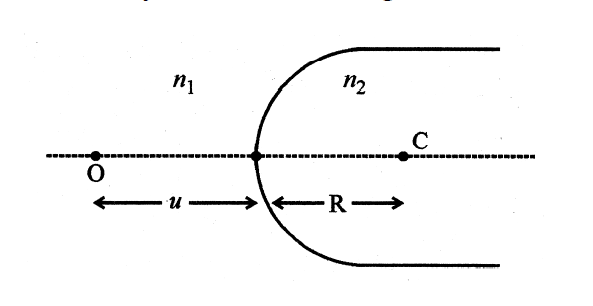
- hen the image formed above acts as a virtual object for concave spherical, surface separating the medium $n_2$ from $n_1 (n_2> n_1),$ draw this ray diagram and write the similar (similar to (a) relation. Hence obtain the expression for the lens maker's formula.
- 8View SolutionThe mixture a pure liquid and a solution in a long vertical column (i.e, horizontal dimensions < < vertical dimensions) produces diffusion of solute particles and hence a refractive index gradient along the vertical dimension. A ray of light entering the column at right angles to the vertical is deviated from its original path. Find the deviation in travelling a horizontal distance d < < h, the height of the column.
- 9View Solution
- Draw a ray diagram showing the image formation by a compound microscope. Hence obtain expression for total magnification when the image is formed at infinity.
- Distinguish between myopia and hypermetropia. Show diagrammatically how these defects can be corrected.
- 10A gravitational lens may be assumed to have a varying width of the formView Solution
$\text{w}(\text{b})=\text{k}_1\text{ In }\Big(\frac{\text{k}_2}{\text{b}}\Big)\ \ \text{b}_\text{min}<\text{b}<\text{b}_\text{max}$
$=\text{k}_1\text{ In }\Big(\frac{\text{k}_2}{\text{b}_\text{min}}\Big)\ \ \text{b}<\text{b}_\text{min}$
Show that an observer will see an image of a point object as a ring about the center of the lens with an angular radius
$\beta=\sqrt{\frac{(\text{n}-1)\text{k}_1\frac{\text{u}}{\text{v}}}{\text{u}+\text{v}}}$