A mass m is allowed to roll down an inclined plane $(\theta)$ If the vertical height is h, find.
- Acceleration along the inclined plane.
- Velocity down the plane.
Download our app for free and get started
Consider a mass z capable of rolling down the inclined plane from a vertical height 'h'. Rolling comprises of transitory motion of centre of mass and rotation produced by friction force. Using the forces (represented) acting on the mass, we have,
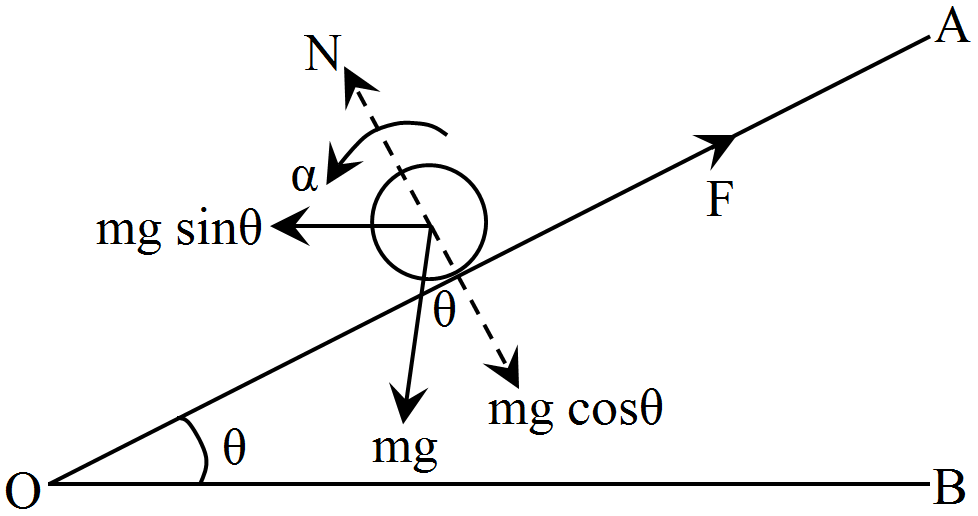
$\text{N}=\text{mg}\cos\ \theta\text{ and }\sin\ \theta-\text{F}_{\text{f}}=\text{ma}\dots(1)$ $\text{F}_{\text{f}}=\mu\text{ N}=\mu\text{ mg}\cos\ \theta$ $\therefore \text{mg}\ \sin\theta-\mu\text{ mg}\cos\ \theta$ $\text{Torque}\ \tau=\mu\text{ mg }\cos\ \theta$ $\text{r}=\text{I }\alpha=\text{I}\frac{\text{a}}{\text{r}}\dots(2)$
Using $F_f$ in (i), we have
$\text{mg }\sin\theta=\Big(\text{m}+\frac{\text{I}}{\text{r}^2}\Big)\text{a}$
$\text{a}=\frac{\text{mg }\sin\ \theta}{\text{m}\Big(1+\frac{\text{K}^2}{\text{r}^2}\Big)}=\frac{\text{g }\sin\ \theta}{\Big(1+\frac{\text{K}^2}{\text{r}^2}\Big)}$
$\text{N}=\text{mg}\cos\ \theta\text{ and }\sin\ \theta-\text{F}_{\text{f}}=\text{ma}\dots(1)$ $\text{F}_{\text{f}}=\mu\text{ N}=\mu\text{ mg}\cos\ \theta$ $\therefore \text{mg}\ \sin\theta-\mu\text{ mg}\cos\ \theta$ $\text{Torque}\ \tau=\mu\text{ mg }\cos\ \theta$ $\text{r}=\text{I }\alpha=\text{I}\frac{\text{a}}{\text{r}}\dots(2)$
- $\text{F}_{\text{f}}\text{ r}=\frac{\text{I}}{\text{r}^2}$
Using $F_f$ in (i), we have
$\text{mg }\sin\theta=\Big(\text{m}+\frac{\text{I}}{\text{r}^2}\Big)\text{a}$
$\text{a}=\frac{\text{mg }\sin\ \theta}{\text{m}\Big(1+\frac{\text{K}^2}{\text{r}^2}\Big)}=\frac{\text{g }\sin\ \theta}{\Big(1+\frac{\text{K}^2}{\text{r}^2}\Big)}$
- Using a in $v^2 = u^2 + 2as$, we have

Download our appand get started for free
Experience the future of education. Simply download our apps or reach out to us for more information. Let's shape the future of learning together!No signup needed.*
Similar Questions
- 1Two blocks of masses $400g$ and $200g$ are connected through a light string going over a pulley which is free to rotate about its axis. The pulley has a moment of inertia $1.6 \times 10^{-4}kg-m^2$ and a radius 2.0cm. Find:View Solution
- The kinetic energy of the system as the $400g$ block falls through $50cm$.
- The speed of the blocks at this instant.
- 2View SolutionA uniform rod of length L lies on a smooth horizontal table. A particle moving on the table strikes the rod perpendicularly at an end and stops. Find the distance travelled by the centre of the rod by the time it turns through a right angle. Show that if the mass of the rod is four times that of the particle, the collision is elastic.
- 3A cylinder of mass $5kg$ and radius $30cm$ and free to rotate about its axis, receives an angular impulse of $3kgm^2 s^{-1}$ followed by a similar impulse after every $4$ seconds. What is the angular speed of the cylinder $30s$ after the initial impulse? The cylinder is at rest initially.View Solution
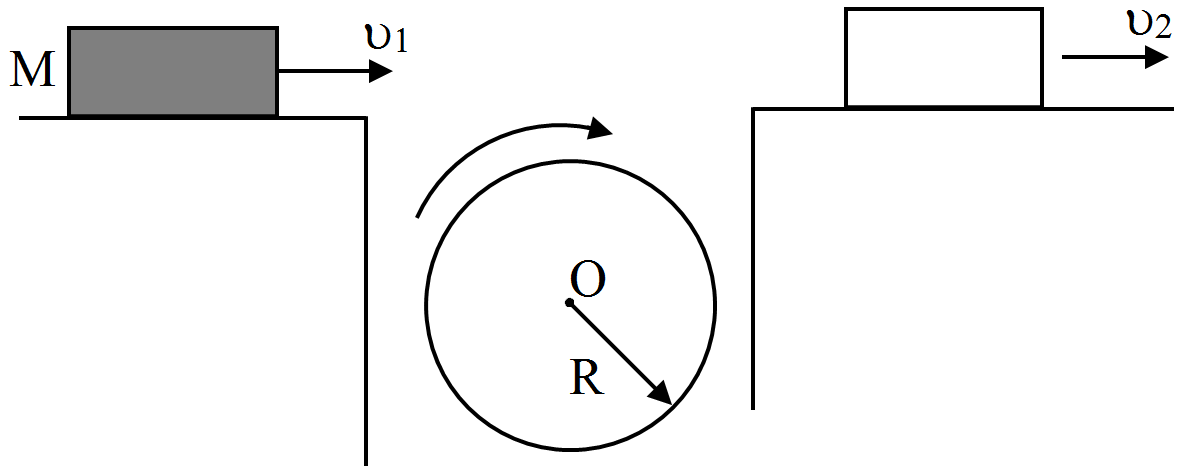
- 4A block of mass M is moving with a velocity $v_1$ on a frictionless surface as shown in fig. It passes over to a cylinder of radius R and moment of inertia I which has fixed axis and is initially at rest. When it first makes contact with the cylinder, it slips on the cylinder, but the friction is large enough so that slipping ceases before it losses contact with the cylinder. Finally it goes to the dotted position with velocity $v_2$ compute $v_2$ in terms of $v_1, M, I$ and $R$.View Solution
- 5View SolutionA 6.5m long ladder rests against a vertical wall reaching a height of 6.0m. A 60kg man stands half way up the ladder.
- Find the torque of the force exerted by the man on the ladder about the upper end of the ladder.
- Assuming the weight of the ladder to be negligible as compared to the man and assuming the wall to be smooth, find the force exerted by the ground on the ladder.
- 6Locate the centre of mass of a system of particles of mass $m_1 = 1kg, m_2 = 2kg$ and $m_3 = 3kg$, situated at the corners of an equilateral triangle of side 1.0 metre.View Solution
- 7A star of mass twice the solar mass and radius $106km$ rotates about its axis with an angular speed of $10^{‑6}$ rad per sec. What is the angular speed of the star when it collapses (due to inward gravitational forces) to a radius of $10^4km$? Solar mass = $1.99 \times 10^{23}kg$.View Solution
- 8View SolutionFind the centre of mass of a uniform:
- Half-disc.
- Quarter-disc.
- 9View SolutionWhat do you mean by the term "equilibrium"? What are equilibrium of rest and equilibrium of motion? State the conditions for complete equilibrium of a body.
- 10A circular hole of radius $1m$ is cut off from a disc of radius $6m$. The centre of the hole is $3m$ from the centre of the disc. Find the centre of mass of the remaining disc.View Solution