What do you mean by the term "equilibrium"? What are equilibrium of rest and equilibrium of motion? State the conditions for complete equilibrium of a body.
Download our app for free and get started
Equilibrium: A body or a system of particles is said to be in a state of equilibrium if inspite of a number of forces or torques acting on it, the body or the system of particles remains in its original state of rest or of uniform motion (translational or rotational or both). Thus, equilibrium state means that acceleration (both linear as well as angular) of the body/system must be zero. Hence, equilibrium is of two types:
For equilibrium $\vec{\text{p}}=\text{a constant or }\frac{\text{d}\vec{\text{p}}}{\text{dt}}=0$
$\text{ or }\sum\vec{\text{F}}_{\text{ext}}=0$
Hence for rotational equilibrium, the vector sum of all the external torques acting on the system/ body must be zero.
For equilibrium $\vec{\text{L}}=\text{a constant or }\frac{\text{d}\vec{\text{p}}}{\text{dt}}=0$
$\text{ or }\sum\vec{\tau}_{\text{ext}}=0$
- Equilibrium of rest: If a given system remains in a state of rest and does not change its position inspite of number of forces acting on it, it is said to be in an equilibrium of rest e.g., our house, our school etc.
- Equilibrium of motion: If a given system maintains its state of uniform motion, translational or rotational or combined, under the action of a number of forces then it is said to be in an "equilibrium of motion" e.g., our Earth, the planetary system, electrons revolving around the nucleus of an atom. For a state of equilibrium of motion, the value of linear momentum and/ or angular momentum of the system should have a finite and constant value.
- For translational motion,
For equilibrium $\vec{\text{p}}=\text{a constant or }\frac{\text{d}\vec{\text{p}}}{\text{dt}}=0$
$\text{ or }\sum\vec{\text{F}}_{\text{ext}}=0$
Hence for rotational equilibrium, the vector sum of all the external torques acting on the system/ body must be zero.
- For rotational motion,
For equilibrium $\vec{\text{L}}=\text{a constant or }\frac{\text{d}\vec{\text{p}}}{\text{dt}}=0$
$\text{ or }\sum\vec{\tau}_{\text{ext}}=0$

Download our appand get started for free
Experience the future of education. Simply download our apps or reach out to us for more information. Let's shape the future of learning together!No signup needed.*
Similar Questions
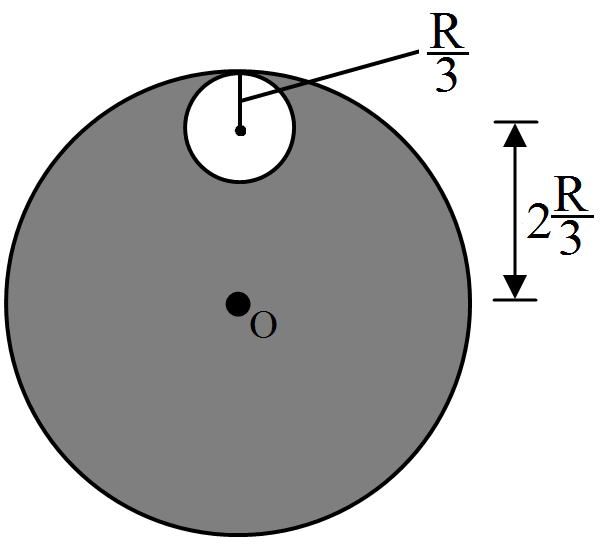
- 1From a circular disc of radius R and mass 9M, a small disc of radius $\frac{\text{R}}{3}$ is removed as shown in Fig. Find the moment of inertia of the remaining disc about an axis perpendicular to the plane of the disc and passing through the point O.View Solution
- 2A solid disc and a ring, both of radius $10cm$ are placed on a horizontal table simultaneously, with initial angular speed equal to 10 π rad $s^{-1}$. Which of the two will start to roll earlier? The co-efficient of kinetic friction is $\mu_\text{k}=0.2$View Solution
- 3Two cylindrical hollow drums of radii R and 2R, and of a common height h, are rotating with angular velocities $\omega$ (anti-clockwise) and $\omega$ (clockwise), respectively. Their axes, fixed are parallel and in a horizontal plane separated by $(3\text{R}+\delta).$ They are now brought in contact $(\delta\rightarrow0){:}$View Solution
- Show the frictional forces just after contact.
- Identify forces and torques external to the system just after contact.
- What would be the ratio of final angular velocities when friction ceases?
- 4Prove the result that the velocity v of translation of a rolling body (like a ring, disc, cylinder or sphere) at the bottom of an inclined plane of a height h is given by $\text{v}^2=\frac{2\text{gh}}{\Big(\frac{1+\text{k}^2}{\text{R}^2}\Big)}$ using dynamical consideration (i.e. by consideration of forces and torques).View Solution
Note: k is the radius of gyration of the body about its symmetry axis, and R is the radius of the body. The body starts from rest at the top of the plane. - 5A grindstone has a moment of inertia of $6kg m^2$. A constant torque is applied and the grindstone is found to have a speed of $150rpm, 10s$. after starting from rest. Calculate the torque.View Solution
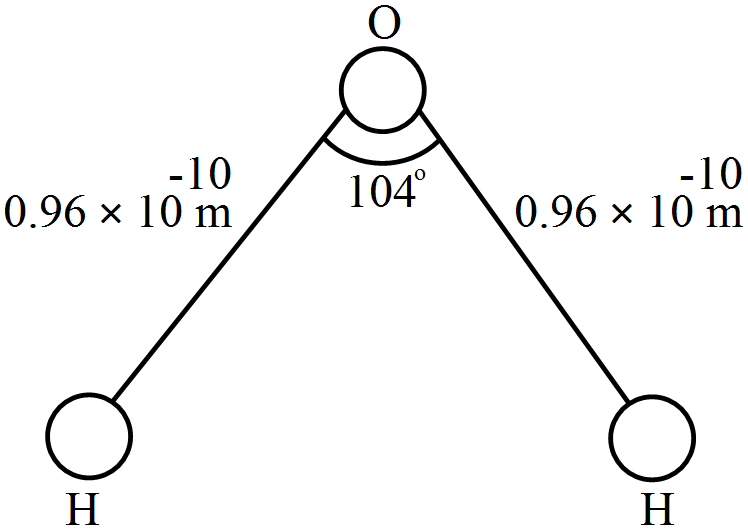
- 6View SolutionThe structure of a water molecule is shown in figure. Find the distance of the centre of mass of the molecule from the centre of the oxygen atom.
- 7View SolutionA solid cylinder of mass M and radius R has a light flexible rope wound around it. The rope carries a mass m at its free end. The mass is rest at a height h above the floor. Find the angular velocity of the cylinder at the instant the mass m, after release, strikes the floor. Assume friction to be absent and the cylinder to rotate about its own axis.
- 8A meter stick held vertically, with one end on the ground, is then allowed to fall. What is the value of the radial and tangential acceleration of the top end of the stick when the stick has turned through on angle $\theta?$ What is the speed with which the top end of the stick hits the ground? Assume that the end of the stick in. contact with the ground does not slip.View Solution
- 9A star of mass twice the solar mass and radius $106km$ rotates about its axis with an angular speed of $10^{‑6}$ rad per sec. What is the angular speed of the star when it collapses (due to inward gravitational forces) to a radius of $10^4km$? Solar mass = $1.99 \times 10^{23}kg$.View Solution
- 10View SolutionExplain why friction is necessary to make the disc in roll in the direction indicated.
- Give the direction of frictional force at B, and the sense of frictional torque, before perfect rolling begins.
- What is the force of friction after perfect rolling begins?