In the HCl molecule, the separation between the nuclei of the two atoms is about $1.27\mathring{\text{A}}\big(1\mathring{\text{A}}= 10^{-10} \text{m}\big).$ Find the approximate location of the CM of the molecule, given that a chlorine atom is about 35.5 times as massive as a hydrogen atom and nearly all the mass of an atom is concentrated in its nucleus.
Download our app for free and get started
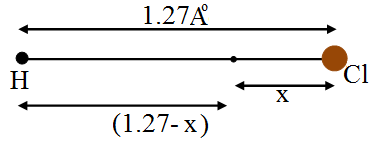 Distance between H and Cl atoms $=1.27\mathring{\text{A}}$
Mass of H atom = m
Mass of Cl atom = 35.5m
Let the centre of mass of the system lie at a distance x from the Cl atom.
Distance of the centre of mass from the H atom = (1.27 - x)
Let us assume that the centre of mass of the given molecule lies at the origin. Therefore, we can have,
[m(1.27 - x) + 35.5mx] / (m + 35.5m) = 0
m(1.27 - x) + 35.5mx = 0
1.27 - x = -35.5x
$\therefore\text{ x}=-1.27/(35.5-1)=-0.37\mathring{\text{A}}$
Here, the negative sign indicates that the centre of mass lies at the left of the molecule. Hence, the centre of mass of the HCl molecule lies $0.37\mathring{\text{A}}$ from the Cl atom.

Download our appand get started for free
Experience the future of education. Simply download our apps or reach out to us for more information. Let's shape the future of learning together!No signup needed.*
Similar Questions
- 1View SolutionFind the centre of mass of a uniform:
- Half-disc.
- Quarter-disc.
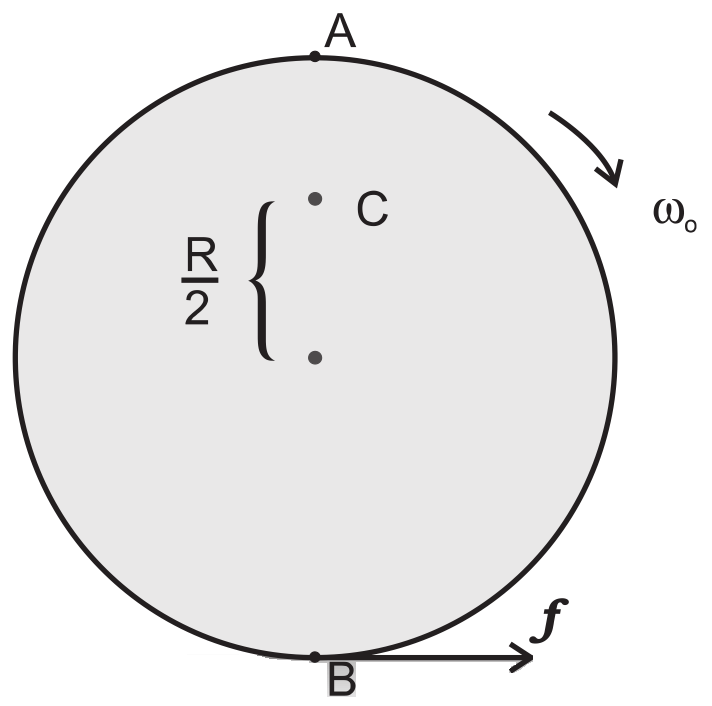
- 2A disc rotating about its axis with angular speed $\omega_0$ is placed lightly (without any translational push) on a perfectly frictionless table. The radius of the disc is R. What are the linear velocities of the points A, B and C on the disc shown in will the disc roll in the direction indicated?View Solution
- 3View SolutionA solid sphere rolls down two different inclined planes of the same heights but different angles of inclination.
- Will it reach the bottom with the same speed in each case?
- Will it take longer to roll down one plane than the other?
- If so, which one and why?
- 4View SolutionHow much fraction of the kinetic energy of rolling is purely:
- Translational.
- Rotational.
- 5View SolutionTwo particles, each of mass m and speed v, travel in opposite directions along parallel lines separated by a distance d. Show that the angular momentum vector of the two particle system is the same whatever be the point about which the angular momentum is taken.
- 6View SolutionA disc of radius R is cut out from a larger disc of radius 2R in such a way that the edge of the hole touches the edge of the disc. Locate the centre of mass of the residual disc.
- 7View SolutionA hoop of radius 2m weighs 100kg. It rolls along a horizontal floor so that its centre of mass has a speed of 20cm/s. How much work has to be done to stop it?
- 8A meter stick held vertically, with one end on the ground, is then allowed to fall. What is the value of the radial and tangential acceleration of the top end of the stick when the stick has turned through on angle $\theta?$ What is the speed with which the top end of the stick hits the ground? Assume that the end of the stick in. contact with the ground does not slip.View Solution
- 9Calculate the angular momentum and rotational kinetic energy of earth about its own axis. How long could this amount of energy supply one kilowatt power to each of the $3.5 \times 10^9$ persons on earth? (Mass of earth = $6.0 \times 1024kg$ and radius = $6.4 \times 10^{24}km)$.View Solution
- 10Separation of Motion of a system of particles into motion of the centre of mass and motion about the centre of mass: Show $\frac{\text{dL}}{\text{dt}}=\sum\text{r}'_\text{i}\times\frac{\text{dp}'}{\text{dt}}$ Further, show that $\frac{\text{dL}'}{\text{dt}}=\tau'_\text{ext}$ where $\tau'_\text{ext}$ is the sum of all external torques acting on the system about the centre of mass. (Hint: Use the definition of centre of mass and third law of motion. Assume the internal forces between any two particles act along the line joining the particles)View Solution