Question
Explain the structure of nucleic acid compounds.
Answer

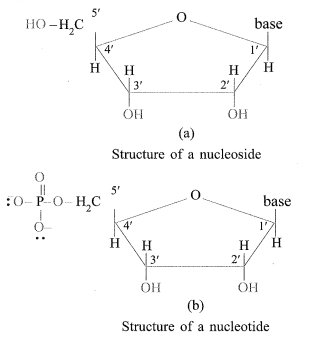
"A unit formed by the attachment of a base to 1' position of sugar is known as nucleoside."
In nucleosides the sugar carbons are numberd as 1', 2', 3' etc. In order to distinguish these from the bases - when nucleoside is linked to phosphoric acid at 5'-position of sugar moiety, we got a nucleotide.
Image
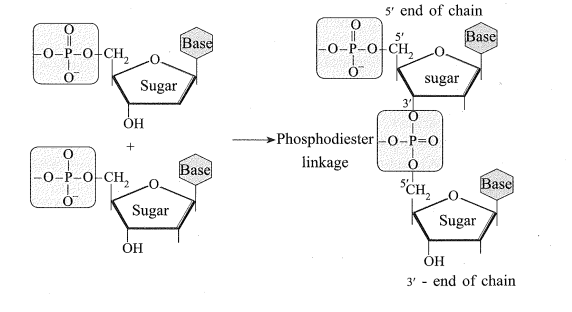
Nucleotides are joined together by phosphodiester linkage between 5' and 3' carbon atoms of the pentose sugar. The formation of a typical dinucleotide is shown in figure.

Image
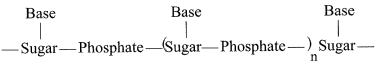
A simplified version of nucleic acid chain is as shown below.
Image

Need a full question paper?

Generate a complete, print-ready paper with questions like this in minutes — across 16+ boards, with answer keys.
Start Generating Free

Similar questions

Read the passage given below and answer the following questions:
A compound $(X)$ containing $C, H$ and $O$ is unreactive towards sodium. It also does not react with Schiff s reagent. On refluxing with an excess of hydroiodic acid, $(X)$ yields only one organic product $( Y).$ On hydrolysis, $(Y)$ yields a new compound $(Z)$ which can be converted into $(Y)$ by reaction with red phosphorus and iodine. The compound $(Z)$ on oxidation with potassium permanganate gives a carboxylic acid. The equivalent weight of this acid is $60.$
The following questions are multiple choice questions. Choose the most appropriate answer:
  1. The compound $(X)$ is an:
  1. Acid.
  2. Aldehyde.
  3. Alcohol.
  4. Ether.
  1. The $\text{IUPAC}$ name of the acid formed is:
  1. Methanoic acid.
  2. Ethanoic acid.
  3. Propanoic acid.
  4. Butanoic acid.
  1. Compound $(Y)$ is:
  1. Ethyl iodide.
  2. Methyl iodide.
  3. Propyl iodide.
  4. Mixture of $(a)$ and $(b).$
  1. Compound $(Z)$ is:
  1. Methanol.
  2. Ethanol.
  3. Propanol.
  4. Butanol.
  1. Compound $(X)$ on treatment with excess of $Cl_2$ in presence of tight gives:
  1. $\propto-$ Chlorodiethyl ether.
  2. $\propto,\propto\ '-$ Dichlorodiethyl ether.
  3. Perchlorodiethyl ether.
  4. None of these.
What change in the concentration of H₂ will triple the rate of reaction?
(c). Suppose a reaction between A and B, was experimentally found to be first order with respect to both A and B. So the rate equation is:
Rate = k[A][B]
Which of these two mechanisms is consistent with this experimental finding? Why?
Mechanism 1
A → C + D (slow)
B+C → E (fast)
Mechanism 2
A+B →C + D (slow)
C → E (fast)
The potential of each electrode is known as electrode potential. Standard electrode potential is the potential when concentration of each species taking part in electrode reaction is unity and the reaction is taking place at $298K$. By convention, the standard electrode potential of hydrogen $\text{(SHE)}$ is $0.0V$. The electrode potential value for each electrode process is a measure of relative tendency of the active species in the process to remain in the oxidised/ reduced form. The negative electrode potential means that the redox couple is stronger reducing agent than $\frac{\text{H}^+}{\text{H}_2}$ couple. A positive electrode potential means that the redox couple is a weaker reducing agent than the $\frac{\text{H}^+}{\text{H}_2}$ couple. Metals which have higher positive value of standard reduction potential form the oxides of greater thermal stability. In these questions $(Q$. No. $i-iv),$ a statement of assertion followed by a statement ofreason is given. Choose the correct answer out of the following choices.
  1. Assertion and reason both are correct statements and reason is correct explanation for assertion.
  2. Assertion and reason both are correct statements but reason is not correct explanation for assertion.
  3. Assertion is correct statement but reason is wrong statement.
  4. Assertion is wrong statement but reason is correct statement.
  1. Assertion : An electrochemical cell can be set $-$ up only if the redox reaction is spontaneous.
Reason : A reaction is spontaneous if the free energy change is negative.
  1. Assertion : The standard electrode potential of hydrogen is $0.0V.$
Reason : It is by convention.
  1. Assertion : The more negative is the standard reduction potential, greater is its ability to displace $H_2 $ from acid.
Reason : Strength of reducing agent increases with the increase in negative value of the standard reduction potential.
  1. Assertion : The negative value of standard reduction potential means that reduction takes place on this electrode with reference to hydrogen electrode.
Reason : The standard electrode potential of a half cell has a fixed value.
  1. Assertion : The absolute value of electrode potential cannot be determined experimentally.
Reason : The electrode potential values are generally determined with respect to $\text{SHE}$.

Read the passage given below and answer the following questions:
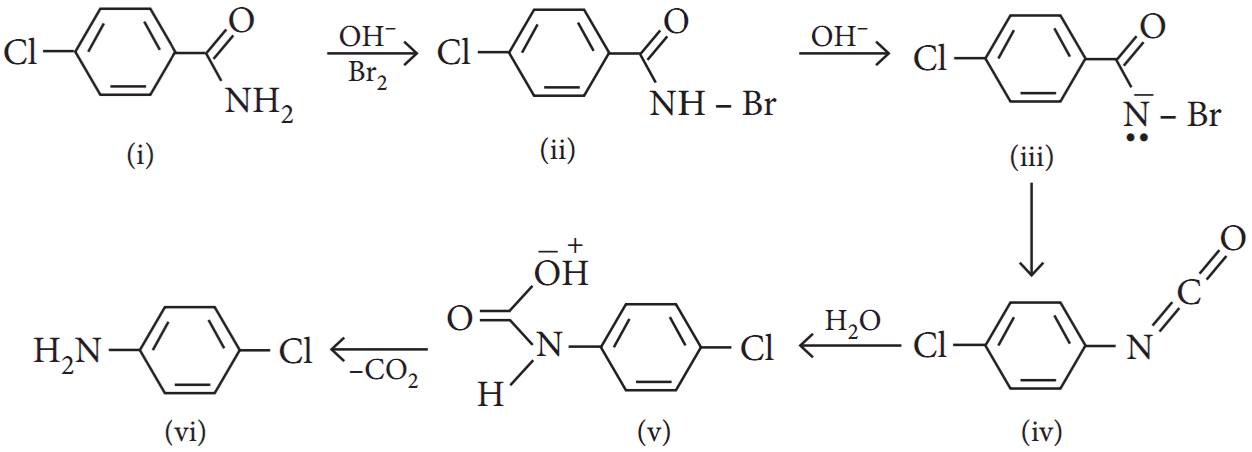
$\ce{RCONH_2}$ is converted into $\ce{RNH_2}$ by means of Hoffmann bromamide degradation. During the reaction amide is treated with $\ce{Br_2}$ and alkali to get amine. This reaction is used to descend the series in which carbon atom is removed as carbonate ion $(\text{CO}^{2-}_3)$ Hoffmann bromide degradation reaction can be written as:

The following questions are multiple choice questions. Choose the most appropriate answer:
  1. Hoffmann bromamide degradation is used for the preparation of
  1. Primary amines.
  2. Secondary amines.
  3. Tertiary amines.
  4. Secondary aromatic amines.
  1. Which is the rate determining step in Hoffmann bromamide degradation?
  1. Formation of $(i)$
  2. Formation of $(ii)$
  3. Formation of $(iii)$
  4. Formation of $(iv).$
  1. Which of the following are used for the conversion of $(i)$ to $(ii)?$
  1. $\ce{KBr}$
  2. $\ce{KBr + CH_3ONa}$
  3. $\ce{KBr + KOH}$
  4. $\ce{Br_2 + KOH}$
  1. Identify Bin the following reaction.
$\text{R}-\text{C}\equiv\text{N}\xrightarrow[\text{(Partially hydrolysis) }]{\text{Cone. HCI}}\text{A}\xrightarrow{\frac{\text{Br}_2}{\text{KOH}}}\text{B}$
  1. $\ce{RCONH_2}$
  2. $\ce{RNH_2}$
  3. $\ce{RNHBr}$
  4. $\ce{R = N = C = O}$
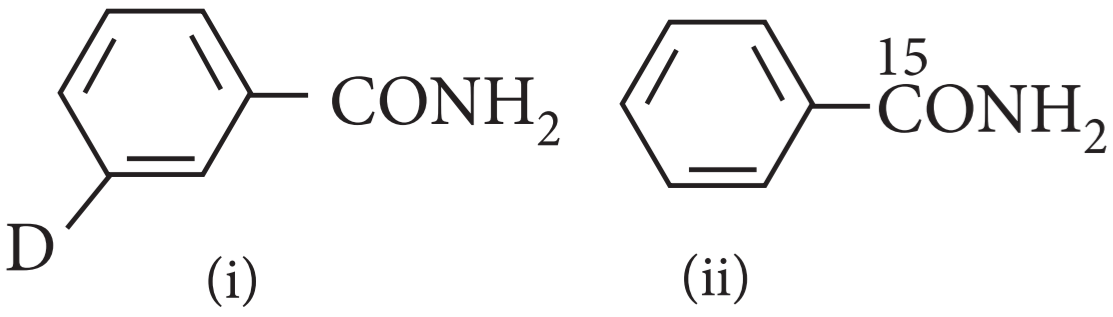
  1. What are the constituent amines formed when the mixture of $(i)$ and $(ii)$ undergoes Hoffmann bromamide degradation?
 
For the reaction : $2\text{NO}_\text{(g)}+\text{Cl}_{2\text{(g)}}\rightarrow2\text{NOCl}_\text{(g)},$ the following data were collected. All the measurements were taken at $263K.$
Experiment No.
Initial $\ce{[NO] (M)}$
Initial $\ce{[Cl_2] (M)}$
Initial rate of disapp. of $\ce{Cl_2 (M/ min)}$
$1.$ $0.15$ $0.15$ $0.60$
$2.$ $0.15$ $0.30$ $1.20$
$3.$ $0.30$ $0.15$ $2.40$
$4.$ $0.25$ $0.25$ $?$
The following questions are multiple choice questions. Choose the most appropriate answer:
  1. The molecularity of the reaction is:
  1. $1$
  2. $2$
  3. $3$
  4. $4$
  1. The expression for rate law is:
  1. $\text{r}=\text{k}[\text{NO}][\text{Cl}_2]$
  2. $\text{r}=\text{k}[\text{NO}]^2[\text{Cl}_2]$
  3. $\text{r}=\text{k}[\text{NO}][\text{Cl}_2]^2$
  4. $\text{r}=\text{k}[\text{NO}]^2[\text{Cl}_2]^2$
  1. The overall order of the reaction is:
  1. $2$
  2. $0$
  3. $1$
  4. $3$
  1. The value of rate constant is:
  1. $150.32\ M^{-2}\ min^{-1}$
  2. $200.08\ M^{-1}\ min^{-1}$
  3. $177.77\ M^{-2}\ min^{-1}$
  4. $155.75\ M^{-1}\ min^{-1}$
  1. The initial rate of disappearance of $Cl_2$ in experiment $4$ is:
  1. $1.75\ M\ min^{-1}$
  2. $3.23\ M\ min^{-1}$
  3. $2.25\ M\ min^{-1}$
  4. $2.77\ M\ min^{-1}$
All chemical reactions involve interaction of atoms and molecules. A large number of atoms/molecules are present in a few gram of any chemical compound varying with their atomic / molecular masses. To handle such large number conveniently, the mole concept was introduced. All electrochemical cell reactions are also based on mole concept. For example, a $4.0$ molar aqueous solution of $\ce{NaCl}$ is prepared and $500\ mL$ of this solution is electrolysed. This leads to the evolution of chlorine gas at one of the electrode. The amount of products formed can be calculated by using mole concept.
The following questions are multiple choice questions. Choose the most appropriate answer :
  1. The total number of moles of chlorine gas evolved is :
  1. $0.5$
  2. $1.0$
  3. $1.5$
  4. $1.9$
  1. If cathode is a $Hg$ electrode, then the maximum weight of amalgam formed from this solution is :
  1. $300g$
  2. $446g$
  3. $396g$
  4. $296g$
  1. The total charge $($coulomb$)$ required for complete electrolysis is :
  1. $186000$
  2. $24125$
  3. $48296$
  4. $193000$
  1. In the electrolysis, the number of moles of electrons involved are :
  1. $2$
  2. $1$
  3. $3$
  4. $4$
  1. In electrolysis of aqueous $\text{NaCl}$ solution when $Pt$ electrode is taken, then which gas is liberated at cathode?
  1. $\ce{H2}$ gas
  2. $\ce{Cl2}$ gas
  3. $\ce{O2}$ gas
  4. None of these.
Number of molecules which must collide simultaneously to give product is called molecularity. It is equal to sum of coefficients of reactants present in stoichiometric chemical equation. For reaction, $m_1A + m_2B \rightarrow$ Product Molecularity $= [m_1 + m_2]$ ln complex reaction each step has its own molecularity which is equal to the sum of coefficients of reactants present in a particular step. Molecularity is a theoretical property. Its value is any whole number. Number of concentration terms on which rate of reaction depends is called order of reaction or sum of powers of concentration terms present in the rate equation is called order of reaction. If rate equation ofreaction is: Rate $=\text{k}\cdot\text{C}^{\text{m}_1}_\text{A}\cdot\text{C}^{\text{m}_2}_\text{B}$ Then order of reaction $= m_1 + m_2.$ ln simple reaction, order and molecularity are same. ln complex reaction, order of slowest step is the order ofover all reaction. This step is known as rate determining step. Order is an experimental property. Its value may be zero, fractional or negative. The following questions are multiple choice questions. Choose the most appropriate answer:
  1. Higher order $(> 3)$ reactions are rare due to:
  1. Shifting of equilibrium towards reactants due to elastic collisions.
  2. Loss of active species on collision.
  3. Low probability of simultaneous collision of all the reacting species.
  4. Increase in entropy and activation energy as more molecules are involved.
  1. The molecularity of the reaction:
$6\text{FeSO}_4+3\text{H}_2\text{SO}_4+\text{KClO}_3\rightarrow\text{KCl}+3\text{Fe}_2(\text{SO}_4)_3+3\text{H}_2\text{O}$ is:
  1. $6$
  2. $10$
  3. $3$
  4. $7$
  1. Which of the following statements is false in the following?
  1. Order of a reaction may be even zero.
  2. Molecularity of a reaction is always a whole number.
  3. Molecularity and order always have same values for a reaction.
  4. Order of a reaction depends upon the mechanism of the reaction.
  1. The rate of reaction, $A + 2B \rightarrow$ products, is given by the following equation:
$-\frac{\text{d}[\text{A}]}{\text{dt}}=\text{k}[\text{A}][\text{B}]^2$
If B is present in large excess, the order of the reaction is:
  1. Zero
  2. First
  3. Second
  4. Third
  1. The rate of the reaction, $A + B + C \rightarrow$  products, is given by $\text{r}=\frac{\text{d}[\text{A}]}{\text{dt}}=\text{k}[\text{A}]^\frac{1}{2}[\text{B}]^\frac{1}{3}[\text{C}]^\frac{1}{4}.$ The order of the reaction is:
  1. $\frac{1}{3}$
  2. $\frac{1}{4}$
  3. $\frac{1}{2}$
  4. $\frac{13}{12}$
Read the passage given below and answer the following questions: The order of reactivity towards $S_N1$ reaction depends upon the stability of carbocation in the first step. Greater the stability of the carbocation, greater will be its ease of formation from alkyl halide and hence faster will be the rate of the reaction. As we know $, 3^\circ$ carbocation is most stable, therefore, the tert $-$ alkyl that halides will undergo $S_N1$ reaction very fast. For example, it has been observed that the reaction $\ce{(CH_3)_3CBr}$ with $\ce{OH}^-$ ion to give $2-$ methyl $-2-$ propanol is about I million times as fast as the corresponding reaction of the methyl bromide to give methanol. The primary alkyl halides always react predominantly by $S_N2$ mechanism. On the other hand, the tertiary alkyl halides react predominantly by $S_N1$ mechanism. Secondary alkyl halides may react by either mechanism or by both the mechanisms without much preference depending upon the nature of the nucleophile and solvent. In these questions $(Q$. No. $i-tv),$ a statement of assertion followed by a statement of reason is given. Choose tile correct answer out of tile following choices.
  1. Assertion and reason both are correct statements and reason is correct explanation for assertion.
  2. Assertion and reason both are correct statements but reason is not correct explanation for assertion.
  3. Assertion is correct statement but reason is wrong statement.
  4. Assertion is wrong statement but reason is correct statement.
  1. Assertion : Low concentration of nudeophile favours $S_N1$ mechanism.
Reason : $2^\circ$ alkyl halides are less reactive than $1^\circ$ towards $S_N1$ reactions.​​​​​​​
  1. Assertion : Polar solvent slows down $S_N2$ reactions.
Reason : $\ce{CH_3-Br}$ is less reactive than $\ce{CH_3Cl}$.​​​​​​​
  1. Assertion : Benzyl bromide when kept in acetone $-$ water it produces benzyl alcohol.
Reason : The reaction follows $S_N2$ mechanism.
  1. Assertion : Rate of hydrolysis of methyl chloride to methanol is higher in $\text{DMF}$ than in water.
Reason : Hydrolysis of methyl chloride follows second order kinetics.
  1. Assertion : $S_N1$ reaction is carried out in the presence of a polar protic solvent.
Reason : A polar protic solvent increases the stability of carbocation due to solvation.
Read the passage given below and answer the following questions: An ideal solution may be defined as the solution which obeys Raoult's law exactly over the entire range of concentration. The solutions for which vapour pressure is either higher or lower than that predicted by Raoult's law are called non-ideal solutions.Non-ideal solutions can show either positive or negative deviations from Raoult's law depending on whether the A-B interactions in solution are stronger or weaker than A - A and B - B interactions. The following questions are multiple choice questions. Choose the most appropriate answer:
  1. Which of the following solutions is/are ideal solution(s)?
  1. Bromoethane and iodoethane.
  2. Acetone and chloroform
  3. Benzene and acetone
  4. n-heptane and n-hexane
  1. Only I
  2. I and II
  3. II and III
  4. I and Iv
  1. For which of the following solutions $\Delta\text{H}_{\text{mix}}$ and $\Delta\text{V}_{\text{mix}}$ is negative?
  1. Acetone and aniline
  2. Ethyl alcohol and cyclohexane
  3. Acetone and CS2
  4. Benzene and toluene
  1. Which of the following is not true for positive deviations?
  1. The A-B interactions in solution are weaker than the A - A and B - B interactions.
  2. $\text{P}_\text{A}<\text{P}\mathring{\text{A}}\ \text{x}_\text{A}$ and $\text{P}_\text{B}<\text{P}\mathring{\text{B}}\ \text{x}_\text{B}$
  3. Carbon tetrachloride and chloroform mixture is an example of positive deviations.
  4. All of these.
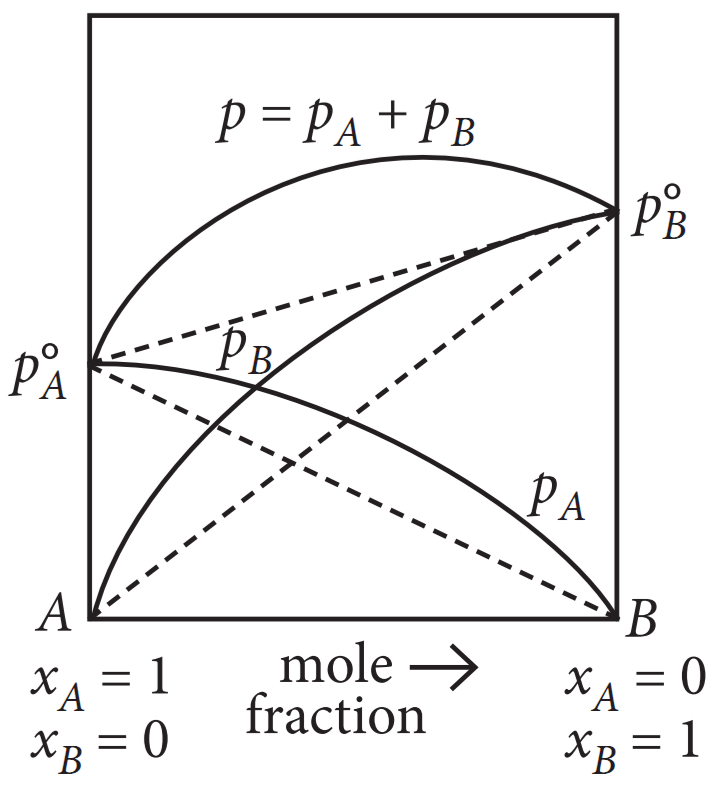
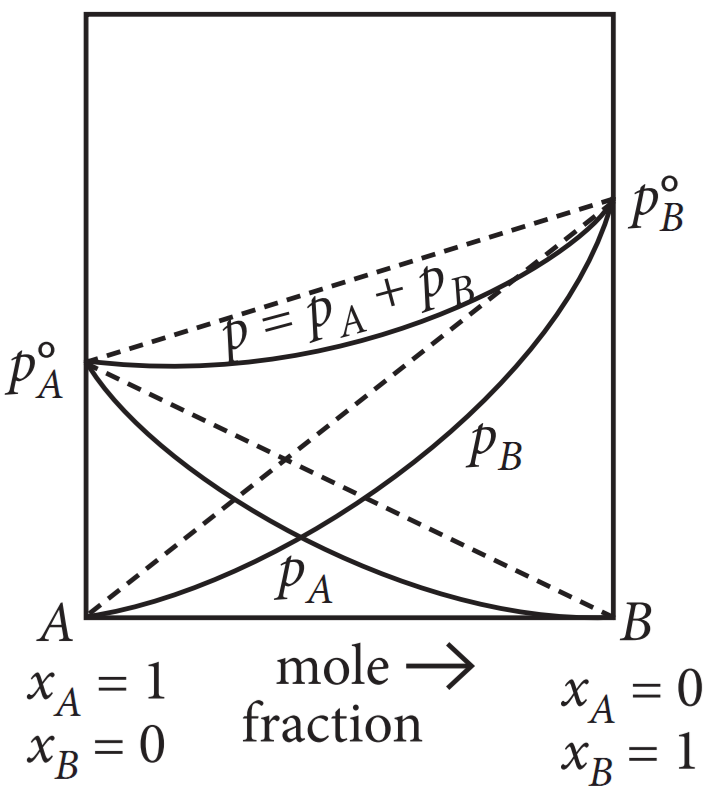
  1. For water and nitric acid mixture, which of the given graph is correct?
 
  1.  
 
  1.  
  1. Both of these
  2. None of these
  1. Water-HCI mixture.
  1. Shows positive deviations.
  2. Forms minimum boiling azeotrope.
  3. Shows negative deviations.
  4. Forms maximum boiling azeotrope.
  1. I and II
  2. I and III
  3. I and IV
  4. III and IV
Read the passage given below and answer the following questions:
Amines are basic in nature. The basic strength of amines can be expressed by their dissociation constant, $K_b$ or $pK_b.$
$\text{RNH}_2+\text{H}_2\text{O}\rightleftharpoons\text{RNH}^+_3+\text{OH}^-$
$\text{k}_\text{b}=\frac{[\text{RNH}^+_3][\text{OH}^-]}{[\text{RNH}_2]}\text{and}\text{ pk}_\text{b}=-\log\text{k}_\text{b}$
Greater the $K_b$ value or smaller the $pK_b$ value, more is the basic strength of a mine. Aryl amines such as aniline are less basic than aliphatic amines due to the involvement of lone pair of electrons on $N-$atom with the resonance in benzene. In derivatives of aniline, the electron releasing groups increase the basic strength while electron withdrawing groups decrease the basic strength. The base weakening effect of electron withdrawing group and base strengthening effect of electron releasing group is more marked at $p-$position than at $m-$position. $a-$Substituted aniline is less basic than aniline due to ortho effect and is probable due to combination of electronic and steric effect.
The following questions are multiple choice questions. Choose the most appropriate answer:
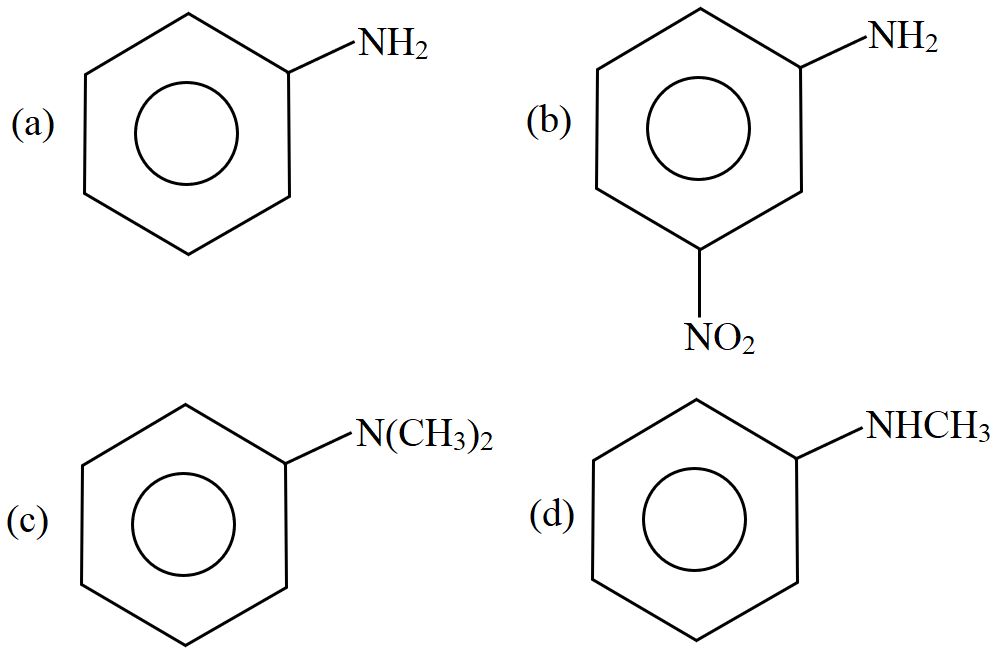
  1. Which of the following has lowest $pK_b$ value?
  1. The strongest base among the following is:
  1. $\ce{C_6H_5NH_2}$
  2. $\ce{p-NO_2 - C_6H_4NH_2}$
  3. $\ce{m-NO_2 - C_6H_4NH_2}$
  4. $\ce{C_6H_5CH_2NH_2}$
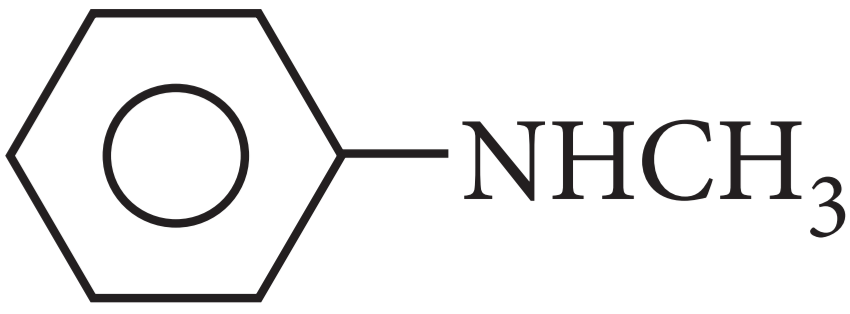
  1. Maximum $pK_b$ value of:
  1.  
  1.  
  1. $\ce{(CH_3CH_2)_2NH}$
  2. $\ce{(CH_3)_2NH}$
  1.  The order of basic strength among the following amines in benzene solution is:
  1. Methylamine is more basic than $NH_3.$
  2. Amines form hydrogen bonds.
  3. Ethylamine has higher boiling point than propane.
  4. Dimethylamine is less basic than methylamine.
  1. $\ce{CH_3CH_2NH_2}$ contains a basic $-NH_2$ group, but $\ce{CH_3CONH_2}$ does not because:
  1. Acetamide is amphoteric in character.
  2. In ethylamine the electron pair on $N-$atom is delocalised by resonance.
  3. In ethylamine there is no resonance while in acetamide the lone pair of electrons on $N-$ atom is delocalised and is less available for protonation.
  4. None of these.