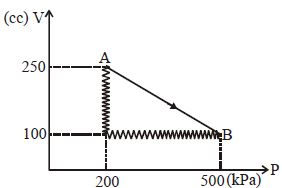
Find the change in the entropy in the following process $100 \,gm$ of ice at $0°C$ melts when dropped in a bucket of water at $50°C$ (Assume temperature of water does not change) ..... $ cal/K$
Diffcult
Download our app for free and get started
(b)Gain of entropy of ice
${S_1} = \frac{{\Delta Q}}{T} = \frac{{mL}}{T} = \frac{{80 \times 100}}{{(0 + 273)}} = \frac{{8 \times {{10}^3}}}{{273}}cal/K$
Loss of entropy of water $ = {S_2} = - \frac{{\Delta Q}}{T} = - \frac{{mL}}{T}$
$ = \frac{{80 \times 100}}{{(273 + 50)}} = \frac{{8 \times {{10}^3}}}{{323}}cal/K$
Total change of entropy
${S_1} + {S_2} = \frac{{8 \times {{10}^3}}}{{273}} - \frac{{8 \times {{10}^3}}}{{323}} = + 4.5\;cal/K$
${S_1} = \frac{{\Delta Q}}{T} = \frac{{mL}}{T} = \frac{{80 \times 100}}{{(0 + 273)}} = \frac{{8 \times {{10}^3}}}{{273}}cal/K$
Loss of entropy of water $ = {S_2} = - \frac{{\Delta Q}}{T} = - \frac{{mL}}{T}$
$ = \frac{{80 \times 100}}{{(273 + 50)}} = \frac{{8 \times {{10}^3}}}{{323}}cal/K$
Total change of entropy
${S_1} + {S_2} = \frac{{8 \times {{10}^3}}}{{273}} - \frac{{8 \times {{10}^3}}}{{323}} = + 4.5\;cal/K$

Download our appand get started for free
Experience the future of education. Simply download our apps or reach out to us for more information. Let's shape the future of learning together!No signup needed.*
Similar Questions
- 1For an isothermal expansion of a perfect gas, the value of $\frac{{\Delta P}}{P}$ is equalView Solution
- 2View SolutionIn practice, all heat engines have efficiency less than that of a Carnot engine because
- 3One mole of an ideal gas at an initial temperature of $T\, K$ does $6\, R\, joules$ of work adiabatically. If the ratio of specific heats of this gas at constant pressure and at constant volume is $\frac{5}{3}$ , the final temperature of gas will beView Solution
- 4$Assertion :$ Adiabatic expansion is always accompanied by fall in temperature.View Solution
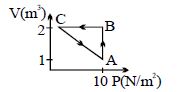
$Reason :$ In adiabatic process, volume is inversely proportional to temperature. - 5An ideal gas is taken through the cycle $A \to B \to C \to A$ , as shown in the figure. If the net heat supplied to the gas in the cycle is $5\ J$, the work done by the gas in the process $C \to A$ is .... $J$View Solution
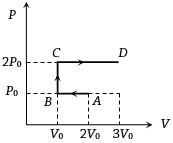
- 6$P-V$ diagram of an ideal gas is as shown in figure. Work done by the gas in process $ABCD$ isView Solution
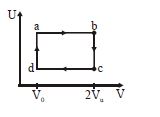
- 7The figure given below shows the variation in the internal energy $U$ with volume $V$ of $2.0\ mole$ of an ideal gas in a cyclic process $abcda$ . The temperatures of the gas during the processes $ab$ and $cd$ are $500\ K$ and $300\ K$ respectively, the heat absorbed by the gas during the complete process is .... $J$View Solution
(Take $R$ = $8.3\ J/mol-K$ and $ln\ 2$ = $0.69$)
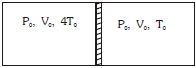
- 8Figure shows a cylindrical adiabatic container of total volume $2V_0$ divided into two equal parts by a conducting piston (which is free to move). Each part containing identical gas at pressure $P_0$ . Initially temperature of left and right part is $4T_0$ and $T_0$ respectively. An external force is applied on the piston to keep the piston at rest. Find the value of external force required when thermal equilibrium is reached. ( $A =$ Area of piston)View Solution
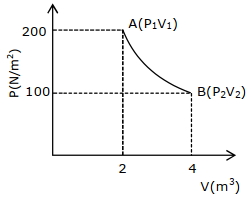
- 9One mole of an ideal gas at $27^{\circ} {C}$ is taken from ${A}$ to ${B}$ as shown in the given ${PV}$ indicator diagram. The work done by the system will be $......\times 10^{-1} \,{J}$View Solution
[Given : $R=8.3\, {J} /\,mole\,{K}, \ln 2=0.6931$ ] (Round off to the nearest integer)
- 10A monoatomic gas is taken along path $AB$ as shown. Calculate change in internal energy of systemView Solution