Question

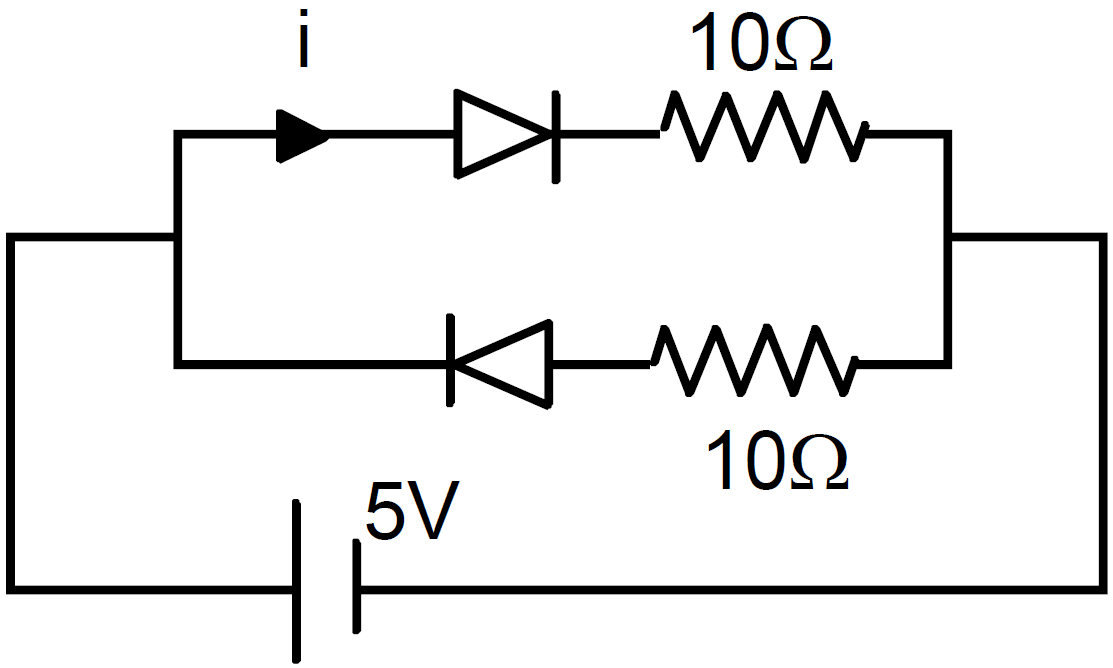
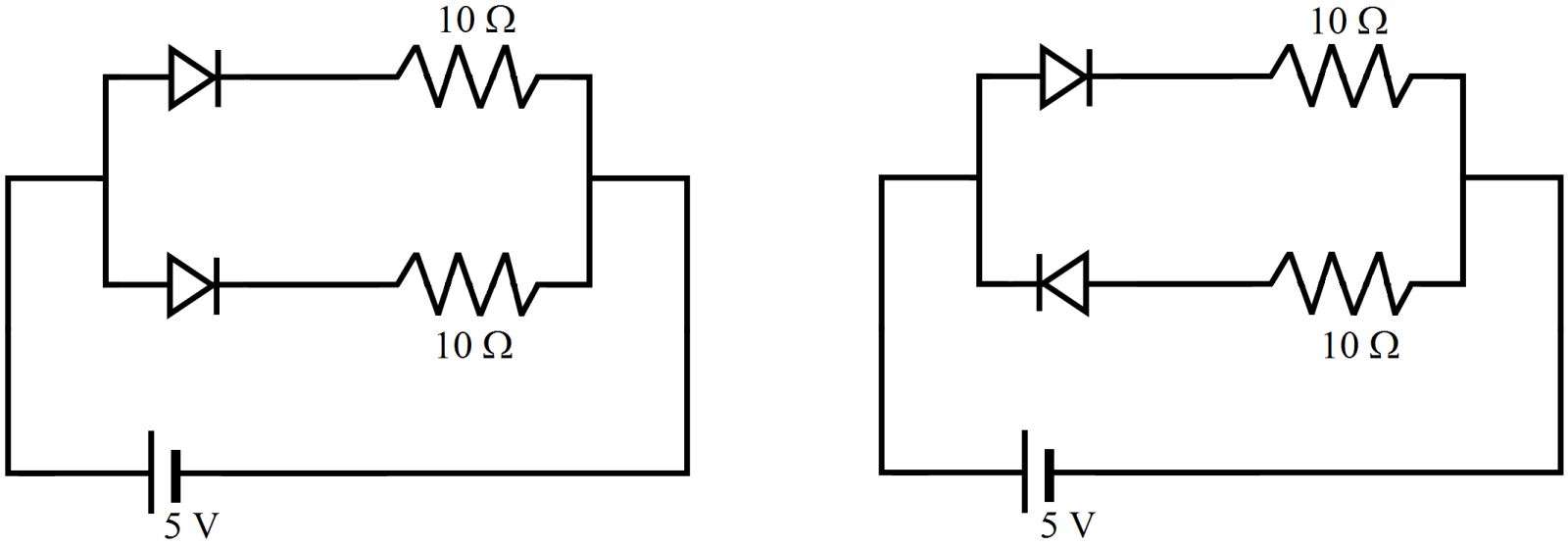
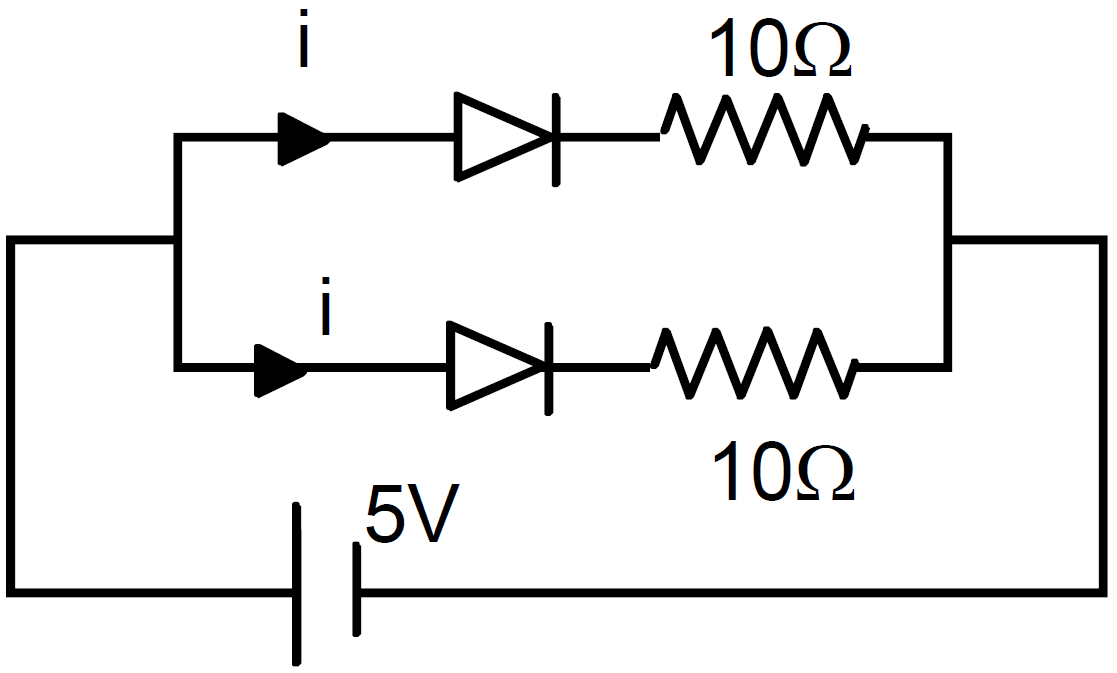
Find the current through the battery circuits shown in figure.

Answer

Both diodes are forward biased. Thus the net diode resistance is 0.

$\text{i}=\frac{5}{\frac{10\times10}{10+10}}=\frac{5}{5}=1\text{A}$
One diode is forward biased and other is reverse biased.

$\text{i}=\frac{\text{V}}{\text{R}_\text{net}}=\frac{5}{10+0}=\frac{1}{2}=0.5\text{A}$

Need a full question paper?

Generate a complete, print-ready paper with questions like this in minutes — across 16+ boards, with answer keys.
Start Generating Free

Similar questions

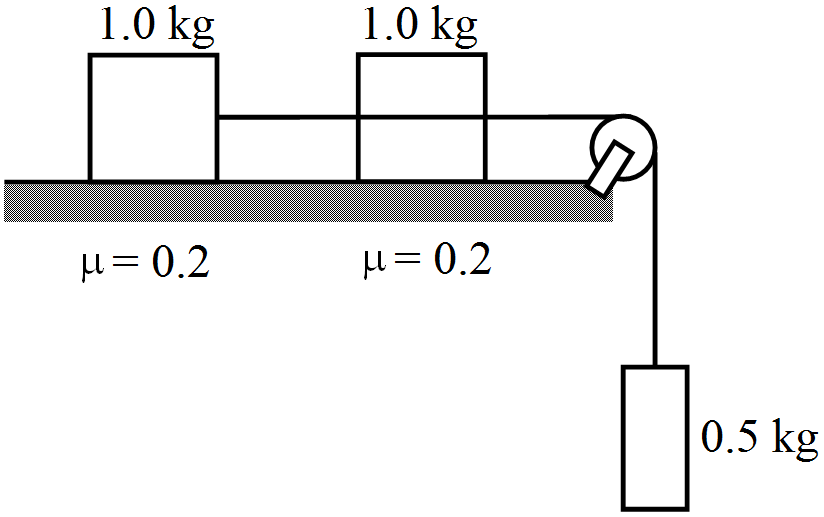
Consider the situation shown in figure. Calculate:
  1. The acceleration of the $1.0\ kg$ blocks.
  2. The tension in the string connecting the $1.0\ kg$ blocks.
  3. The tension in the string attached to $0.50\ kg.$
Two charges -q each are separated by distance 2d. A third charge +q is kept at mid point O. Find potential energy of +q as a function of small distance x from O due to -q charges. Sketch P.E. v/s x and convince yourself that the charge at O is in an unstable equilibrium.
A neutron moving with a speed $υ$ strikes a hydrogen atom in ground state moving towards it with the same speed. Find the minimum speed of the neutron for which inelastic $($completely or partially$)$ collision may take place. The mass of neutron $=$ mass of hydrogen $= 1.67 \times 10^{-27}kg$.
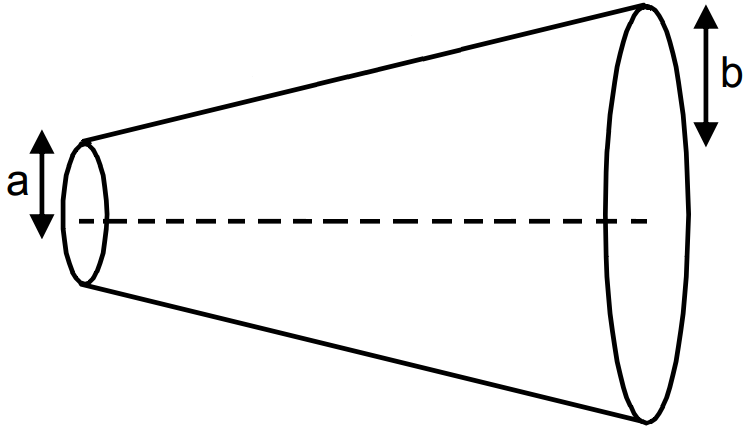
Figure. shows a conductor of length l with a circular cross-section. The radius of the cross-section varies linearly from a to b. The resistivity of the material is ρ. Assuming that b - a << l, find the resistance of the conductor.
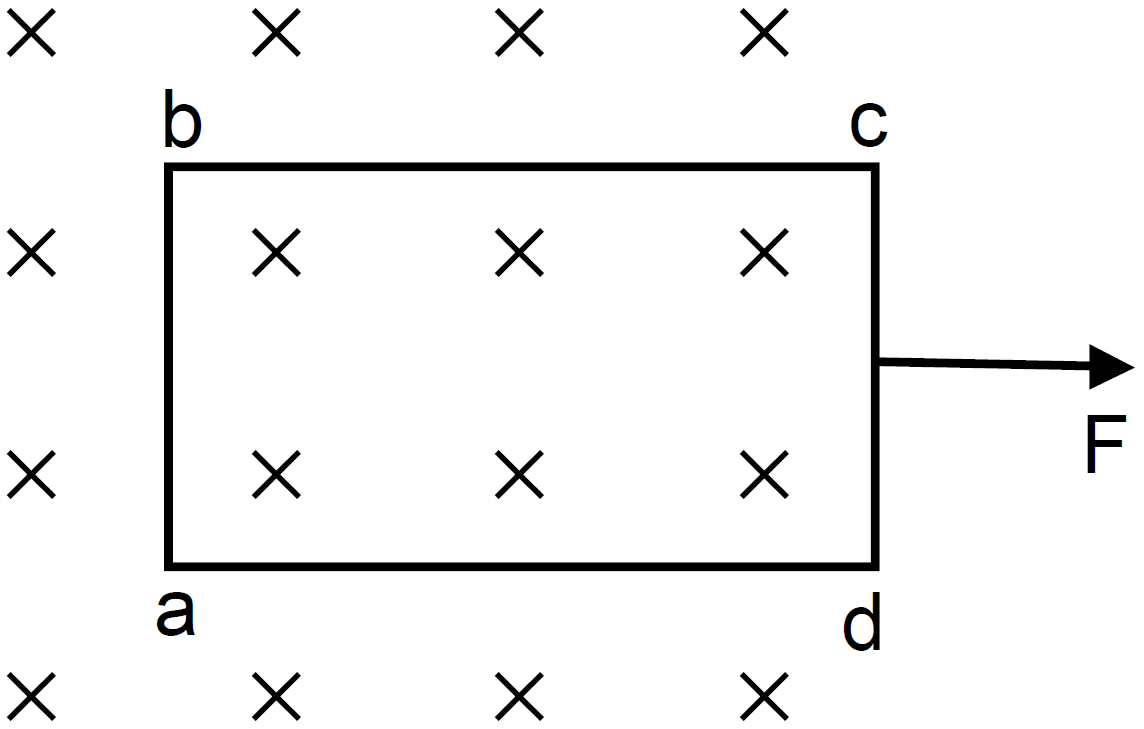
A rectangular frame of wire abcd has dimensions $32\ cm \times 8.0\ cm$ and a total resistance of $2.0\Omega.$ It is pulled out of a magnetic field $B = 0.020T$ by applying a force of $3.2 \times 10^{-5}N\ ($figure$)$. It is found that the frame moves with constant speed. Find
An electron is projected horizontally with a kinetic energy of $10\ keV$. A magnetic field of strength $1.0 \times 10^{-7}T$ exists in the vertically upward direction.
  1. Will the electron deflect towards the right or left of its motion?
  2. Calculate the sideways deflection of the electron while travelling through $1m$. Make appropriate approximations.
$i$. Define the capacitance of a capacitor. Obtain the expression for the capacitance of a parallel plate capacitor in vacuum in terms of plate area $A$ and separation d between the plates.
$ii.$ A slab of material of dielectric constant $k$ has the same area as the plates of a parallel plate $\frac{3 d}{4}$ capacitor but has a thickness $ -$. Find the ratio of the capacitance with dielectric inside it to its capacitance without the dielectric.
(a) For circuits used for transporting electric power, a low power factor implies large power loss in transmission. Explain.
(b) Power factor can often be improved by the use of a capacitor of appropriate capacitance in the circuit. Explain.
State Ampere's circuital law. Using Ampere's circuital law, derive an expression for the magnetic field along the axis of a toroidal solenoid.
(i) Obtain an expression for torque acting on a rectangular current carrying coil in a uniform magnetic field. (ii) Calculate magnetic dipole of a circular electric current loop.