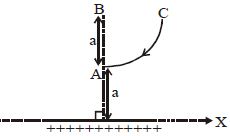
For an infinite line of charge having charge density $\lambda $ lying along $x-$ axis, the work required in moving charge $q$ from $C$ to $A$ along arc $CA$ is :-
Experience the future of education. Simply download our apps or reach out to us for more information. Let's shape the future of learning together!No signup needed.*
A spherical portion has been removed from a solid sphere having a charge distributed uniformly in its volume in the figure. The electric field inside the emptied space is
All the six capacitors shown in the circuit are identical. Each can withstand maximum $200\, volt$ between its terminals. The maximum voltage that can be applied safely between $A$ and $B$ is.....$V$
A parallel plate capacitor having capacitance $12\, pF$ is charged by a battery to a potential difference of $10\, V$ between its plates. The charging battery is now disconnected and a porcelain slab of dielectric constant $6.5$ is slipped between the plates. The work done by the capacitor on the slab is.......$pJ$
A square of side ‘$a$’ has charge $Q$ at its centre and charge ‘$q$’ at one of the corners. The work required to be done in moving the charge ‘$q$’ from the corner to the diagonally opposite corner is
Two capacitors of capacities $2 {C}$ and ${C}$ are joined in parallel and charged up to potential ${V}$. The battery is removed and the capacitor of capacity $C$ is filled completely with a medium of dielectric constant ${K}$. The potential difference across the capacitors will now be
In free space, a particle $A$ of charge $1\,\mu C$ is held fixed at a point $P.$ Another particle $B$ of the same charge and mass $4\,\mu g$ is kept at a distance of $1\,mm$ from $P$. If $B$ is released, then its velocity at a distance of $9\,mm$ from $P$ is [ Take $\frac{1}{{4\pi {\varepsilon _0}}} = 9 \times {10^9}\,N{m^2}{C^{ - 2}}$ ]
The electric potential $V(x)$ in a region around the origin is given by $V(x) = 4x^2\,volts$ . The electric charge enclosed in a cube of $1\,m$ side with its centre at the origin is (in coulomb)
Two capacitors of equal capacitance $(C_1 = C_2)$ are shown in the figure. Initially, while the switch $S$ is open, one of the capacitors is uncharged and the other carries charge $Q_0$. The energy stored in the charged capacitor is $U_0$. Sometimes after the switch is closed, the capacitors $C_1$ and $C_2$ carry charges $Q_1$ and $Q_2$, respectively; the voltages across the capacitors are $ V_1$ and $V_2$; and the energies stored in the capacitors are $U_1$ and $U_2$. Which of the following statements is INCORRECT ?