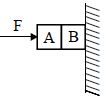
Given in the figure are two blocks $A$ and $B$ of weight $20\, N$ and $100\, N$, respectively. These are being pressed against a wall by a force $F$ such that the system does not slide as shown. If the coefficient of friction between the blocks is $0.1$ and between block $B$ and the wall is $0.15$, the frictional force applied by the wall on block $B$ is ........ $N$
Medium
Download our app for free and get started
Various forces acting on the system are shown in the figure. For vertical equilibrium of the system,
$\mathrm{f}_{\mathrm{B}}=100 \mathrm{N}+20 \mathrm{N}=120 \mathrm{N}$
i.e., frictional force applied by the wall on the block $B$ is $120 N$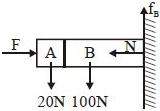

Download our appand get started for free
Experience the future of education. Simply download our apps or reach out to us for more information. Let's shape the future of learning together!No signup needed.*
Similar Questions
- 1A body of mass $\mathrm{m}$ is kept on a rough horizontal surface (coefficient of friction $=\mu$ ) A horizontal force is applied on the body, but it does not move. The resultant of normal reaction and the frictional force acting on the object is given by $\mathrm{F},$ where $\mathrm{F}$ isView Solution
- 2Abody is placed on a rough inclined plane of inclination $\theta$ .As the angle $\theta$ is increased from $0^o$ to $90^o$ the contact force between the block and the planeView Solution
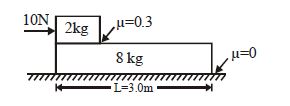
- 3Determine the time in which the smaller block reaches other end of bigger block in the figure. $(g = 10\ m s^{-2})$ .......... $\sec$View Solution
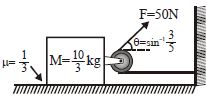
- 4In the given figure the acceleration of $M$ is $(g = 10 \,ms^{-2})$View Solution
- 5A particle has initial velocity $10\,\, m/s$. It moves due to constant retarding force along the line of velocity which produces a retardation of $5\,\, m/s^2$. ThenView Solution
- 6A uniform wooden stick of mass $1.6 \mathrm{~kg}$ and length $l$ rests in an inclined manner on a smooth, vertical wall of height $h( < l)$ such that a small portion of the stick extends beyond the wall. The reaction force of the wall on the stick is perpendicular to the stick. The stick makes an angle of $30^{\circ}$ with the wall and the bottom of the stick is on a rough focr. The reaction of the wall on the stick is equal in magnitude to the reaction of the floor on the st $ck$. The ratio $h / l$ and the frictional force $f$ at the bottom of the stick are $\left(g=10 \mathrm{~m} \mathrm{~s}^{-2}\right)$View Solution
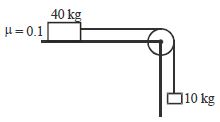
- 7For the given figure find acceleration of $40\, kg$ block ........ $m/s^2$View Solution
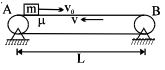
- 8With what minimum velocity should block be projected from left end $A$ towards end $B$ such that it reaches the other end $B$ of conveyer belt moving with constant velocity $v$. Friction coefficient between block and belt is $\mu$ .View Solution
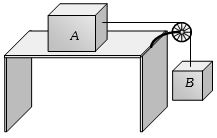
- 9The blocks $A$ and $B$ are arranged as shown in the figure. The pulley is frictionless. The mass of $A$ is $10 \,kg$. The coefficient of friction of $A$ with the horizontal surface is $0.20$. The minimum mass of $B $ to start the motion will be...... $kg$View Solution
- 10A block of mass $m$ slides down the plane inclined at angle $30^{\circ}$ with an acceleration $\frac{ g }{4}$. The value of coefficient of kinetic friction will be :View Solution