Infinite number of cells having $emf$ and internal resistance $\left( {E,r} \right)$, $\left( {\frac{E}{n},\frac{r}{n}} \right)$, $\left( {\frac{E}{{{n^2}}},\frac{r}{{{n^2}}}} \right)$, $\left( {\frac{E}{{{n^3}}},\frac{r}{{{n^3}}}} \right)$..... are connected in series in same manner across an external resistance of $\frac{{nr}}{{n + 1}}$ . Current flowing through the external resistor is
Diffcult


Download our appand get started for free
Experience the future of education. Simply download our apps or reach out to us for more information. Let's shape the future of learning together!No signup needed.*
Similar Questions
- 1Two resistors $400\, \Omega$ and $800\, \Omega$ are connected in series across a $6 V$ battery. The potential difference measured by a voltmeter of $10\, k \Omega$ across $400\, \Omega$ resistor is close to$....V$View Solution
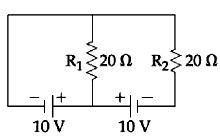
- 2In the given circuit the cells have zero internal resistance. The currents (in Amperes) passing through resistance $R_1$ and $R_2$ respectively, areView Solution
- 3Three resistances $P, Q, R$ each of $2 \,\,\Omega$ and an unknown resistance $S$ form the four arms of a Wheatstone bridge circuit. When a resistance of $6 \,\,\Omega$ is connected in parallel to $S$ the bridge gets balanced. What is the value of $S\,?$ ............... $\Omega$View Solution
- 4Two wires of same metal have the same length but their cross-sections are in the ratio $3:1$. They are joined in series. The resistance of the thicker wire is $10\,\Omega $. The total resistance of the combination will be ............. $\Omega$View Solution
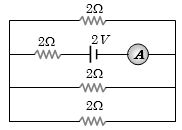
- 5View SolutionThe reading of the ammeter as per figure shown is
- 6The resistance of a wire is $R$. It is bent at the middle by $180^{\circ}$ and both the ends are twisted together to make a shorter wire. The resistance of the new wire isView Solution
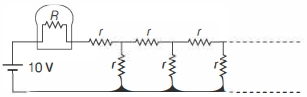
- 7A light bulb of resistance $R=16 \,\Omega$ is attached in series with an infinite resistor network with identical resistances $r$ as shown below. A $10 \,V$ battery drives current in the circuit. ............. $\Omega$ the value of $r$ such that the bulb dissipates about $1 \,W$ of power.View Solution
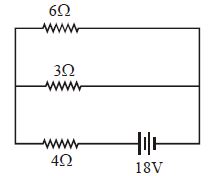
- 8The total power dissipated in watts in the circuit shown is ............. $W$View Solution
- 9The resistance of the series combination of two resistance is $S$. When they are joined in parallel the total resistance is $P$. If $S = nP$, then the minimum possible value of $n$ isView Solution
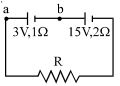
- 10Two batteries one of the $\mathrm{emf}$ $3\,V$, internal resistance $1$ ohm and the other of $\mathrm{emf}$ $15\, V$, internal resistance $2$ $\mathrm{ohm}$ are connected in series with a resistance $R$ as shown. If the potential difference between $a$ and $b$ is zero the resistance of $R$ in $\mathrm{ohm}$ isView Solution