Question
Read the passage given below and answer the following questions:
Coordination compounds are formulated and named according to the $\text{IUPAC}$ system.
Few rules for naming coordination compounds are:
  1. In ionic complex, the cation is named first and then the anion.
  2. In the coordination entity, the ligands are named first and then the central metal ion.
  3. When more than one type of ligands are present, they are named in alphabetical order of preference without any consideration of charge.
The following questions are multiple choice questions. Choose the most appropriate answer:
  1. The $\ce{[Pt(NH_3)_3Br(NO_2)Cl]Cl}$ name of the complex $\ce{[Pt(NH_3)_3Br(NO_2)Cl]Cl}$ is:
  1. Triamminechlorobromonitroplatinum $(IV)$ chloride.
  2. Triamminebromonitrochloroplatinum $(IV)$ chloride.
  3. Triamminebromidochloridonitroplatinum $(IV)$ chloride.
  4. Triamminenitrochlorobromoplatinum $(IV)$ chloride.
  1. The $\text{IUPAC}$ name of $\ce{[Ni(CO)_4]}$ is:
  1. Tetracarbonylnickel $(II).$
  2. Tetracarbonylnickel $(0).$
  3. Tetracarbonylnickelate $(II).$
  4. Tetracarbonylnickelate $(0).$
  1. As per $\text{IUPAC}$ nomenclature, the name of the complex $\ce{[Co(H_2O)_4(NH_3)_2]Cl_3}$ is:
  1. Tetraaquadiamminecobalt $(II)$ chloride.
  2. Tetraaquadiamminecobalt $(III)$ chloride.
  3. Diamminetetraaquacobalt $(II)$ chloride.
  4. Diamminetetraaquacobalt $(III)$ chloride.
  1. Which of the following represents correct formula of dichloridobis $($ethane $-1, 2-$diamine$)$ cobalt $(III)$ ion?
  1. $\ce{[CoCl_2(en)]^{2+}}$
  2. $\ce{[CoCl_2(en)_2]^{2+}}$
  3. $\ce{[CoCl_2(en)]^+}$
  4. $\ce{[CoCl_2(en)_2]^+}$
  1. Correct formula of pentaamminenitro$-O-$cobalt $(III)$ sulphate is:
  1. $\ce{[Co(NO_2)(NH_3)_5]SO_4}$
  2. $\ce{[Co(ONO)(NH_3)_5]SO_4}$
  3. $\ce{[Co(NO_2)(NH_3)_4](SO_4)_2}$
  4. $\ce{[Co(ONO)(NH_3)_4](SO_4)_2}$

Answer

  1. $(c)$ Triamminebromidochloridonitroplatinum $(IV)$ chloride
Ligands are named in alphabetical order irrespective of their charge.
  1. $(b)$ Tetracarbonylnickel $(0).$
  2. $(d)$ Diamminetetraaquacobalt $(III)$ chloride.
  3. $(d)\  \ce{[CoCl_2(en)_2]^+}$
  4. $(b)\  \ce{[Co(ONO)(NH_3)_5]SO_4}$
Ligand $\text{NO}_2^-$ is ambidentate ligand as it can donate electrons through either nitrogen $(NO_2)$ or oxygen $\text{(ONO)}.$

Need a full question paper?

Generate a complete, print-ready paper with questions like this in minutes — across 16+ boards, with answer keys.

Start Generating Free

Similar questions

All chemical reactions involve interaction of atoms and molecules. A large number of atoms/molecules are present in a few gram of any chemical compound varying with their atomic / molecular masses. To handle such large number conveniently, the mole concept was introduced. All electrochemical cell reactions are also based on mole concept. For example, a $4.0$ molar aqueous solution of $\ce{NaCl}$ is prepared and $500\ mL$ of this solution is electrolysed. This leads to the evolution of chlorine gas at one of the electrode. The amount of products formed can be calculated by using mole concept.
The following questions are multiple choice questions. Choose the most appropriate answer :
  1. The total number of moles of chlorine gas evolved is :
  1. $0.5$
  2. $1.0$
  3. $1.5$
  4. $1.9$
  1. If cathode is a $Hg$ electrode, then the maximum weight of amalgam formed from this solution is :
  1. $300g$
  2. $446g$
  3. $396g$
  4. $296g$
  1. The total charge $($coulomb$)$ required for complete electrolysis is :
  1. $186000$
  2. $24125$
  3. $48296$
  4. $193000$
  1. In the electrolysis, the number of moles of electrons involved are :
  1. $2$
  2. $1$
  3. $3$
  4. $4$
  1. In electrolysis of aqueous $\text{NaCl}$ solution when $Pt$ electrode is taken, then which gas is liberated at cathode?
  1. $\ce{H2}$ gas
  2. $\ce{Cl2}$ gas
  3. $\ce{O2}$ gas
  4. None of these.
Read the passage given below and answer the following questions:
The properties of the solutions which depend only on the number of solute particles but not on the nature of the solute are called colligative properties. Relative lowering in vapour pressure is also an example of colligative properties. For an experiment, sugar solution is prepared, for which lowering in vapour pressure was found to be 0.061 mm of Hg. (Vapour pressure of water at 20° C is 17.5 mm of Hg)
The following questions are multiple choice questions. Choose the most appropriate answer:
  1. Relative lowering of vapour pressure for the given solution is.
  1. 0.00348
  2. 0.061
  3. 0.122
  4. 1.75
  1. The vapour pressure (mm of Hg) of solution will be.
  1. 17.5
  2. 0.61
  3. 17.439
  4. 0.00348
  1. Mole fraction of sugar in the solution is.
  1. 0.00348
  2. 0.9965
  3. 0.061
  4. 1.75
  1. If weight of sugar taken is 5g in 108g of water, then molar mass of sugar will be.
  1. 358
  2. 120
  3. 240
  4. 400
  1. The vapour pressure (mm of Hg) of water at 293K when 25g of glucose is dissolved in 450g of water is.
  1. 17.2
  2. 17.4
  3. 17.120
  4. 17.02
Dependence of the rate of reaction on the concentration of reactants, temperature, and other factors is the most general method for weeding out unsuitable reaction mechanisms. The term mechanism means all the individual collisional or elementary processes involving molecules $($atoms, radicals, and ions included$)$ that take place simultaneously or consecutively to produce the observed overall reaction. For example, when hydrogen gas reacts with bromine, the rate of the reaction was found to be proportional to the concentration of $H_2$ and to the square root of the concentration of $Br_2.$ Furthermore, the rate was inhibited by increasing the concentration of $HBr$ as the reaction proceeded. These observations are not consistent with a mechanism involving bimolecular collisions of a single molecule of each kind. The currently accepted mechanism is considerably more complicated, involving the dissociation of bromine molecules into atoms followed by reactions between atoms and molecules:
It is clear from this example that the mechanism cannot be predicted from the overall stoichiometry.
$($source: Moore, J. W., Pearson, $R. G. (1981).$ Kinetics and mechanism. John Wiley Sons.$)$
$(a).$ Predict the expression for the rate of reaction and order for the following:
$H_2 + Br_2 \rightarrow 2 HBr$
What are the units of rate constant for the above reaction?
$(b).$ How will the rate of reaction be affected if the concentration of $Br_2$ is tripled?
Read the passage given below and answer the following questions:
Haloarenes are less reactive than haloalkanes. The low reactivity of haloarenes can be attributed to:
  • Resonance effect.
  • $sp^2$ hybridisation of $C - X$ bond.
  • Polarity of $C - X$ bond
  • Instability of phenyl cation $($formed by self$-$ionisation of haloarene$).$
  • Repulsion between the electron rich attacking nucleophiles and electron rich arenes.
Reactivity of haloarenes can be increased or decreased by the presence of certain groups at certain positions for example, nitro $(-NO_{^2})$ group at o/ p positions increases the reactivity of haloarenes towards nucleophilc substitution reactions.
The following questions are multiple choice questions Choose the most appropriate answer:
  1. Aryl halides are less reactive towards nucleophilic substitution reaction as compared to alkyl halides due to
  1. The formation of less stable carbonium ion.
  2. Resonance stabilisation.
  3. Larger carbon$-$halogen bond.
  4. Inductive effect.
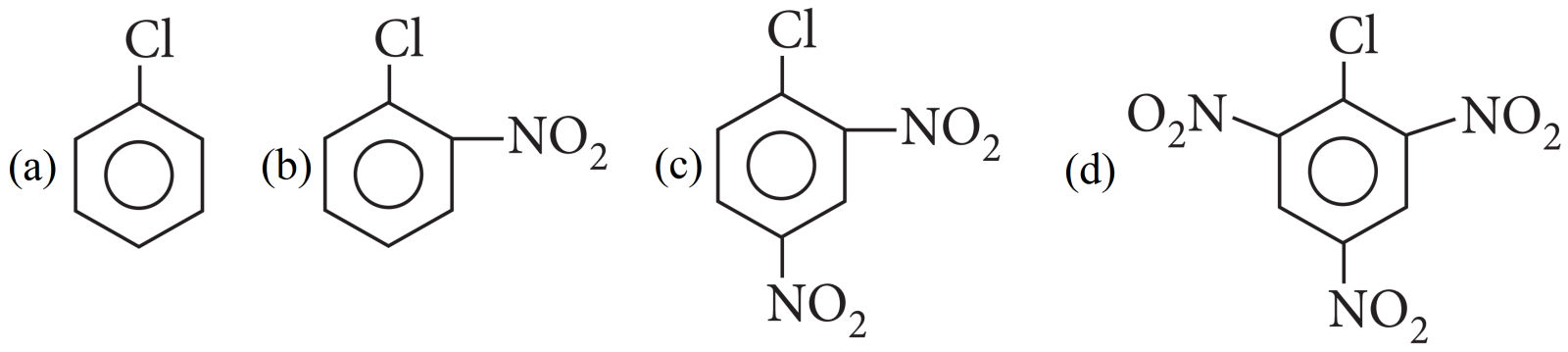
  1. Which of the following aryl halides is the most reactive towards nucleophilic substitution?
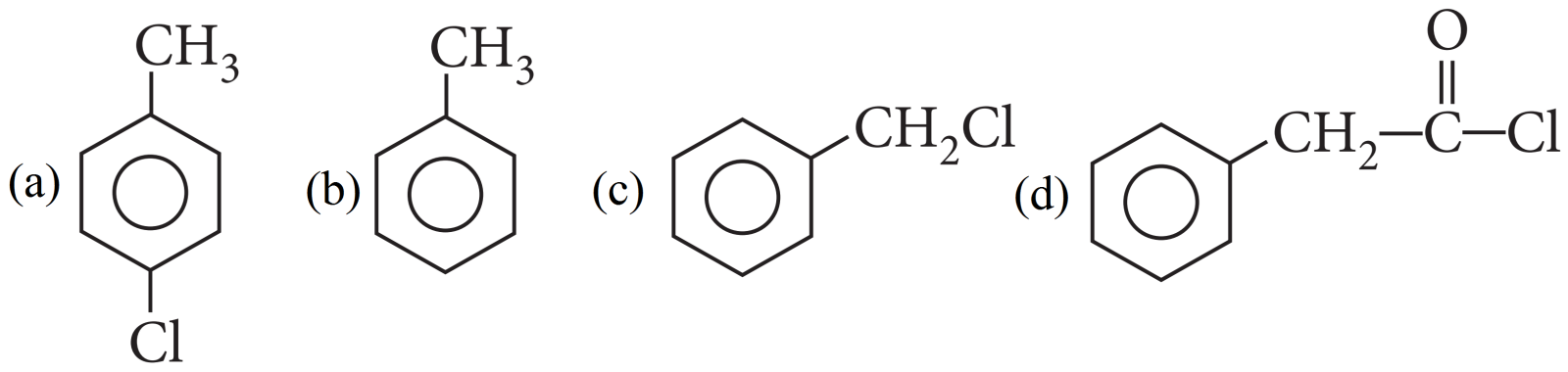
  1. Which one of the following will react fastest with aqueous $\text{NaOH}$?
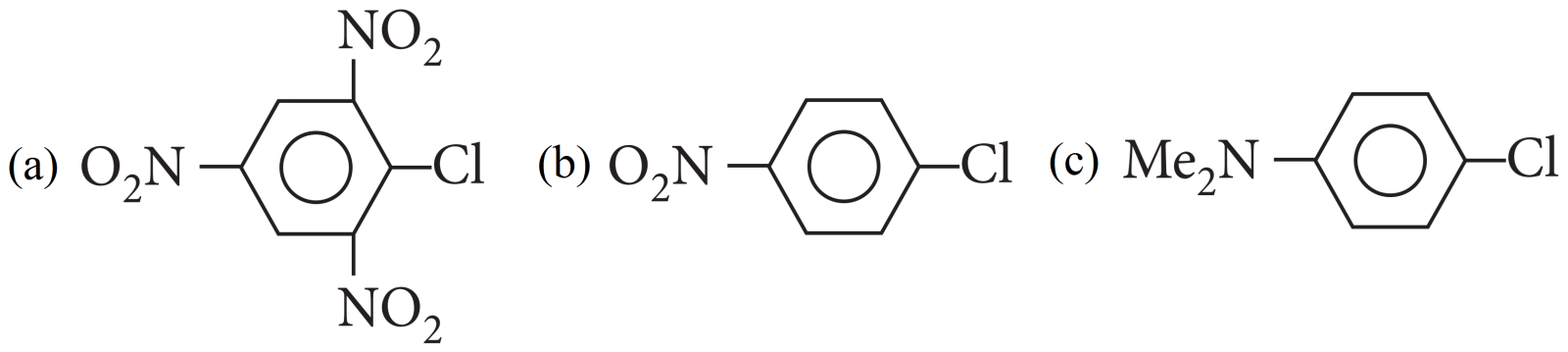
  1. Which chloro derivative of benzene among the followings would undergo hydrolysis most readily with aqueous sodium hydroxide to furnish the corresponding hydroxy derivative?
  1. $\ce{C_6H_5Cl}$
  1. The reactivity of the compounds $\ce{(i)\ MeBr, (ii)\ PhCH_2Br, (iii)\ MeCI, (iv)\ p-MeOC_6H_4Br}$ decreases as:
  1. $\ce{(i) > (ii) > (iii) > (iv)}$
  2. $\ce{(iv) > (ii) > (i) > (iii)}$
  3. $\ce{(iv) > (iii) > (i) > (ii)}$
  4. $\ce{(ii) > (i) > (iii) > (iv)}$
Read the passage given below and answer the following questions:
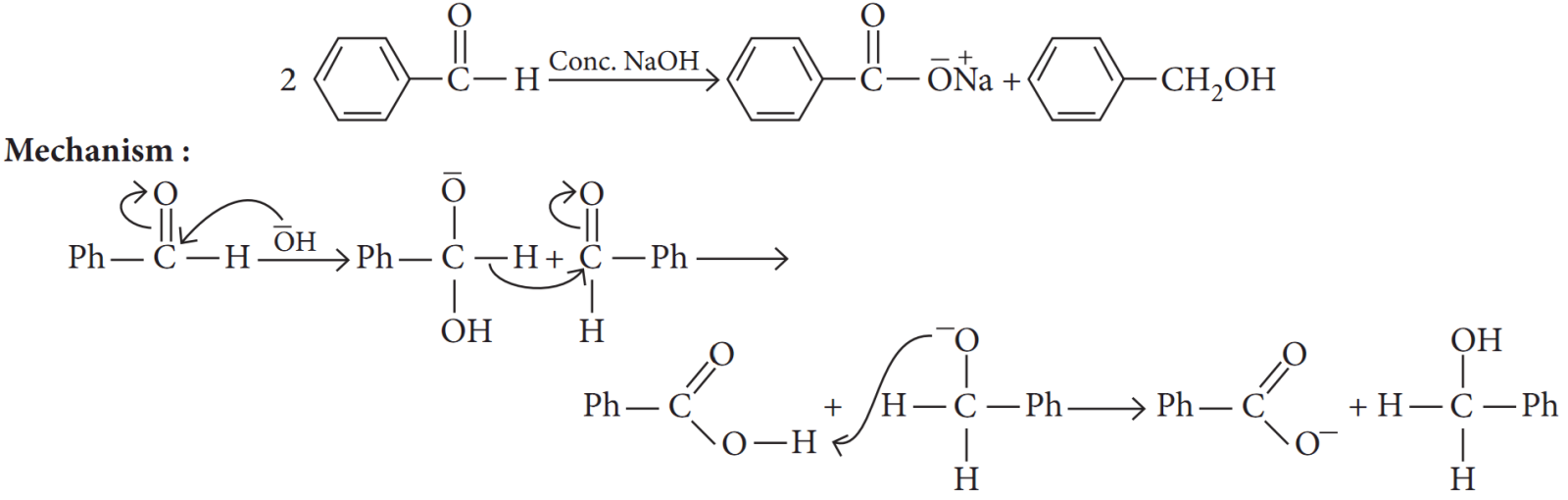
When an aldehyde with no et $-$ hydrogen reacts with concentrated aqueous $\ce{NaOH},$ half the aldehyde is converted to carboxylic acid salt and other half is converted to an alcohol. In other words, half of the reactant is oxidized and other half is reduced. This reaction is known as Cannizzaro reaction.

The following questions are multiple choice questions. Choose the most appropriate answer:
  1. A mixture of benzaldehyde and formaldehyde on heating with aqueous $\ce{NaOH}$ solution gives:
  1. Benzyl alcohol and sodium formate.
  2. Sodium benzoate and methyl alcohol.
  3. Sodium benzoate and sodium formate.
  4. Benzyl alcohol and methyl alcohol.
  1. Which of the following compounds will undergo Cannizzaro reaction?
  1. $\ce{CH_3CHO}$
  2. $\ce{CH_3COCH_3}$
  3. $\ce{C_6H_5CHO}$
  4. $\ce{C_6H_5CH_2CHO}$
  1. Trichloroacetaldehyde is subjected to Cannizzaro's reaction by using $\ce{NaOH}$. The mixture of the products contains sodium trichloroacetate ion and another compound. The other compounds is:
  1. $2, 2, 2-$ trichloroethanol.
  2. Trichloromethanol.
  3. $2, 2, 2-$ trichloropropanol.
  4. Chloroform.
  1. In Cannizzaro reaction given below:
$2\text{PhCHO}\xrightarrow{\stackrel{-}{\hbox{ OH}}}\text{PhCH}_2+\text{OH}+\text{PhCO}_2^-$ the slowest step is:
  1. The attack $^-OH$ at the carboxyl group.
  2. The transfer of hydride to the carbonyl group.
  3. The abstraction of proton from the carboxylic group.
  4. The deprotonation of $\ce{PhCH_2OH}.$
  1. Which of the following reaction will not result in the formation of carbon $-$ carbon bonds?
  1. Cannizzaro reaction.
  2. Wurtz reaction.
  3. Reimer $-$Tiemann reaction.
  4. Friedel $-$ Crafts' acylation.
Read the passage given below and answer the following questions: Williamson's synthesis is used for the preparation of symmetrical as well as unsymmerical ether. It is $S_N2$ reaction mechanism. In Williamson's synthesis, $1^\circ$ alkyl halide are used for preparation of ethers because $2^\circ$ and $3^\circ$ alkyl halide give alkene. Ethers are cleaved by hydrogen halides to alcohol and alkyl halide where alkyl halide is corresponding to that alkyl which has less number of carbon atom $($it is because of less steric hindrance$).$ In polar media unsymmetrical ether like tertiary butyl ethyl ether gives ethyl alcohol and tertiary butyl halide as reaction proceeds via carbocation. In these questions $(Q.$ No. $i-iv),$ a statement of assertion followed by a statement of reason is given. Choose the correct answer out of the following choices.
  1. Assertion and reason both are correct statements and reason is correct explanation for assertion.
  2. Assertion and reason both are correct statements but reason is not correct explanation for assertion.
  3. Assertion is correct statement but reason is wrong statement.
  4. Assertion is wrong statement but reason is correct statement.
  1. Assertion: Rate of reaction of alkyl halide in Williamson's synthesis reaction is $\ce{1^\circ RX > 2^\circ RX > 3^\circ RX}.$
Reason: It is a type of bimolecular substitution reaction $(S_N2).$
  1. Assertion: $T-$Butyl methyl ether is not prepared by the reaction of $t-$butyl bromide with sodium methoxide.
Reason: Sodium methoxide is a weak nucleophile.
  1. Assertion: Williamson's synthesis method cannot be used for preparing diphenyl ether.
Reason: Aryl halides do not undergo nucleophilic substitution easily.
  1. Assertion: When isopropyl bromide is treated with sodium isopropoxide, di$-$isopropyl ether is obtained as a major product.
Reason: With secondary alkyl halides, both substitution and elimination occur.
  1. Assertion: Both symmetrical and unsymmetrical ethers can be prepared by Williamson's synthesis.
Reason: Williamson's synthesis is an example of nucleophilic substitution reaction.
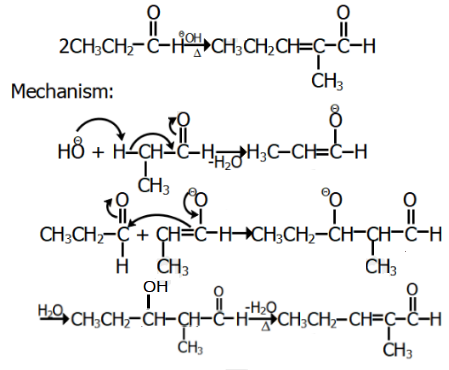
Read the passage given below and answer the following questions: The addition reaction of enol or enolate to the carbonyl functional group of aldehyde or ketone is known as aldol addition. The $\beta-$ hydroxyaldehyde or $\beta\beta-$ hydroxyketone so obtained undergo dehydration in second step to produce a conjugated enone. The first part of reaction is an addition reaction and the second part is an elimination reaction. Carbonyl compound having $\alpha \alpha -$ hydrogen undergoes aldol condensation reaction.
  1. Condensation reaction is the reverse of which of the following reaction?
  1. Lock and key hypothesis
  2. Oxidation
  3. Hydrolysis
  4. Glycogen formation
  1. Which of the following compounds would be the main product of an aldol condensation of acetaldehyde and acetone?
  1. $\ce{CH_3CH=CHCHO}$
  2. $\ce{CH_3CH=CHCOCH_3}$
  3. $\ce{(CH_3)_2C=CHCHO}$
  4. $\ce{(CH_3)_2C=CHCOCH_3}$
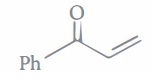
  1. Which combination of carbonyl compounds gives phenyl vinyl ketone by an aldol condensation?
  1.  Acetophenone and Formaldehyde
  2. Acetophenone and acetaldehyde
  3. Benzaldehyde and acetaldehyde
  4. Benzaldehyde and acetone
  5. Which of the following will undergo aldol condensation?
  1. $\ce{HCHO}$
  2. $\ce{CH_3CH_2OH}$
  3. $\ce{C_6H_5CHO}$
  4. $\ce{CH_3CH_2CHO}$
Read the passage given below and answer the following questions: Due to intermolecular hydrogen bonding, the boiling points of alcohols and phenols are much higher than those of corresponding haloalkanes, haloarenes, aliphatic and aromatic hydrocarbons. Among isomeric alcohols, the boiling points follow the order: primary > secondary > tertiary. Boiling points of ethers are much lower than those of isomeric alcohols. The solubility of alcohols in water decreases as the molecular mass of alcohols increases. Amongst isomeric alcohols solubility increases with branching. The solubility of phenols in water is much lower than that of alcohols. Lower ethers such as dimethyl ether and ethyl methyl ether are soluble in water, but the solubility decreases as the molecular mass increases. In these questions (Q. No. i-iv), a statement of assertion followed by a statement of reason is given. Choose the correct answer out of the following choices.
  1. Assertion and reason both are correct statements and reason is correct explanation for assertion.
  2. Assertion and reason both are correct statements but reason is not correct explanation for assertion.
  3. Assertion is correct statement but reason is wrong statement.
  4. Assertion is wrong statement but reason is correct statement.
  1. Assertion: Alcohols have higher boiling points than ethers of comparable molecular masses.
Reason: Alcohols and ethers are isomeric in nature.
  1. Assertion: The solubility of phenols in water is much lower than that of alcohols.
Reason: Phenols do not form H-bonds with water.
  1. Assertion: Among n-butane, ethoxyethane, 1-propanol and 2-propanol, the increasing order of boiling points is, 1-butanol < 1-propanol < ethoxyethane < n-butane.
Reason: Boiling point increases with increase in molecular mass.
  1. Assertion: Dimethyl ether and diethylether are soluble in water.
Reason: As the molecular mass increases, solubility of ethers in water decreases.
  1. Assertion: Butan-2-ol has higher boiling point than 2-methylpropan-2-ol.
Reason: Amongst isomeric alcohols, the boiling points decreases with branching.
Electrical work done in unit time is equal to electrical potential multiplied by total charge passed. ln order to obtain maximum work from a cell, the charge has to be passed reversibly. The reversible work done by a cell is equal to decrease in its Gibb's energy. Hence, Gibb's energy of reaction is given by $\Delta\text{G}=\text{nFE}_\text{cell}$ Hence, Eis the emfof the cell and $nF$ is the amount of energy. In these questions $(Q$. No. $i-Iv),$ a statement of assertion followed by a statement ofreason is given. Choose the correct answer out of the following choices.
  1. Assertion and reason both are correct statements and reason is correct explanation for assertion.
  2. Assertion and reason both are correct statements but reason is not correct explanation for assertion.
  3. Assertion is correct statement but reason is wrong statement.
  4. Assertion is wrong statement but reason is correct statement.
  1. Assertion : $\Delta\text{G}^\circ=-\text{nFE}^\circ$
Reason : $E^\circ$ ​​​​​​​ should be positive for a spontaneous reaction.
  1. Assertion : An electrochemical cell can be set up only if the red ox reaction is spontaneous.
Reason : A reaction is spontaneous if free energy change is negative.
  1. Assertion : For an electrochemical cell, $\Delta\text{G}<0$ and $\text{E}_\text{cell}>0.$
Reason : The given cell is non $-$ spontaneous.
  1. Assertion : Current stops flowing when $E_\text{cell} = 0$.
Reason : Equilibrium of the cell reaction is attained.
  1. Assertion :$ E_\text{cell}$ should have a positive value for the cell to function.
Reason : $E_\text{cell} = E_\text{cathode} - E_\text{anode}$
Explain the structure of nucleic acid compounds.