A meter stick held vertically, with one end on the ground, is then allowed to fall. What is the value of the radial and tangential acceleration of the top end of the stick when the stick has turned through on angle $\theta?$ What is the speed with which the top end of the stick hits the ground? Assume that the end of the stick in. contact with the ground does not slip.
Download our app for free and get started
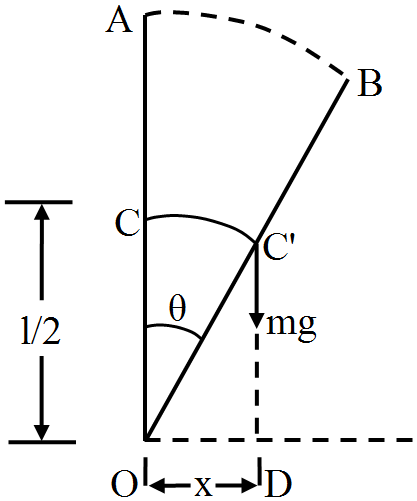
Let OA be the initial vertical position of the stick of length I with the end O in contact with ground. As the stick falls, it revolves around point O. OB represents the position of the stick at any time t = t when it has turned thorough an angle $\theta.$
C and C’ are the centre of mass of the stick at t = 0 and t = t respectively. The torque of the weight mg of the stick at t = t about O is
$=\text{mg}\times\text{x}=\text{mg}\frac{\text{l}}{2}\sin\theta\dots(1)$
If I and α denote the moment of inertia, and angular acceleration of stick, we have
$\tau=\text{I}\alpha\text{ or }\alpha=\frac{\tau}{\text{I}}=\frac{\text{mgl}}{2\text{}}\sin\theta\dots(2)$
The moment of inertia, I of stick about axis passing through one end O is
$\text{I}=\frac{\text{ml}^2}{3}$
$\therefore\alpha=\frac{3}{2}\frac{\text{g}}{\text{l}}\sin\theta\dots(3)$
Now, by definition $\alpha=\frac{\text{d}\omega}{\text{dt}}=\frac{\text{d}\omega}{\text{d}\theta}.\frac{\text{d}\theta}{\text{dt}}=\omega\frac{\text{d}\omega}{\text{d}\theta}\dots{4}$
From eqns. (3) and (4) $\omega\text{ a }\omega=\frac{3}{2}\frac{\text{g}}{\text{l}}\sin\theta\text{ d }\theta\dots(5)$
Intergrating, we get $\frac{\omega^2}{2}=-\frac{3}{2}\frac{\text{g}}{\text{l}}\cos\theta+\text{C}_1\dots(6)$
where $C_1$ is a constant of integration. Its value is found from the initial condition i.e., at $\text{t}=0;\theta=0\text{ and }\omega=0$
$\therefore0=-\frac{3}{2}\frac{\text{g}}{\text{l}}+\text{C}_1\text{ or }\text{C}_1=\frac{3}{2}\frac{\text{g}}{\text{l}}\dots(7)$
Combining Eqns. (6) and (7), we get
$\omega^2=\frac{3\text{g}}{\text{l}}(1-\cos\theta)\dots(8)$
The radial acceleration $a_r$ is
$\text{a}_{\text{r}}=\omega^2\text{l}=3\text{g}(1-\cos\theta)$
The tangential acceleration $a_1$ is
$\text{a}_{\text{t}}=\text{l}\alpha=\frac{3}{2}\text{g}\sin\theta\dots(10)$
Iet $\omega_0$ be the angular speed of the end A of stick as it this the ground. (The stick has turned through $\theta=90^\circ).$ Then
$\omega_0=3\text{g}\dots(11)$
The linear speed $v_0$ of the end A of stick as it hits are ground is $\text{v}_0=\text{l}\omega_0=3\text{gl}\dots(12)$

Download our appand get started for free
Experience the future of education. Simply download our apps or reach out to us for more information. Let's shape the future of learning together!No signup needed.*
Similar Questions
- 1View SolutionTorques of equal magnitude are applied to a hollow cylinder and a solid sphere, both having the same mass and radius. The cylinder is free to rotate about its standard axis of symmetry, and the sphere is free to rotate about an axis passing through its centre. Which of the two will acquire a greater angular speed after a given time.
- 2View SolutionShow that a(b × c) is equal in magnitude to the volume of the parallelepiped formed on the three vectors a, b and c.
- 3View SolutionA solid cylinder of mass M and radius R has a light flexible rope wound around it. The rope carries a mass m at its free end. The mass is rest at a height h above the floor. Find the angular velocity of the cylinder at the instant the mass m, after release, strikes the floor. Assume friction to be absent and the cylinder to rotate about its own axis.
- 4Prove the result that the velocity v of translation of a rolling body (like a ring, disc, cylinder or sphere) at the bottom of an inclined plane of a height h is given by $\text{v}^2=\frac{2\text{gh}}{\Big(\frac{1+\text{k}^2}{\text{R}^2}\Big)}$ using dynamical consideration (i.e. by consideration of forces and torques).View Solution
Note: k is the radius of gyration of the body about its symmetry axis, and R is the radius of the body. The body starts from rest at the top of the plane. - 5An isolated particle of mass m is moving in a horizontal plane (x - y), along the x-axis at a certain height about the ground. It explodes suddenly into two fragments of masses $\frac{\text{m}}{4}$ and $3\frac{\text{m}}{4}.$ An instant later, the smaller fragment is at y = + 15 cm. What is the position of larger fragment at this instant?View Solution
- 6A hoop of radius $2m$ weighs $100kg$. It rolls along a horizontal floor so that its centre of mass has a speed of $20cm/s$. How much work has to be done to stop it?View Solution
- 7A disc of radius R is rotating with an angular speed $\omega_\text{o}$ about a horizontal axis. It is placed on a horizontal table. The coefficient of kinetic friction is $\mu_\text{k}{:}$View Solution
- What was the velocity of its centre of mass before being brought in contact with the table?
- What happens to the linear velocity of a point on its rim when placed in contact with the table?
- What happens to the linear speed of the centre of mass when disc is placed in contact with the table?
- Which force is responsible for the effects in (b) and (c).
- What condition should be satisfied for rolling to begin?
- Calculate the time taken for the rolling to begin.
- 8View Solution
- Obtain an expression for moment of inertia of uniform circular disc about an axis perpendicular to the plane of disc and passing through its centre.
- Three point masses of 1kg, 2kg and 3kg lie at (1, 2), (0, -1) and (2, -3) respectively. Calculate the co-ordinates of centre of mass of the system.
- 9Separation of Motion of a system of particles into motion of the centre of mass and motion about the centre of mass: Show $\text{p}=\text{p}'_\text{i}+\text{m}_\text{i}\text{V}$ where $p_i$ is the momentum of the ith particle (of mass $m_i$ ) and $p′_i = m_iv′_i$. Note: $v′_i$ is the velocity of the ith particle relative to the centre of mass. Also, prove using the definition of the centre of mass.View Solution
- 10View SolutionShow that for an isolated system the centre of mass moves with a uniform velocity along a straight line path.