A hoop of radius 2m weighs 100kg. It rolls along a horizontal floor so that its centre of mass has a speed of 20cm/s. How much work has to be done to stop it?
Download our app for free and get started
Radius of the hoop, $r=2 \mathrm{~m}$ Mass of the hoop, $\mathrm{m}=100 \mathrm{~kg}$ Velocity of the hoop, $\mathrm{v}=20 \mathrm{~cm} / \mathrm{s}=0.2 \mathrm{~m} / \mathrm{s}$ Total energy of the hoop $=$ Translational KE + Rotational KE $\mathrm{E}_{\mathrm{r}}=\frac{1}{2} \mathrm{mv}^2+\frac{1}{2} \mathrm{I} \omega^2$ Moment of inertia of the hoop about its centre, I $=m r^2 E_{\mathrm{r}}=\frac{1}{2} \mathrm{mv}^2+\frac{1}{2} \mathrm{mr}^2 \omega^2$ But we have the relation, $\mathrm{v}=\mathrm{r} \omega \therefore \mathrm{E}_{\mathrm{r}}=\frac{1}{2} \mathrm{mv}^2+\frac{1}{2} \mathrm{mr}^2 \omega^2$
$\therefore \mathrm{E}_{\mathrm{r}}=\frac{1}{2} \mathrm{mv}^2+\frac{1}{2} \mathrm{mv}^2 \therefore \mathrm{E}_{\mathrm{r}}=\mathrm{mv}^2$ The work required to be done for stopping the hoop is equal to the total energy of the hoop. $\therefore$ Required work to be done, $W=m v^2=100 \times(0.2)^2=4 \mathrm{~J}$
$\therefore \mathrm{E}_{\mathrm{r}}=\frac{1}{2} \mathrm{mv}^2+\frac{1}{2} \mathrm{mv}^2 \therefore \mathrm{E}_{\mathrm{r}}=\mathrm{mv}^2$ The work required to be done for stopping the hoop is equal to the total energy of the hoop. $\therefore$ Required work to be done, $W=m v^2=100 \times(0.2)^2=4 \mathrm{~J}$

Download our appand get started for free
Experience the future of education. Simply download our apps or reach out to us for more information. Let's shape the future of learning together!No signup needed.*
Similar Questions
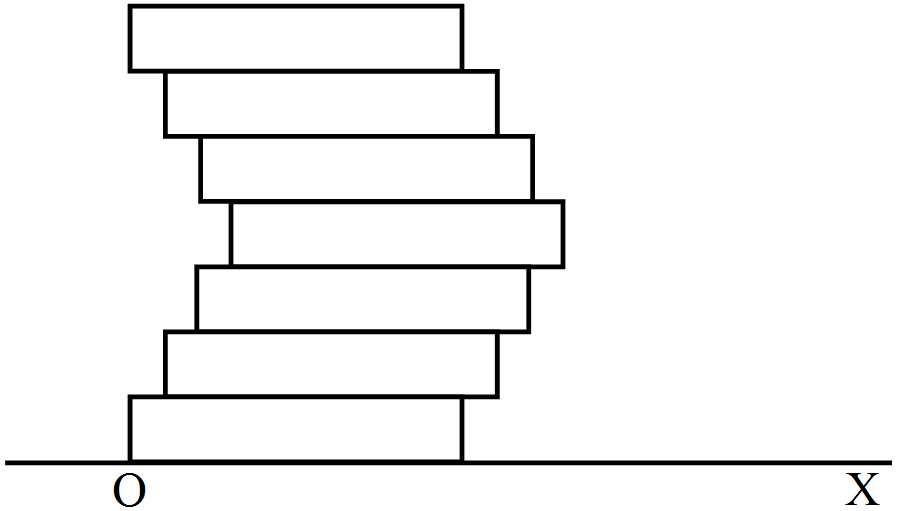
- 1Seven homogeneous bricks, each of length L, are arranged as shown in figure. Each brick is displaced with respect to the one in contact by $\frac{\text{L}}{10}.$ Find the x-coordinate of the centre of mass relative to the origin shown.View Solution
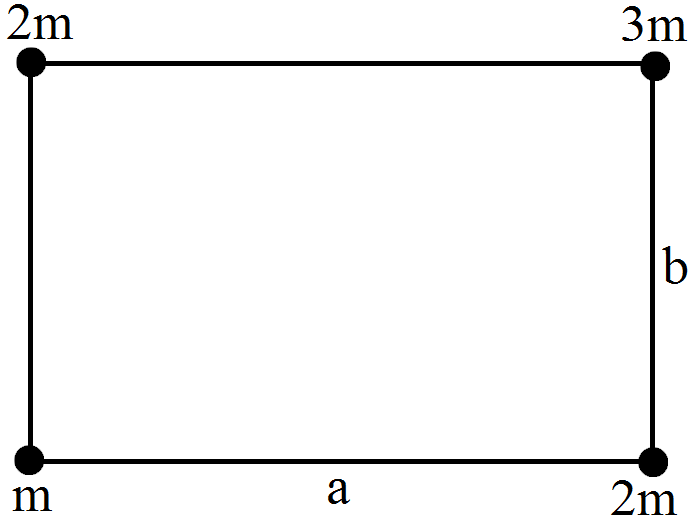
- 2View SolutionFour bodies have been arranged at the corners of a rectangle shown in figure. Find the centre of mass of the system.
- 3View SolutionA disc of radius R is cut out from a larger disc of radius 2R in such a way that the edge of the hole touches the edge of the disc. Locate the centre of mass of the residual disc.
- 4A $2kg$ body and a $3kg$ body are moving along the x-axis. At a particular instant, the $2kg$ body is $1m$ from the origin and has a velocity of $3ms^{-1}$ and the $3kg$ body is $2m$ from the origin and has velocity of $-1 ms^{-1}$. Find the position and velocity of the centre of mass and also find the total momentum.View Solution
- 5A beam of uniform cross-section and uniform mass-density of mass $20kg$ is supported at ends. A mass of $5kg$ is placed at a distance of $\frac{\text{L}}{5\text{m}} $ from one of its end. If beam is L m long, what are reactions of supports? In dealing with problems of equilibrium of a rigid body (like beam in this question). first of all draw a free body diagram of the system, indicating all of the forces acting on the system.View Solution
- 6View SolutionA 3m long ladder weighing 20 kg leans on a frictionless wall. Its feet rest on the floor 1 m from the wall as shown in Fig.6.27. Find the reaction forces of the wall and the floor.
- 7A uniform square plate S(side c) and a uniform rectangular plate R(sides b, a) have identical areas and masses:View Solution
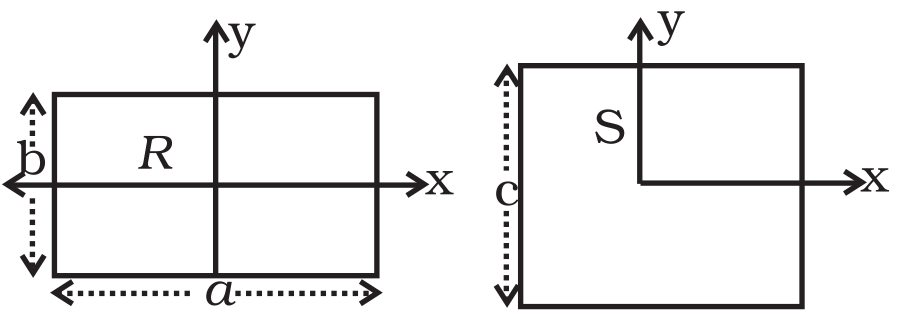
Show that:- $\frac{\text{I}_\text{xR}}{\text{I}_\text{xS}}<1$
- $\frac{\text{I}_\text{ys}}{\text{I}_\text{ys}}>1$
- $\frac{\text{I}_{2\text{R}}}{\text{I}_{2\text{s}}}>1$
- 8A circular hole of radius $1m$ is cut off from a disc of radius $6m$. The centre of the hole is $3m$ from the centre of the disc. Find the centre of mass of the remaining disc.View Solution
- 9A uniform cube of mass m and side a is placed on a frictionless horizontal surface. A vertical force F is applied to the edge as shown in match the following (most appropriate choice):View Solution
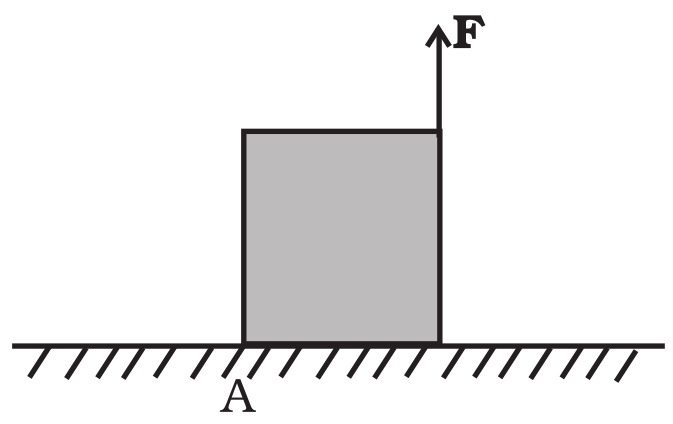
a. $\frac{\text{mg}}{4}<\text{F}<\frac{\text{mg}}{2}$ i. Cube will move up. b. $\text{F}>\frac{\text{mg}}{2}$ ii. Cube will not exhibit motion. c. $\text{F}>\text{mg}$ iii. Cube will begin to rotate and slip at A. d. $\text{F}=\frac{\text{mg}}{4}$ iv. Normal reaction effectively at $\frac{\text{a}}{3}$ - 10View SolutionA ball is whirled in a circle by attaching it to a fixed point with a string. Is there an angular rotation of the ball about its centre? If yes, is this angular velocity equal to the angular velocity of the ball about the fixed point?