Question
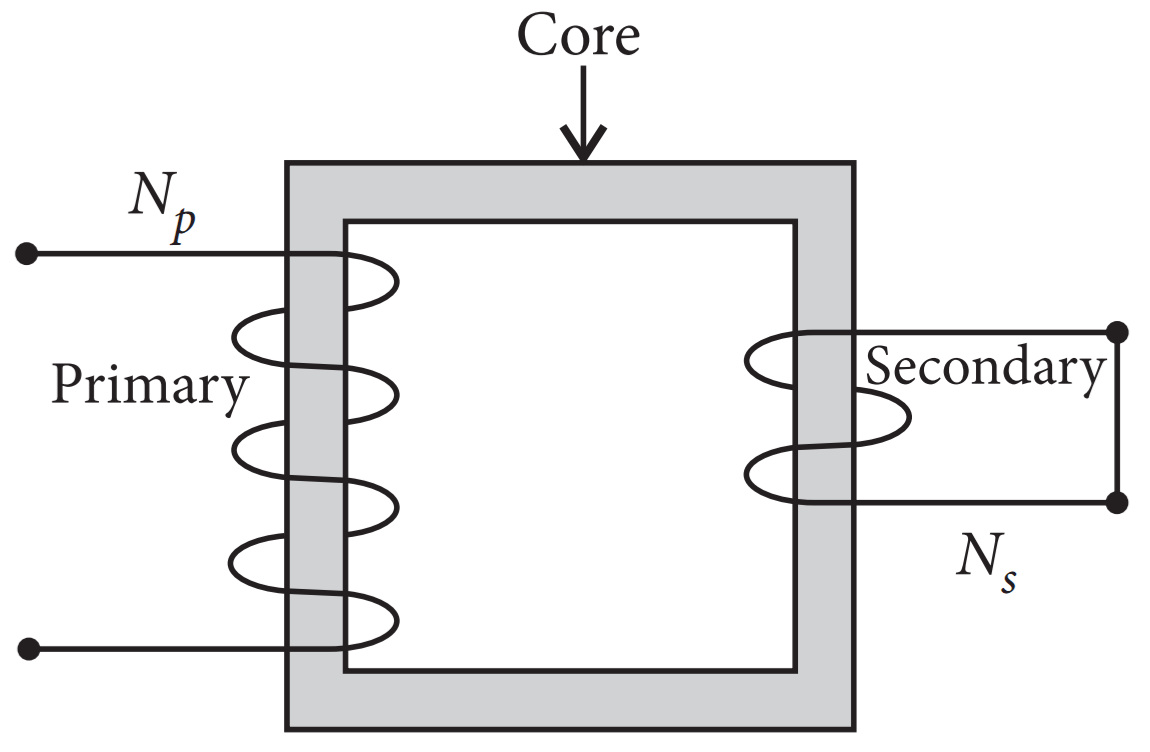
Step-down transformers are used to decrease or step-down voltages. These are used when voltages need to be lowered for use in homes and factories. A small town with a demand of 800kW of electric power at 220V is situated 15km away from an electric plant generating power at 440V. The resistance of the two wire line carrying power is 0.5Q per km. The town gets power from the line through a 4000 - 220V step-down transformer at a sub-station in the town.
  1. The value of total resistance of the wires is:
  1. $25\Omega$
  2. $30\Omega$
  3. $35\Omega$
  4. $15\Omega$
  1. The line power loss in the form of heat is:
  1. 550kW
  2. 650kW
  3. 600kW
  4. 700kW
  1. How much power must the plant supply, assuming there is negligible power loss due to leakage?
  1. 600kW
  2. 1600kW
  3. 500W
  4. 1400kW
  1. The voltage drop in the power line is:
  1. 1700V
  2. 3000V
  3. 2000V
  4. 2800V
  1. The total value of voltage transmitted from the plant is:
  1. 500V
  2. 4000V
  3. 3000V
  4. 7000V

Answer

  1. (d) $15\Omega$
Explanation:
Resistance of the two wire lines carrying power $=0.5\frac{\Omega}{\text{Km}}$
Total resistance $=(15+15)0.5=15\Omega$
  1. (c) 600kW
Explanation:
Line power loss $= I^2R$
RMS current in the coil,
$\text{I}=\frac{\text{P}}{\text{V}_1}=\frac{800\times10^3}{4000}=200\text{A}$
$\therefore$ Power loss $= (200)^2 \times 15 = 600kW$
  1. (d) 1400kW
Explanation:
Assuming that the power loss is negligible due to the leakage of the current.
The total power supplied by the plant,
= 800kW + 600kW = 1400kW
  1. (b) 3000V
Explanation:
Voltage drop in the power line = IR
= 200 × 15 = 3000V
  1. (d) 7000V
Explanation:
Total voltage transmitted from the plant,
= 3000V + 4000V = 7000V

Need a full question paper?

Generate a complete, print-ready paper with questions like this in minutes — across 16+ boards, with answer keys.

Start Generating Free

Similar questions

An elevator is descending with uniform acceleration. To measure the acceleration, a person in the elevator drops a coin at the moment the elevator starts. The coin is 6ft above the floor of the elevator at the time it is dropped. The person observes that the coin strikes the floor in 1 second. Calculate from these data the acceleration of the elevator.
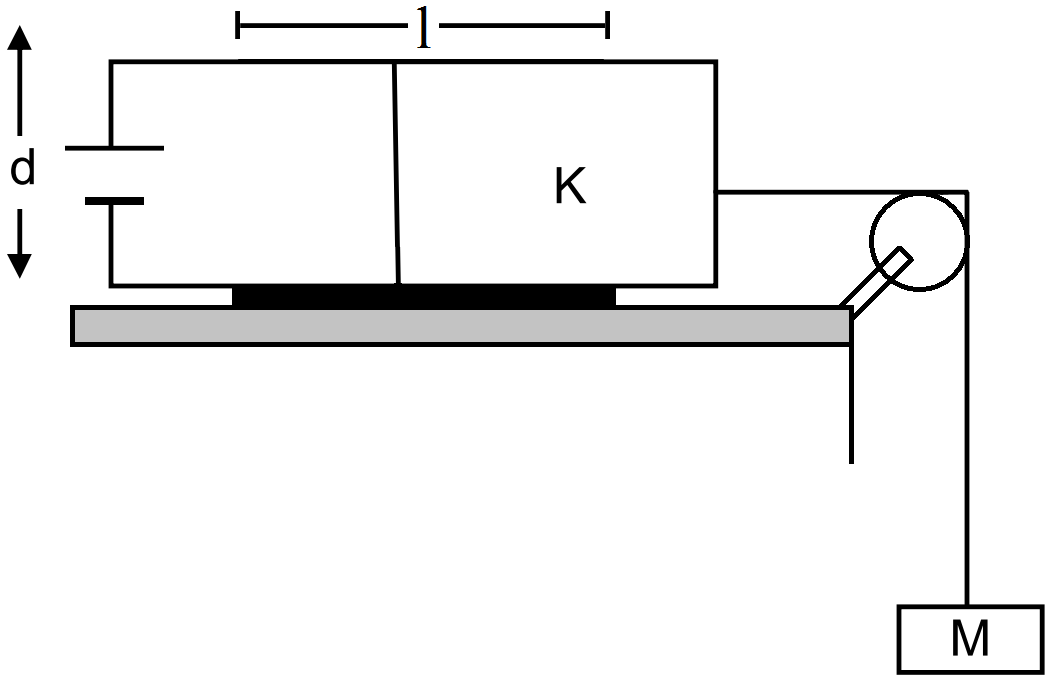
Consider the situation shown in figure. The width of each plate is b. The capacitor plates are rigidly clamped in the laboratory and connected to a battery of emf $\in.$ All surfaces are frictionless. Calculate the value of M for which the dielectric slab will stay in equilibrium.
Draw a graph showing the change in potential corresponding to the change in distance from a point charge. For the charged system shown in the figure, prove that the potential difference between points $A$ and $B$ is
Image
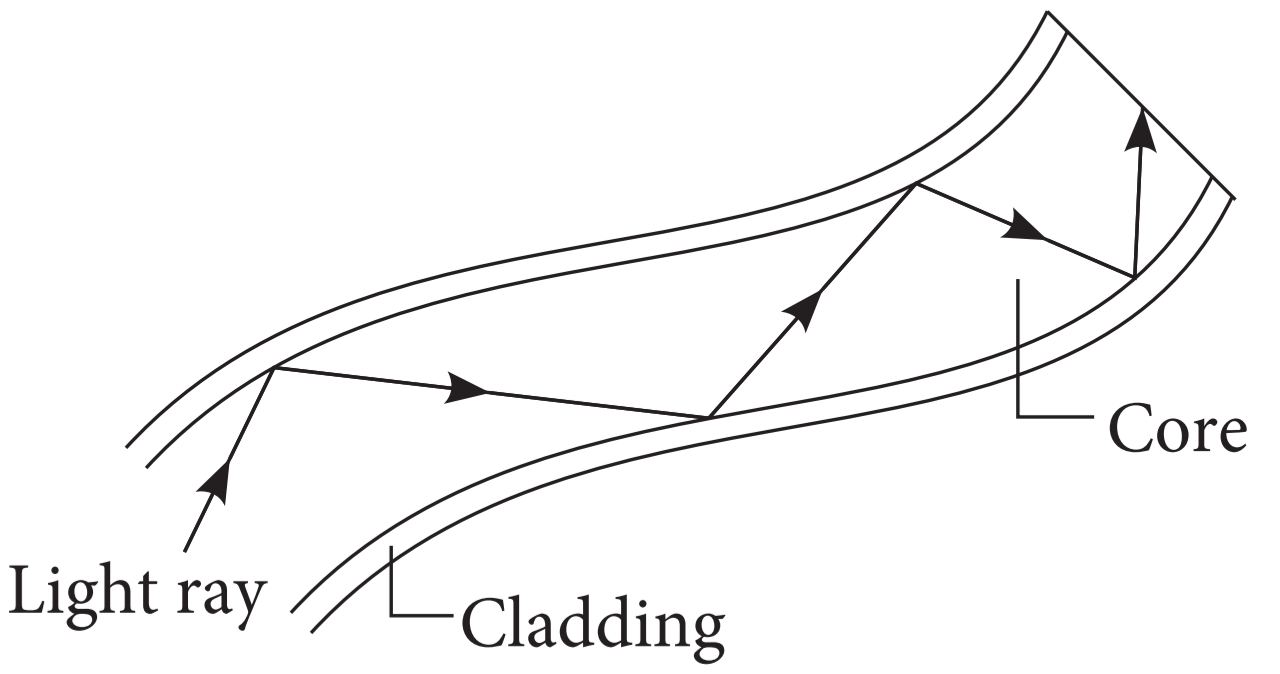
An optical fibre is a thin tube of transparent material that allows light to pass through, without being refracted into the air or another external medium. It make use of total internal reflection. These fibres are fabricated in such a way that light reflected at one side of the inner surface strikes the other at an angle larger than critical angle. Even, if fibre is bent, light can easily travel along the length.
  1. Which of the following is based on the phenomenon of total internal reflection of light?
  1. Sparkling of diamond.
  2. Optical fibre communication.
  3. Instrument used by doctors for endoscopy.
  4. All of these.
  1. A ray of light will undergo total internal reflection inside the optical fibre, if it.
  1. Goes from rarer medium to denser medium.
  2. Is incident at an angle less than the critical angle.
  3. Strikes the interface normally.
  4. Is incident at an angle greater than the critical angle.
  1. If in core, angle of incidence is equal to critical angle, then angle of refraction will be.
  1. $0^\circ$
  2. $45^\circ$
  3. $90^\circ$
  4. $180^\circ$
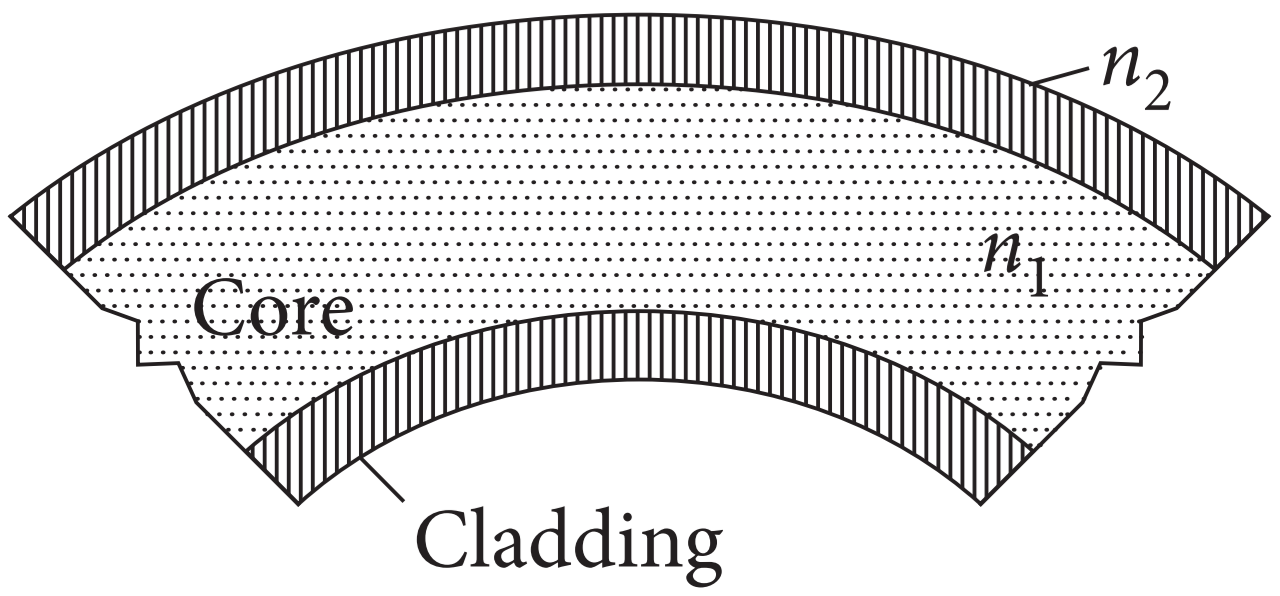
  1. In an optical fibre (shown), correct relation for refractive indices of core and cladding is:
  1. $n_1 = n_2$
  2. $n_1 > n_2$
  3. $n_1 < n_2$
  4. $n_1 + n_2 = 2$
  1. If the value of critical angle is 300 for total internal reflection from given optical fibre, then speed of light in that fibre is:
  1. $3 \times 10^8ms^{-1}$
  2. $1.5 \times 10^8ms^{-1}$
  3. $6 \times 10^8ms^{-1}$
  4. $4.5 \times 10^8ms^{-1}$
A tungsten cathode and a thoriated-tungsten cathode have the same geometric dimensions and are operated at the same temperature. The thoriated-tungsten cathode gives 5000 times more current than the other cathode. Find the operating temperature. Take relevant data from the previous problem.
LASER: Electromagnetic radiation is a natural phenomenon found in almost all areas of daily life, from radio waves to sunlight to x-rays. Laser radiation - like all light - is also a form of electromagnetic radiation. Electromagnetic radiation that has a wavelength between 380 nm and 780 nm is visible to the human eye and is commonly referred to as light. At wavelengths longer than 780 nm, optical radiation is termed infrared (IR) and is invisible to the eye. At wavelengths shorter than 380 nm, optical radiation is termed ultraviolet (UV) and is also invisible to the eye. The term laser light refers to a much broader range of the electromagnetic spectrum that just the visible spectrum, anything between 150 nm up to 11000 nm (i.e., from the UV up to the far IR). The term laser is an acronym which stands for light amplification by stimulated emission of radiation. Einstein explained the stimulated emission. In an atom, electron may move to higher energy level by absorbing a photon. When the electron comes back to the lower energy level it releases the same photon. This is called spontaneous emission. This may also so happen that the excited electron absorbs another photon, releases two photons and returns to the lower energy state. This is known as stimulated emission.
Laser emission is therefore a light emission whose energy is used, in lithotripsy, for targeting and ablating the tone inside human body organ.
Apart from medical usage, laser is used for optical disk drive, printer, barcode reader etc.
(i) What is the full form of LASER?
(a) light amplification by simultaneous emission of radiation
(b) light amplified by synchronous emission of radiation
(c) light amplified by stimulated emission of radiation
(d) light amplification by stimulated emission of radiation

(ii) The stimulated emission is the process of
(a) absorption of two photon when electron moves from lower to higher energy level
(b) release of two photons by absorbing one photon when electron comes back from higher to lower energy level
(c) release of a photon when electron comes back from higher to lower energy level
(d) absorption of a photon when electron moves from lower to higher energy level

(iii) What is the range of amplitude of LASER?
(a) 150 nm - 400 nm
(b) 700 nm - 11000 nm
(c) Both 150 nm - 400 nm and 700 nm 11000 nm
(d) 800 nm - 12000 nm
OR
LASER is used in
(a) Ionization
(b) Transmitting Satellite signal
(c) Optical disk drive
(d) Radio communication

(iv) Lithotripsy is
(a) Laboratory application
(b) An industrial application
(c) A medical application
(d) Process control application 

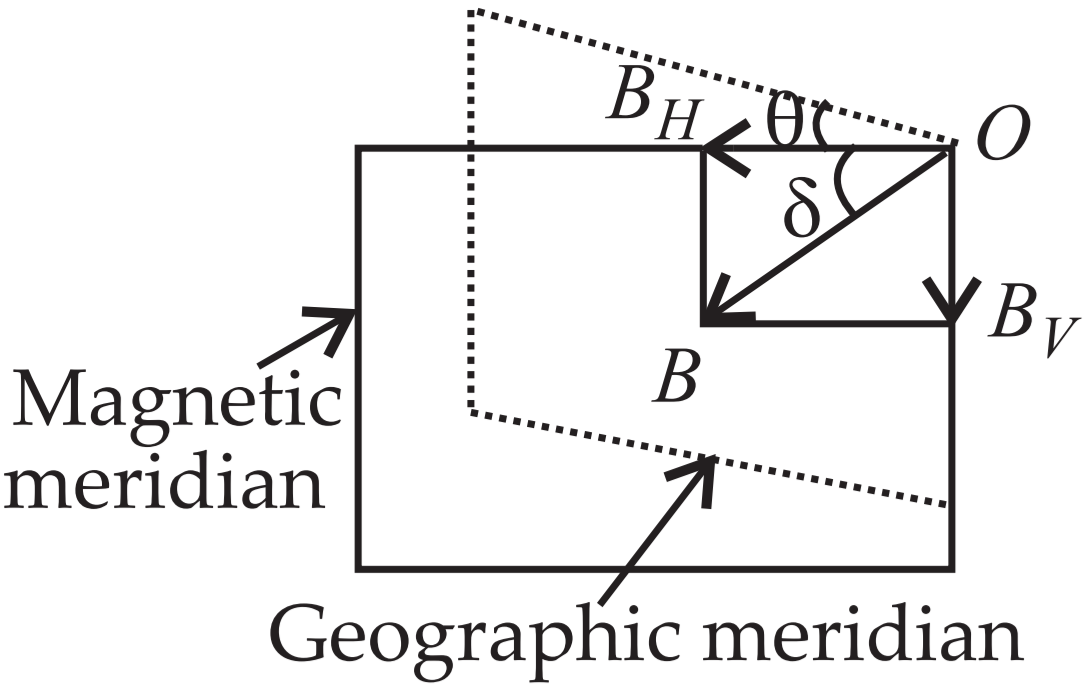
'Tile earth's magnetic field at a point on its surface is usually characterised by three quantities: (a) declination (bl inclination or dip and (cl horizontal component of the field. These are known as the elements of the earth's magnetic field. At a place, angle between geographic meridian and magnetic meridian is defined as magnetic declination, whereas angle made by the earth's magnetic field with the horizontal in magnetic meridian is known as magnetic dip.
  1. In a certain place, the horizontal component of magnetic field is $\frac{1}{\sqrt{3}}$ times the vertical component. 'Tile angle of dip at this place is:
  1. $\text{Zero}$
  2. $\frac{\pi}{3}$
  3. $\frac{\pi}{2}$
  4. $\frac{\pi}{6}$
  1. The angle between the true geographic north and the north shown by a compass needle is called as:
  1. Inclination.
  2. Magnetic declination.
  3. Angle of meridian.
  4. Magnetic pole.
  1. Tile angles of dip at the poles and the equator respectively are
  1. 30º, 30º
  2. 0º, 90º
  3. 45º, 90º
  4. 90º, 0º
  1. A compass needle which is allowed to move in a horizontal plane is taken to a geomagnetic pole. It
  1. Will become rigid showing no movement.
  2. Will stay in any position.
  3. Will stay in north-south direction only.
  4. Will stay in east-west direction only.
  1. Select the correct statement from the following.
  1. The magnetic dip is zero at the centre of the earth.
  2. Magnetic dip decreases as we move away from the equator towards the magnetic pole.
  3. Magnetic dip increases as we move away from the equator towards the magnetic pole.
  4. Magnetic dip does not vary from place to place.
Mention the changes occurring in the geomagnetic components.
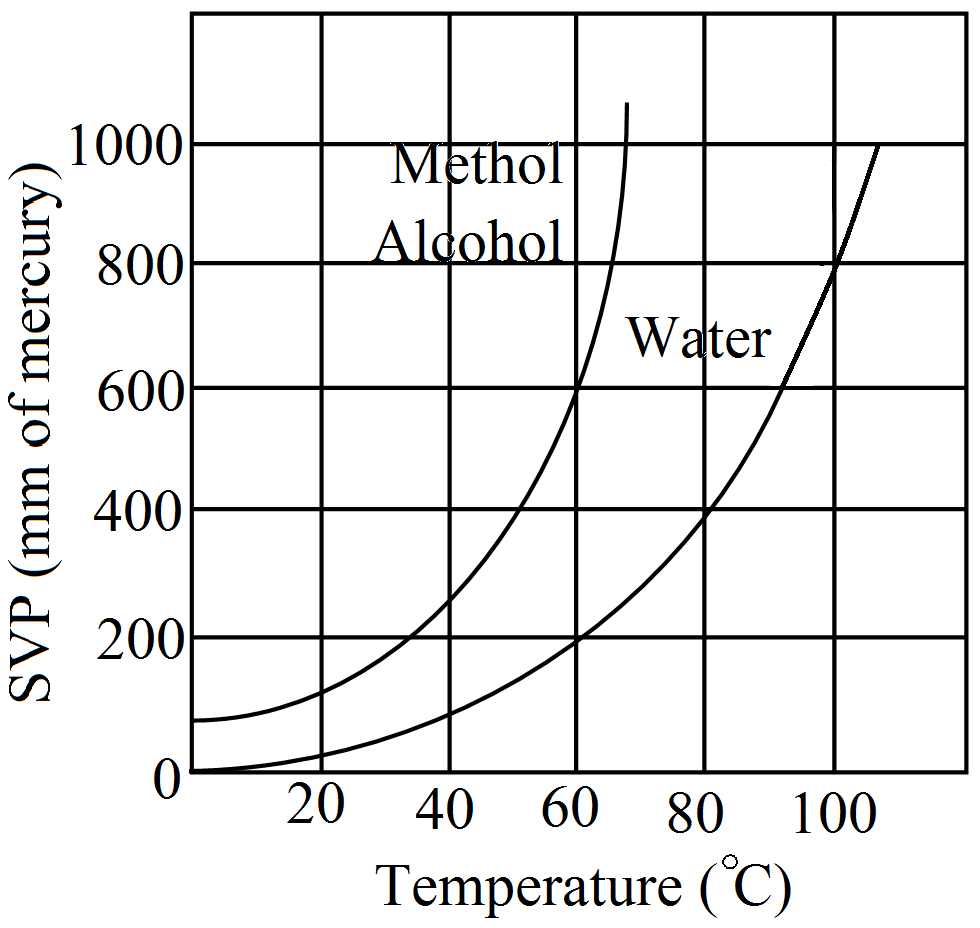
The human body has an average temperature of 98°F. Assume that the vapour pressure of the blood in the veins behaves like that of pure water. Find the minimum atmospheric pressure which is necessary to prevent the blood from boiling. Use figure. of the text for the vapour pressures.
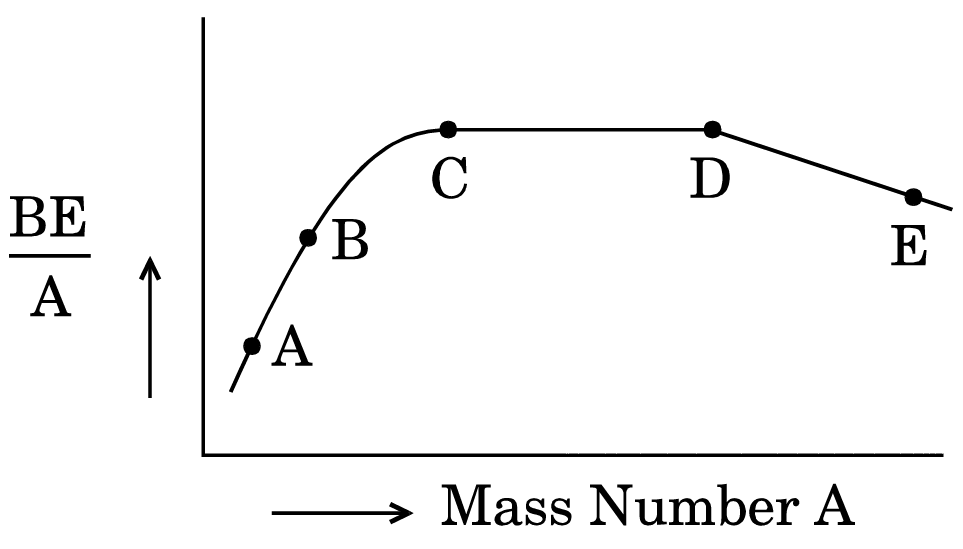
  1. The figure shows the plot of binding energy (BE) per nucleon as a function of mass number A. The letters A, B, C, D and E represent the positions of typical nuclei on the curve. Point out, giving reasons, the two processes (in terms of A, B, C, D and E), one of which can occur due to nuclear fission and the other due to nuclear fusion.
  1. Identify the nature of the radioactive radiations emitted in each step of the decay process given below.
$^{A}_{Z}\text{X}\rightarrow ^{A-4}_{Z-2}\text{Y}\rightarrow ^{A-4}_{Z-1}\text{W}$.