Stress vs strain curve for the elastic tissue of the aorta, the large tube (vessel) carrying blood from the heart, will be : [stress is proportional to square of the strain for the elastic tissue of the aorta]
Medium
Download our app for free and get started
As stress $ \propto $ $strain^2$ hence graph $(a)$ correctly dipicts.

Download our appand get started for free
Experience the future of education. Simply download our apps or reach out to us for more information. Let's shape the future of learning together!No signup needed.*
Similar Questions
- 1If the temperature of a wire of length $2 \,m$ and area of cross-section $1 \,cm ^2$ is increased from $0^{\circ} C$ to $80^{\circ} C$ and is not allowed to increase in length, then force required for it is ............$N$ $\left\{Y=10^{10} \,N / m ^2, \alpha=10^{\left.-6 /{ }^{\circ} C \right\}}\right.$View Solution
- 2A wire can be broken by applying a load of $200\, N$. The force required to break another wire of the same length and same material, but double in diameter, is .......... $N$View Solution
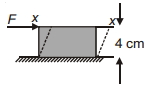
- 3A steel plate of face area $1 \,cm ^2$ and thickness $4 \,cm$ is fixed rigidly at the lower surface. A tangential force $F=10 \,kN$ is applied on the upper surface as shown in the figure. The lateral displacement $x$ of upper surface w.r.t. the lower surface is .............. $m$ (Modulus of rigidity for steel is $8 \times 10^{11} \,N / m ^2$ )View Solution
- 4View SolutionBulk modulus was first defined by
- 5A sphere contracts in volume by $0.01 \%$ when taken to the bottom of sea $1 \,km$ deep. Find Bulk modulus of the material of sphere ........... $N / m ^2$View Solution
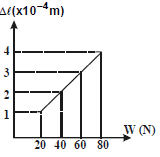
- 6The adjacent graph shows the extension $(\Delta l)$ of a wire of length $1\, m$ suspended from the top of a roof at one end and with a load $W$ connected to the other end. If the cross-sectional area of the wire is $10^{-6}\, m^2$, calculate the Young’s modulus of the material of the wire.View Solution
- 7View SolutionWhen shearing force is applied on a body, then the elastic potential energy is stored in it. On removing the force, this energy
- 8The ratio of two specific heats of gas ${C_p}/{C_v}$ for argon is $1.6$ and for hydrogen is $1.4$. Adiabatic elasticity of argon at pressure $P$ is $E.$ Adiabatic elasticity of hydrogen will also be equal to $E$ at the pressureView Solution
- 9When a load of $10 \,kg$ is suspended on a metallic wire, its length increase by $2 \,mm$. The force constant of the wire is ........ $N / m$View Solution
- 10A steel wire of length ' $L$ ' at $40^{\circ}\,C$ is suspended from the ceiling and then a mass ' $m$ ' is hung from its free end. The wire is cooled down from $40^{\circ}\,C$ to $30^{\circ}\,C$ to regain its original length ' $L$ '. The coefficient of linear thermal expansion of the steel is $10^{-5} { }^{\circ}\,C$, Young's modulus of steel is $10^{11}\, N /$ $m ^2$ and radius of the wire is $1\, mm$. Assume that $L \gg $ diameter of the wire. Then the value of ' $m$ ' in $kg$ is nearlyView Solution