The amplification factor of a triode is $18$ and its plate resistance is $8 \times 10 \Omega$. A load resistance of $10 \Omega$ is connected in the plate circuit. The voltage gain will be
[RPMT 2002]


Download our appand get started for free
Experience the future of education. Simply download our apps or reach out to us for more information. Let's shape the future of learning together!No signup needed.*
Similar Questions
- 1View SolutionAvalanche breakdown is due to
- 2For a transistor, the current amplification factor is $0.8.$ The transistor is connected in common emitter configuration. The change in the collector current when the base current changes by 6 $m A$ isView Solution
- 3The depletion layer in silicon diode is $1 \mu m$ wide and the knee potential is $0.6 V$, then the electric field in the depletion layer will beView Solution
- 4View SolutionWhich of the following does not vary with plate or grid voltages
- 5A hole in a $P$-type semiconductor isView Solution
- 6The $i-V$ characteristic of a $P-N$ junction diode is shown below. The approximate dynamic resistance of the $P-N$ junction when a forward bias of $2$ volt is appliedView Solution
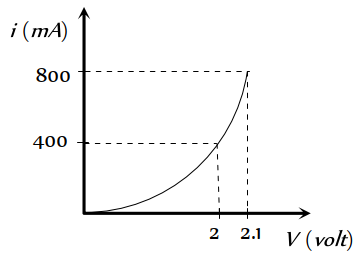
- 7View SolutionWhich of the following statements is true for an N-type semiconductor
- 8View SolutionFor germanium crystal, the forbidden energy gap in joules is
- 9Plate resistance of two triode valves is $2 k \Omega$ and $4 k \Omega$, amplification factor of each of the valves is $40.$ The ratio of voltage amplification, when used with $4 k \Omega$ load resistance, will beView Solution
- 10View SolutionThe charge on a hole is equal to the charge of