The amplitude of a damped oscillator decreases to $0.9\,times$ its original magnitude in $5\,s.$ In another $10\,s$ it will decrease to $\alpha $ times its original magnitude, where $\alpha $ equals
Medium


Download our appand get started for free
Experience the future of education. Simply download our apps or reach out to us for more information. Let's shape the future of learning together!No signup needed.*
Similar Questions
- 1A block of mass $1 \,kg$ attached to a spring is made to oscillate with an initial amplitude of $12\, cm$. After $2\, minutes$ the amplitude decreases to $6\, cm$. Determine the value of the damping constant for this motion. (take In $2=0.693$ )View Solution
- 2A spring having a spring constant $‘K’$ is loaded with a mass $‘m’$. The spring is cut into two equal parts and one of these is loaded again with the same mass. The new spring constant isView Solution
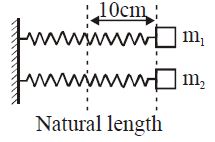
- 3The drawing shows a top view of a frictionless horizontal surface, where there are two indentical springs with particles of mass $m_1$ and $m_2$ attached to them. Each spring has a spring constant of $1200\ N/m.$ The particles are pulled to the right and then released from the positions shown in the drawing. How much time passes before the particles are again side by side for the first time if $m_1 = 3.0\ kg$ and $m_2 = 27 \,kg \,?$View Solution
- 4A particle moves in $xy$ plane according to the law $x = a \sin \omega t$ and $y = a(1-\cos \omega t)$ where $a$ and $\omega$ are constants. The particle tracesView Solution
- 5A particle performs $SHM$ with a period $T$ and amplitude $a.$ The mean velocity of the particle over the time interval during which it travels a distance $a/2$ from the extreme position isView Solution
- 6A particle undergoing simple harmonic motion has time dependent displacement given by $x(t)\, = \,A\,\sin \,\frac{{\pi t}}{{90}}$. The ratio of kinetic to potential energy $o$ the particle at $t=210\,s$ will beView Solution
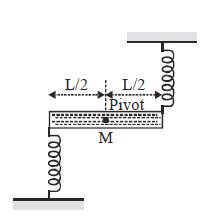
- 7A uniform stick of mass $M$ and length $L$ is pivoted at its centre. Its ends are tied to two springs each of force constant $K$ . In the position shown in figure, the strings are in their natural length. When the stick is displaced through a small angle $\theta $ and released. The stickView Solution
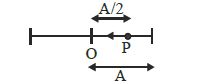
- 8A particle starts from a point $P$ at a distance of $A/2$ from the mean position $O$ and travels towards left as shown in the figure. If the time period of $SHM$ , executed about $O$ is $T$ and amplitude $A$ then the equation of motion of particle isView Solution
- 9Two small bodies of mass of $2\, kg$ each attached to each other using a thread of length $10\, cm$, hang on a spring whose force constant is $200\, N/m$, as shown in the figure. We burn the thread. What is the distance between the two bodies when the top body first arrives at its highest position .... $cm$ ? (Take $\pi^2 = 10$)View Solution
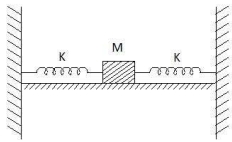
- 10In the figure given below. a block of mass $M =490\,g$ placed on a frictionless table is connected with two springs having same spring constant $\left( K =2 N m ^{-1}\right)$. If the block is horizontally displaced through ' $X$ 'm then the number of complete oscillations it will make in $14 \pi$ seconds will be $.........$View Solution