Assertion : Cyclotron does not accelerate electron.
Reason : Mass of the electrons is very small
AIIMS 2000, Easy


Download our appand get started for free
Experience the future of education. Simply download our apps or reach out to us for more information. Let's shape the future of learning together!No signup needed.*
Similar Questions
- 1A rectangular coil (Dimension $5\,cm\times 2\,cm$ ) with $100\,turns,$ carrying a current of $3\,A$ in the clock-wise direction, is kept centered at the origin and in the $X-Z$ plane. A magnetic field of $1\,T$ is applied along $X-$ axis. If the coil is tilted through $45^o$ about $Z-$ axis, then the torque on the coil is.....$Nm$View Solution
- 2A charged particle of mass $m$ and charge $q$ describes circular motion of radius $r$ in a uniform magnetic field of strength $B$. The frequency of revolution isView Solution
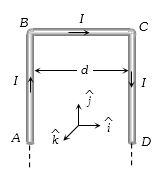
- 3$AB$ and $CD$ are long straight conductor, distance $d$ apart, carrying a current $I$. The magnetic field at the midpoint of $BC$ isView Solution
- 4An electron is moving along the positive $X$-axis. You want to apply a magnetic field for a short time so that the electron may reverse its direction and move parallel to the negative $X$-axis. This can be done by applying the magnetic field alongView Solution
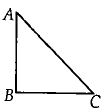
- 5A charged particle moves with velocity $v$ in a uniform magnetic field $\overrightarrow B $. The magnetic force experienced by the particle isView Solution
- 6View SolutionA galvanometer can be used as a voltmeter by connecting a
- 7A semi circular arc of radius $r$ and a straight wire along the diameter, both are carrying same current $i.$ Find out magnetic force per unit length on the small element $P$, which is at the centre of curvature.View Solution

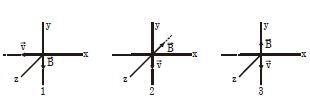
- 8The figure shows three situations when an electron with velocity $\vec v$ travels through a nuniform magnetic field $\vec B$ . In each case, what is the direction of magnetic force on the electron?View Solution
- 9A rectangular region $A B C D$ contains a uniform magnetic field $B_0$ directed perpendicular to the plane of the rectangle. A narrow stream of charged particles moving perpendicularly to the side $AB$ enters this region and is ejected through the adjacent side $B C$ suffering a deflection through $30^{\circ}$. In order to increase this deflection to $60^{\circ}$, the magnetic field has to beView Solution
- 10A current carrying closed loop in the form of a right angle isosceles triangle $ABC$ is placed in a uniform magnetic field acting along $AB.$ If the magnetic force on the arm $BC$ is $\vec F,$ the force on the arm $AC$ isView Solution