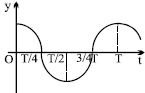
The displacement-time graph of a particle executing $SHM$ is shown. Which of the following statements is/are true ?
Advanced
Download our app for free and get started
$v=0$ at $t=T / 2$
a is maximum at extremes
$F=0$ at $t=\frac{3 T}{4}$
$\mathrm{K.E.}=0$ at $\mathrm{t}=\mathrm{T} / 2$

Download our appand get started for free
Experience the future of education. Simply download our apps or reach out to us for more information. Let's shape the future of learning together!No signup needed.*
Similar Questions
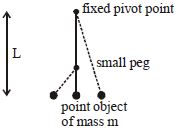
- 1A simple pendulum of length $L$ is constructed from a point object of mass $m$ suspended by a massless string attached to a fixed pivot point. $A$ small peg is placed a distance $2L/3$ directly below the fixed pivot point so that the pendulum would swing as shown in the figure below. The mass is displaced $5$ degrees from the vertical and released. How long does it take to return to its starting position?View Solution
- 2If two similar springs each of spring constant $K _{1}$ are joined in series, the new spring constant and time period would be changed by a factorView Solution
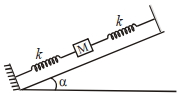
- 3In the given figure, a body of mass $M$ is held between two massless springs, on a smooth inclined plane. The free ends of the springs are attached to firm supports. If each spring has spring constant $k,$ the frequency of oscillation of given body is :View Solution
- 4Two particle executing $S.H.M.$ of same amplitude of $20 \,cm$ with same period along the same line about same equilibrium position. The maximum distance between the two is $20 \,cm$. Their phase difference in radian is equal toView Solution
- 5A rectangular block of mass $5\,kg$ attached to a horizontal spiral spring executes simple harmonic motion of amplitude $1\,m$ and time period $3.14\,s$. The maximum force exerted by spring on block is $.......N$.View Solution
- 6View SolutionThe total energy of a particle, executing simple harmonic motion is
- 7A cylindrical block of wood (density $= 650\, kg\, m^{-3}$), of base area $30\,cm^2$ and height $54\, cm$, floats in a liquid of density $900\, kg\, m^{-3}$ . The block is depressed slightly and then released. The time period of the resulting oscillations of the block would be equal to that of a simple pendulum of length ..... $cm$ (nearly)View Solution
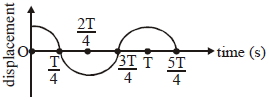
- 8The displacement time graph of a particle executing $S.H.M.$ is given in figure: (sketch is schematic and not to scale) Which of the following statements is are true for this motion?View Solution
$(A)$ The force is zero $t=\frac{3 T}{4}$
$(B)$ The acceleration is maximum at $t=T$
$(C)$ The speed is maximum at $t =\frac{ T }{4}$
$(D)$ The $P.E.$ is equal to $K.E.$ of the oscillation at $t=\frac{T}{2}$
- 9The position co-ordinates of a particle moving in a $3-D$ coordinates system is given by $x = a\,cos\,\omega t$ , $y = a\,sin\,\omega t$ and $z = a\omega t$ The speed of the particle isView Solution
- 10A particle performs $SHM$ with a period $T$ and amplitude $a.$ The mean velocity of the particle over the time interval during which it travels a distance $a/2$ from the extreme position isView Solution