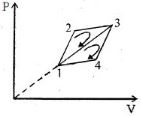
The efficiency of a thermodynamic cycle $1-2-3- 1 ($see picture$)$ is $20\%$ and for another thermodynamic cycle $1 - 3-4 - 1$ efficiency is equal to $10\%$. Determine the efficiency $\eta ($ in $\%)$ of the thermodynamic cycle $1-2-3-4- 1.$The gas is assumed to be ideal
Diffcult
Download our app for free and get started
$\frac{1}{5}=1-\frac{Q_{L}}{Q_{g}}$
$\Rightarrow Q_{L}=\frac{4}{5} Q_{g}$$\frac{1}{10}=1-{Q_{L}^{\prime}}$
${Q_{L}}$
$Q_{L}^{\prime}=\frac{9}{10} Q_{L}=\frac{36}{50} Q_{g}$
$\eta=1-\frac{Q_{L}^{\prime}}{Q_{g}}=1-\frac{36}{50}=\frac{14}{15}$
$\Rightarrow 28 \%$
$\Rightarrow Q_{L}=\frac{4}{5} Q_{g}$$\frac{1}{10}=1-{Q_{L}^{\prime}}$
${Q_{L}}$
$Q_{L}^{\prime}=\frac{9}{10} Q_{L}=\frac{36}{50} Q_{g}$
$\eta=1-\frac{Q_{L}^{\prime}}{Q_{g}}=1-\frac{36}{50}=\frac{14}{15}$
$\Rightarrow 28 \%$

Download our appand get started for free
Experience the future of education. Simply download our apps or reach out to us for more information. Let's shape the future of learning together!No signup needed.*
Similar Questions
- 1The specific heat at constant pressure of a real gas obeying $\mathrm{PV}^2=\mathrm{RT}$ equation is :View Solution
- 2The pressure $P_{1}$ and density $d_{1}$ of diatomic gas $\left(\gamma=\frac{7}{5}\right)$ changes suddenly to $P _{2}\left(> P _{1}\right)$ and $d _{2}$ respectively during an adiabatic process. The temperature of the gas increases and becomes $......$ times of its initial temperature.$\left(\right.$ given $\left.\frac{ d _{2}}{ d _{1}}=32\right)$View Solution
- 3View SolutionIf an ideal gas is compressed isothermally then
- 4If $150 J$ of heat is added to a system and the work done by the system is $110 J$, then change in internal energy will be .......... $J$View Solution
- 5A Carnot freezer takes heat from water at $0\,^oC$ inside it and rejects it to the room at a temperature of $27\,^oC$. The latent heat of ice is $336 \times 10^3\, J\,kg^{-1}$. lf $5\, kg$ of water at $0\,^oC$ is converted into ice at $0\,^oC$ by the freezer, then the energy consumed by the freezer is close toView Solution
- 6Work done by a Carnot engine operating between temperatures $127^{\circ}\,C$ and $27^{\circ}\,C$ is $2\,kJ$. The amount of heat transferred to the engine by the reservoir is $........\,kJ$View Solution
- 7The temperature of sink of Carnot engine is ${27^o}C$. Efficiency of engine is $25\%.$ Then temperature of source is ...... $^oC$View Solution
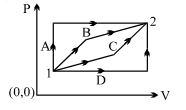
- 8An ideal gas is taken from state $1$ to state $2$ through optional path $A, B, C \& D$ as shown in $P-V$ diagram. Let $Q, W$ and $U$ represent the heat supplied, work done $\&$ internal energy of the gas respectively. ThenView Solution
- 9$100\ g$ of water is heated from $30^o C$ to $50^o C$. Ignoring the slight expansion of the water, the change in its internal energy is .......$kJ$ (specific heat of water is $4184\ J/kg/K$):View Solution
- 10View SolutionWork done per mol in an isothermal change is