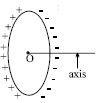
The figure shows a nonconducting ring which has positive and negative charge non uniformly distributed on it such that the total charge is zero. Which of the following statements is true?
Diffcult
Download our app for free and get started
By symmetry potential due to negative part $=$(potential due to particle part). (Also every small charge is equidistant from axis)
$\therefore$ Potential at all potential axis is zero
Direction of field is perpendicular to axis and towards negative side
There will be a torque when placed in uniform field
Download our app
and get started for free
Experience the future of education. Simply download our apps or reach out to us for more information. Let's shape the future of learning together!No signup needed.*
A uniform electric field pointing in positive $x$-direction exists in a region. Let $A$ be the origin, $B$ be the point on the $x$-axis at $x = + 1$ $cm$ and $C$ be the point on the $y$-axis at $y = + 1\,cm$. Then the potentials at the points $A$, $B$ and $C$ satisfy
In the given circuit, a charge of $+80 \ \mu C$ is given to the upper plate of the $4 \ \mu F$ capacitor. Then in the steady state, the charge on the upper plate of the $3 \ \mu F$ capacitor is :
A small sphere of mass $m =\ 0.5\, kg$ carrying a positive charge $q = 110\ \mu C$ is connected with a light, flexible and inextensible string of length $r = 60 \ cm$ and whirled in a vertical circle. If a vertically upwards electric field of strength $E = 10^5 NC^{-1}$ exists in the space, The minimum velocity of sphere required at highest point so that it may just complete the circle........$m/s$ $(g = 10\, ms^{-2})$
Two thin concentric hollow conducting spheres of radii $R_1$ and $R_2$ bear charges $Q_1$ and $Q_2$ respectively. If $R_1 < R_2$, then the potential of a point at a distance $r$ from the centre $(R_1 < r < R_2)$ is
Charges are placed on the vertices of a square as shown. Let $E$ be the electric field and $V$ the potential at the centre. If the charges on $A$ and $B$ are interchanged with those on $D$ and $C$ respectively, then