The speed of sound in any gas depends upon
AIPMT 1988, Easy


Download our appand get started for free
Experience the future of education. Simply download our apps or reach out to us for more information. Let's shape the future of learning together!No signup needed.*
Similar Questions
- 1A pipe $30\, cm$ long, is open at both ends. Which harmonic mode of the pipe resonates a $1.1\, kHz$ source ? (Speed of sound in air $= 330\, ms^{-1}$)View Solution
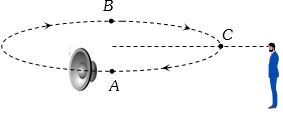
- 2A small source of sound moves on a circle as shown in the figure and an observer is standing on $O$. Let ${n_1},\;{n_2}$ and ${n_3}$be the frequencies heard when the source is at $A,\,B$ and $C$ respectively. ThenView Solution
- 3Two closed organ pipes of length $100\,cm$ and $101\,cm$ long give $16$ beats in $20\,sec$ when each pipe is sounded in fundamental mode. Calculate velocity of sound .... $ms^{-1}$View Solution
- 4A bat moving at $10\,ms^{-1}$ towards a wall sends a sound signal of $8000\,Hz$ towards it. On reflection it hears a sound of frequency $f$. The value of $f$ in $Hz$ is close to (speed of sound $= 320\,ms^{-1}$ )View Solution
- 5A wire of density $8 \times 10^3\,kg / m ^3$ is stretched between two clamps $0.5\,m$ apart. The extension developed in the wire is $3.2 \times 10^{-4}\,m$. If $Y =8 \times 10^{10}\,N / m ^2$, the fundamental frequency of vibration in the wire will be $......\,Hz$.View Solution
- 6View SolutionA pulse or a wave train travels along a stretched string and reaches the fixed end of the string. It will be reflected back with
- 7${v_1}$ and ${v_2}$ are the velocities of sound at the same temperature in two monoatomic gases of densities ${\rho _1}$ and ${\rho _2}$ respectively. If $\frac{\rho _1}{\rho _2} = \frac{1}{4}$ then the ratio of velocities ${v_1}$ and ${v_2}$ will beView Solution
- 8An ideal gas is in thermodynamic equilibrium. The number of degrees of freedom of a molecule of the gas in $n$. The internal energy of one mole of the gas is $U_n$ and the speed of sound in the gas is $v_n$. At a fixed temperature and pressure, which of the following is the correct option?View Solution
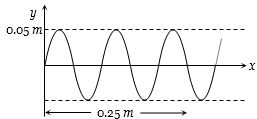
- 9If the speed of the wave shown in the figure is $330m/s$ in the given medium, then the equation of the wave propagating in the positive $x-$direction will be (all quantities are in $M.K.S.$ units)View Solution
- 10A man is standing on a railway platform listening to the whistle of an engine that passes the man at constant speed without stopping. If the engine passes the man at time ${t_0}$. How does the frequency $f$ of the whistle as heard by the man changes with timeView Solution