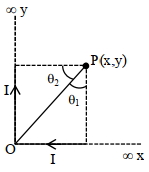
There are two infinitely long straight current carrying conductors and they are held at right angles to each other so that their common ends meet at the origin as shown in the figure given below. The ratio of current in both conductor is $1: 1$. The magnetic field at point $P$ is ...... .
JEE MAIN 2021, Diffcult
Download our app for free and get started
${B}_{\text {due to wire }(1)}=\frac{\mu_{{o}} {I}}{4 \pi {y}}\left[\sin 90+\sin \theta_{1}\right]$
$=\frac{\mu_{0}}{4 \pi} \frac{{I}}{{y}}\left(1+\frac{{x}}{\sqrt{{x}^{2}+{y}^{2}}}\right) \ldots \ldots(1)$
${B}_{\text {due to wire }(2)}=\frac{\mu_{0}}{4 \pi} \frac{{I}}{{x}}\left(\sin 90^{\circ}+\sin \theta_{2}\right)$
$=\frac{\mu_{0}}{4 \pi} \frac{{I}}{{x}}\left(1+\frac{{y}}{\sqrt{{x}^{2}+{y}^{2}}}\right) \ldots \ldots(2)$
Total magnetic field
${B}={B}_{1}+{B}_{2}$
${B}=\frac{\mu_{0} {I}}{4 \pi}\left[\frac{1}{{y}}+\frac{{x}}{{y} \sqrt{{x}^{2}+{y}^{2}}}+\frac{1}{{x}}+\frac{{y}}{{x} \sqrt{{x}^{2}+{y}^{2}}}\right]$
${B}=\frac{\mu_{0} {I}}{4 \pi}\left[\frac{{x}+{y}}{{xy}}+\frac{{x}^{2}+{y}^{2}}{{xy} \sqrt{{x}^{2}+{y}^{2}}}\right]$
${B}=\frac{\mu_{0} {I}}{4 \pi}\left[\frac{{x}+{y}}{{xy}}+\frac{\sqrt{{x}^{2}+{y}^{2}}}{{xy}}\right]$
${B}=\frac{\mu_{0} {I}}{4 \pi {xy}}\left[\sqrt{{x}^{2}+{y}^{2}}+({x}+{y})\right]$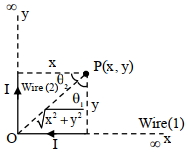

Download our appand get started for free
Experience the future of education. Simply download our apps or reach out to us for more information. Let's shape the future of learning together!No signup needed.*
Similar Questions
- 1A magnetic needle suspended parallel to a magnetic field requires $\sqrt 3\,J $ of work to turn it through $60^o$. The torque needed to maintain the needle in this position will beView Solution
- 2Two identical moving coil galvanometer have $10 \Omega$ resistance and full scale deflection at $2 \mu A$ current. One of them is converted into a voltmeter of $100 mV$ full scale reading and the other into an Ammeter of $1 mA$ full scale current using appropriate resistors. These are then used to measure the voltage and current in the Ohm's law experiment with $R =1000 \Omega$ resistor by using an ideal cell. Which of the following statement( $s$ ) is/are correct?View Solution
$(1)$ The measured value of $R$ will be $978 \Omega$
$(2)$ The resistance of the Voltmeter will be $100 k \Omega$.
$(3)$ The resistance of the Ammeter will be $0.02 \Omega$ (round off to $2^{\text {nd }}$ decimal place)
$(4)$ If the ideal cell is replaced by a cell having internal resistance of $5 \Omega$ then the measured value of $R$ will be more than $1000 \Omega$.
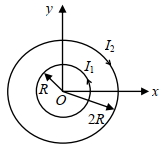
- 3Two concentric circular loops, one of radius $R$ and the other of radius $2 R$, lie in the $x y$-plane with the origin as their common center, as shown in the figure. The smaller loop carries current $I_1$ in the anti-clockwise direction and the larger loop carries current $I_2$ in the clockwise direction, with $I_2>2 I_1 . \vec{B}(x, y)$ denotes the magnetic field at a point $(x, y)$ in the $x y$-plane. Which of the following statement($s$) is(are) current?View Solution
$(A)$ $\vec{B}(x, y)$ is perpendicular to the $x y$-plane at any point in the plane
$(B)$ $|\vec{B}(x, y)|$ depends on $x$ and $y$ only through the radial distance $r=\sqrt{x^2+y^2}$
$(C)$ $|\vec{B}(x, y)|$ is non-zero at all points for $r$
$(D)$ $\vec{B}(x, y)$ points normally outward from the $x y$-plane for all the points between the two loops
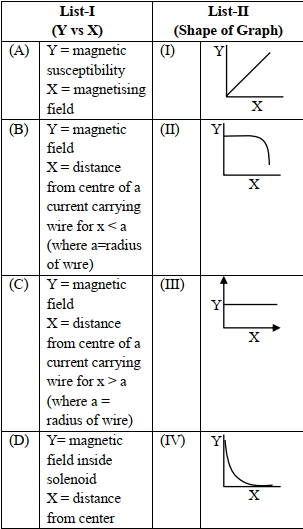
- 4Match List-$I$ with List-$II$View Solution
Choose the correct answer from the options given below :
- 5In a hydrogen atom, an electron of mass $m$ and charge $e$ revolves in an orbit of radius $r$ making $n$ revolutions per second. If the mass of hydrogen nucleus is $M$, the magnetic moment associated with the orbital motion of electron isView Solution
- 6The resistance of a galvanometer is $90\, ohms$. If only $10$ percent of the main current may flow through the galvanometer, in which way and of what value, a resistor is to be usedView Solution
- 7View SolutionA strong magnetic field is applied on a stationary electron, then
- 8A thin circular frame of radius $'a'$ is made of insulating material. A square loop is constructed with in it. If loop carrying current $I$ , then magnetic induction at geometrical centre $'O'$ will beView Solution

- 9View SolutionA charged particle is released from rest in a region of steady uniform electric and magnetic fields which are parallel to each other the particle will move in a
- 10In following diagram there is a straight wire carrying a current $I.$ Consider a circular path with radius $(R)$ near it. It $\vec B_T$ is the tangential component of magnetic field then find the value of integral $\int {{{\vec B}_T}.\overrightarrow {dl} } $View Solution