Three immiscible liquids of densities $d_1 > d_2 > d_3$ and refractive indices $\mu _1 > \mu _2 > \mu _3$ are put in a beaker. The height of each liquid column is $\frac{\text{h}}{3}$. A dot is made at the bottom of the beaker. For near normal vision, find the apparent depth of the dot.
Download our app for free and get started
Key concept: Coordinate convention: At the first surfece (+upward and -ve downward) $\frac{\mu_2}{\text{h}'}-\frac{\mu_1}{(-\text{h})}=\frac{\mu_2-\mu_1}{\infty}$ (infinity because the surface is plane), or $\text{h}'=-\frac{\mu_2}{\mu_1}\text{h}$. The negative sign shown that it is on the side of the object h' is the apparent depth of O after refraction from interface. 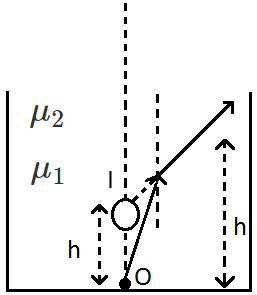 The position of image if O after refraction from surface-1. If seen from $\mu_2$ the apparent depth is $ h_1. \text{h}_1=-\frac{\mu_2}{\mu_1}\frac{\text{h}}{3}$ The nagative sign shows that it is on the side of the object.
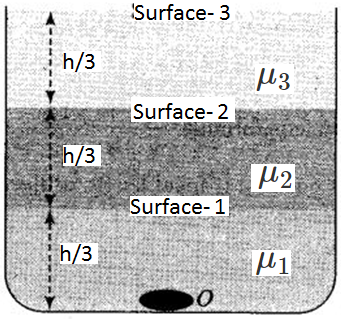
Since, the image formed by surface-1 will act as an object for surface-2. IF seen form $\mu_3$, the apparent depth is $h_2$. Similarly, the image formed by Medium 2, $O_2$ acts as an object for Medium 3. $\text{h}_2=-\frac{\mu_3}{\mu_2}\Big(\frac{\mu_2}{\mu_1}\frac{\text{h}}{3}+\frac{\text{h}}{3}\Big)=-\frac{\text{h}}{3}\Big(\frac{\mu_3}{\mu_1}+\frac{\mu_2}{\mu_1}\Big)$ Finally the oimage formed by surface-2 will act as an object for surface-2. If seen from outside, the apparent depth is $h_3. \text{h}_3=-\frac{1}{\mu_3}\bigg[\frac{\text{h}}{3}+\frac{\text{h}}{3}\Big(\frac{\mu_3}{\mu_2}+\frac{\mu_3}{\mu_1}\Big)\bigg]=-\frac{\text{h}}{3}\Big(\frac{1}{\mu_1}+\frac{1}{\mu_2}+\frac{1}{\mu_3}\Big)$ Hence apparent depth of dot is $\frac{\text{h}}{3}\Big(\frac{1}{\mu_1}+\frac{1}{\mu_2}+\frac{1}{\mu_3}\Big)$.Important point:
Apparent depth (distance of final image from final surface) $=\frac{\text{t}_1}{\text{n}_{1\text{real}}}+\frac{\text{t}_2}{\text{n}_{2\text{real}}}+\frac{\text{t}_3}{\text{n}_{3\text{real}}}+\ .....\ +\frac{\text{t}_\text{n}}{\text{n}_\text{nreal}}$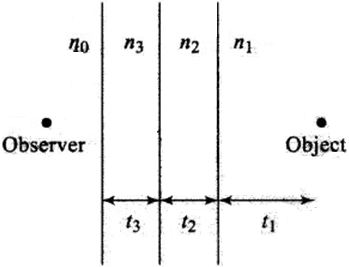
The position of image if O after refraction from surface-1. If seen from $\mu_2$ the apparent depth is $ h_1. \text{h}_1=-\frac{\mu_2}{\mu_1}\frac{\text{h}}{3}$ The nagative sign shows that it is on the side of the object.Since, the image formed by surface-1 will act as an object for surface-2. IF seen form $\mu_3$, the apparent depth is $h_2$. Similarly, the image formed by Medium 2, $O_2$ acts as an object for Medium 3. $\text{h}_2=-\frac{\mu_3}{\mu_2}\Big(\frac{\mu_2}{\mu_1}\frac{\text{h}}{3}+\frac{\text{h}}{3}\Big)=-\frac{\text{h}}{3}\Big(\frac{\mu_3}{\mu_1}+\frac{\mu_2}{\mu_1}\Big)$ Finally the oimage formed by surface-2 will act as an object for surface-2. If seen from outside, the apparent depth is $h_3. \text{h}_3=-\frac{1}{\mu_3}\bigg[\frac{\text{h}}{3}+\frac{\text{h}}{3}\Big(\frac{\mu_3}{\mu_2}+\frac{\mu_3}{\mu_1}\Big)\bigg]=-\frac{\text{h}}{3}\Big(\frac{1}{\mu_1}+\frac{1}{\mu_2}+\frac{1}{\mu_3}\Big)$ Hence apparent depth of dot is $\frac{\text{h}}{3}\Big(\frac{1}{\mu_1}+\frac{1}{\mu_2}+\frac{1}{\mu_3}\Big)$.Important point:
Apparent depth (distance of final image from final surface) $=\frac{\text{t}_1}{\text{n}_{1\text{real}}}+\frac{\text{t}_2}{\text{n}_{2\text{real}}}+\frac{\text{t}_3}{\text{n}_{3\text{real}}}+\ .....\ +\frac{\text{t}_\text{n}}{\text{n}_\text{nreal}}$

Download our appand get started for free
Experience the future of education. Simply download our apps or reach out to us for more information. Let's shape the future of learning together!No signup needed.*
Similar Questions
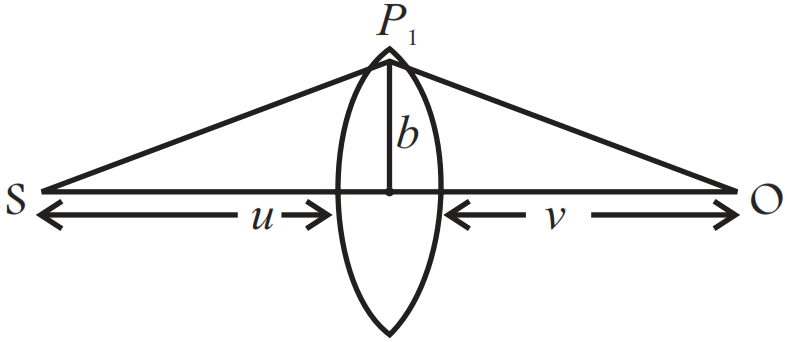
- 1Consider a thin lens placed between a source (S) and an observer (O) (Fig). Let the thickness of the lens vary as $\text{w}\text{(b)}=\text{w}_0-\frac{\text{b}^2}{\alpha}$, where b is the verticle distance from the pole. $w_0$ is a constant. Using Fermat’s principle i.e. the time of transit for a ray between the source and observer is an extremum, find the condition that all paraxial rays starting from the source will converge at a point O on the axis. Find the focal length.View Solution
- 2View SolutionA myopic adult has a far point at 0.1m. His power of accomodation is 4 diopters.
- What power lenses are required to see distant objects?
- What is his near point without glasses?
- What is his near point with glasses? (Take the image distance from the lens of the eye to the retina to be 2cm.)
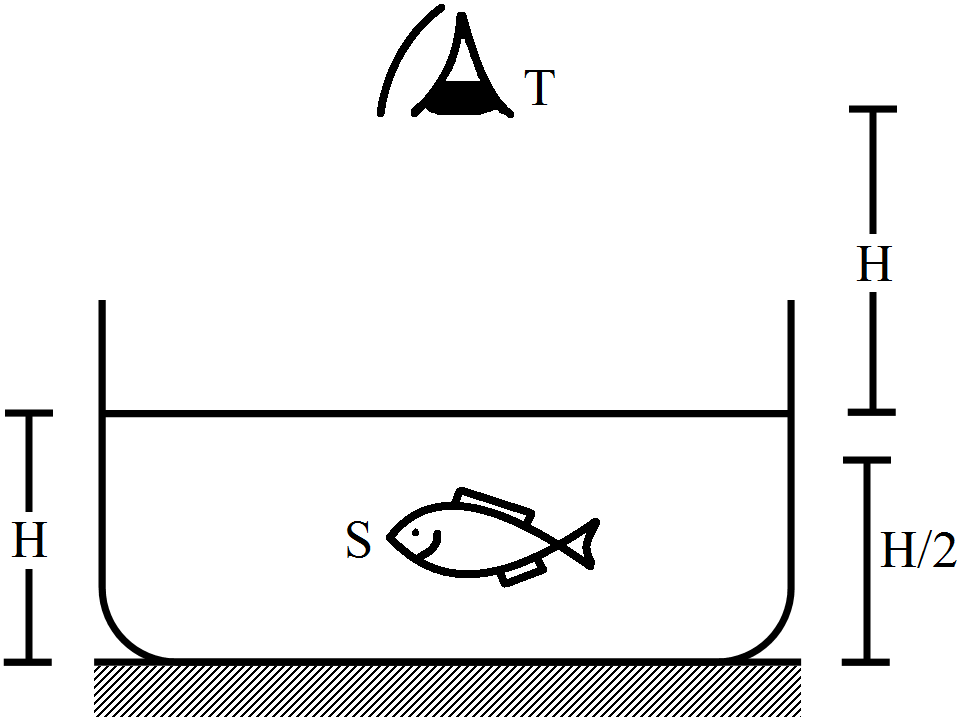
- 3View SolutionConsider the situation in figure. The bottom of the pot is a reflecting plane mirror, S is a small fish and T is a human eye. Refractive index of water is.
- At what distance(s) from itself will the fish see the image(s) of the eye?
- At what distance(s) from itself will the eye see the image(s) of the fish.
- 4View SolutionAn object 1.5 cm in size is placed on the side of the convex lens in the arrangement (a) above. The distance between the object and the convex lens is 40 cm. Determine the magnification produced by the two-lens system, and the size of the image.
- 5View SolutionThe separation between the objective and the eyepiece of a compound microscope can be adjusted between 9.8cm to 11.8cm. If the focal lengths of the objective and the eyepiece are 1.0cm and 6cm respectively, find the range of the magnifying power if the image is always needed at 24cm from the eye.
- 6View SolutionThe mixture a pure liquid and a solution in a long vertical column (i.e, horizontal dimensions < < vertical dimensions) produces diffusion of solute particles and hence a refractive index gradient along the vertical dimension. A ray of light entering the column at right angles to the vertical is deviated from its original path. Find the deviation in travelling a horizontal distance d < < h, the height of the column.
- 7View SolutionA Cassegrain telescope uses two mirrors. Such a telescope is built with the mirrors 20 mm apart. If the radius of curvature of the large mirror is 220 mm and the small mirror is 140 mm, where will the final image of an object at infinity be?
- 8k transparent slabs are arranged one over another. The refractive indices of the slabs are $\mu_1,\mu_2,\mu_3, \ ...\mu_{\text{k}}$ and the thicknesses are $t_1, t_2, t_3, ... t_k$ . An object is seen through this combination with nearly perpendicular light. Find the equivalent refractive index of the system which will allow the image to be formed at the same place.View Solution
- 9View Solution
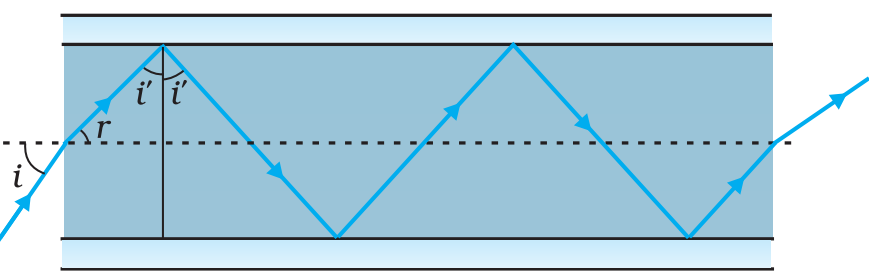
- a cross - section of a ‘light pipe’ made of a glass fibre of refractive. The outer covering of the pipe is made of a material of refractive. What is the range of the angles of the incident rays with the axis of the pipe for which total reflections inside the pipe take place, as shown in the figure.
- What is the answer if there is no outer covering of the pipe?
- 10View SolutionA man with normal near point (25 cm) reads a book with small print using a magnifying glass: a thin convex lens of focal length 5 cm.
- What is the closest and the farthest distance at which he should keep the lens from the page so that he can read the book when viewing through the magnifying glass?
- What is the maximum and the minimum angular magnification (magnifying power) possible using the above simple microscope?