An object 1.5 cm in size is placed on the side of the convex lens in the arrangement (a) above. The distance between the object and the convex lens is 40 cm. Determine the magnification produced by the two-lens system, and the size of the image.
Exercise
Download our app for free and get started
For convex lens, Object distance from the lens, u = -40cm Focal length, f = 30 cm Object size, 0 = 1.5 cm Using lens formula $\frac{1}{\text{v}}-\frac{1}{\text{u}}=\frac{1}{\text{f}}$ We get, $\frac{1}{\text{v}}-\frac{1}{-40}=\frac{1}{30}$ $\frac{1}{\text{v}}=\frac{1}{30}-\frac{1}{40}=\frac{1}{120}$i.e., v= 120 cm (for real object)
From relation, Magnification, $\text{m}=-\frac{\text{v}}{\text{u}}$, we get $\text{m}=-\frac{120}{-40}=+3$ The image formed by the convex lens becomes object for concave lens at a distance of (120 - 8) = 112 cm on the other side. For concave lens, Focal length, f = - 20 cm Object distance, u = +112 cm (on the other side) Image distance, v = ? Using lens formula, we get $\frac{1}{\text{v}}-\frac{1}{\text{u}}=\frac{1}{\text{f}}$ Now, $\frac{1}{\text{v}}-\frac{1}{112}=\frac{1}{-20}$ $\Rightarrow \ \frac{1}{\text{v}}=-\frac{1}{20}+\frac{1}{112}$ $=-\frac{23}{560}$ $\text{v}=-\frac{560}{23} \ \text{cm}$ (for virtual object) Using the formula of magnification m = $\frac{\text{v}}{\text{u}}$, we get $\text{m}=-\frac{\frac{560}{23}}{-112}$ $=-\frac{560}{23}\times\frac{1}{-112}$ $=-\frac{5}{23}$ Net magnification, $\text{m}=3\times\Big(\frac{-5}{23}\Big)$ $=-\frac{15}{23}$ = 0. 652 ( negative due to virtual image) and as, $\text{m}=\frac{\text{I}}{0}$ I = m × 0 = 0.652 × 1.5 = 0.98 cm (size of final image).
From relation, Magnification, $\text{m}=-\frac{\text{v}}{\text{u}}$, we get $\text{m}=-\frac{120}{-40}=+3$ The image formed by the convex lens becomes object for concave lens at a distance of (120 - 8) = 112 cm on the other side. For concave lens, Focal length, f = - 20 cm Object distance, u = +112 cm (on the other side) Image distance, v = ? Using lens formula, we get $\frac{1}{\text{v}}-\frac{1}{\text{u}}=\frac{1}{\text{f}}$ Now, $\frac{1}{\text{v}}-\frac{1}{112}=\frac{1}{-20}$ $\Rightarrow \ \frac{1}{\text{v}}=-\frac{1}{20}+\frac{1}{112}$ $=-\frac{23}{560}$ $\text{v}=-\frac{560}{23} \ \text{cm}$ (for virtual object) Using the formula of magnification m = $\frac{\text{v}}{\text{u}}$, we get $\text{m}=-\frac{\frac{560}{23}}{-112}$ $=-\frac{560}{23}\times\frac{1}{-112}$ $=-\frac{5}{23}$ Net magnification, $\text{m}=3\times\Big(\frac{-5}{23}\Big)$ $=-\frac{15}{23}$ = 0. 652 ( negative due to virtual image) and as, $\text{m}=\frac{\text{I}}{0}$ I = m × 0 = 0.652 × 1.5 = 0.98 cm (size of final image).

Download our appand get started for free
Experience the future of education. Simply download our apps or reach out to us for more information. Let's shape the future of learning together!No signup needed.*
Similar Questions
- 1A ball is kept at a height h above the surface of a heavy transparent sphere made of a material of refractive index $\mu.$ The radius of the sphere is R. At t = 0, the ball is dropped to fall normally on the sphere. Find the speed of the image formed as a function of time for $\text{t}<\sqrt{\frac{2\text{h}}{\text{g}}}.$ Consider only the image by a single refraction.View Solution
- 2View SolutionA particle is moving at a constant speed V from a large distance towards a concave mirror of radius R along its principal axis. Find the speed of the image formed by the mirror as a function of the distance x of the particle from the mirror.
- 3View SolutionA 4.5 cm needle is placed 12 cm away from a convex mirror of focal length 15 cm. Give the location of the image and the magnification. Describe what happens as the needle is moved farther from the mirror.
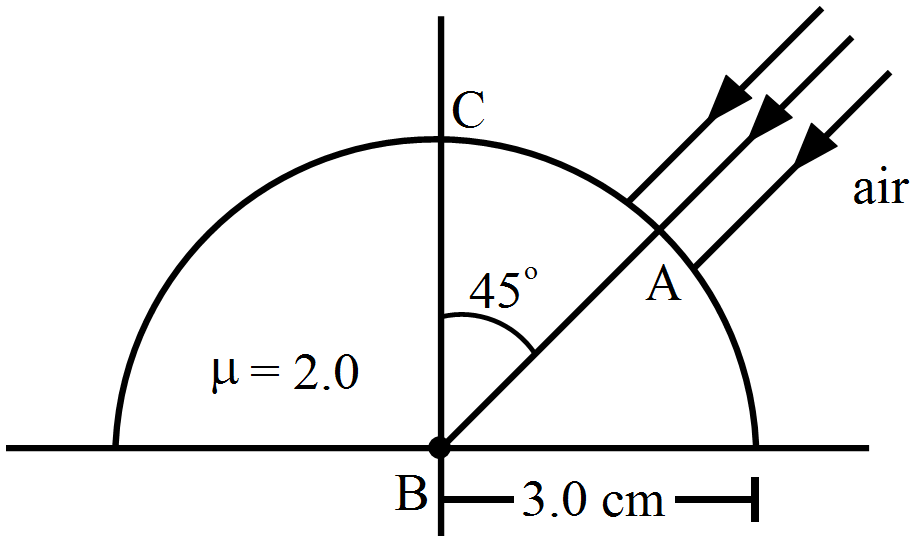
- 4View SolutionFigure shows a transparent hemisphere of radius 3.0cm made of a material of refractive index 2.0.
- A narrow beam of parallel rays is incident on the hemisphere as shown in the figure. Are the rays totally reflected at the plane surface?
- Find the image formed by the refraction at the first surface.
- Find the image formed by the reflection or by the refraction at the plane surface.
- Trace qualitatively the final rays as they come out of the hemisphere.
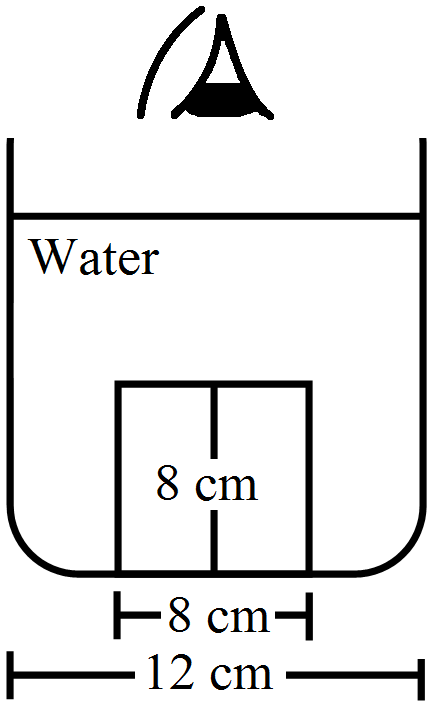
- 5A cylindrical vessel of diameter 12cm contains $800\pi\text{cm}^3$ of water. A cylindrical glass piece of diameter 8.0 cm and height 8.0cm is placed in the vessel. If the bottom of the vessel under the glass piece is seen by the paraxial rays, locate its image. The index of refraction of glass is 1.50 and that of water is 1.33.View Solution
- 6View SolutionThe separation between the objective and the eyepiece of a compound microscope can be adjusted between 9.8cm to 11.8cm. If the focal lengths of the objective and the eyepiece are 1.0cm and 6cm respectively, find the range of the magnifying power if the image is always needed at 24cm from the eye.
- 7View Solution
- State Huygen’s principle. Using this principle draw a diagram to show how a plane wave front incident at the interface of the two media gets refracted when it propagates from a rarer to a denser medium. Hence verifiy Snell’s law of refraction.
- When monochromatic light travels from a rarer to a denser medium, explain the following, giving reasons:
- Is the frequency of reflected and refracted light same as the frequency of incident light?
- Does the decrease in speed imply a reduction in the energy carried by light wave?
- 8View SolutionA concave mirror forms an image of 20cm high object on a screen placed 5.0m away from the mirror. The height of the image is 50cm. Find the focal length of the mirror and the distance between the mirror and the object.
- 9View Solution
- For a ray of light travelling from a denser medium of refractive index $n_1$ to a rarer medium of refractive index $n_2$ prove that $\frac{\text{n}_{2}}{\text{n}_{1}} = \sin \text{i}_{c} ,$ where $i_c$ is the critical angle of incidence for the media.
- Explain with the help of a diagram, how the above principle is used for transmission of video signals using optical fibres.
- 10View Solution
- Draw a ray diagram to show refraction of a ray of monochromatic light passing through a glass prism.
- Explain briefly how the phenomenon of total internal reflection is used in fibre optics.