k transparent slabs are arranged one over another. The refractive indices of the slabs are $\mu_1,\mu_2,\mu_3, \ ...\mu_{\text{k}}$ and the thicknesses are $t_1, t_2, t_3, ... t_k$ . An object is seen through this combination with nearly perpendicular light. Find the equivalent refractive index of the system which will allow the image to be formed at the same place.
Download our app for free and get started
Total no. of slabs = k, thickness $= t_1, t_2, t_3, ... t_k$ Refractive index $=\mu_1,\mu_2,\mu_3, \ ...\mu_{\text{k}}$
$\therefore$ The shift $\Delta\text{t}=\Big(1-\frac{1}{\mu_1}\Big)\text{t}_1+\Big(1-\frac{1}{\mu_2}\Big)\text{t}_2+ \ ... \ \Big(1-\frac{1}{\mu_{\text{k }}}\Big)\text{t}_{\text{k}} \ ...(1)$
If, $\mu\rightarrow$ refractive index of combination of slabs and image is formed at same place,
$\Delta\text{t}=\Big(1-\frac{1}{\mu}\Big)(\text{t}_1+\text{t}_2+...+\text{t}_{\text{k}}) \ ...(2)$
Equation (1) and (2), we get,
$\Big(1-\frac{1}{\mu}\Big)(\text{t}_1+\text{t}_2+...+\text{t}_{\text{k}})$
$=\Big(1-\frac{1}{\mu_1}\Big)\text{t}_1+\Big(1-\frac{1}{\mu_2}\Big)\text{t}_2+ ...+\Big(1-\frac{1}{\mu_{\text{k}}}\Big)\text{t}_{\text{k}}$
$=(\text{t}_1+\text{t}_2+...+\text{t}_{\text{k}})-\Big(\frac{\text{t}_1}{\mu_1}+\frac{\text{t}_2}{\mu_2}+...+\frac{\text{t}_{\text{k}}}{\mu_{\text{k}}}\Big)$
$=-\frac{1}{\mu}\sum\limits_{\text{i}=1}^\text{k}\text{t}_1=-\sum\limits_{\text{i}=1}^\text{k}\Big(\frac{\text{t}_1}{\mu_1}\Big)\Rightarrow\mu=\frac{\sum\limits_{\text{i}=1}^\text{k}\text{t}_1}{\sum\limits_{\text{i}=1}^\text{k}\big(\frac{\text{t}_1}{\mu_1}\big)}.$
$\therefore$ The shift $\Delta\text{t}=\Big(1-\frac{1}{\mu_1}\Big)\text{t}_1+\Big(1-\frac{1}{\mu_2}\Big)\text{t}_2+ \ ... \ \Big(1-\frac{1}{\mu_{\text{k }}}\Big)\text{t}_{\text{k}} \ ...(1)$
If, $\mu\rightarrow$ refractive index of combination of slabs and image is formed at same place,
$\Delta\text{t}=\Big(1-\frac{1}{\mu}\Big)(\text{t}_1+\text{t}_2+...+\text{t}_{\text{k}}) \ ...(2)$
Equation (1) and (2), we get,
$\Big(1-\frac{1}{\mu}\Big)(\text{t}_1+\text{t}_2+...+\text{t}_{\text{k}})$
$=\Big(1-\frac{1}{\mu_1}\Big)\text{t}_1+\Big(1-\frac{1}{\mu_2}\Big)\text{t}_2+ ...+\Big(1-\frac{1}{\mu_{\text{k}}}\Big)\text{t}_{\text{k}}$
$=(\text{t}_1+\text{t}_2+...+\text{t}_{\text{k}})-\Big(\frac{\text{t}_1}{\mu_1}+\frac{\text{t}_2}{\mu_2}+...+\frac{\text{t}_{\text{k}}}{\mu_{\text{k}}}\Big)$
$=-\frac{1}{\mu}\sum\limits_{\text{i}=1}^\text{k}\text{t}_1=-\sum\limits_{\text{i}=1}^\text{k}\Big(\frac{\text{t}_1}{\mu_1}\Big)\Rightarrow\mu=\frac{\sum\limits_{\text{i}=1}^\text{k}\text{t}_1}{\sum\limits_{\text{i}=1}^\text{k}\big(\frac{\text{t}_1}{\mu_1}\big)}.$

Download our appand get started for free
Experience the future of education. Simply download our apps or reach out to us for more information. Let's shape the future of learning together!No signup needed.*
Similar Questions
- 1View Solution
- Draw the ray diagram of an astronomical telescope when the final image is formed at infinity. Write the expression for the resolving power of the telescope.
- An astronomical telescope has an objective lens of focal length 20m and eyepiece of focal length 1cm.
- Find the angular magnification of the telescope.
- If this telescope is used to view the Moon, find the diameter of the image formed by the objective lens. Given the diameter of the Moon is $3.5 \times 10^6m$ and radius of lunar orbit is $3.8 \times 10^8m.$
- 2View SolutionA small bulb is placed at the bottom of a tank containing water to a depth of 80cm. What is the area of the surface of water through which light from the bulb can emerge out? Refractive index of water is 1.33. (Consider the bulb to be a point source).
- 3View SolutionAn optical instrument used for angular magnification has a 25D objective and a 20D eyepiece. The tube length is 25cm when the eye is least strained.
- Whether it is a microscope or a telescope?
- What is the angular magnification produced?
- 4View SolutionA compound microscope consists of an objective of focal length 1cm and an eyepiece of focal length 5cm. An object is placed at a distance of 0.5cm from the objective. What should be the separation between the lenses so that the microscope projects an inverted real image of the object on a screen 30cm behind the eyepiece?
- 5Three thin prisms are combined as shown in figure. The refractive indices of the crown glass for red, yellow and violet rays are $\mu_\text{r},\mu_\text{y}$ and $\mu_\text{v}$ respectively and those for the flint glass are $\mu'_\text{r},\mu'_\text{y}$ and $\mu'_\text{v}$ respectively. Find the ratio $\frac{\text{A}'}{\text{A}}$ for which.View Solution
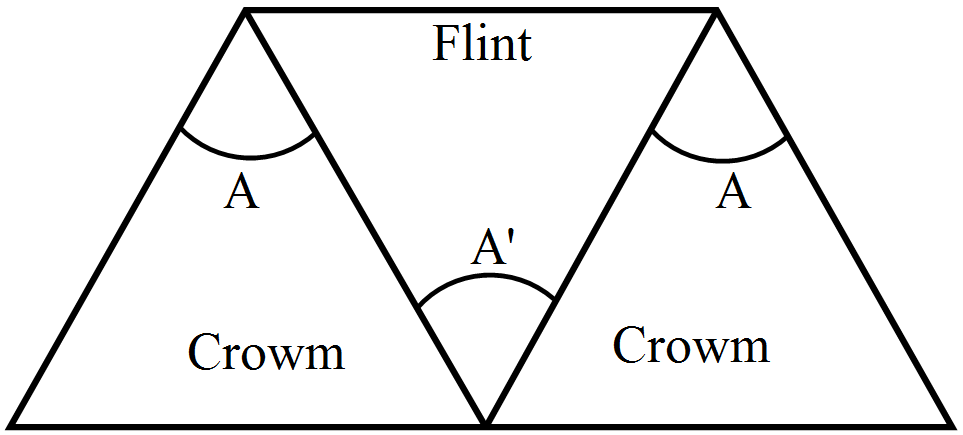
- There is no net angular dispersion.
- There is no net deviation in the yellow ray.
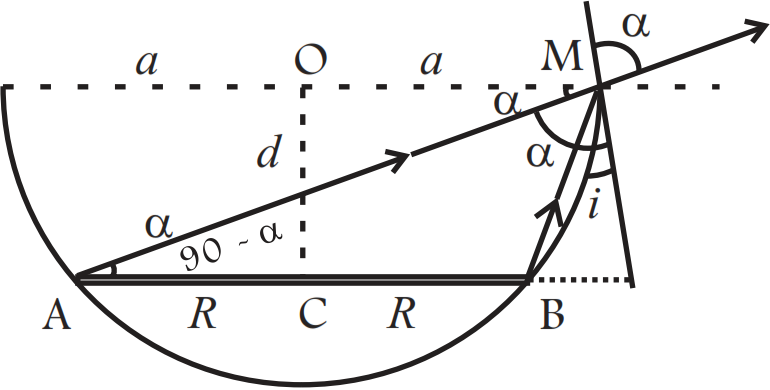
- 6View SolutionA circular disc of radius 'R' is placed co-axially and horizontally inside an opaque hemispherical bowl of radius 'a' (Fig). The far edge of the disc is just visible when viewed from the edge of the bowl. The bowl is filled with transparent liquid of refractive index μ and the near edge of the disc becomes just visible. How far below the top of the bowl is the disc placed?
- 7View SolutionA Cassegrain telescope uses two mirrors. Such a telescope is built with the mirrors 20 mm apart. If the radius of curvature of the large mirror is 220 mm and the small mirror is 140 mm, where will the final image of an object at infinity be?
- 8View SolutionTwo convex lenses, each of focal length 10cm, are placed at a separation of 15cm with their principal axes coinciding,
- Show that a light beam coming parallel to the principal axis diverges as it comes out of the lens system.
- Find the location of the virtual image formed by the lens system of an object placed far away.
- Find the focal length of the equivalent lens.
- 9View SolutionA double convex lens has focal length 25cm. The radius of curvature of one of the surfaces is double of the other. Find the radii, if the refractive index of the material of the lens is 1.5.
- 10View SolutionUse the mirror equation to deduce that:
- an object placed between f and 2f of a concave mirror produces a real image beyond 2f.
- a convex mirror always produces a virtual image independent of the location of the object.
- the virtual image produced by a convex mirror is always diminished in size and is located between the focus and the pole.