Two capacitors of capacities ${C_1}$ and ${C_2}$ are charged to voltages ${V_1}$ and ${V_2}$ respectively. There will be no exchange of energy in connecting them in parallel, if
Easy
Download our app for free and get started
(c)

Download our appand get started for free
Experience the future of education. Simply download our apps or reach out to us for more information. Let's shape the future of learning together!No signup needed.*
Similar Questions
- 1If an electron moves from rest from a point at which potential is $50\, volt$ to another point at which potential is $70\, volt$, then its kinetic energy in the final state will beView Solution
- 2A spherical metal shell $A$ of radius $R_A$ and a solid metal sphere $B$ of radius $R_B\left( < R_A\right)$ are kept far apart and each is given charge ' $+Q$ '. Now they are connected by a thin metal wire. ThenView Solution
$(A)$ $E_A^{\text {lnside }}=0$
$(B)$ $Q_A > Q_B$
$(C)$ $\frac{\sigma_A}{\sigma_B}=\frac{R_B}{R_A}$
$(D)$ $E_A^{\text {on sulface }} < E_B^{\text {on uurface }}$
- 3A particle of charge $Q$ and mass $M$ moves in a circular path of radius $R$ in a uniform magnetic field of magnitude $B$. The same particle now moves with the same speed in a circular path of same radius $R$ in the space between the cylindrical electrodes of the cylindrical capacitor. The radius of the inner electrode is $R/2$ while that of the outer electrode is $ 3R/2.$ Then the potential difference between the capacitor electrodes must beView Solution
- 4When a charge of $3\, coulomb$ is placed in a uniform electric field, it experiences a force of $3000\, Newton$. Within this field, potential difference between two points separated by a distance of $1\, cm$ is........$volts$View Solution
- 5Three capacitors of capacitance $3\,\mu \,F,\,10\,\mu \,F\,$ and $15\,\mu \,F\,$ are connected in series to a voltage source of $100\,V$. The charge on $15\,\mu \,F\,$is.......$\mu C$View Solution
- 6View SolutionIf a charge is shifted from a low potential region to high potential region, the electric potential energy
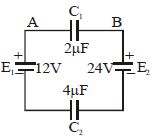
- 7Two capacitors $C_1$ and $C_2$ are connected in a circuit as shown in figure. The potential difference $(V_A -V_B)$ is....$V$View Solution
- 8$1000$ small water drops each of capacitance $C$ join together to form one large spherical drop. The capacitance of bigger sphere is ......... $C$View Solution
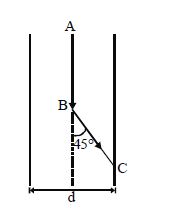
- 9A sphere carrying charge of $Q$ having weight $w$ falls under gravity between a pair of vertical plates at a distance of $d$ from each other. When a potential difference $V$ is applied between the plates the acceleration of sphere changes as shown in the figure, to along line $BC$. The value of $Q$ is :-View Solution
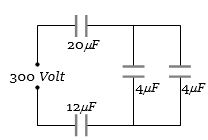
- 10In the adjoining figure, four capacitors are shown with their respective capacities and the $P.D.$ applied. The charge and the $P.D.$ across the $4\,\mu F$ capacitor will beView Solution