Derive the lens formula $\frac{1}{\text{f}}=\frac{1}{\text{v}}-\frac{1}{\text{u}}$ for a thin concave lens, using the necessary ray diagram.
Download our app for free and get started
The formation of image by a concave lens 'L' is shown in fig. AB is object and A' B' is the image. Triangles ABO and A' B' O are similar $\frac{\text{AB}}{\text{A}'\text{B}}=\frac{\text{OB}}{\text{OB}'}\dots(\text{i})$ Also triangles NOF and A' B' F are similar $\frac{\text{NO}}{\text{A}'\text{B}}=\frac{\text{OP}}{\text{FB}'}$ But NO = AB $\frac{\text{AB}}{\text{A}'\text{B}'}=\frac{\text{OB}}{\text{FB}'}\dots(\text{i})$ Comparing equation (i) and (ii) $\frac{\text{OB}}{\text{OB}'}=\frac{\text{OF}}{\text{FB}'}$ $\Rightarrow\frac{\text{OB}}{\text{OB}'}=\frac{\text{OF}}{\text{OF}-\text{OB}'}$ Using sign conventions of coordinate geometry OB = -u, OB' = -v, OF = -f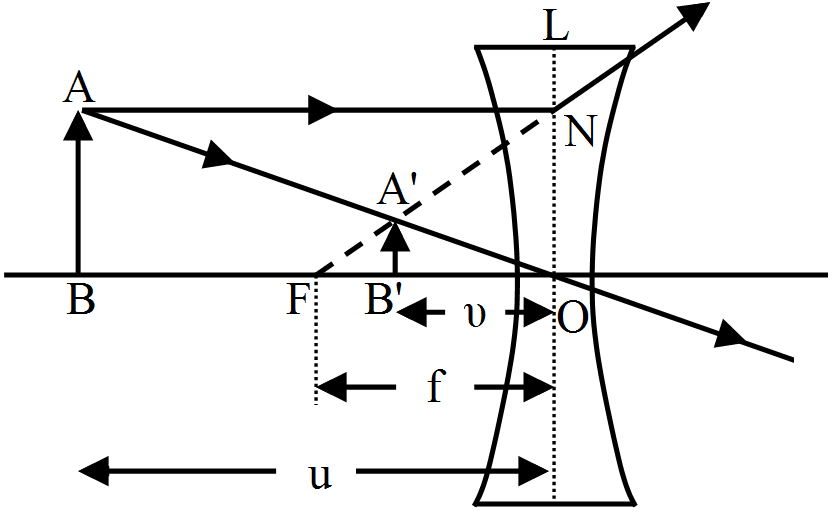
$\frac{-\text{u}}{-\text{v}}=\frac{-\text{f}}{-\text{f}+\text{v}}$ $\Rightarrow\text{uf}-\text{uv}=\text{vf}$ $\Rightarrow\text{uv}=\text{uf}-\text{uf}$ Dividing throughout by uvf, we get $\frac{1}{\text{f}}=\frac{1}{\text{v}}-\frac{1}{\text{u}}$ This is the required lens formula.
$\frac{-\text{u}}{-\text{v}}=\frac{-\text{f}}{-\text{f}+\text{v}}$ $\Rightarrow\text{uf}-\text{uv}=\text{vf}$ $\Rightarrow\text{uv}=\text{uf}-\text{uf}$ Dividing throughout by uvf, we get $\frac{1}{\text{f}}=\frac{1}{\text{v}}-\frac{1}{\text{u}}$ This is the required lens formula.

Download our appand get started for free
Experience the future of education. Simply download our apps or reach out to us for more information. Let's shape the future of learning together!No signup needed.*
Similar Questions
- 1View SolutionA thin convex lens of focal length 25cm is cut into two pieces 0.5cm above the principal axis. The top part is placed at (0, 0) and an object placed at (-50cm, 0). Find the coordinates of the image.
- 2View SolutionAn astronomical telescope is to be designed to have a magnifying power of 50 in normal adjustment. If the length of the tube is 102cm, find the powers of the objective and the eyepiece.
- 3View Solution
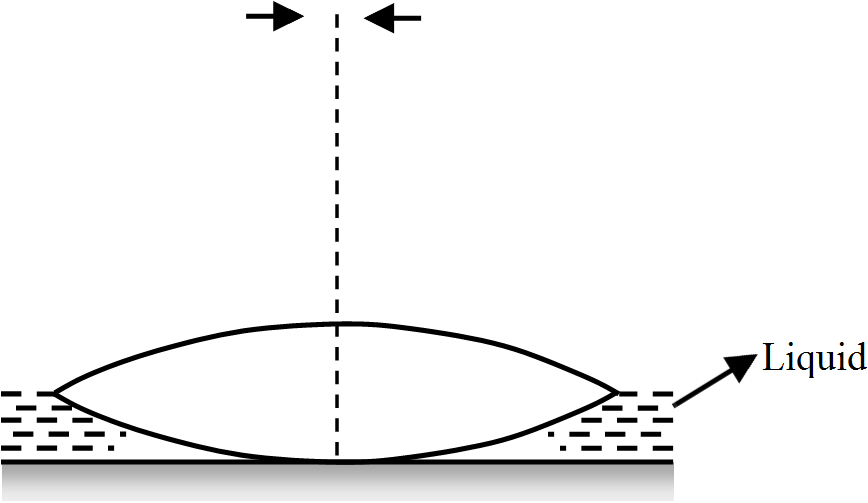
- An equiconvex lens with radii of curvature of magnitude r each, is put over a liquid layer poured on top of a plane mirror. A small needle, with its tip on the principal axis of the lens, is moved along the axis until its inverted real image coincides with the needle itself. The distance of the needle from the lens is measured to be 'a'. On removing the liquid layer and repeating the experiment the distance is found to be 'b'.
- If r = 10cm, a = 15cm, b = 10cm, find the refractive index of the liquid.
- 4View SolutionA man with normal near point (25 cm) reads a book with small print using a magnifying glass: a thin convex lens of focal length 5 cm.
- What is the closest and the farthest distance at which he should keep the lens from the page so that he can read the book when viewing through the magnifying glass?
- What is the maximum and the minimum angular magnification (magnifying power) possible using the above simple microscope?
- 5View SolutionDraw a ray diagram to show the formation of real image of the same size as that of the object placed in front of a converging lens. Using this ray diagram establish the relation between u, v and f for this lens.
- 6View SolutionA small object is placed at the centre of the bottom of a cylindrical vessel of radius 3cm and height 4cm filled completely with water. Consider the ray leaving the vessel through a corner. Suppose this ray and the ray along the axis of the vessel are used to trace the image. Find the apparent depth of the image and the ratio of real depth to the apparent depth under the assumptions taken. Refractive index of water = 1.33
- 7View Solution
- State Huygen’s principle. Using this principle draw a diagram to show how a plane wave front incident at the interface of the two media gets refracted when it propagates from a rarer to a denser medium. Hence verifiy Snell’s law of refraction.
- When monochromatic light travels from a rarer to a denser medium, explain the following, giving reasons:
- Is the frequency of reflected and refracted light same as the frequency of incident light?
- Does the decrease in speed imply a reduction in the energy carried by light wave?
- 8View SolutionA paperweight in the form of a hemisphere of radius 3.0cm is used to hold down a printed page. An observer looks at the page vertically through the paperweight. At what height above the page will the printed letters near the centre appear to the observer?
- 9View SolutionA double convex lens has focal length 25cm. The radius of curvature of one of the surfaces is double of the other. Find the radii, if the refractive index of the material of the lens is 1.5.
- 10View Solution
- Draw a ray diagram to show refraction of a ray of monochromatic light passing through a glass prism.
- Explain briefly how the phenomenon of total internal reflection is used in fibre optics.