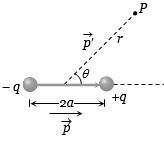
Two equal charges $q$ of opposite sign separated by a distance $2a$ constitute an electric dipole of dipole moment $p$. If $P$ is a point at a distance $r$ from the centre of the dipole and the line joining the centre of the dipole to this point makes an angle $\theta $ with the axis of the dipole, then the potential at $P$ is given by $(r > > 2a)$ (Where $p = 2qa$)
Easy


Download our appand get started for free
Experience the future of education. Simply download our apps or reach out to us for more information. Let's shape the future of learning together!No signup needed.*
Similar Questions
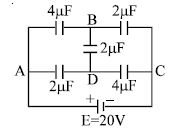
- 1View SolutionThe figure shows a diagonal symmetric arrangement of capacitors and a battery.Identify the correct statements.
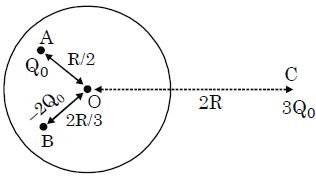
- 2A thin conducting spherical shell (center at $O$ ) having charge $Q_0$ , radius $R$ and three point charges $Q_0$ , $-2Q_0$ , $3Q_0$ are also kept at point $A$ , $B$ and $C$ respectively as shown. Find the potential at any point on the conducting shell. (Potential at infinity is assumed to be zero)View Solution
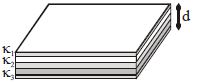
- 3A parallel plate capacitor is filled with $3$ dielectric materials of same thickness, as shown in the sketch. The dielectric constants are such that $k_3 > k_2 > k_1$. Let the magnitudes of the electric field in and potential drops across each dielectric be $E_3$, $E_2$,$ E_1$, $\Delta V_3$, $\Delta V_2$ and $\Delta V_1$, respectively. Which one of the following statement is true ?View Solution
- 4The charge given to a hollow sphere of radius $10\, cm$ is $3.2×10^{-19}\, coulomb$. At a distance of $4\, cm$ from its centre, the electric potential will beView Solution
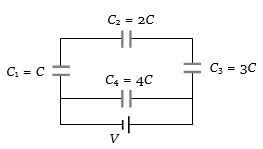
- 5A network of four capacitors of capacity equal to ${C_1} = C,\,\,{C_2} = 2C,\,{C_3} = 3C$ and ${C_4} = 4C$ are conducted in a battery as shown in the figure. The ratio of the charges on ${C_2}$ and ${C_4}$ isView Solution
- 6View SolutionIf a unit positive charge is taken from one point to another over an equipotential surface, then
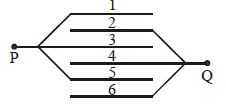
- 7Six metallic plates each with a surface area of one side $A$, are placed at a distance $d$ from each other. The alternate plates are connected to points $P$ and $Q$ as shown in figure. The capacitance of the system isView Solution
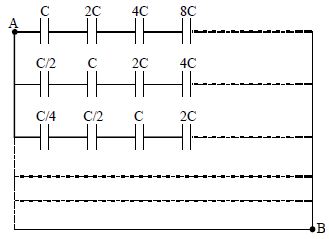
- 8Consider an infinite matrix of capacitors as shown in the figure. The effective capacitance between point $A$ and $B$ will beView Solution
- 9Uniform electric field of magnitude $100$ $V/m$ in space is directed along the line $y = 3 + x$. Find the potential difference between point $A$ $ (3, 1)$ $\&$ $B$ $(1, 3)$.......$V$View Solution
- 10A capacitor of capacitance $50 \; pF$ is charged by $100 \; V$ source. It is then connected to another uncharged identical capacitor. Electrostatic energy loss in the process is $\dots \; nJ$.View Solution