Question
Two linear simple harmonic motions of equal amplitudes and frequencies $\omega$ and $2\omega$ are impressed on a particle along the axes of X and Y respectively. If the initial phase difference between them $\frac{\pi}{2}$ is find the resultant path followed by the particle.

Answer

Two simple harmonic motions of equal amplitudes (A) and frequencies o and 20 and initial phase difference of $\frac{\pi}{2}$ are represented by$\text{x}=\text{A}\sin\omega\text{t}\cdots\text{(i)}$
$\text{y}=\text{A}\sin\Big(2\omega\text{t}+\frac{\pi}{2}\Big)$
$=\text{A}\cos2\omega\text{t}\cdots\text{(ii)}$
Since $\cos2\omega\text{t}=(1-2\sin^2\omega\text{t})$$\therefore\text{y}=\text{A}[1-2\sin^2\omega\text{t}]\cdots\text{(iii)}$
From equ.(i), $\sin^2\omega\text{t}=\frac{\text{x}^2}{\text{A}^2}$$\therefore\text{y}=\text{A}\Big[1-\frac{2\text{x}^2}{\text{A}^2}\Big]$
$=\text{A}-\frac{2\text{x}^2}{\text{A}}$
$\Rightarrow\frac{2\text{x}^2}{\text{A}}+\text{y}-\text{A}=0$
$=\text{x}^2+\frac{\text{Ay}}{2}-\frac{\text{A}^2}{2}=0$
Which is the equation of a parabola. Hence the resultant path followed by the particle is parabolic.

Need a full question paper?

Generate a complete, print-ready paper with questions like this in minutes — across 16+ boards, with answer keys.

Start Generating Free

Similar questions

A stone loses $\frac{1}{10}\text{th}$ of its velocity on passing through a sand bag of length x. For its velocity to be made zero, how many more similar bags are to be placed on its path?
A table with smooth horizontal surface is fixed in a cabin that rotates with a uniform angular velocity $\omega$ in a circular path of radius R (In figure). A smooth groove AB of length L(<$\theta$ with the radius OA of the circle in which the cabin rotates. A small particle is kept at the point A in the groove and is released to move along AB. Find the time taken by the particle to reach the point B.
A car is speeding up on a horizontal road with an acceleration a. Consider the following situations in the car.
  1. A ball is suspended from the ceiling through a string and is maintaining a constant angle with the vertical. Find this angle.
  2. A block is kept on a smooth incline and does not slip on the incline. Find the angle of the incline with the horizontal.
Given in are examples of some potential energy functions in one dimension. The total energy of the particle is indicated by a cross on the ordinate axis. In each case, specify the regions, if any, in which the particle cannot be found for the given energy. Also, indicate the minimum total energy the particle must have in each case. Think of simple physical contexts for which these potential energy shapes are relevan.
A three-wheeler starts from rest, accelerates uniformly with $1m s^{–2}$ on a straight road for $10s$, and then moves with uniform velocity. Plot the distance covered by the vehicle during the nth second $(n = 1, 2, 3….)$ versus n. What do you expect this plot to be during accelerated motion : a straight line or a parabola?
A parallel-plate capacitor having plate area $400cm^2$ and separation between the plates $1.0mm$ is connected to a power supply of 100V. A dielectric slab of thickness $1.0mm$ and dielectric constant $5.0$ is inserted into the gap:
  1. Find the increase in electrostatic energy.
  2. If the power supply is now disconnected and the dielectric slab is taken out, find the further increase in energy.
  3. Why does the energy increase in inserting the slab as well as in taking it out?
A rectangular box lies on a rough inclined surface. The coefficient of friction between the surface and the box is $\mu$. Let the mass of the box be m.
  1. At what angle of inclination $\theta$ of the plane to the horizontal will the box just start to slide down the plane?
  2. What is the force acting on the box down the plane, if the angle of inclination of the plane is increased to a $\theta>$?
  3. What is the force needed to be applied upwards along the plane to make the box either remain stationary or just move up with uniform speed?
  4. What is the force needed to be applied upwards along the plane to make the box move up the plane with acceleration a?
Answer the following:
What is the temperature of the triple-point of water on an absolute scale whose unit interval size is equal to that of the Fahrenheit scale?
Find the expression of the position of the center of mass of a system of n-particles.
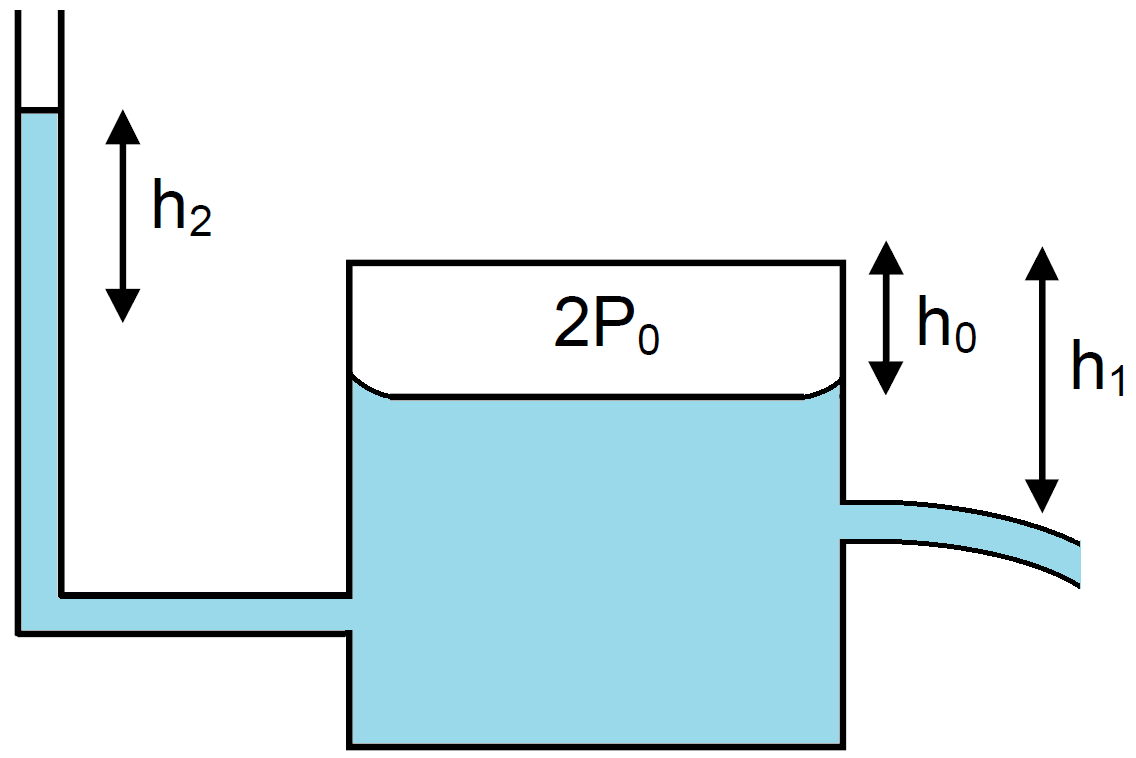
Figure. shows a large closed cylindrical tank containing water. Initially the air trapped above the water surface has a height $h_0$ and pressure $2p_0$ where $p_0$ is the atmospheric pressure. There is a hole in the wall of the tank at a depth $h_1$ below the top from which water comes out. A long vertical tube is connected as shown.
  1. Find the height $h_2$ of the water in the long tube above the top initially.
  2. Find the speed with which water comes out of the hole.
  3. Find the height of the water in the long tube above the top when the water stops coming out of the hole.