Question
Two wires carrying equal currents i each, are placed perpendicular to each other, just avoiding a contact. If one wire is held fixed and the other is free to move under magnetic forces, what kind of motion will result?

Answer

The magnetic force on a wire carrying an electric current i is $\overrightarrow{\text{F}}=\text{i}.\big(\overrightarrow{\text{l}}\times\overrightarrow{\text{B}}\big),$ where l is the length of the wire and B is the magnetic field acting on it. Suppose we have one wire in the horizontal direction (fixed) and other wire in the vertical direction (free to move). If the horizontal wire is carrying current from right to left is held fixed perpendicular to the vertical wire, which is free to move, the upper portion of the free wire will tend to move in the left direction and the lower portion of the wire will tend to move in the right direction, according to Fleming's left hand rule, as the magnetic field acting on the wire due to the fixed wire will point into the plane of paper above the wire and come out of the paper below the horizontal wire and the current will flow in upward direction in the free wire. Thus, the free wire will tend to become parallel to the fixed wire so as to experience maximum attractive force.

Need a full question paper?

Generate a complete, print-ready paper with questions like this in minutes — across 16+ boards, with answer keys.
Start Generating Free

Similar questions

Consider the situation of the previous problem:
  1. Find the tension in the string in equilibrium.
  2. Suppose the ball is slightly pushed aside and released. Find the time period of the small oscillations.
  1. Derive an expression for equivalent capacitance of three capacitors when connected in series.
  2. Derive an expression for equivalent capacitance of three capacitors when connected in parallel.
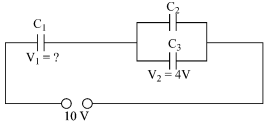
Define capacitor. Obtain the relation of equivalence in series combination of capacitors by making a circuit diagram. Write the value of voltage $V_1$ in the given circuit.
Image
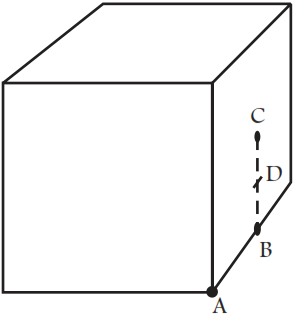
What will be the total flux through the faces of the cube (Fig.) with side of length a if a charge q is placed at:
  1. A: a corner of the cube.
  2. B: mid-point of an edge of the cube.
  3. C: centre of a face of the cube.
  4. D: mid-point of B and C.
Ram is a  student of class X in a village school. His uncle gifted him a bicycle with a dynamo fitted in it. He was very excited to get it. While cycling during night, he could light the bulb and see the objects on the road. He however, did not know this device works. He asked this question to his teacher. the teacher considered it an opportunity to explain the working to the whole class.
Answer the following question:
  1. State the principle and working of a dynamo.
  2. Write two values each displayed by Ram and his school teacher.
  1. State the two Kirchhoff's laws. Explain briefly how these rules are justified.
  2. The current is drawn from a cell of emf E and internal resistance r connected to the network of resistors each of resistance r as shown in the figure. Obtain the expression for (i) the current draw from the cell and (ii) the power consumed in the network.
The temperature and pressure at Simla are $15.0^\circ C$ and $72.0\ cm$ of mercury and at Kalka these are $35.0^\circ C$ and $76.0\ cm$ of mercury. Find the ratio of air density at Kalka to the air density at Simla.
The separation between the objective and the eyepiece of a compound microscope can be adjusted between $9.8\ cm$ to $11.8\ cm$. If the focal lengths of the objective and the eyepiece are $1.0\ cm$ and $6\ cm$ respectively, find the range of the magnifying power if the image is always needed at $24\ cm$ from the eye.
Consider the situation of the previous problem. Consider the fastest electron emitted parallel to the large metal plate. Find the displacement of this electron parallel to its initial velocity before it strikes the large metal plate.
A gravitational lens may be assumed to have a varying width of the form
$\text{w}(\text{b})=\text{k}_1\text{ In }\Big(\frac{\text{k}_2}{\text{b}}\Big)\ \ \text{b}_\text{min}<\text{b}<\text{b}_\text{max}$
$=\text{k}_1\text{ In }\Big(\frac{\text{k}_2}{\text{b}_\text{min}}\Big)\ \ \text{b}<\text{b}_\text{min}$
Show that an observer will see an image of a point object as a ring about the center of the lens with an angular radius
$\beta=\sqrt{\frac{(\text{n}-1)\text{k}_1\frac{\text{u}}{\text{v}}}{\text{u}+\text{v}}}$