Question
What are thermometer scales? How are these obtained? Find the expressions of various thermal scales and tell which of these scales is standard and explain the rason for choosing it. What is ultimate temperature?

Answer

SELF

Need a full question paper?

Generate a complete, print-ready paper with questions like this in minutes — across 16+ boards, with answer keys.
Start Generating Free

Similar questions

A tightly-wound solenoid of radius a and length l has n turns per unit length. It carries an electric current i. Consider a length dx of the solenoid at a distance x from one end. This contains n(dx) turns and may be approximated as a circular current in (dx).
  1. Write the magnetic field at the centre of the solenoid due to this circular current. Integrate this expression under proper limits to find the magnetic field at the centre of the solenoid.
  2. Verify that if a >> l, the field tends to $\text{B}=\frac{\mu_0\text{nil}}{2\text{a}}.$ Interpret these results.
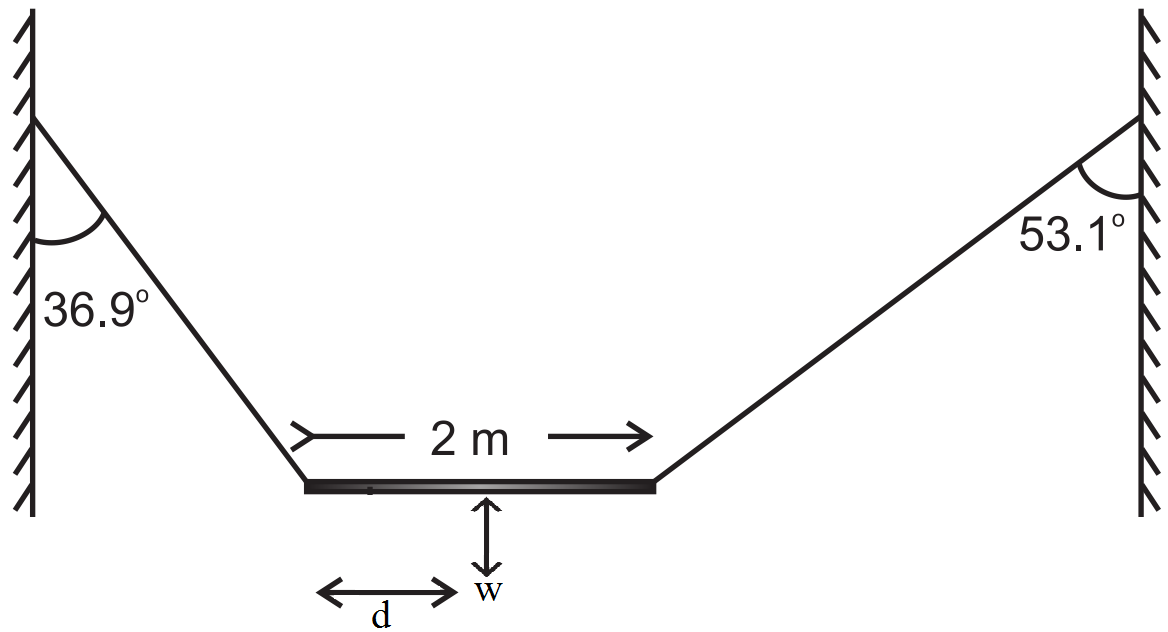
A non-uniform bar of weight W is suspended at rest by two strings of negligible weight as shown in. The angles made by the strings with the vertical are $36.9°$ and $53.1°$ respectively. The bar is $2m$ long. Calculate the distance d of the centre of gravity of the bar from its left end.
  1. State first law of thermodynamics. What are its limitations? Why $C_p > C_v$?
  2. An electric heater supplies heat to a system at a rate 100W. If the system performs work at a rate of 75 joules per second at what rate is the internal energy increases.
OR
  1. Derive an expression for the work done during the isothermal expression of x mole of an ideal gas.
  2. A steam engine delivers $5.4 \times 10^8J$ of work per minute and services $3.6 \times 10^9J$ of heat per minute from its boiler. What is the efficiency of the engine? How much heat is wasted per minute?
What is Bernoulli's theory for horizontal tube?
Mean solar day is the time interval between two successive noon when sun passes through zenith point (meridian). Sidereal day is the time interval between two successive transit of a distant star through the zenith point (meridian). By drawing appropriate diagram showing earth’s spin and orbital motion, show that mean solar day is four minutes longer than the sidereal day. In other words, distant stars would rise 4 minutes early every successive day.
A $14.5kg$ mass, fastened to the end of a steel wire of unstretched length $1.0m$, is whirled in a vertical circle with an angular velocity of $2rev/s$ at the bottom of the circle. The cross-sectional area of the wire is $0.065cm^2$. Calculate the elongation of the wire when the mass is at the lowest point of its path.
Two small spheres, each having a mass of 20g, are suspended from a common point by two insulating strings of length 40cm each. The spheres are identically charged and the separation between the balls at equilibrium is found to be 4cm. Find the charge on each sphere.
Do permeability and relative permeability have the same dimensions?
A particle A having a charge of $2.0 \times 10^{-6}C$ is held fixed on a horizontal table. A second charged particle of mass $80g$ stays in equilibrium on the table at a distance of $10cm$ from the first charge. The coefficient of friction between the table and this second particle is $\mu=0.2.$ Find the range within which the charge of this second particle may lie.
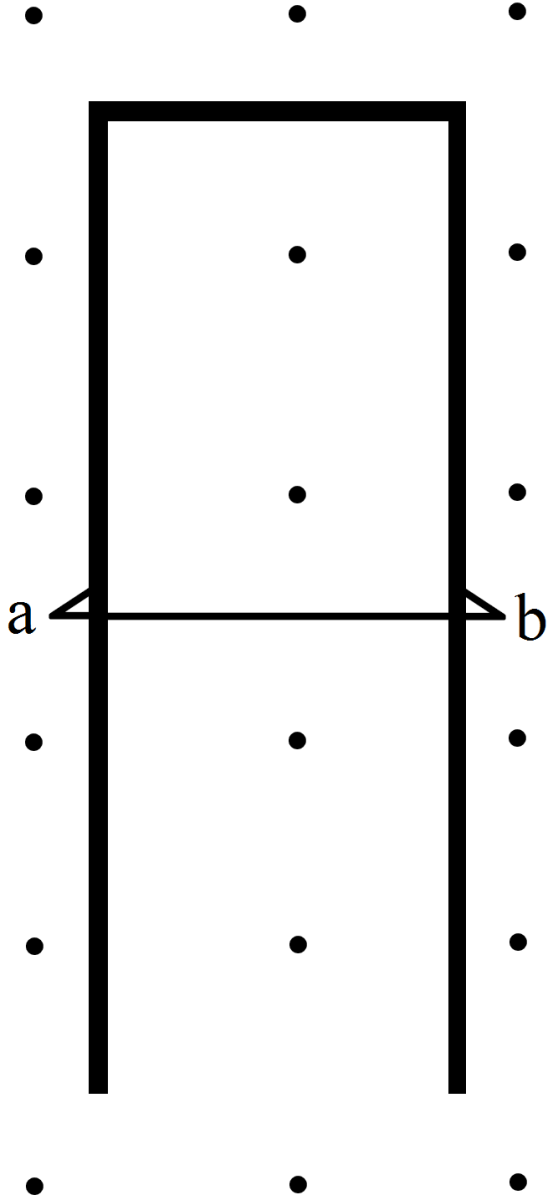
A conducting wire ab of length l, resistance r and mass m starts sliding at $t = 0$ down a smooth, vertical, thick pair of connected rails as shown in figure. A uniform magnetic field B exists in the space in a direction perpendicular to the plane of the rails.
  1. Write the induced emf in the loop at an instant t when the speed of the wire is v.
  2. What would be the magnitude and direction of the induced current in the wire?
  3. Find the downward acceleration of the wire at this instant.
  4. After sufficient time, the wire starts moving with a constant velocity. Find this velocity $v_m$​​​​​​​.
  5. Find the velocity of the wire as a function of time.
  6. Find the displacement of the wire as a function of time.
  7. Show that the rate of heat developed in the wire is equal to the rate at which the gravitational potential energy is decreased after steady state is reached.