Question
Which is incorrect

Answer

(d)In isothermal process $\Delta Q \ne 0.$

Need a full question paper?

Generate a complete, print-ready paper with questions like this in minutes — across 16+ boards, with answer keys.
Start Generating Free

Similar questions

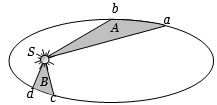
The figure shows the motion of a planet around the sun in an elliptical orbit with sun at the focus. The shaded areas $A$ and $B$ are also shown in the figure which can be assumed to be equal. If ${t_1}$ and ${t_2}$ represent the time for the planet to move from $a$ to $b$ and $d$ to $c$ respectively, then
The pitch of the screw gauge is $1\, mm$ and there are $100$ divisions on the circular scale. When nothing is put in between the jaws, the zero of the circular scale lies $8$ divisions below the reference line. When a wire is placed between the jaws, the first linear scale division is clearly visible while $72^{\text {nd }}$ division on circular scale coincides with the reference line. The radius of the wire is.........$mm$
Two identical bodies are made of a material for which the heat capacity increases with temperature. One of these is held at a temperature of $100^{\circ} C$, while the other one is kept at $0^{\circ} C$. If the two are brought into contact, then assuming no heat loss to the environment, the final temperature that they will reach is
The length of a uniform rod is $100.0 \,cm$ and radius is $1.00 \,cm$. If length is measured with a meter rod having least count $1 \,mm$ and radius is measured with vernier callipers having least count $0.1 \,mm$, the percentage error in calculated volume of cylinder is ............. $\%$
For television broadcasting, the frequency employed is normally
 A certain number of spherical drops of a liquid of radius $r$ coalesce to form a single drop of radius $R$ and volume $V.$  If $T$ is the surface tension of the liquid, then
Due to which property of water, tiny particles of camphor dance on the surface of water
$A$ cone of radius $r$ and height $h$ rests on a rough horizontal surface, the coefficient of friction between the cone and the surface being $\mu$ . $A$ gradually increasing horizontal force $F$ is applied to the vertex of the cone. The largest value of $\mu$ for which the cone will slide before it topples is
All of the following statements are correct except
The capacity of a parallel plate condenser is $5\,\mu F$. When a glass plate is placed between the plates of the conductor, its potential becomes $1/8^{th}$ of the original value. The value of dielectric constant will be