Light is incident from glass $(\mu=1.50)$ to water $(\mu=1.33).$ Find the range of the angle of deviation for which there are two angles of incidence.
Download our app for free and get started
$\mu_\text{g}=1.5=\frac{3}{2}; \ \mu_\text{w}=1.33=\frac{4}{3}$For two angles of incidence,
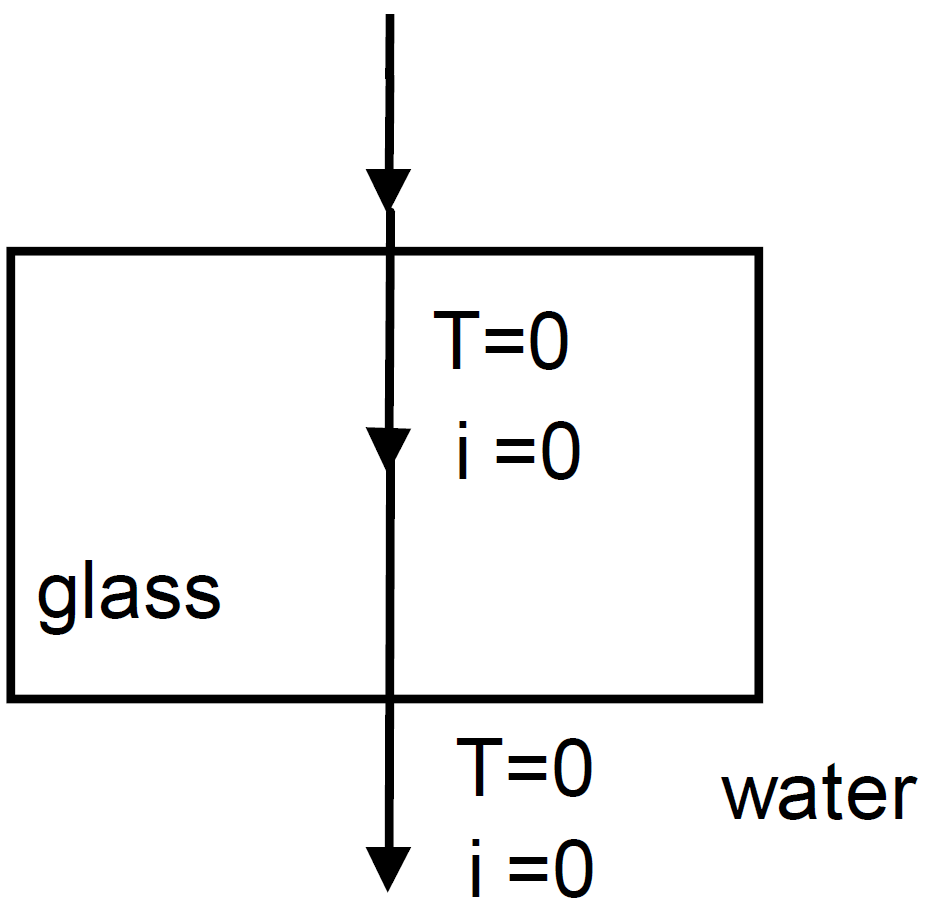
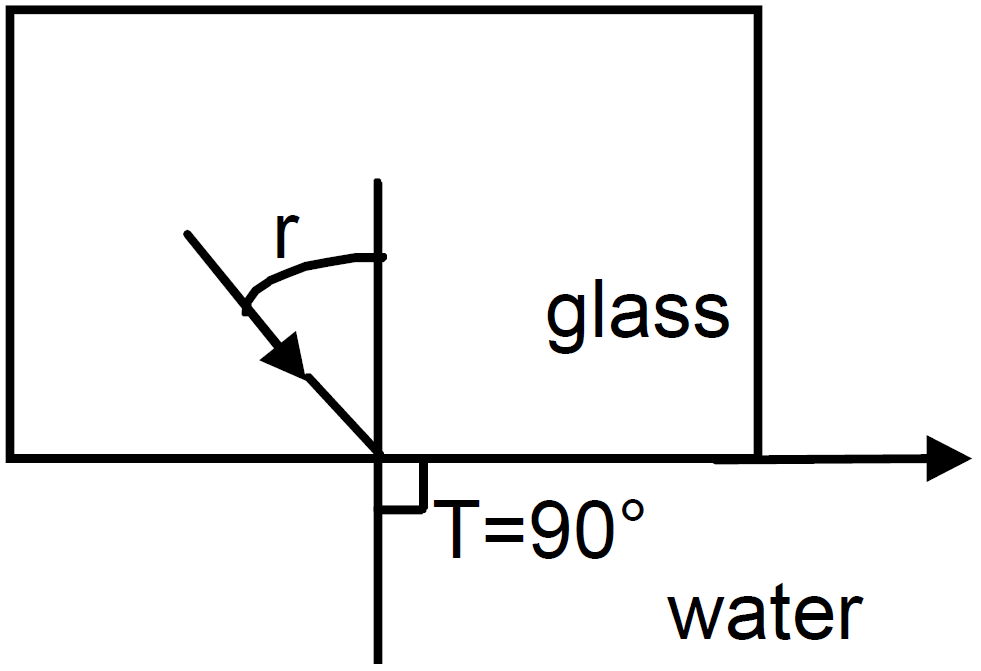
$\Rightarrow\sin\theta_\text{C}=\frac{8}{9}$
$\Rightarrow\sin^{-1}\Big(\frac{8}{9}\Big)=62.73^{\circ}$
$\therefore$ Angle of deviation $= 90^{\circ} - \theta_\text{C} = 90^{\circ}=\sin^{-1}\Big(\frac{8}{9}\Big)=\cos^{-1}\Big(\frac{8}{9}\Big)=37.27^{\circ}$
Here, if the angle of incidence is increased beyond critical angle, total internal reflection occurs and deviation decreases. So, the range of deviation is 0 to $\cos^{-1}\Big(\frac{8}{9}\Big).$
- When light passes straight through normal,
- When light is incident at critical angle,
$\Rightarrow\sin\theta_\text{C}=\frac{8}{9}$
$\Rightarrow\sin^{-1}\Big(\frac{8}{9}\Big)=62.73^{\circ}$
$\therefore$ Angle of deviation $= 90^{\circ} - \theta_\text{C} = 90^{\circ}=\sin^{-1}\Big(\frac{8}{9}\Big)=\cos^{-1}\Big(\frac{8}{9}\Big)=37.27^{\circ}$
Here, if the angle of incidence is increased beyond critical angle, total internal reflection occurs and deviation decreases. So, the range of deviation is 0 to $\cos^{-1}\Big(\frac{8}{9}\Big).$

Download our appand get started for free
Experience the future of education. Simply download our apps or reach out to us for more information. Let's shape the future of learning together!No signup needed.*
Similar Questions
- 1With the help of a ray diagram, show the formation of image of a point object due to refraction of light at a spherical surface separating two media of refractive indices $n_1$ and $n_2 (n_2 > n_1)$ respectively. Using this diagram, derive the relation.View Solution
$\frac{\text{n}_2}{\text{v}}-\frac{\text{n}_1}{\text{u}}=\frac{\text{n}_1-\text{n}_2}{\text{R}}$
Write the sign conventions used. What happens to the focal length of convex lens when it is immersed in water? - 2View SolutionDefine magnifying power of a telescope. Write its expression.
A small telescope has an objective lens of focal length 150 cm and an eye piece of focal length 5 cm. If this telescope is used to view a 100m high tower 3 km away, find the height of the final image when it is formed 25 cm away from the eye piece. - 3A ball is kept at a height h above the surface of a heavy transparent sphere made of a material of refractive index $\mu.$ The radius of the sphere is R. At t = 0, the ball is dropped to fall normally on the sphere. Find the speed of the image formed as a function of time for $\text{t}<\sqrt{\frac{2\text{h}}{\text{g}}}.$ Consider only the image by a single refraction.View Solution
- 4View SolutionFind the maximum magnifying power of a compound Microscope having a 25 diopter lens as the objective, a 5 diopter lens as the eyepiece and the separation 30cm between the two lenses. The least distance for clear vision is 25cm.
- 5View Solution
- Draw a ray diagram showing the image formation by a compound microscope. Hence obtain expression for total magnification when the image is formed at infinity.
- Distinguish between myopia and hypermetropia. Show diagrammatically how these defects can be corrected.
- 6Two concave mirrors of equal radii of curvature R are fixed on a stand facing opposite directions. The whole system has a mass m and is kept on a frictionless horizontal table.View Solution
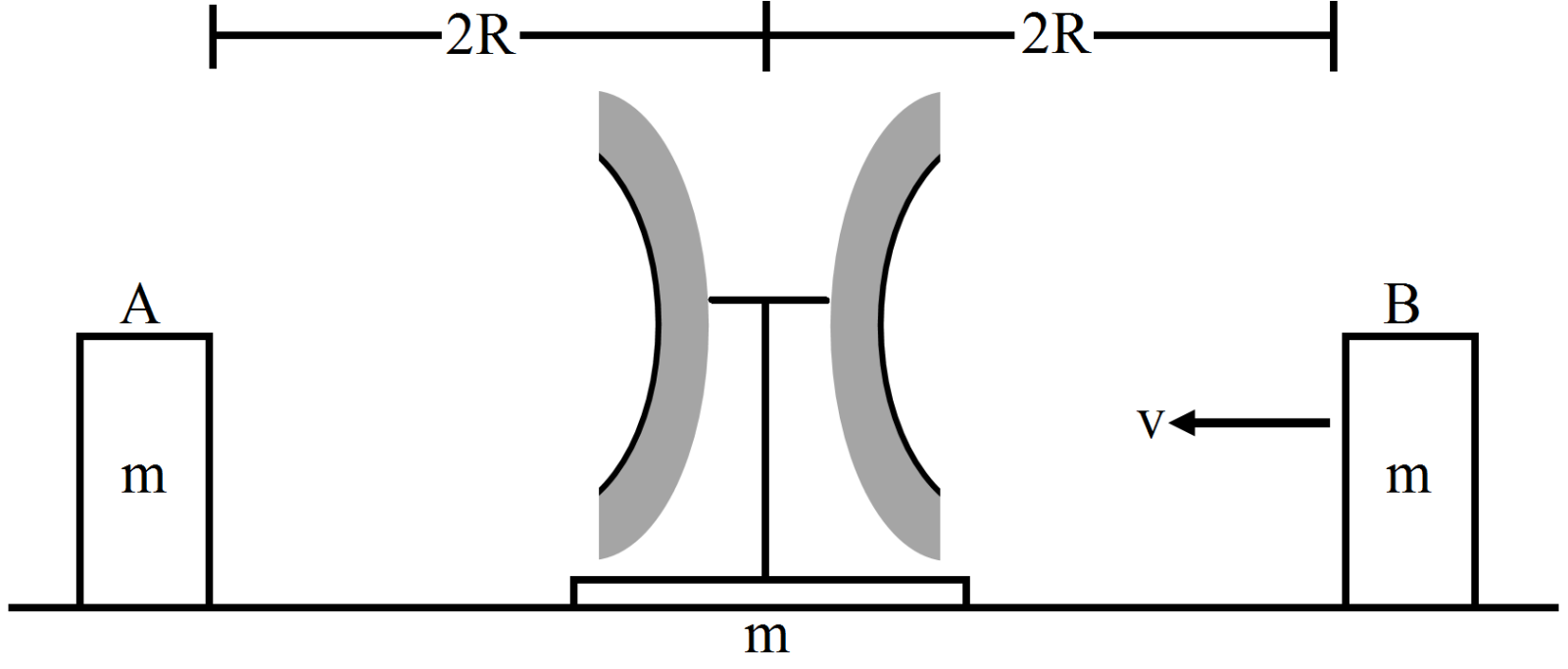
Two blocks A and B, each of mass m, are placed on the two sides of the stand. At t = 0, the separation between A and the mirrors is 2 R and also the separation between B and the mirrors is 2 R. The block B moves towards the mirror at a speed v. All collisions which take place are elastic. Taking the original position of the mirrors-stand system to be x = 0 and X-axis along AB, find the position of the images of A and B at t =- $\frac{\text{R}}{\text{v}}$
- $\frac{3\text{R}}{\text{v}}$
- $\frac{5\text{R}}{\text{v}}$
- 7View SolutionA small object is placed at the centre of the bottom of a cylindrical vessel of radius 3cm and height 4cm filled completely with water. Consider the ray leaving the vessel through a corner. Suppose this ray and the ray along the axis of the vessel are used to trace the image. Find the apparent depth of the image and the ratio of real depth to the apparent depth under the assumptions taken. Refractive index of water = 1.33
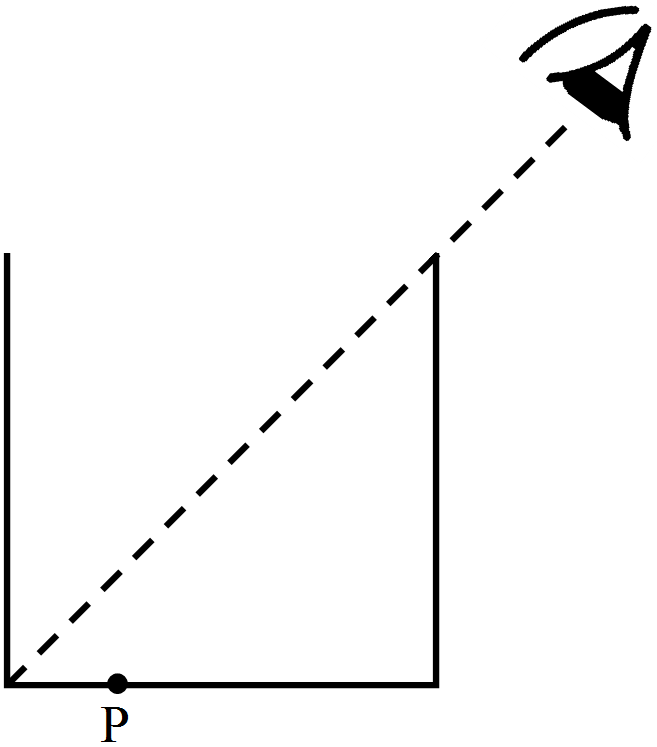
- 8View SolutionA cylindrical vessel, whose diameter and height both are equal to 30cm, is placed on a horizontal surface and a small particle P is placed in it at a distance of 5.0cm from the centre. An eye is placed at a position such that the edge of the bottom is just visible. The particle P is in the plane of drawing. Up to what minimum height should water be poured in the vessel to make the particle P visible?
- 9View SolutionAn object 1.5 cm in size is placed on the side of the convex lens in the arrangement (a) above. The distance between the object and the convex lens is 40 cm. Determine the magnification produced by the two-lens system, and the size of the image.
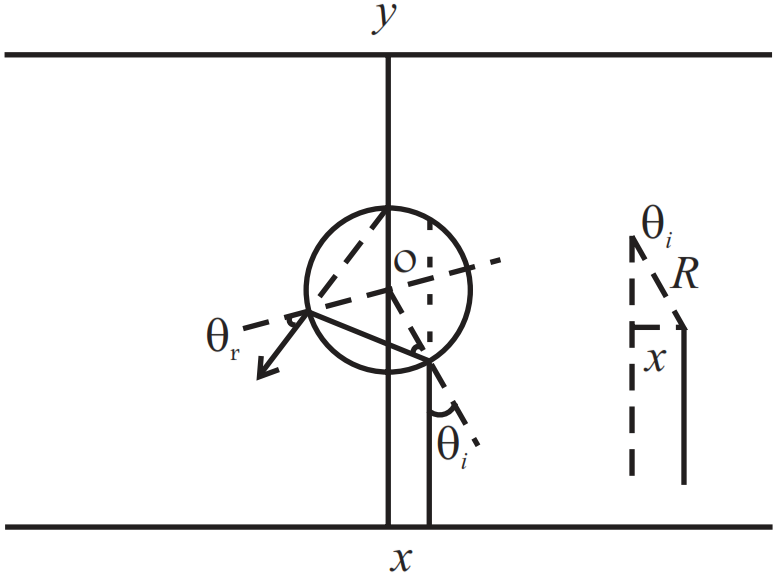
- 10View SolutionAn infinitely long cylinder of radius R is made of an unusual exotic material with refractive index -1 (Fig). The cylinder is placed between two planes whose normals are along the y direction. The center of the cylinder O lies along the y-axis. A narrow laser beam is directed along the y direction from the lower plate. The laser source is at a horizontal distance x from the diameter in the y direction. Find the range of x such that light emitted from the lower plane does not reach the upper plane.