What length of a copper wire of cross$-$sectional area $0.01\ mm^2$ will be needed to prepare a resistance of $1\text{k}\Omega?$ Resistivity of copper $=1.7\times10^{-8}\Omega\text{-m}.$
Download our app for free and get started
$\text{f}_\text{cu}=1.7\times10^{-8}\Omega\text{-m}$
$\text{A}=0.01\text{mm}^2=0.01\times10^{-6}\text{m}^2$
$\text{R}=1\text{K}\Omega=10^3\Omega$
$\text{R}=\frac{\text{f}\ell}{\text{a}}$
$\Rightarrow10^3=\frac{1.7\times10^{-8}\times\ell}{10^{-6}}$
$\Rightarrow\ell=\frac{10^3}{1.7}=0.58\times10^3\text{m}=0.6\text{km}.$
$\text{A}=0.01\text{mm}^2=0.01\times10^{-6}\text{m}^2$
$\text{R}=1\text{K}\Omega=10^3\Omega$
$\text{R}=\frac{\text{f}\ell}{\text{a}}$
$\Rightarrow10^3=\frac{1.7\times10^{-8}\times\ell}{10^{-6}}$
$\Rightarrow\ell=\frac{10^3}{1.7}=0.58\times10^3\text{m}=0.6\text{km}.$

Download our appand get started for free
Experience the future of education. Simply download our apps or reach out to us for more information. Let's shape the future of learning together!No signup needed.*
Similar Questions
- 1The four arms of a Wheatstone bridge $($Fig. $3.19)$ have the following resistances:View Solution
$AB =100 \Omega, BC =10 \Omega, CD =5 \Omega \text {, and } DA =60 \Omega \text {. }$
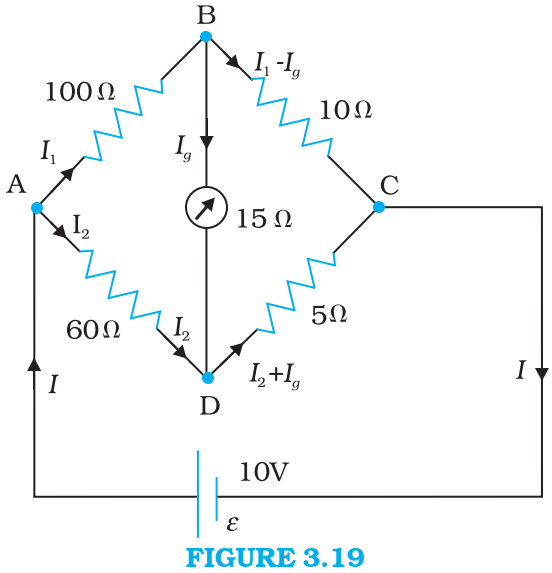
A galvanometer of $15 \Omega$ resistance is connected across $BD$. Calculate the current through the galvanometer when a potential difference of $10 V$ is maintained across $AC$. - 2View SolutionWhy are alloys used for making standard resistance coils?
- 3View Solution
- Three resistors $2\ \Omega,\ 4\ \Omega\ \text{and}\ 5\ \Omega$ are combined in parallel. What is the total resistance of the combination?
- If the combination is connected to a battery of emf 20 V and negligible internal resistance, determine the current through each resistor, and the total current drawn from the battery.
- 4View SolutionAn electric bulb, when connected across a power supply of 220V, consumes a power of 60W. If the supply drops to 180V, what will be the power consumed? If the supply is suddenly increased to 240V, what will be the power consumed?
- 5View Solution
- Two cells of emf $E_1$ and $E_2$ have their internal resistances $r_1$ and $r_2$, respectively. Deduce an expression for the equivalent emf and internal resistance of their parallel combination when connected across an external resistance $R.$ Assume that the two cells are supporting each other.
- In case the two cells are identical, each of emf $E = 5V$ and internal resistance $\text{r}=2\Omega,$ calculate the voltage across the external resistance $\text{R}=10\Omega.$
- 6View SolutionDefine the terms (i) drift velocity, (ii) relaxation time.
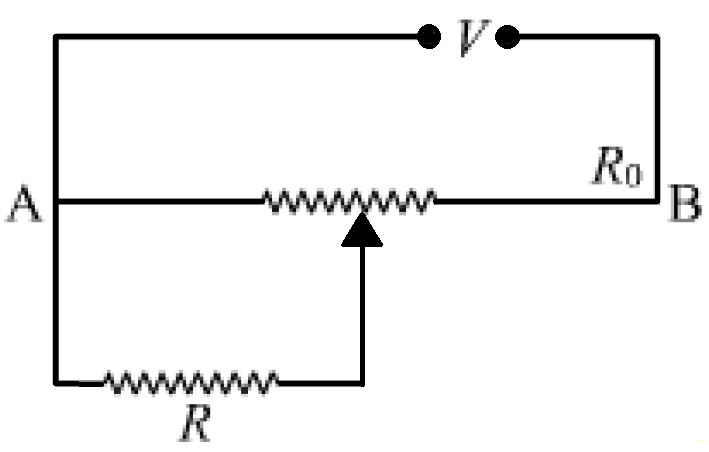
A conductor of length L is connected to a dc source of emf ε. If this conductor is replaced by another conductor of same material and same area of cross-section but of length 3L, how will the drift velocity change? - 7A resistance of R draws current from a potentiometer. The potentiometer wire $, AB, $ has a total resistance of $R_o. A$ voltage $V$ is supplied to the potentiometer. Derive an expression for the voltage across $R$ when the sliding contact is in the middle of potentiometer wire.View Solution
- 8What are the advantages of the null$-$point method in a Wheatstone bridge? What additional measurements would be required to calculate $R_{unknown}$ by any other method?View Solution
- 9A 10 m long wire of uniform cross-section and 20 $\Omega$ resistance is used in a potentiometer. The wire is connected in series with a battery of 5V along with an external resistance of 480 $\Omega$. If an unknown emf E is balanced at 6.0 m length of the wire, calculate:View Solution
- The potential gradient of the potentiometer wire.
- The value of unknown emf E.
- 10View SolutionCalculate the current drawn from the battery in the given network shown here. State Kirchhoff’s loop law and name the law on which it is based.