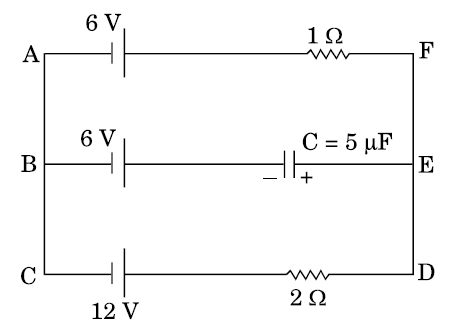
Two heating elements of resistances $R_{1}$ and $R_{2}$ when operated at a constant supply of voltage, $V$, Consume power $P_1$ and $P_2$ respectively. Deduce the expressions for the power of their combination when they are, in turn, connected in $(i)$ series and $(ii)$ parallel across the same voltage supply.
CBSE OUTSIDE DELHI - SET 1 2011
Download our app for free and get started
$P_1=\frac{V^2}{R_1}$
$P_2=\frac{V^2}{R_2}$
In Series
$P=\frac{V^2}{{R_1}+{R_2}}$
Alternatively
$p=\frac{V^2}{V^2\bigg(\frac{1}{p_1}+\frac{1}{p_2}\bigg)}$
$\frac{1}{p }=\frac{1}{p_1 }+\frac{1}{p_2 }$
In Parallel
$P=\frac{V^2(R_1+R_2)}{R_1+R_2}$
Alternatively
$P=\frac{V^2}{R}=\frac{V^2(P_1+P_2)}{V^2}$
$P=P_1+P_2 $
$P_2=\frac{V^2}{R_2}$
In Series
$P=\frac{V^2}{{R_1}+{R_2}}$
Alternatively
$p=\frac{V^2}{V^2\bigg(\frac{1}{p_1}+\frac{1}{p_2}\bigg)}$
$\frac{1}{p }=\frac{1}{p_1 }+\frac{1}{p_2 }$
In Parallel
$P=\frac{V^2(R_1+R_2)}{R_1+R_2}$
Alternatively
$P=\frac{V^2}{R}=\frac{V^2(P_1+P_2)}{V^2}$
$P=P_1+P_2 $

Download our appand get started for free
Experience the future of education. Simply download our apps or reach out to us for more information. Let's shape the future of learning together!No signup needed.*
Similar Questions
- 1View SolutionHow many time constants will elapse before the power delivered by a battery drops to half of its maximum value in an RC circuit?
- 2A cell of emf 'E' and internal resistance 'r' is connected across a variable load resistor R. Draw the plots of the terminal voltage V versus (i) R and (ii) the current I.View Solution
It is found that when R = 4$\Omega$, the current is 1 A and when R is increased to 9$\Omega$, the current reduces to 0.5 A. Find the values of the emf E and internal resistance r. - 3Calculate the temperature at which the resistance of a conductor becomes 20% more than its resistance at 27°C. The value of the temperature coefficient of resistance of the conductor is $2.0 \times 10\frac{-4}{\text{K}}.$View Solution
- 4Three resistors $1\ \Omega,\ 2\ \Omega$ and $3\ \Omega$ are combined in series. What is the total resistance of the combination?View Solution
If the combination is connected to a battery of emf $12 V$ and negligible internal resistance, obtain the potential drop across each resistor. - 5View SolutionAn electric bulb, when connected across a power supply of 220V, consumes a power of 60W. If the supply drops to 180V, what will be the power consumed? If the supply is suddenly increased to 240V, what will be the power consumed?
- 6View Solution
- The potential difference applied across a given resistor is altered so that the heat produced per second increases by a factor of 9. By what factor does the applied potential difference change?
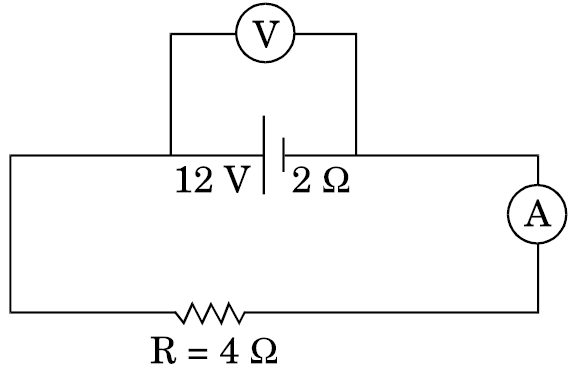
- In the figure shown, an ammeter A and a resistor of $4\Omega$ are connected to the terminals of the source. The emf of the source is 12 V having an internal resistance of $2\Omega$. Calculate the voltmeter and ammeter readings.
- 7View Solution
- In a metre bridge [Fig. 3.27], the balance point is found to be at 39.5 cm from the end A, when the resistor Y is of $12.5\ \Omega.$ Determine the resistance of X. Why are the connections between resistors in a Wheatstone or meter bridge made of thick copper strips?
- Determine the balance point of the bridge above if X and Y are interchanged.
- What happens if the galvanometer and cell are interchanged at the balance point of the bridge? Would the galvanometer show any current?
- 8A plate of area $10\ cm^2$ is to be electroplated with copper $($density $9000\ kg/m^3)$ to a thickness of $10$ micrometres on both sides, using a cell of $12V$. Calculate the energy spent by the cell in the process of deposition. If this energy is used to heat $100g$ of water, calculate the rise in the temperature of the water. $\ce{ECE}$ of copper $= 3 \times 10^{-7}kg C^1 $ and specific heat capacity of water $= 4200Jkg^1.$View Solution
- 9View SolutionDefine relaxation time of the free electrons drifting in a conductor. How is it related to the drift velocity of free electrons? Use this relation to deduce the expression for the electrical resistivity of the material.
- 10View SolutionIn the given circuit, with steady current, calculate the potential difference across the capacitor and the charge stored in it.