Young’s modulus of perfectly rigid body material is
Easy


Download our appand get started for free
Experience the future of education. Simply download our apps or reach out to us for more information. Let's shape the future of learning together!No signup needed.*
Similar Questions
- 1An aluminium rod with Young's modulus $Y =7.0$ $\times 10^{10} N / m ^2$ undergoes elastic strain of $0.04 \%$. The energy per unit volume stored in the rod in SI unit is:View Solution
- 2View SolutionIf the length of a wire is reduced to half, then it can hold the ......... load
- 3A wire of cross-sectional area $3\,m{m^2}$ is first stretched between two fixed points at a temperature of $20°C$. Determine the tension when the temperature falls to $10°C$. Coefficient of linear expansion $\alpha = {10^{ - 5}} { ^\circ}{C^{ - 1}}$ and $Y = 2 \times {10^{11}}\,N/{m^2}$ ........ $N$View Solution
- 4The increase in length on stretching a wire is $0.05\%$. If its Poisson's ratio is $0.4$, then its diameterView Solution
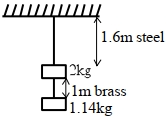
- 5Two wires each of radius $0.2\,cm$ and negligible mass, one made of steel and other made of brass are loaded as shown in the figure. The elongation of the steel wire is $.........\times 10^{-6}\,m$. [Young's modulus for steel $=2 \times 10^{11}\,Nm ^{-2}$ and $g =10\,ms ^{-2}$ ]View Solution
- 6$A$ and $B$ are two wires. The radius of $A$ is twice that of $B.$ They are stretched by the some load. Then the stress on $B$ isView Solution
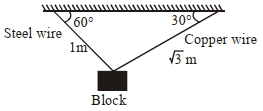
- 7A block of weight $100 N$ is suspended by copper and steel wires of same cross sectional area $0.5 cm ^2$ and, length $\sqrt{3} m$ and $1 m$, respectively. Their other ends are fixed on a ceiling as shown in figure. The angles subtended by copper and steel wires with ceiling are $30^{\circ}$ and $60^{\circ}$, respectively. If elongation in copper wire is $\left(\Delta \ell_{ C }\right)$ and elongation in steel wire is $\left(\Delta \ell_{ s }\right)$, then the ratio $\frac{\Delta \ell_{ C }}{\Delta \ell_{ S }}$ is. . . . . .View Solution
[Young's modulus for copper and steel are $1 \times 10^{11} N / m ^2$ and $2 \times 10^{11} N / m ^2$ respectively]
- 8A uniformly tapering conical wire is made from a material of Young's modulus $Y$ and has a normal, unextended length $L.$ The radii, at the upper and lower ends of this conical wire, have values $R$ and $3R,$ respectively. The upper end of the wire is fixed to a rigid support and a mass $M$ is suspended from its lower end. The equilibrium extended length, of this wire, would equalView Solution
- 9View SolutionWhich of the following is the graph showing stress-strain variation for elastomers?
- 10View SolutionTwo identical wires of rubber and iron are stretched by the same weight, then the number of atoms in the iron wire will be