Questions

5 Marks Questions

Take a timed test

23 questions · self-marked practice — reveal the answer and mark yourself.

Question 15 Marks
The following graph shows the change in temperature of a block of ice when heated. Use the graph to answer the following questions:
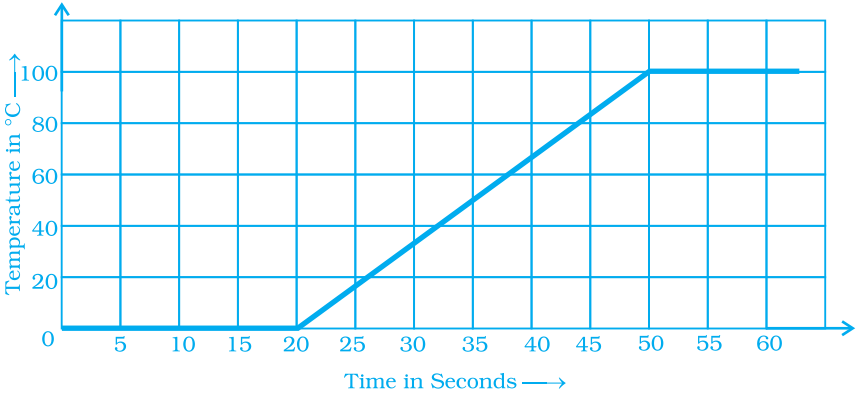
$a.$ For how many seconds did the ice block have no change in temperature?
$b.$ For how long was there a change in temperature?
$c.$ After how many seconds of heating did the temperature become constant at $0^\circ\ C$?
$d.$ What was the temperature after $25$ seconds?
$e.$ What will be the temperature after $1.5$ minutes? Justify your answer.
Answer
$a.$ In the first $20\ s$, the ice block have no change in temperature.
$b.$ There was a change in temperature from $20s$ to $50 s,$
i.e. $50 - 20 = 30s.$
$c.$ Observing the graph, we see that after $50s$ of heating the temperature became constant.
$d. 20^\circ C$ was the temperature after $25s$.
$e.$ Since, the temperature became constant at $100^\circ C$ after $50\ s$ heating, so the temperature will be $100^\circ C$ even after $1.5$ min.
View full question & answer
Question 25 Marks
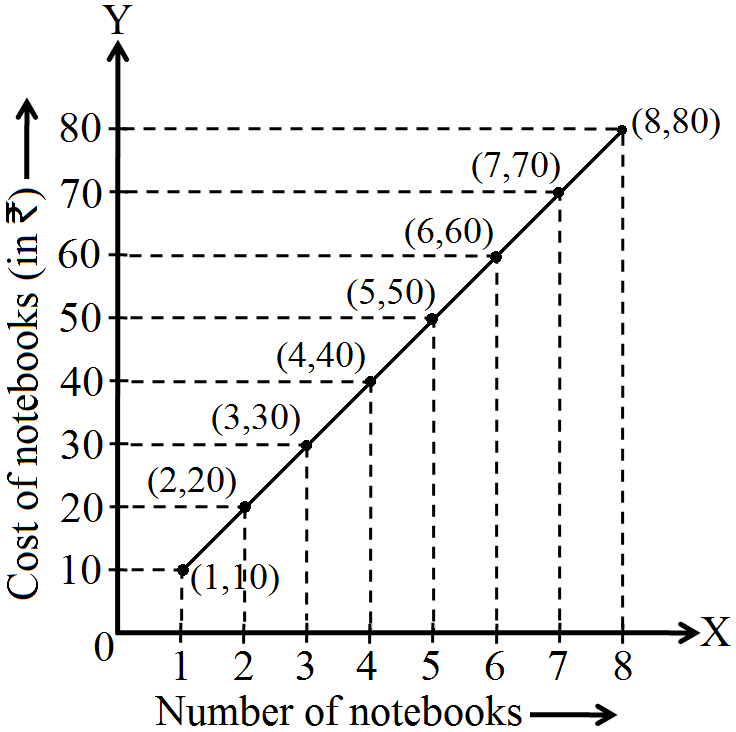
The cost of a note book is $Rs.10.$ Draw a graph after making a table showing cost of $2, 3, 4, .... $ note books. Use it to find
$a.$ the cost of $7$ notebooks.a
$b.$ The number of note books that can be purchased with $Rs.50$.
Answer
Let $x$ : number of notebooks
$y$ : cost of a notebook
$x$
$1$
$2$
$3$
$4$
$5$
$6$
$7$
$8$
$y$
$10$
$20$
$30$
$40$
$50$
$60$
$70$
$80$

$a.$ The cost of $7$ notebooks is aqua to the ordinate of the point $(7, 70),$ i.e. cost of $7$ notebooks $= Rs.\ 70$
$b.$ The number of notebooks that can be purchased with $Rs.\ 50$. is equal to the abscissa of the point $(5, 50)$.
Hence, $5$ notebooks can be purchased with $Rs.\ 50$.
View full question & answer
Question 35 Marks
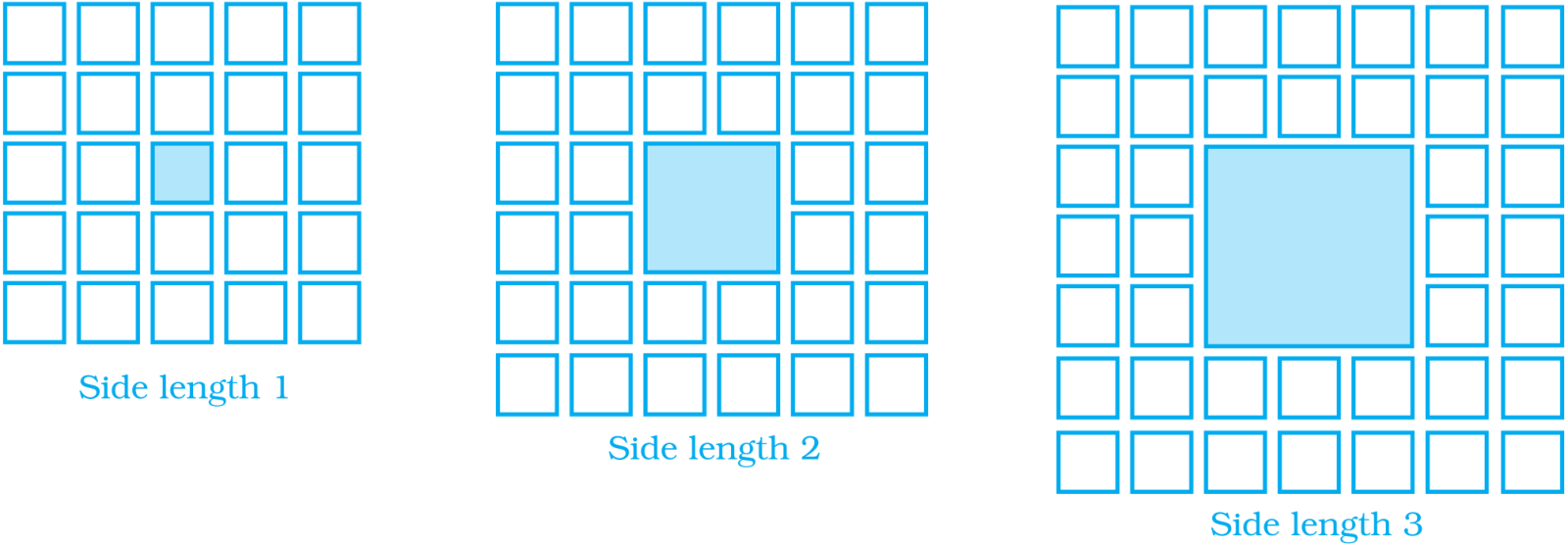
Sonal and Anmol made a sequence of tile designs from square white tiles surrounding one square purple tile. The purple tiles come in many sizes. Three of the designs are shown below.
$a.$ Copy and complete the table
Side Length of Purple
$1$
$2$
$3$
$4$
$5$
$10$
$100$
Number of white Tiles in Border
             

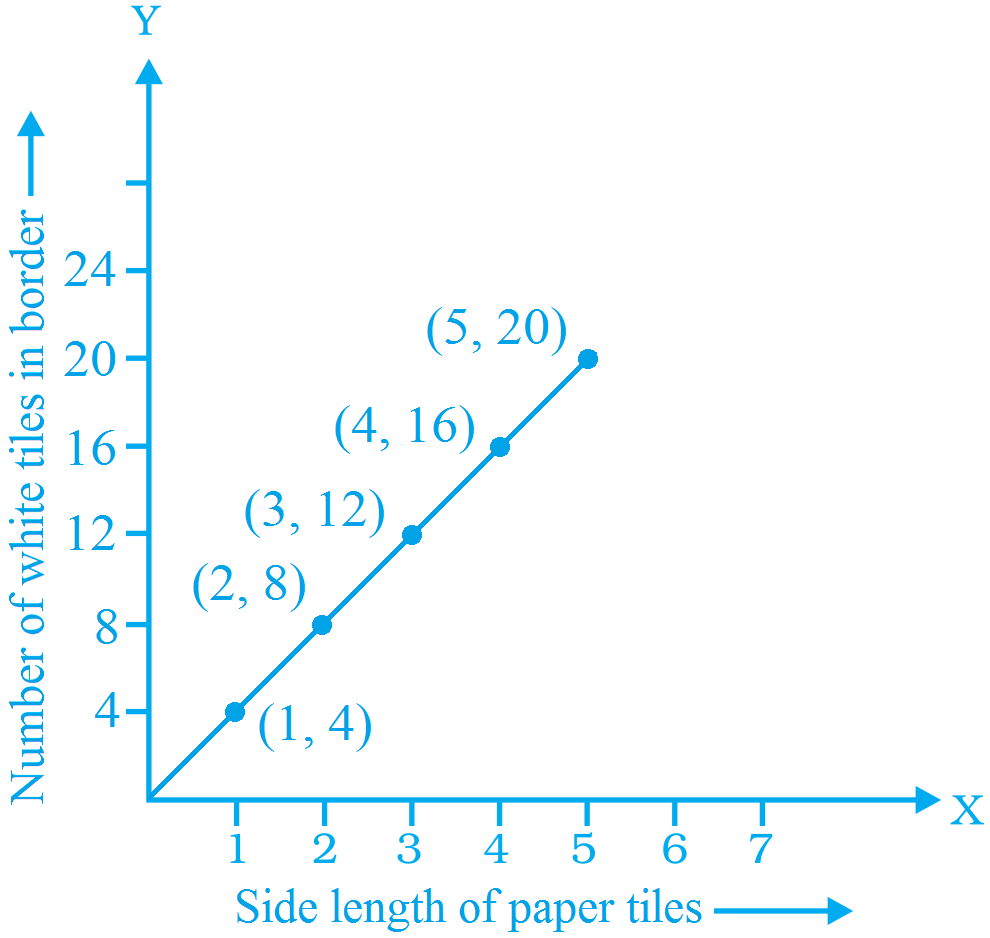
$b.$ Draw a graph using the first five pairs of numbers in your table.
$c.$ Do the points lie on a line?
Answer
$a.$ In side length $1$ the number of white tile surrounding purple tile Is $4$.
Similarly, in side length $2$ the number of white tiles surrounding purple tile is $8$.
Thus, we can arrange the following table which shows side length of purple corresponding to the number of white tiles in border.
Side length of purple
$1$
$2$
$3$
$4$
$5$
$10$
$100$
number of white tiles in border
$4$
$8$
$12$
$16$
$20$
$40$
$400$
Hence, the table show $y = 8x + 16$
$b.$ On the basis of table given in sol $(a)$ part, we draw the following graph

$c.$ If we join all points in above graph, we get a straight line. this shows, that all points lies on a line.
View full question & answer
Question 45 Marks
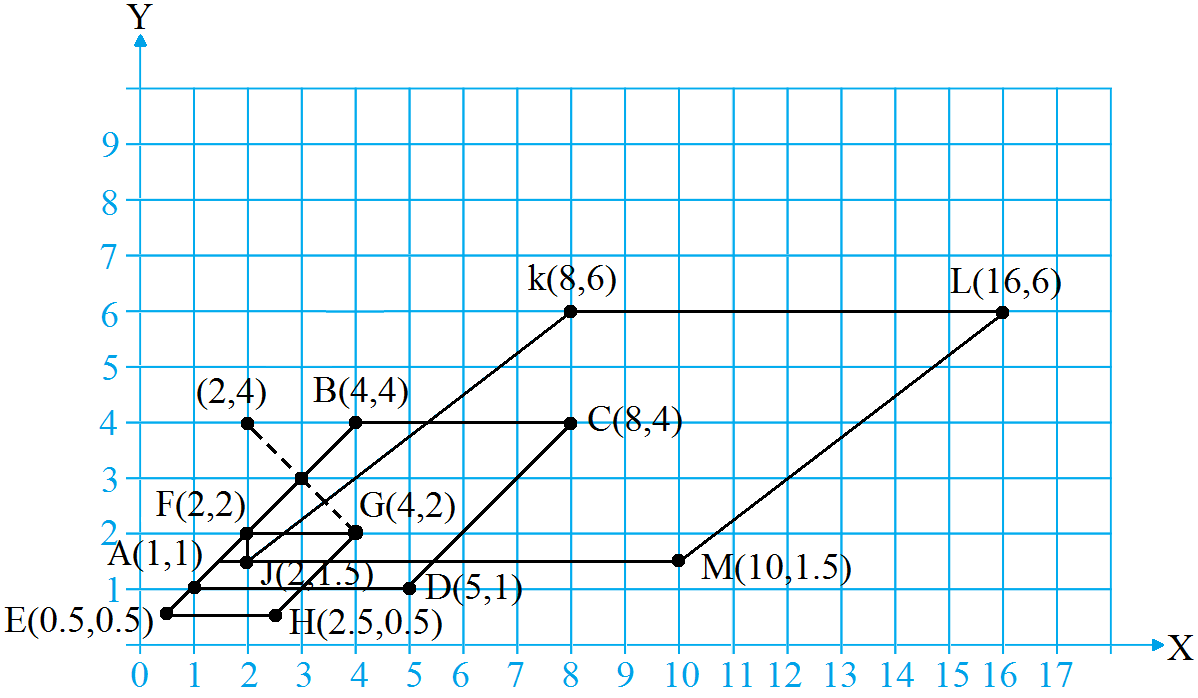
Draw a parallelogram $ABCD$ on a graph paper with the coordinates given in Table $I.$ Use this table to complete Tables $II$ and $III$ to get the coordinates of $E, F, G, H$ and $J, K, L, M$.
Table $I$
point
$(x, y)$
$A$
$(1, 1)$
$B$
$(4, 4)$
$C$
$(8, 4)$
$D$
$(5, 1)$
Table $II$
point
$(0.5x, 0.5y)$
$E$
$(0.5, 0.5)$
$F$
 
$G$
 
$H$
 
Table $III$
point
$(2x, 1.5y)$
$J$
$(2, 1.5)$
$K$
 
$L$
 
$M$
 
Draw parallelograms $EFGH$ and $JKLM$ on the same graph paper. Plot the points $(2, 4)$ and $(4, 2)$ on a graph paper, then draw a line segment joining these two points.
Answer
Complete table is shown below
point
$(0.5x, 0.5y)$
points
$(2x, 1.5y)$
$E$
$(0.5, 0.5)$
$J$
$(2, 1.5)$
$F$
$(2, 2)$
$K$
$(8, 6)$
$G$
$(4, 2)$
$L$
$(16, 6)$
$H$
$(2.5, 0.5)$
$M$
$(10, 15)$
View full question & answer
Question 55 Marks

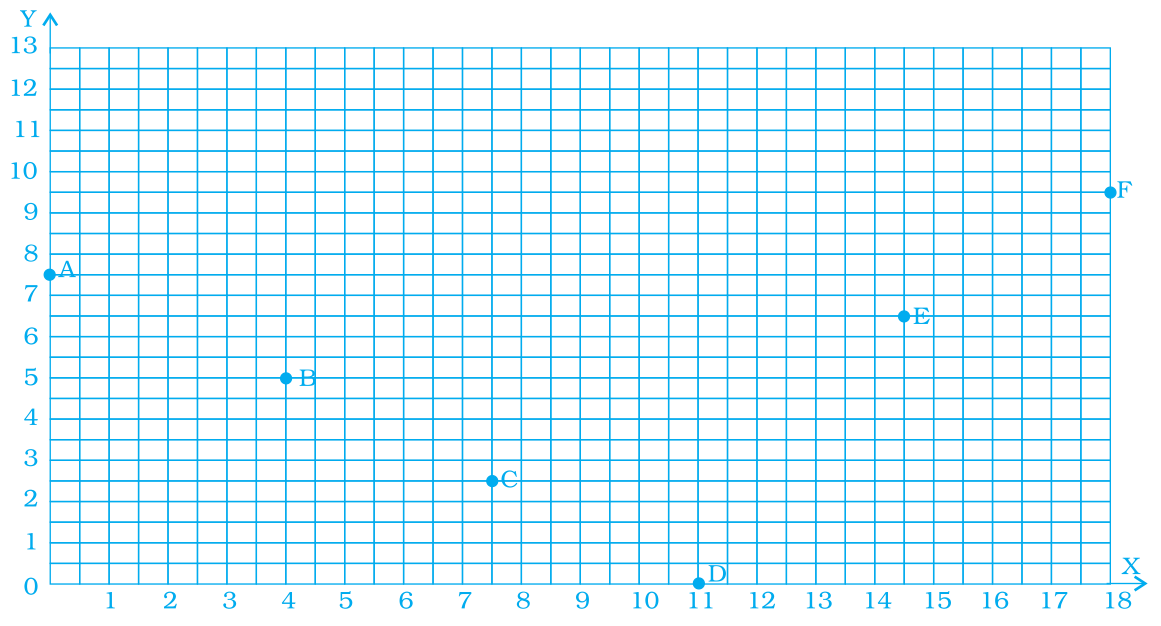
Find the coordinates of all letters in the graph given below.
Answer
The point $A$ is on the $Y$-axis at a distance of $7.5$ units from the origin.
$\therefore\ $The coordinates are $(0, 7.5)$.
The point $B$ is at a distance of $4$ units from $Y$-axis and $5$ units from $X$-axis.
$\therefore\ $ The coordinates of $B$ are $(4, 5)$.
The point $C$ is at a distance of $7.5$ units from $Y$-axis and $2.5$ units from $X$-axis .
$\therefore\ $The coordinates of $C$ denotes $(7.5, 2.5)$.
The point $D$ lies on $X$-axis at a distance of $11$ units from the origin.
$\therefore\ $The coordinates of $D$ are $(11, 0)$.
The point $£$ is at a distance of $14.5$ units from $Y$-axis and $6.5$ units from $X$-axis.
$\therefore\ $The coordinates of $£$ are $(14.5, 6.5).$
The point $F$ is at a distance of $18$ units from $Y$-axis and $9.5$ units from $X$-axis.
$\therefore\ $The coordinates of $£$ are $(18, 9.5)$.
View full question & answer
Question 65 Marks
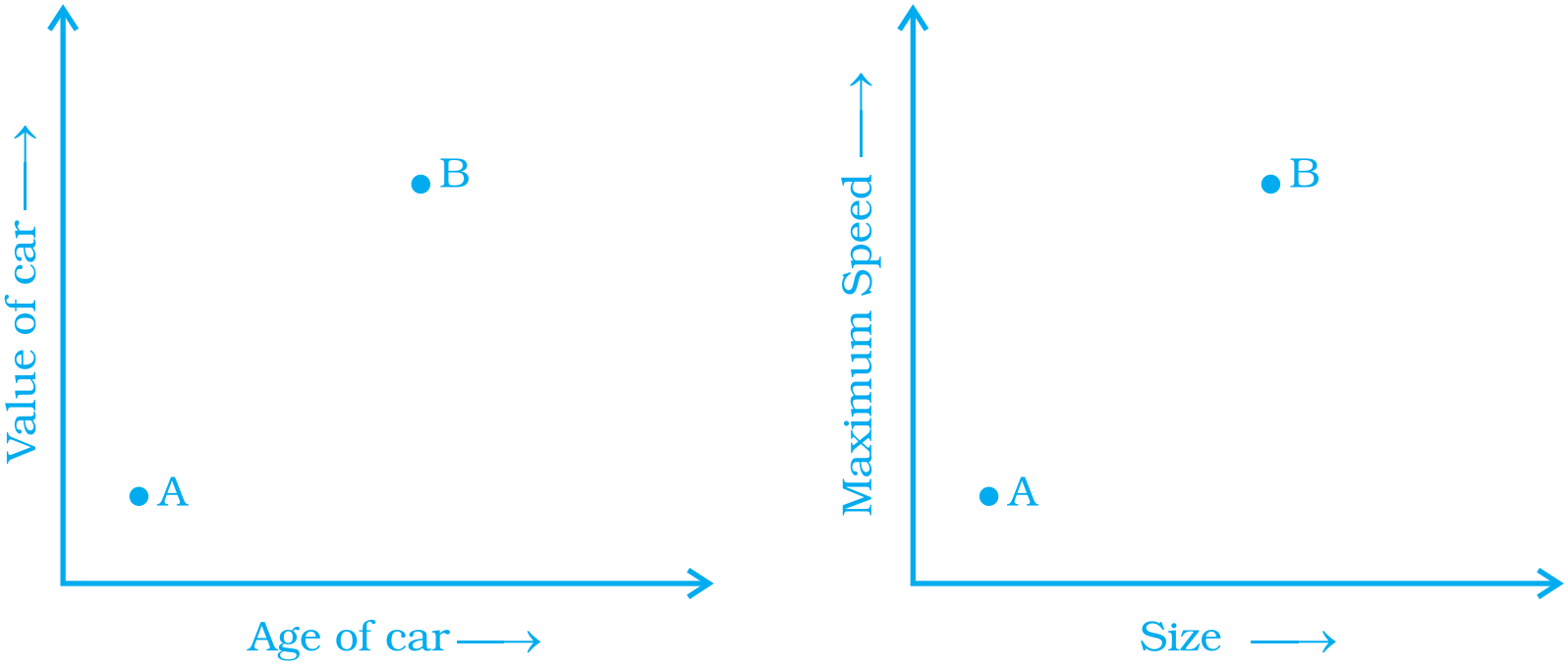
The two graphs below compare Car $A$ and Car $B$. The left graph shows the relationship between age and value. The right graph shows the relationship between size and maximum speed.

Use the graphs to determine whether each statement is true or false, and explain your answer.
$a.$ The older car is less valuable.
$b.$ The faster car is larger.
$c.$ The larger car is older.
$d.$ The faster car is older.
$e.$ The more valuable car is slower.
Answer
$a.$ False, the older car is $8$ i.e. $8$ valuable more than car $A$.
$b.$ True, in the second graph $8$ is larger car having greater speed.
$c.$ True, larger car is $8$ which is older than $A$
$d.$ True, as $8$ is faster as well as older than $A$.
$e.$ False, as $8$ is more valuable but not slower.
View full question & answer
Question 75 Marks
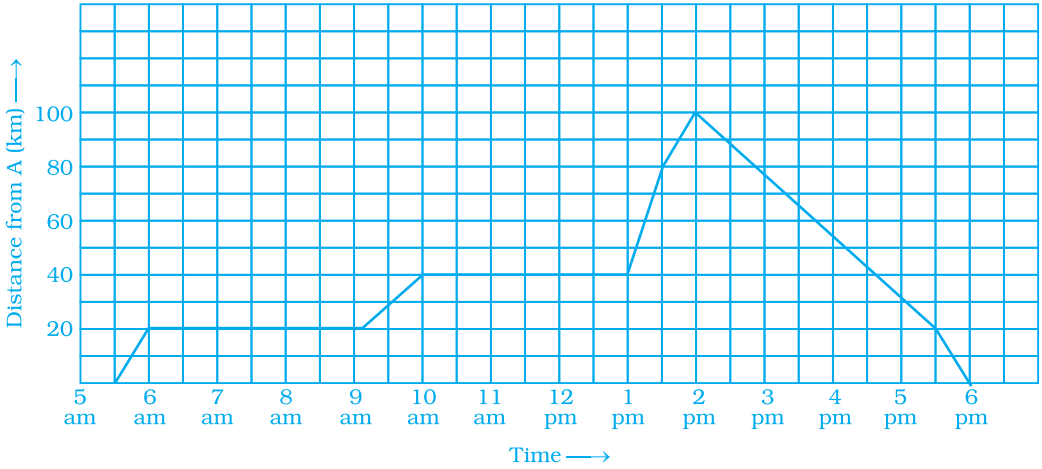
A man started his journey on his car from location $A$ and came back. The given graph shows his position at different times during the whole journey.

$a.$ At what time did he start and end his journey?
$b.$ What was the total duration of journey?
$c.$ Which journey, forward or return, was of longer duration?
$d.$ For how many hours did he not move?
$e.$ At what time did he have the fastest speed?
Answer
Analysing the graph carefully, we observe that
$a.$ He started his journey at $5:30\text{AM}$ and end at $6\text{PM}$.
$b.$ Total duration of journey was $12:30 h$.
$c.$ His forward journey is of duration $8:30 h$ and return journey is of duration $4\ h$. Forward journey was of longer duration.
$d.$ He did not move from $6:30\text{AM}$ to $9:30\text{ AM}$ and $10\text{AM}$ to $1\text{PM}$. So, he did not move for $6\ h$.
$e.$ He have the fastest speed at $1\text{PM}$.
View full question & answer
Question 85 Marks
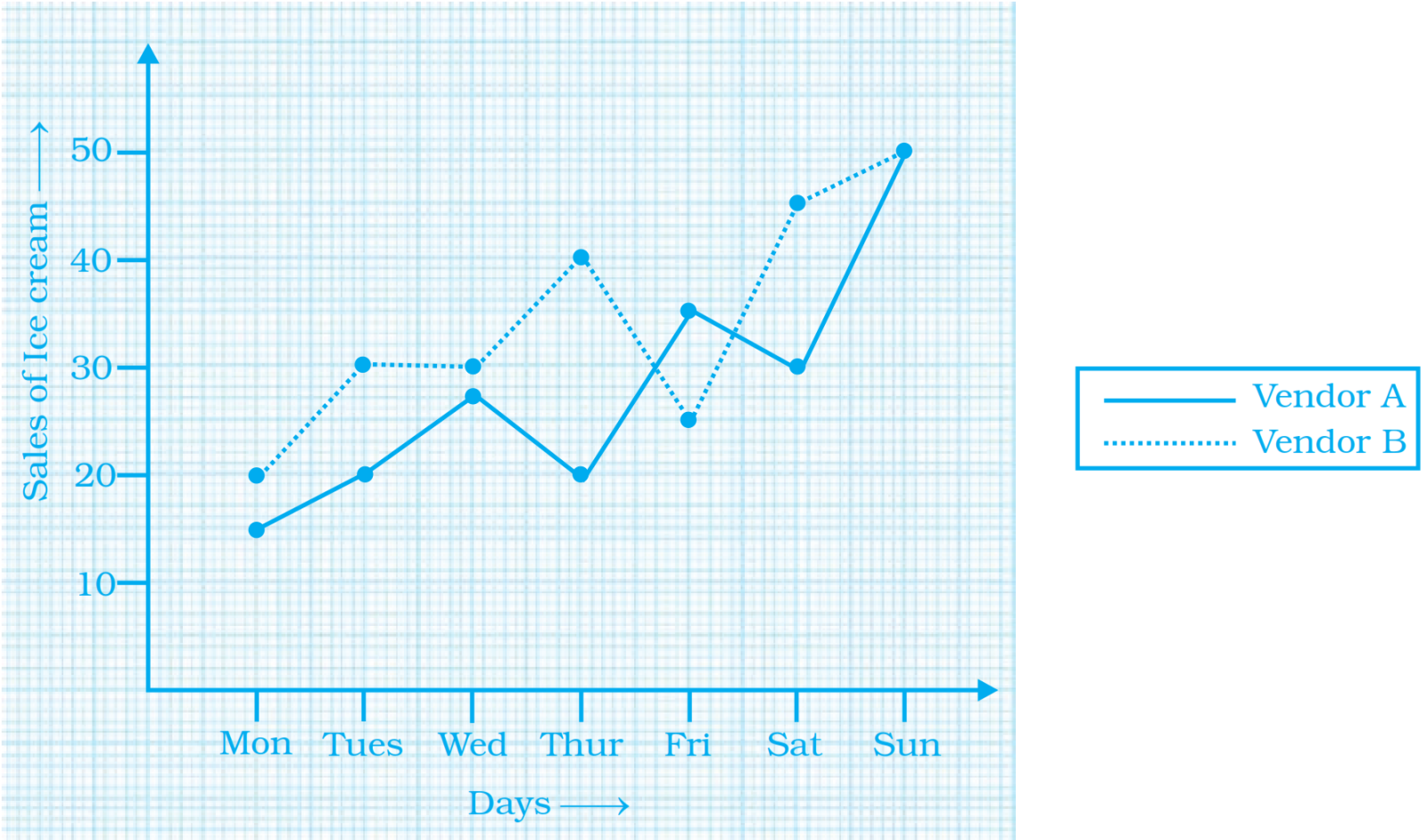
The graph given below compares the sales of ice creams of two vendors for a week.

Observe the graph and answer the following questions.
$a.$ Which vezndor has sold more ice$-$creams on Friday?
$b.$ For which day was the sales same for both the vendors?
$c.$ On which day did the sale of vendor $A$ increase the most as compared to the previous day?
$d.$ On which day was the difference in sales the maximum?
$e.$ On which two days was the sales same for vendor $B$?
Answer
Observing the graph carefully, we conclude that
$a.$ Vendor $A$ has sold more ice$-$creams on Friday.
$b.$ On Sunday , the sales was the same for both the vendors.
$c.$ On Sunday, the sale of vendor $A$ increased the most as compared to Saturday.
$d.$ The difference in sales was the maximum on Thursday.
$e.$ On Tuesday and Wednesday, the sales was the same for vendor $B$.
View full question & answer
Question 95 Marks
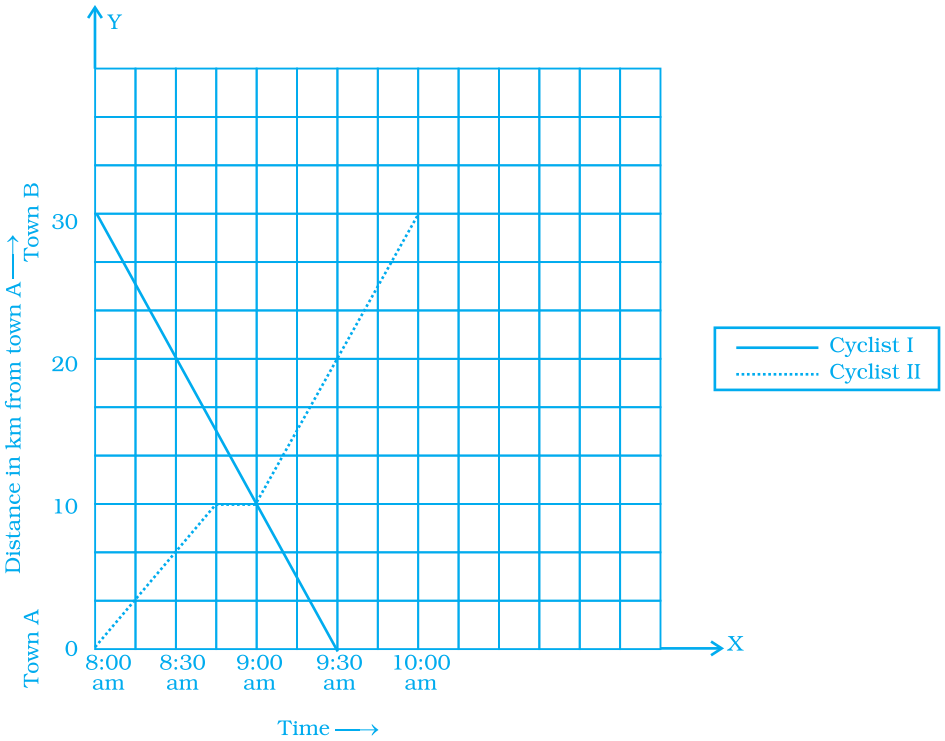
The following graph shows the journey made by two cyclists, one from town $A$ to $B$ and the other from town $Bx$ to $A$.
$a.$ At what time did cyclist $II$ rest? How long did the cyclist rest?
$b.$ Was cyclist $II$ cycling faster or slower after the rest?
$c.$ At what time did the two cyclists meet?
$d.$ How far had cyclist $II$ travelled when he met cyclist $I$?
$e.$ When cyclist $II$ reached town $A$, how far was cyclist $I$ from town $B$?

Answer
$a.$ On the basis of given graph, the cyclist $II$ rest at $8 : 45\text{AM}$ for $15$ min.
$b.$ Cyclist II is cycling faster after rest as he has covered a distance of $20\ km$ in $1h$.
$c.$ Both cyclists meet at $9:00\text{AM}$.
$d.$ The cyclist $II$ had travelled $10\ km$, when he met cyclist $I$.
$e.$ When cyclist $II$ reached town $A$, the cyclist $I$ was $10\ km$ for from town $B$.
View full question & answer
Question 105 Marks
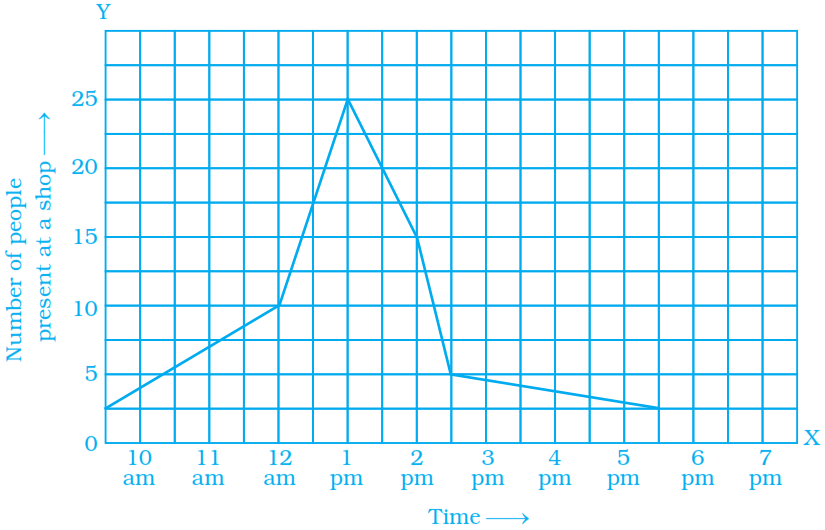
The following graph shows the number of people present at a certain shop at different times. Observe the graph and answer the following questions.

$a.$ What type of a graph is this?
$b.$ What information does the graph give?
$c.$ What is the busiest time of day at the shop?
$d.$ How many people enter the shop when it opens?
$e.$ About how many people are there in the shop at $1:30$ $pm$?
Answer
$a.$ This is a line graph.
$b.$ It represents the number of people, who visited the store at a particular time.
$c.$ The busiest time of day is $1\text{PM}$ at a shop, as at this time maximum number of people i.e. $25$ visited the shop.
$d.$ When it opens less than $5$ people enter the shop.
$e.$ There are $20$ people in the shop at $1:30\text{PM}$.
View full question & answer
Question 115 Marks
Study the distance$-$time graph given below for a car to travel to certain places and answer the questions that follow.
$a.$ How far does the car travel in $2′-h$?
$b.$ How much time does the car take to reach?
$c.$ How long does the car take to cover $80\ km$?
$d.$ How far is $Q$ from the starting point?
$e.$ When does the car reach the place $S$ after starting?
Answer
$a.$ From the given graph, the car travels $80\ km$ in $2\ h$.
$b. 5\ h$ taken by car to reach ft.
$c. 2\ h$ taken by car to cover $80\ km$.
$d. G$ is $120\ km$ far from the starting point.
$e.$ The car reaches the places after starting in $6\ h$.
View full question & answer
Question 125 Marks
The table given below shows the temperatures recorded on a day at different times.
Observe the graph and answer the following questions.
$a.$ What is the temperature at $8\text{AM}$?
$b.$ At what time is the temperature $3^\circ C$?
$c.$ During which hour did the temperature fall?
$d.$ What is the change in temperature between $7\text{AM}$ and $10\text{AM}$
$e.$ During which hour was there a constant temperature?
Answer
Observing the given graph carefully, we have
$a.$ At $8\text{AM}$, the temperature is $7^\circ C$.
$b.$ At $6\text{AM}$, the temperature is $3^\circ C$.
$c.$ The temperature fall in the hour $5\text{AM}$ to $6\text{AM}$.
$d.$ The change in temperature is $3^\circ C$ between $7\text{AM}$ and $10\text{AM}$.
$e.$ Between $8\text{AM}$ to $9\text{AM}$, there was a constant temperature.
View full question & answer
Question 135 Marks
Match the coordinates given in Column $A$ with the items mentioned in Column $B.$
 
Column $A$
 
Column $B$
$(1)$
$(0, 5)$
$(a)$
$y$ coordinate is $2 \times x - $coordinate $+\ 1$.
$(2)$
$(2, 3)$
$(b)$
Coordinates of origin.
$(3)$
$(4, 8)$
$(c)$
Only $y–$coordinate is zero.
$(4)$
$(3, 7)$
$(d)$
The distance from $x –$axis is $5$.
$(5)$
$(0, 0)$
$(e)$
$y$ coordinate is double of $x –$coordinate.
$(6)$
$(5, 0)$
$(f)$
The distance from $y–$axis is $2$.
Answer
 
Column A
 
Column B
$(1)$
$(0, 5)$
$(d)$
The distance from $x–$ axis is $5$.
$(2)$
$(2, 3)$
$(f)$
The distance from $y–$axis is $2$.
$(3)$
$(4, 8)$
$(e)$
$y$ coordinate is double of $x –$coordinate.
$(4)$
$(3, 7)$
$(a)$
$y$ coordinate is $2 \times x - $coordinate $+\ 1$.
$(5)$
$(0, 0)$
$(b)$
Coordinates of origin.
$(6)$
$(5, 0)$
$(c)$
Only $y–$coordinate is zero.
Solution:
$a.$ In the pair $(0, 5)$, the second number also known as ordinate represents the distance from $X-$axis, i.e. $5$.
$b.$ In the pair $(2, 3), 2$ the first number, also known as abscissa represents the distance from $Y-$axis that is $2$.
$c.$ We have the coordinates $(4, 8)$. Clearly, coordinate is double of $x-$coordinate.
$d.$ We have the coordinate $(3, 7)$, where $x-$coordinate $= 3$ and $y-$coordinate $= 7$
Evidently, $y-$coordinate $= 2 \times x-$coordinate $+\ 1$
$e. (0, 0)$ are the coordinates of origin.
$f.$ In the point $(5, 0)$, the $y-$coordinate is zero.
View full question & answer
Question 145 Marks
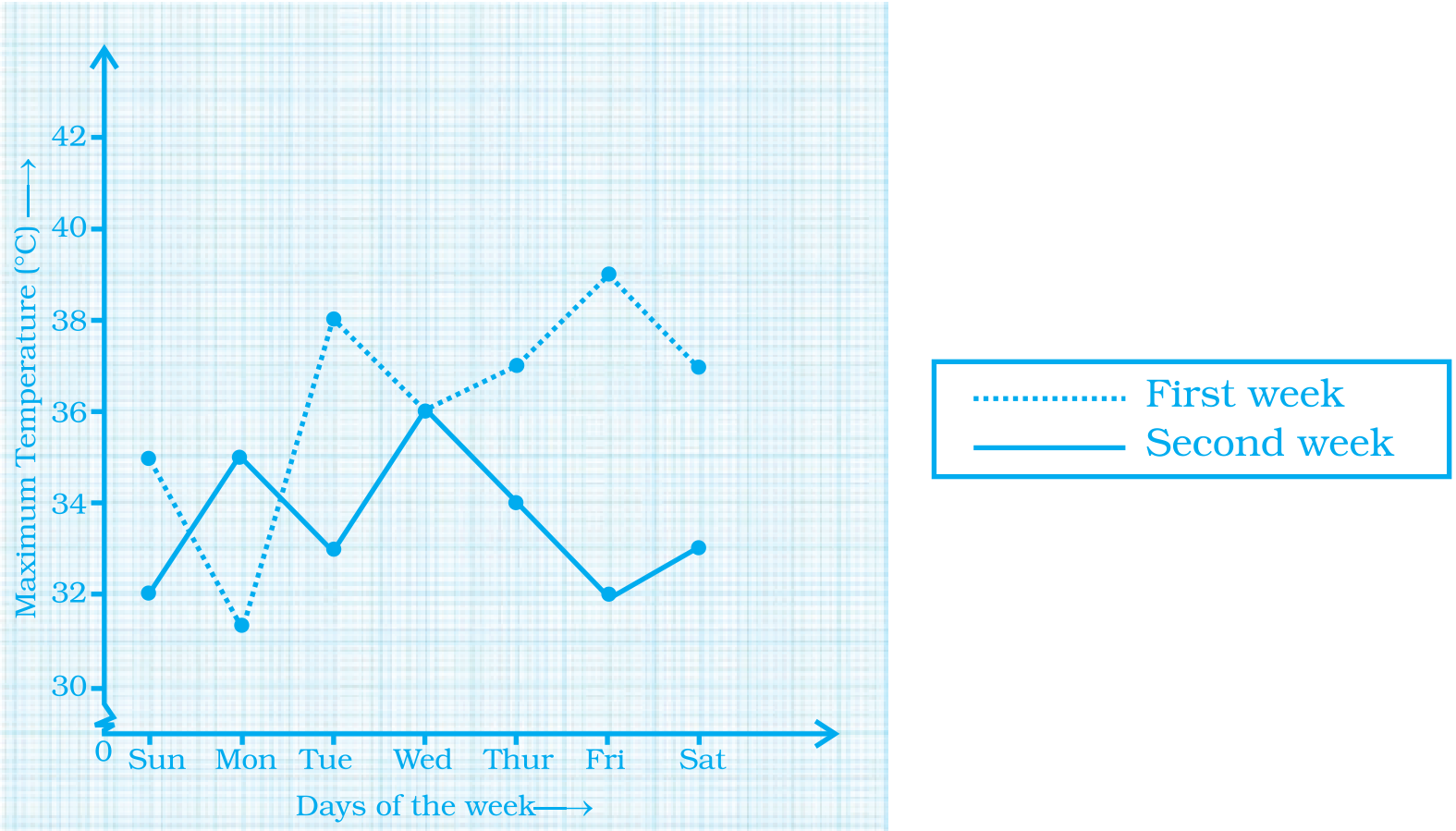
The graph shows the maximum temperatures recorded for two consecutive weeks of a town. Study the graph and answer the questions that follow.

$a.$ What information is given by the two axes?
$b.$ In which week was the temperature higher on most of the days
$c.$ On which day was the temperature same in both the weeks
$d.$ On which day was the difference in temperatures the maximum for both the weeks?
$e.$ What were the temperatures for both the weeks on Thursday?
$f.$ On which day was the temperature $35^\circ C$ for the first week?
$g.$ On which day was the temperature highest for the second week?
Answer
$a.$ The $X-$axis represents days of a particular week and the $X-$axis represents the maximum temperature $($in $^\circ C)$ recorded.
$b.$ Observing the graph, we see that in the first week temperature was higher on most of the days.
$c.$ The temperature was same on Wednesday in both the weeks.
$d.$ The difference in temperatures was the maximum on Friday for both the weeks.
$e.$ The temperature for the first week on Thursday was $37^\circ C$ and the temperature for the second week on the same day was $34^\circ C$.
$f.$ On Sunday, the temperature was $35^\circ\ $ for the first week.
$g.$ On Wednesday, the temperature was highest for the second week.
View full question & answer
Question 155 Marks
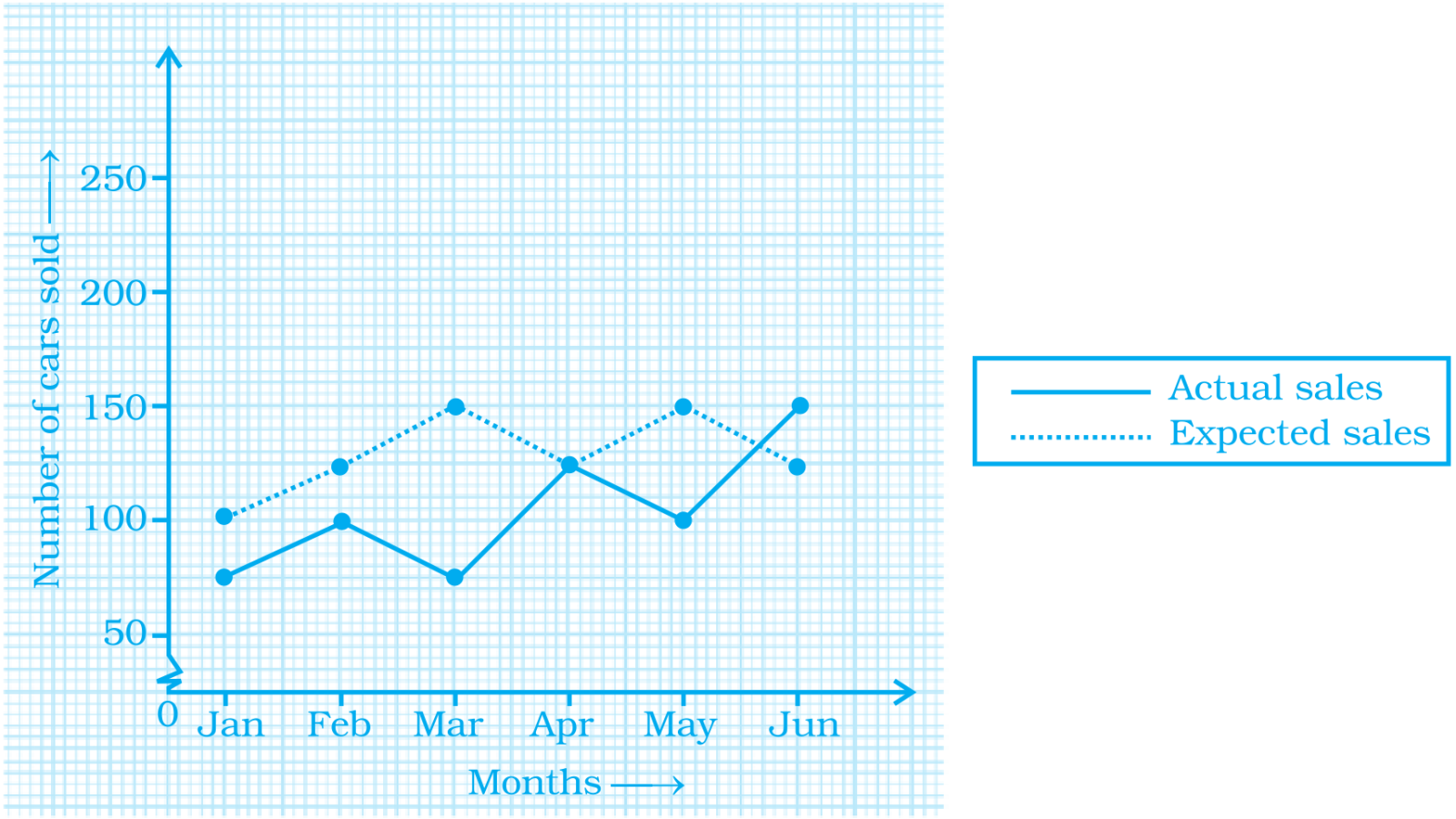
The graph given below gives the actual and expected sales of cars of a company for $6$ months. Study the graph and answer the questions that follow.

$a.$ In which month was the actual sales same as the expected sales
$b.$ For which month$($s$)$ was $($were$)$ the difference in actual and expected sales the maximum?
$c.$ For which month$($s$)$ was $($were$)$ the difference in actual and expected sales the least?
$d.$ What was the total sales of carc in the months$-$January, February and March?
$e.$ What is the average sales of cars in the last three months?
$f.$ Find the ratio of sales in the first three months to the last three months.answer the questions that follow.
Answer
Observing the graph carefully, we conclude that
$a.$ In April, the actual sales was same as the expected sales.
$b.$ In March, the difference in actual and expected sales was the maximum.
$c.$ In April, the difference in actual and expected sales was the least.
$d.$ The total sales of cars in the months January, February and March was $(75 + 100+75)$ i.e. $250$.
$e.$ The average sales of cars in the last three months is $125$ i.e.$125+100+\frac{150}{3}=125$
$f.$ The number of sales of car in the first three months $= 250$ and the number of sales of car in the last three months $= 375$
The required ratio is $250 : 375$ i.e. $2:3$,
View full question & answer
Question 165 Marks
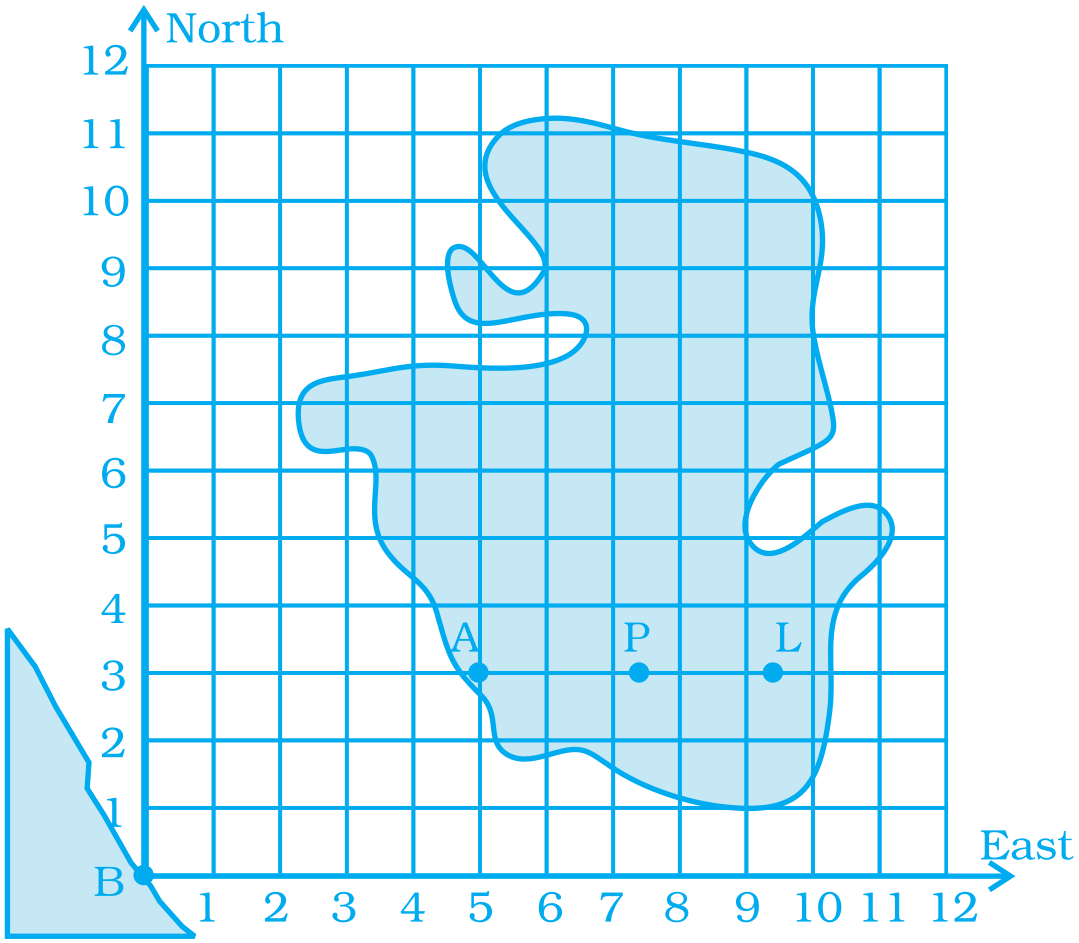
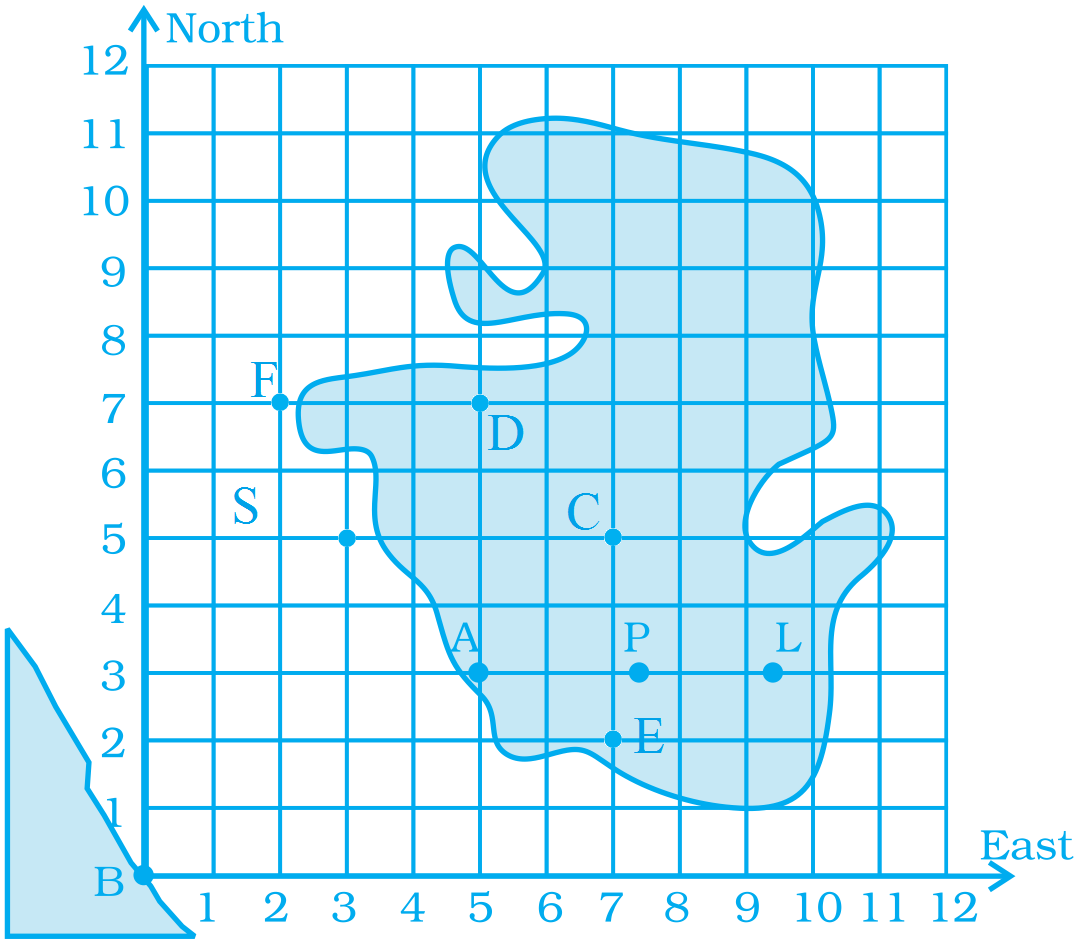
This graph shows a map of an island just off the coast of a continent. The point labelled $B$ represents a major city on the coast. The distance between grid lines represents $1\ km$.

 Point $A$ represents a resort that is located $5\ km$ East and $3\ km$ North of Point $B$. The values $5$ and $3$ are the coordinates of Point $A$. The coordinates can be given as the ordered pair $(5, 3)$, where $5$ is the horizontal coordinate and $3$ is the vertical coordinate.
$i.$ On a copy of the map, mark the point that is $3\ km$ East and $5\ km$ North of Point $B$ and label it $S$. Is Point $S$ in the water or on the island? Is Point $S$ in the same place as Point $A$?
$ii.$ Mark the point that is $7\ km$ east and $5\ km$ north of Point $B$ and label it $C$. Then mark the point that is $5\ km$ east and $7\ km$ north of Point $B$ and label it $D$. Are Points $C$ and $D$ in the same place? Give the coordinates of Points $C$ and $D$.
$iii.$ Which point is in the water, $(2, 7)$ or $(7, 2)$? Mark the point which is in water on your map and label it $E$.
$iv.$ Give the coordinates of two points on the island that are exactly $2\ km$ from Point $A$.
$v.$ Give the coordinates of the point that is halfway between Points $L$ and $P$.
$vi.$ List three points on the island with their $x-$coordinates greater than $8$.
$vii.$ List three points on the island with a $y-$coordinate less than $4$.
Answer

$i.$ The points is in the water.
No, it is not in the same place as point $A$
$ii.$ No, they are not in the same place. The coordinates of points $C$ and $D$ are $(7, 5)$ and $(5, 7)$, respectively.
$iii. (2, 7)$ is in the water.
$iv. (7, 3), (5, 5)$
$v. (8.5, 3)$
$vi. (9, 4), (10, 4), (11, 5)$
$vii. (5, 3), (6, 2), (7, 2)$
Note Answer for option $(vi)$ and $(vii)$ may vary from student to student
View full question & answer
Question 175 Marks
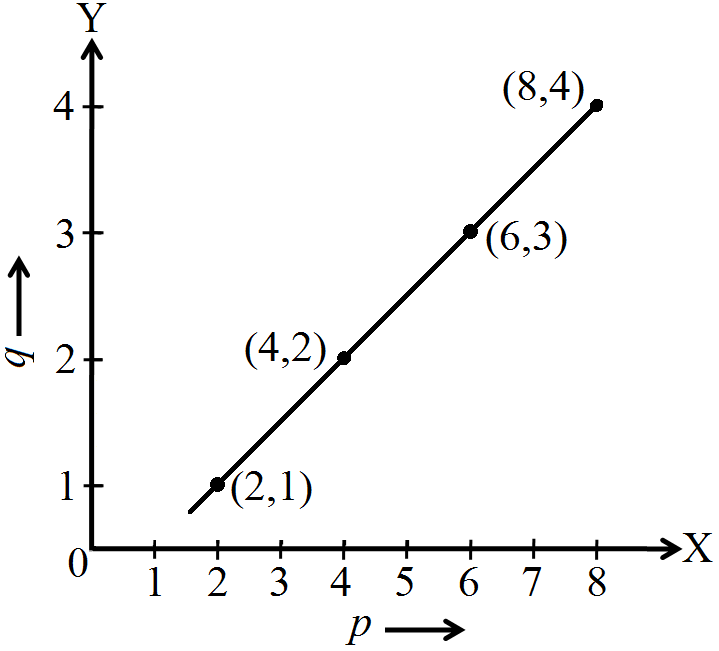
Plot a line graph for the variables $p$ and $q$, where $p$ is two times $q$ i.e. the equation is $p = 2q$. Then, find
$a.$ The value of $p$ when $q = 3$.
$b.$ The value of $q$ when $p = 8$.
Answer
Given, equation is $p = 2q$ If $p = 2$,
then $q$ $=\frac{\text{p}}{2}= \frac{2}{2}=1$
 If $p =4$, then $q=\frac{\text{p}}{2}=\frac{4}{2}=2$
if $p = 6$, then $q=\frac{\text{p}}{2}=\frac{6}{2}=3$
if $p = 8$, then $q =\frac{\text{p}}{2}=\frac{8}{2}=4$
Hence, table for the graph
$p$
$2$
$4$
$6$
$8$
$q$
$1$
$2$
$3$
$4$

$a.$ When $q = 3$, the value of $p$ is $6$.
$b.$ When $p = 8$, the value od $q$ is $4$.
View full question & answer
Question 185 Marks
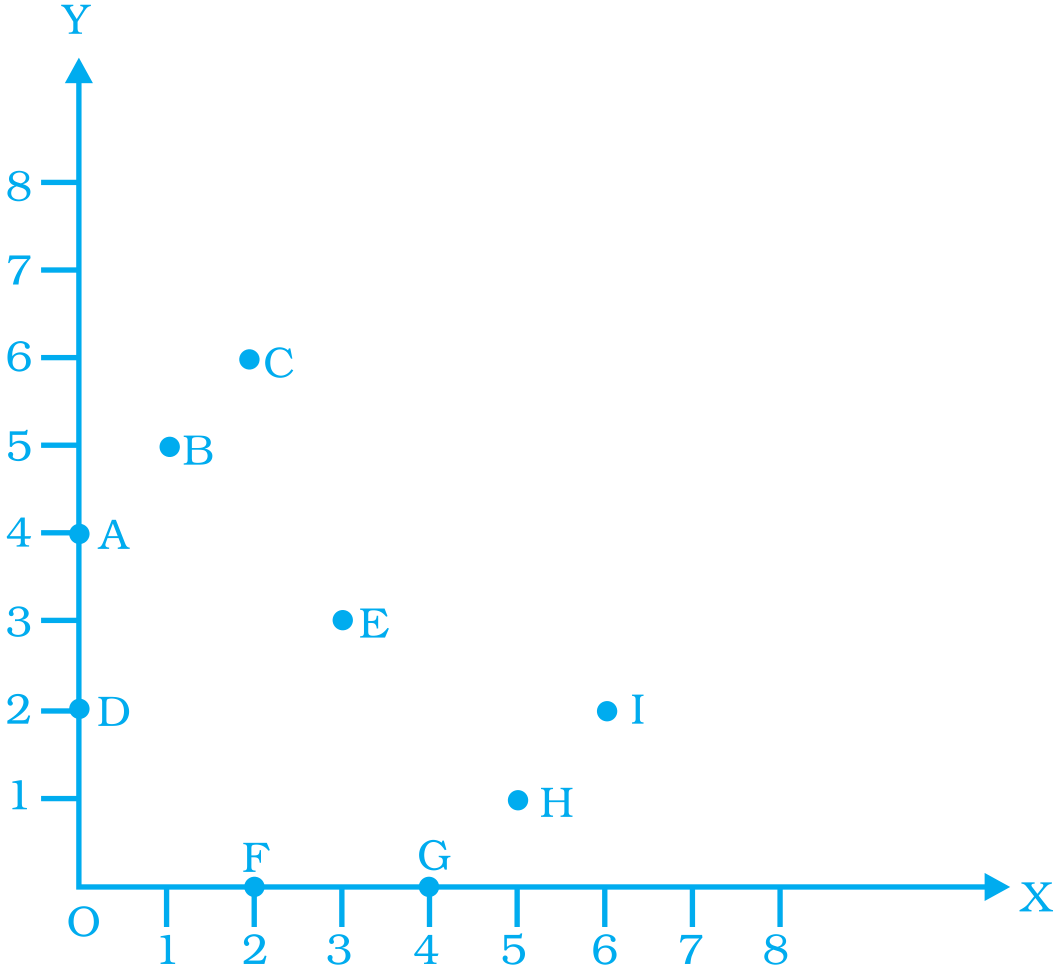
From the given graph, choose the letters that indicate the location of the points given below.

$a. (2, 0)$
$b. (0, 4)$
$c. (5, 1)$
$d. (2, 6)$
$e. (3,3)$
Answer
On observing the graph, we see that the point $F$ is on $X-$axis, so its $Y-$coordinate will be zero.
Also, it is at a distance of $2$ units from origin.
$\therefore\ $The coordinates of $F$ are $(2, 0)$, similarly the coordinates of $G$ are $(4, 0)$.
$H$ is at a distance of $5$ units from $Y-$axis and $1$ unit from $X-$axis.
$\therefore\ $ The coordinates of Hare $(5, 1)$.  is at a distance of $6$ units from $Y-$axis and $2$ units from $X-$axis.
$\therefore\ $ The coordinates of  are $(6, 2)$. The point $D$ and $A$ are on $Y-$axis at distances of $2$ units and $4$ units respectively from the origin.
Hence, the coordinates of $D$ and $A$ are $(0, 2)$ and $(0, 4)$, respectively.
$B$ is at a distance of $1$ unit from $Y-$axis and $5$ units from $X-$axis.
$\therefore\ $The coordinates of Bare $(1, 5)$.
$C$ is at a distance of $2$ units from $Y-$axis and $6$ units from $X-$axis.
 $\therefore\ $ The coordinates of $C$ are $(2, 6)$.
$E$ is at a distance of $3$ units from $Y-$axis and $X-$axis both.
$\therefore\ $The coordinates of $E$ are $(3, 3)$.
View full question & answer
Question 195 Marks
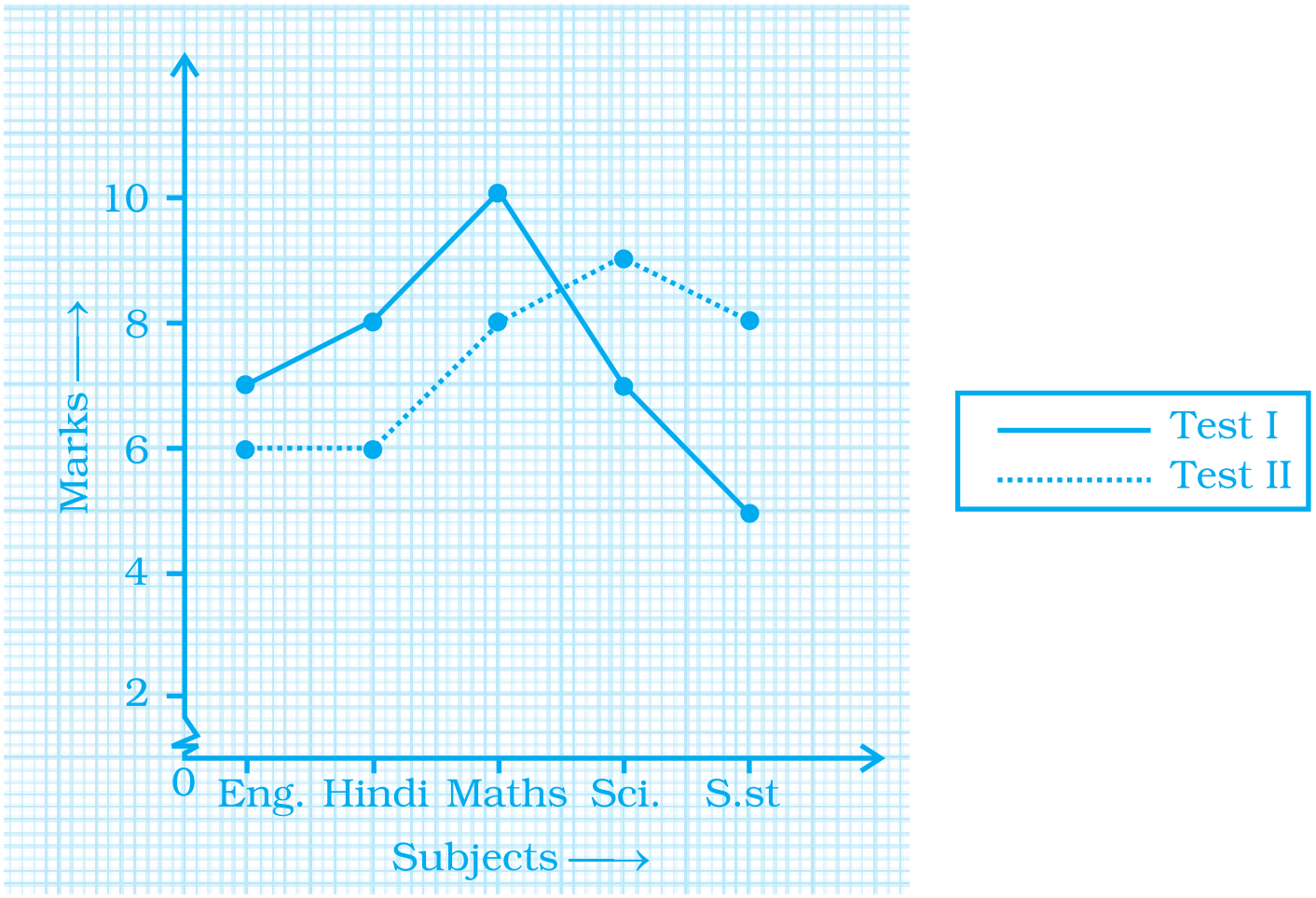
he graph given below shows the marks obtained out of $10$ by Sonia in two different tests. Study the graph and answer the questions that follow.

$a.$ What information is represented by the axes?
$b.$ In which subject did she score the highest in Test $I$?
$c.$ In which subject did she score the least in Test $II$?
$d.$ In which subject did she score the same marks in both the Tests?
$e.$ What are the marks scored by her in English in Test $II$?
$f.$ In which test was the performance better?
$g.$ In which subject and which test did she score full marks?
Answer
Observing the graph carefully, we conclude that
$a.$ The $X-$axis represents subjects and the $Y-$axis represents the marks obtained by Sonia.
$b.$ In Maths, she scored the highest in Test $I$.
$c.$ In English and Hindi, she scored the least in Test $II$.
$d.$ In Hindi and Maths, she scored the same marks in both tests.
$e.$ She scored $6$ marks in English in Test $II$.
$f.$ Same performance in both tests.
$g.$ Test $I$ in Maths, she scored full marks i.e. $10$ marks.
View full question & answer
Question 205 Marks
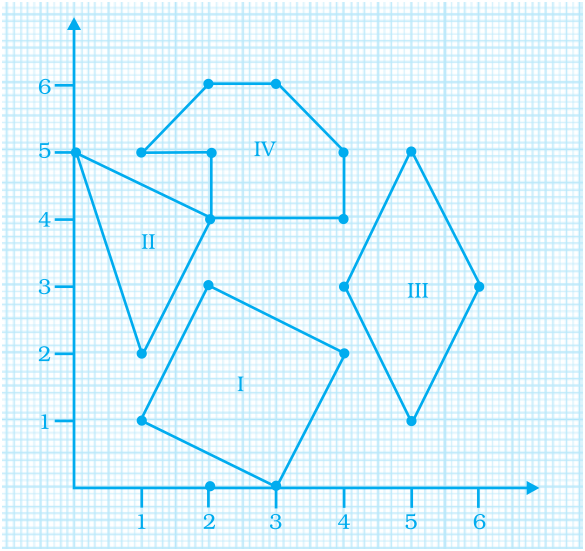
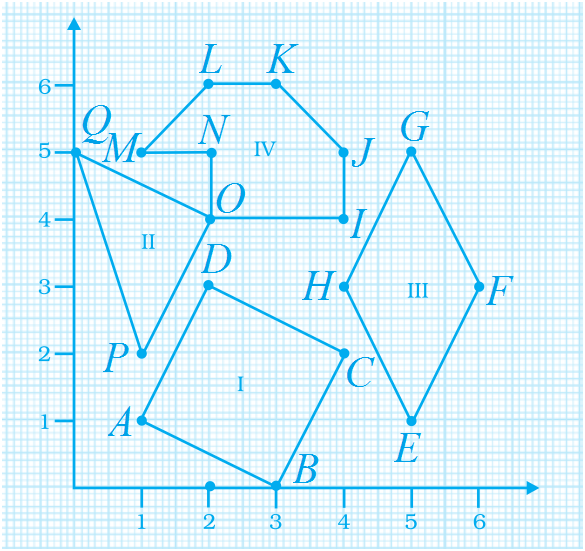
Find the coordinates of the vertices of the given figures.
Answer
$A$
$(1, 1)$
$B$
$(3, 0)$
$C$
$(2, 3)$
$D$
$(2, 3)$
$E$
$(5, 1)$
$F$
$(6, 3)$
$G$
$(5, 5)$
$H$
$(4, 3)$
$I$
$(4, 4)$
$J$
$(4, 5)$
$K$
$(3, 6)$
$L$
$(2, 6)$
$M$
$(1, 5)$
$N$
$(2, 5)$
$O$
$(2, 4)$
$P$
$(1, 2)$
$Q$
$(0, 5)$
 
 
View full question & answer
Question 215 Marks
Match the ordinates of the points given in Column $A$ with the items mentioned in Column $B$
 
Column $A$
 
Column $B$
$(a)$
$(7, 0)$
$(i)$
The ordinate is double the abscissa.
$(b)$
$(11, 11)$
$(ii)$
The ordinate is zero.
$(c)$
$(4, 8)$
$(iii)$
The ordinate is equal to the abscissa.
$(d)$
$(6, 2)$
$(iv)$
The abscissa is double the ordinate.
$(e)$
$(0, 9)$
$(v)$
The abscissa is triple the ordinate.
$(f)$
$(6, 3)$
$(vi)$
The abscissa is zero.
Answer
 
Column $A$
 
Column $B$
$(a)$
$(7, 0)$
$(i)$
The ordinate is zero.
$(b)$
$(11, 11)$
$(ii)$
The ordinate is equal to the abscissa.
$(c)$
$(4, 8)$
$(iii)$
The ordinate is double the abscissa.
$(d)$
$(6, 2)$
$(iv)$
The abscissa is triple the ordinate.
$(e)$
$(0, 9)$
$(v)$
The abscissa is zero.
$(f)$
$(6, 3)$
$(vi)$
The abscissa is double the ordinate.
Solution:
$a.$ learly, the ordinate of the point $(7,0)$ is zero.
$b.$ In the point $(11,11)$, the ordinate is equal to the abscissa.
$c.$ In the point $(4,8)$, the ordinate is double of the abscissa.
$d.$ In the point $(6,2)$, the abscissa, i.e. $x-$coordinate is
triple of theordinate, i.e. $y-$coordinate.
$e.$ The abscissa of the point $(0,9)$ is zero.
$f.$ Clearly,the abscissa is double of the ordinate.
View full question & answer
Question 225 Marks
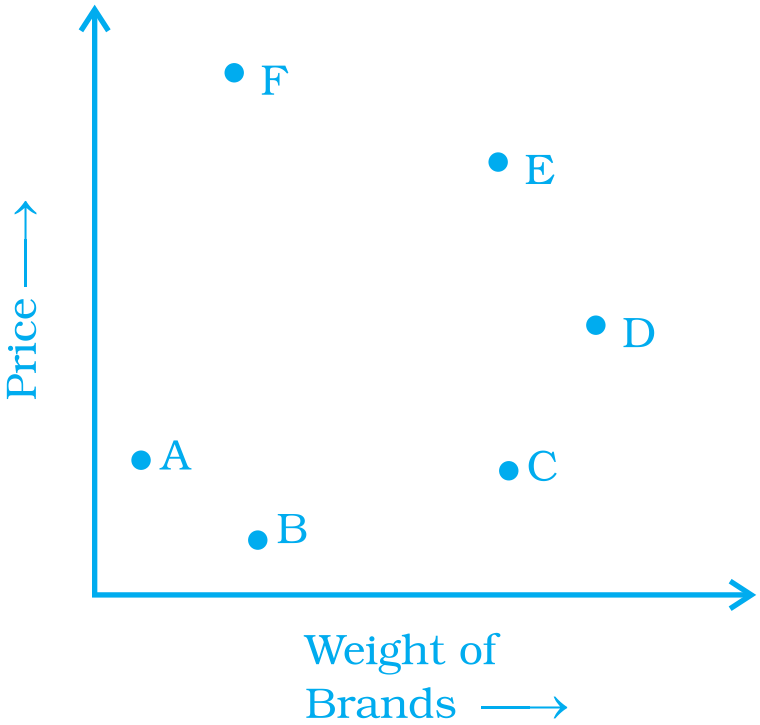
The graph given below compares the price $($ in $Rs.)$ and weight of $6$ bags $($in $kg)$ of sugar of different brands $\text{A, B, C, D, E, F}$.
$a.$ Which brand$(s)$ costs/cost more than Brand $D$?
$b.$ Bag of which brand of sugar is the heaviest?
$c.$ Which brands weigh the same?
$d.$ Which brands are heavier than brand $B$?
$e.$ Which bag is the lightest?
$f.$ Which bags are of the same price?
Answer
$a.$ On observing the graph carefully, we note that
$b.$ The brands $E$ and $F$ cost more than brand $D$.
$c.$ The bag of sugar of brand $D$ is the heaviest.
$d.$ The weights of bag of brand $S$ and $F$; brand $E$ and $C$ weighs same.
$e.$ Brands $\text{C, D, E}$ are heavier than brand $B$.
$f.$ Bag of brand $A$ is the lightest.
$g.$ Bags of brand $A$ and $C$ are of the same price.
View full question & answer
Question 235 Marks
Study the graph given below of a person who started from his home and returned at the end of the day. Answer the questions that follow.
$a.$ At what time did the person start from his home?
$b.$ How much distance did he travel in the first four hours of his journey?
$c.$ What was he doing from $3\text{PM}$ to $5\text{PM}$?
$d.$ What was the total distance travelled by him throughout the day?
$e.$ Calculate the distance covered by him in the first $8h$ of his journey.
$f.$ At what did he cover $16\ km$ of his journey?
$g.$ Calculate the average speed of the man from $A$ to $B$ and $B$ to $C$.
$h.$ At what time did he return home?
Answer
Observing the graph carefully, we conclude that
$a.$ At $10\text{AM},$ the person start from his home.
$b.$ In first $4\ h ($i.e. till $2\text{PM}),$ he travelled $16\ km$.
$c.$ He was taking rest from $3\text{PM}$ to $5\text{PM}$.
$d.$ The total distance covered by the person throughout the day was $40\ km$, i.e. $20\ km$ from $A$ to Sand then $20\ km$ from $C$ to $D$.
$e.$ The distance covered by him in the first $8\ h$ i.e. from $10\text{AM}$ to $6\text{PM}$ was $24\ km$.
$f.$ He covered $16\ km$ of his journey at $2\text{PM}$.
$g.$ The total distance covered from $A$ to $S=20\ km$.
The time taken to travel from $A$ to $B = 5h$
$\therefore$ Average speed of the man from $A$ to $B$
$=\frac{20}{5}=4\text{km/h}$
Average speed from Sto $C=\frac{0}{2}=0\text{km/h}$
$h.$ He returned home at $10\text{PM}$.
View full question & answer