Questions · Page 2 of 5

M.C.Q

MCQ 511 Mark
If one angle of a triangle is equal to the sum of the other two angles, then the triangle is:
  • A
    An isosceles triangle.
  • B
    An obtuse triangle.
  • C
    An equilateral triangle.
  • A right triangle.
Answer
Correct option: D.
A right triangle.
In a right triangle, one angle is 90° and the sum of acute angles of a right triangle is $90^\circ .$
View full question & answer
MCQ 521 Mark
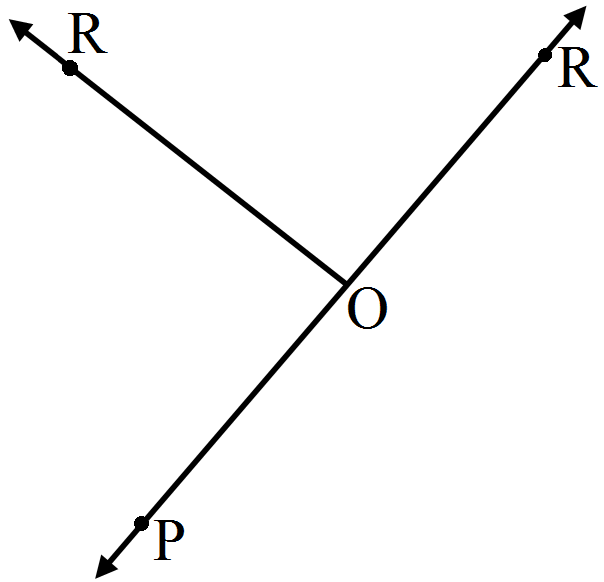
Given $\angle\text{POR}=3\text{x}$ and $\angle\text{QOR}=2\text{x}+10^\circ.$If $POQ$ is a straight line, then the value of $x$ is:
  • A
    $30^\circ$
  • $34^\circ$
  • C
    $36^\circ$
  • D
    None of these
Answer
Correct option: B.
$34^\circ$

$\angle\text{POR}=3\text{x}$ and $\angle\text{QOR}=2\text{x}+10^\circ$
From figure, we can see that $\angle\text{POR}$ and $\angle\text{QOR}$ are two adjacent angles and are supplement.
$\Rightarrow\ \angle\text{POR}+\angle\text{QOR}=180^\circ$
$\Rightarrow\ 3\text{x}+2\text{x}+10^\circ=180^\circ$
$\Rightarrow\ 5\text{x}=170^\circ$
$\Rightarrow\ \text{x}=34^\circ$
View full question & answer
MCQ 531 Mark
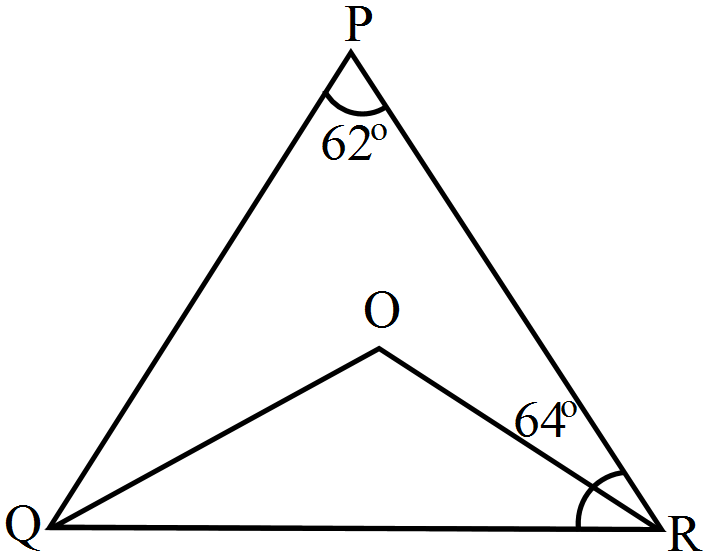
In the adjoining figure $\angle\text{QPR}=62^\circ$ and $\angle\text{PRQ}=64^\circ$ If $OQ$ and $OR$ and bisectors of $\angle\text{PQR}$ and $\angle\text{PRQ}$ respectively, then $\angle\text{OQR}$ and $\angle\text{QOR}:$
  • A
    $121^\circ , 20^\circ$
  • $27^\circ , 121^\circ$
  • C
    $20^\circ , 80^\circ$
  • D
    $26^\circ , 124^\circ$
Answer
Correct option: B.
$27^\circ , 121^\circ$
In $\triangle\text{PQR}$
$\angle\text{QPR}+\angle\text{PQR}+\angle\text{PRQ}=180^\circ$ (Angle sum property)
$\angle\text{PQR}=180^\circ-62^\circ-64^\circ$
$\angle\text{PQR}=54^\circ$
$\angle\text{ORQ}=32^\circ$ (OR is a bisector)
$\angle\text{OQR}=27^\circ$ (OR is a bisector)
In $\triangle\text{OQR}$
$\angle\text{OQR}+\angle\text{ORQ}+\angle\text{QOR}=180^\circ$ (Angle sum property)
$\angle\text{QOR}=180^\circ-32^\circ-27^\circ=121^\circ$
View full question & answer
MCQ 541 Mark
Two lines $AB$ and $CD$ intersect at $O$. If $\angle\text{AOC}+\angle\text{COB}+\angle\text{BOD}=270^\circ,$ then $\angle\text{AOC}=$
  • A
    $180^\circ$
  • B
    $70^\circ$
  • C
    $80^\circ$
  • $90^\circ$
Answer
Correct option: D.
$90^\circ$
Given that,
$AB$ and $CD$ intersect at $O$
$\angle\text{AOC}+\angle\text{COB}+\angle\text{BOD}=270^\circ\text{(i)}$
$\angle​\text{COB}+\angle\text{BOD}=180^\circ$ (Linear pair) $(ii)$
Using $(ii)$ in $(i)$, we get
$\angle​\text{AOC}+180^\circ=270^\circ$
$​\text{AOC}=90^\circ.$
View full question & answer
MCQ 551 Mark
Given two distinct points $P$ and $Q$ in the interior of $\angle\text{ABC},$ then $\overrightarrow{\text{AB}}$ will be:
  • A
    In the exterior of $\angle\text{ABC}$
  • On the $\angle\text{ABC}$
  • C
    On the both sides of $\overrightarrow{\text{BA}}$
  • D
    In the interior of $\angle\text{ABC}$
Answer
Correct option: B.
On the $\angle\text{ABC}$
$\overrightarrow{\text{AB}}$ is a line which from $\angle\text{ABC}$ and it is the part of $\triangle\text{ABC}.$
View full question & answer
MCQ 561 Mark
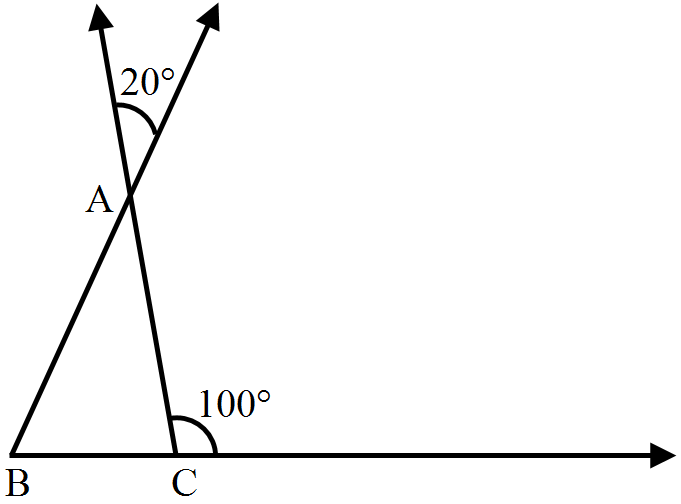
In the given figure, the measure of $\angle\text{ABC}$ is:
  • A
    $20^\circ$
  • $80^\circ$
  • C
    $60^\circ$
  • D
    $100^\circ$
Answer
Correct option: B.
$80^\circ$
$\angle\text{A}=20^\circ$ (Vertical opp Angle)
In $\angle\text{ABC}$
The exterior angle so formed is equal to the sum of the two interior opposite angles.
$\angle\text{A}+\angle\text{ABC}=100^\circ$
$20^\circ+\angle\text{ABC}=100$
$\angle\text{ABC}=100^\circ-20^\circ$
$\angle\text{ABC}=180^\circ.$
View full question & answer
MCQ 571 Mark
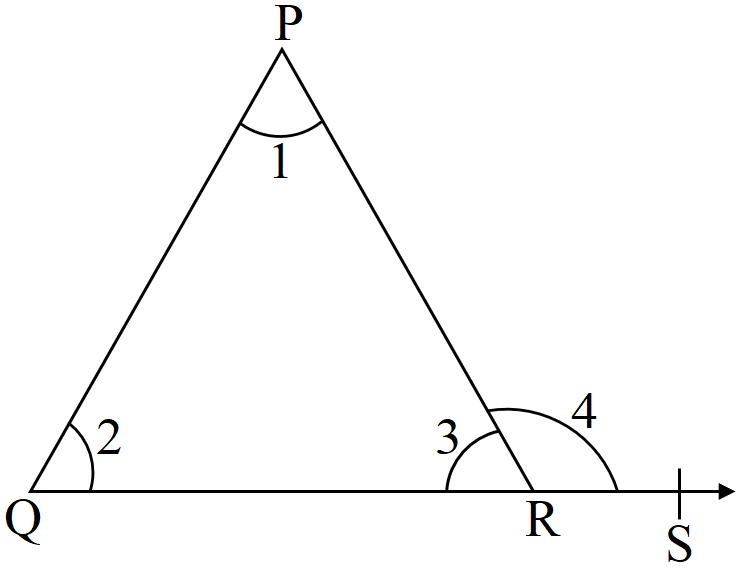
The exterior angle of a triangle is equal to the sum of two:
  • Interior opposite angles.
  • B
    Alternate angles.
  • C
    Exterior angles.
  • D
    Interior angles.
Answer
Correct option: A.
Interior opposite angles.

$\angle1+\angle2+\angle3=180^\circ$ (Angle sum property) $(a)$
$\angle3+\angle4=180^\circ$ (Linear pair) $(b)$
On equating equations a and b, we get
$\angle1+\angle2=\angle4.$
View full question & answer
MCQ 581 Mark
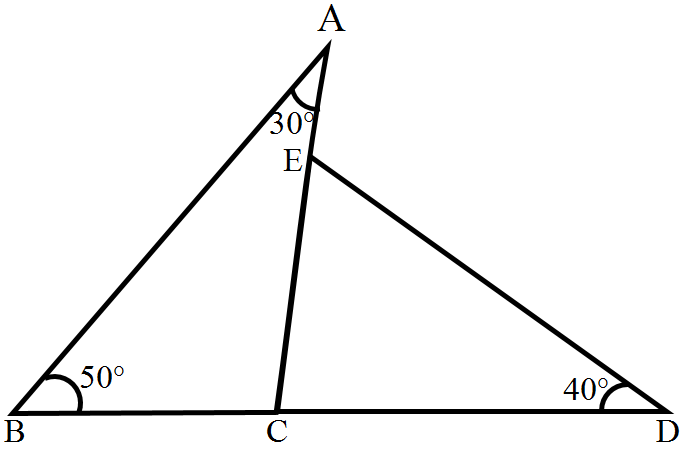
In the given figure, $\angle\text{BAC}=30^\circ,\angle\text{ABC}=50^\circ$ and $\angle\text{CDE}=40^\circ.$ Then $\angle\text{AED}=?$
  • $120^\circ$
  • B
    $110^\circ$
  • C
    $80^\circ$
  • D
    $100^\circ$
Answer
Correct option: A.
$120^\circ$
In $\triangle\text{ABC}$
$\angle\text{ABC}+\angle\text{BAC}+\angle\text{BCA}=180^\circ$ (Angle sum property)
$50^\circ+30^\circ+\angle\text{BCA}=180^\circ$
$\angle\text{BCA}=100^\circ$
In $\triangle\text{ECD}$
$\angle\text{ECD}+\angle\text{CDE}+\angle\text{CED}=180^\circ$ (Angle sum property)
$180^\circ-\angle\text{BCA}+40^\circ+\angle\text{CED}=180^\circ$
$\angle\text{CED}=100^\circ-40^\circ=60^\circ$
$\angle\text{CED}+\angle\text{AED}=180^\circ$ (Linear Pair)
$\angle\text{AED}=180^\circ-60^\circ=120^\circ.$
View full question & answer
MCQ 591 Mark
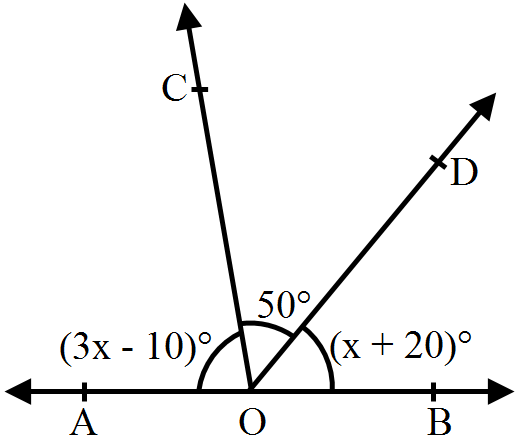
In the given figure, $AOB$ is a straight line. If $\angle\text{AOC}=(3\text{x}-10)^\circ,\angle\text{COD}=50^\circ$ and $\angle\text{BOD}=(\text{x}+20)^\circ$ then $\angle\text{AOC}=?$
  • A
    $50^\circ$
  • B
    $60^\circ$
  • $80^\circ$
  • D
    $40^\circ$
Answer
Correct option: C.
$80^\circ$
We have,$\angle\text{AOC}+\angle\text{COD}+\angle\text{BOD}=180^\circ$ [Since $AOB$ is a straight line]
$\Rightarrow 3x - 10 + 50 + x + 20 = 180$
$\Rightarrow 4x = 120$
$\Rightarrow x = 30$
$\therefore\angle\text{AOC}=[3\times30−10]^\circ$
$\Rightarrow\angle\text{AOC}=80^\circ.$
View full question & answer
MCQ 601 Mark
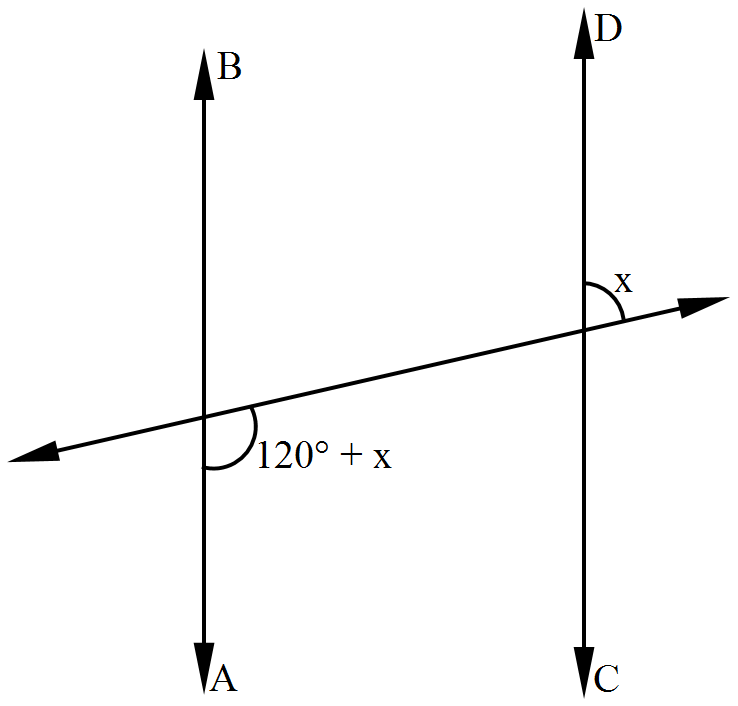
In Fig., If $AB \| CD$, then the value of $x$ is:
  • $30$
  • B
    $12$
  • C
    $15$
  • D
    $20$
Answer
Correct option: A.
$30$
In the given figure we have,
$120^\circ + x + x = 180^\circ$
$\Rightarrow 2x = 180^\circ - 120^\circ$
Or, $\text{x}=\frac{60}{2}=30^\circ.$
View full question & answer
MCQ 611 Mark
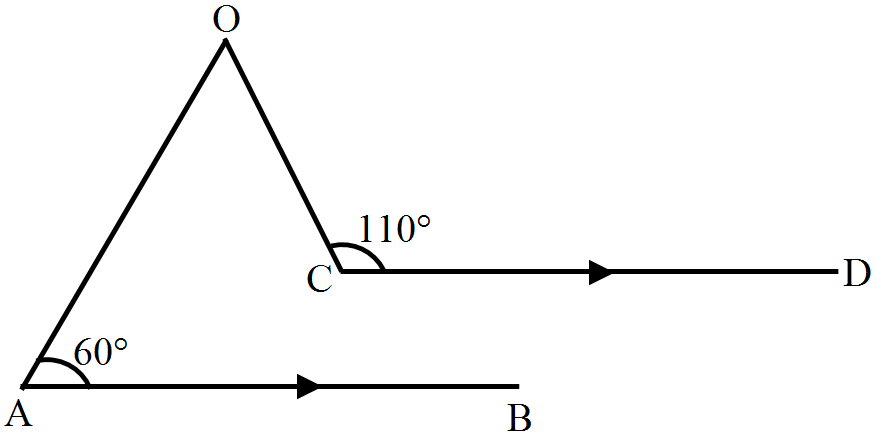
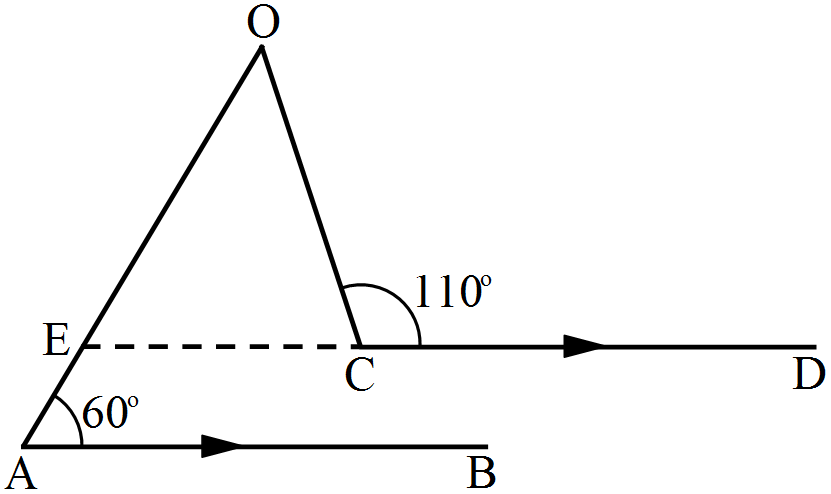
In the given figure, $AB \| CD$. If $\text{BAO}=60^\circ$ and $\angle\text{OCD}=110^\circ,$ then $\angle\text{AOC}=?$
  • A
    $40^\circ$
  • $50^\circ$
  • C
    $60^\circ$
  • D
    $70^\circ$
Answer
Correct option: B.
$50^\circ$

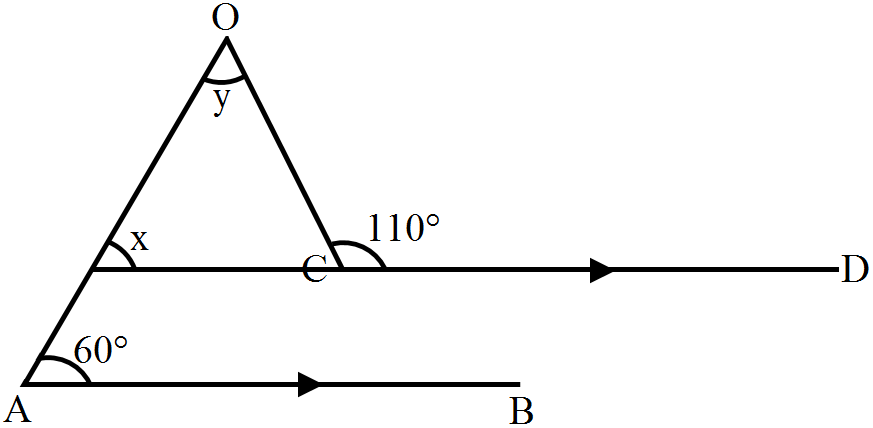
Construction: Extend the line $CD$ such that it intersect $AO$ and is parallel to $AB$
$x = 60^\circ $ (Corresponding angles)
$x + y + 180^\circ - 110^\circ = 180^\circ $ (Angle sum property)
$y = 110^\circ - 60^\circ = 50^\circ .$
View full question & answer
MCQ 621 Mark
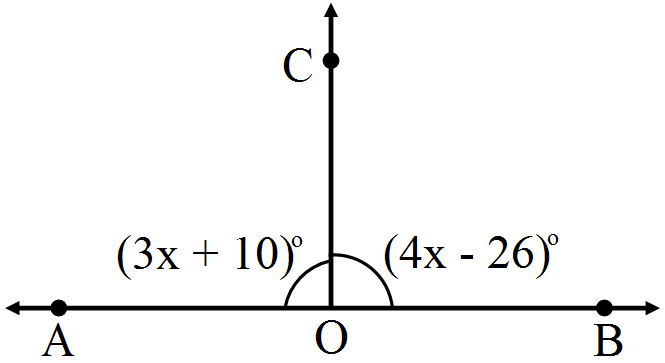
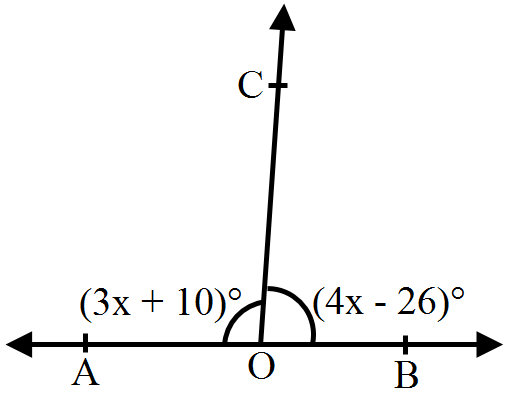
In the given figure, $AOB$ is a straight line. If $\angle\text{AOC}=(3\text{x} +10)^\circ$ and $\angle\text{BOC}=(4\text{x}-26)^\circ,$ then $\angle\text{BOC}=?$
  • A
    $96^\circ$
  • $86^\circ$
  • C
    $76^\circ$
  • D
    $106^\circ$
Answer
Correct option: B.
$86^\circ$
Since $AOB$ is a straight line,
$\angle\text{AOC}+\angle\text{BOC}=180^\circ$
$\Rightarrow(3\text{x}+10)+(4\text{x}-26)=180^\circ$
$\Rightarrow7\text{x}-16=180^\circ$
$\Rightarrow7\text{x}=196$
$\Rightarrow\text{x}=28$
So, $\angle\text{BOC}=4 \text{x}-26=4(28)-26=86^\circ$
View full question & answer
MCQ 631 Mark
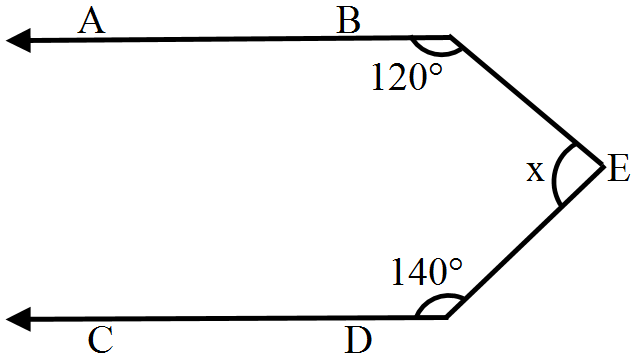
In figure, $AB$ and $CD$ are parallel to each other. The value of $x$ is:
  • A
    $90^\circ$
  • B
    $140^\circ$
  • $100^\circ$
  • D
    $120^\circ$
Answer
Correct option: C.
$100^\circ$

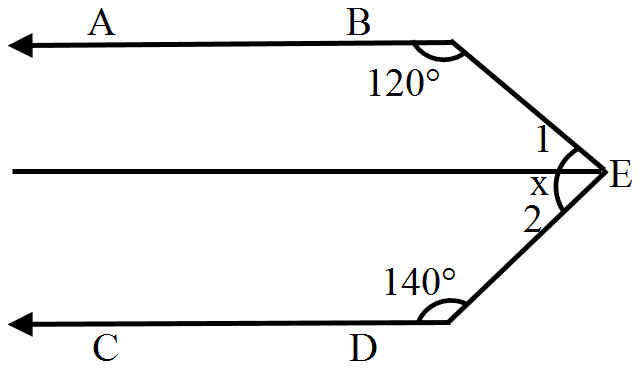
let us draw a line from point E parallel to line $AB, CD$
$\text{X}=\angle1+\angle2$
$AB \| EF$
$\angle1+120^\circ=180^\circ$ (Co - interior angle)
$\angle1=180^\circ-120^\circ$
$\angle1=60^\circ$
$CD \| EF$
$\angle2+140^\circ=180^\circ$ (Co - interior angle)
$\angle2=180^\circ-140^\circ$
$\angle1=40^\circ$
$\text{X}=\angle1+\angle2$
$\text{X}=60^\circ+40^\circ.$
View full question & answer
MCQ 641 Mark
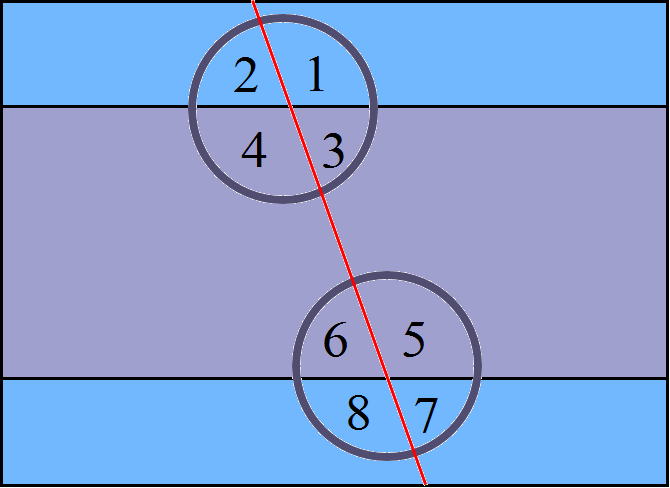
The number of angles formed by a transversal with a pair of parallel lines are.
  • $8$
  • B
    $4$
  • C
    $6$
  • D
    $3$
Answer
Correct option: A.
$8$

As we can see there are $4$ angles formed at every point of intersection thus giving a total of $8$ angles.
View full question & answer
MCQ 651 Mark
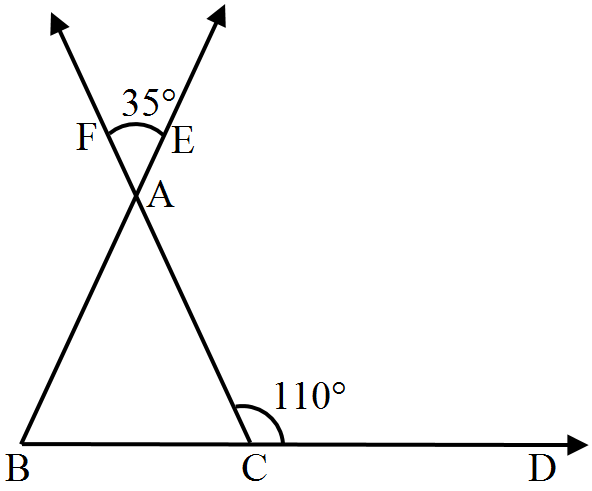
The sides $BC, BA$ and $CA$ of $\triangle\text{ABC}$ have been produced to $D, E$ and $F$ respectively, as shown in the give figure, Then, $\angle\text{B}?$
  • A
    $35^\circ$
  • B
    $65^\circ$
  • C
    $55^\circ$
  • $75^\circ$
Answer
Correct option: D.
$75^\circ$
$\angle\text{FAE}=\text{BAC}(\text{VOA})$$\angle\text{BAC}=35^\circ$
$\angle\text{ACB}+\angle\text{ACD}=180^\circ$ (Linear Pair)
$\angle\text{ACB}+110^\circ=180^\circ$
$\angle\text{ACB}=180^\circ-110^\circ$
$\angle\text{ACB}=70^\circ$
$\angle\text{BAC}+\angle\text{B}+\angle\text{ACB}=180^\circ$
$35^\circ+\angle\text{B}+70^\circ=180^\circ$
$\angle\text{B}+105^\circ=180^\circ$
$\angle\text{B}=180^\circ-105^\circ$
$\angle\text{B}=75^\circ.$
View full question & answer
MCQ 661 Mark
If two angles are supplementary and the larger is $20^\circ $ less then three times the smaller, then the angles are:
  • A
    $72\frac{1}{2}^\circ,17\frac{1}{2}^\circ$
  • B
    $140^\circ,40^\circ$
  • C
    $62\frac{1}{2}^\circ,27\frac{1}{2}^\circ$
  • $130^\circ,50^\circ$
Answer
Correct option: D.
$130^\circ,50^\circ$
Let the two supplementary angles be $x^\circ $ and $180^\circ - x^\circ $
Let $180^\circ - x = 3x 20^\circ$
$4x = 200^\circ$
$x = 50^\circ$
So the angles are $50^\circ $ and $130^\circ .$
View full question & answer
MCQ 671 Mark
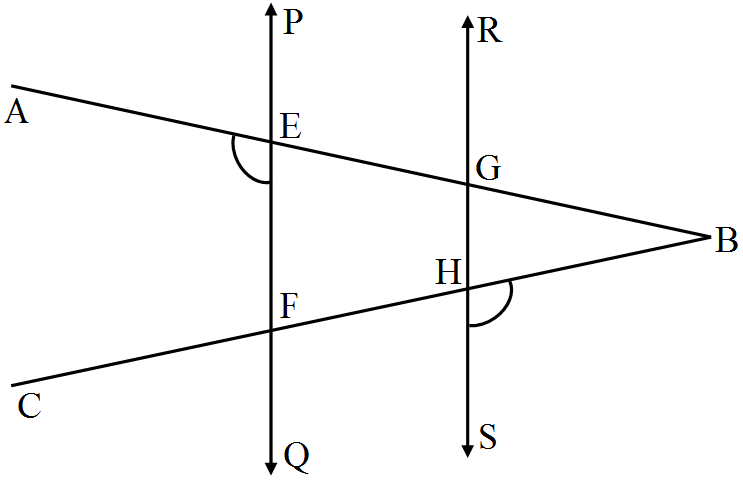
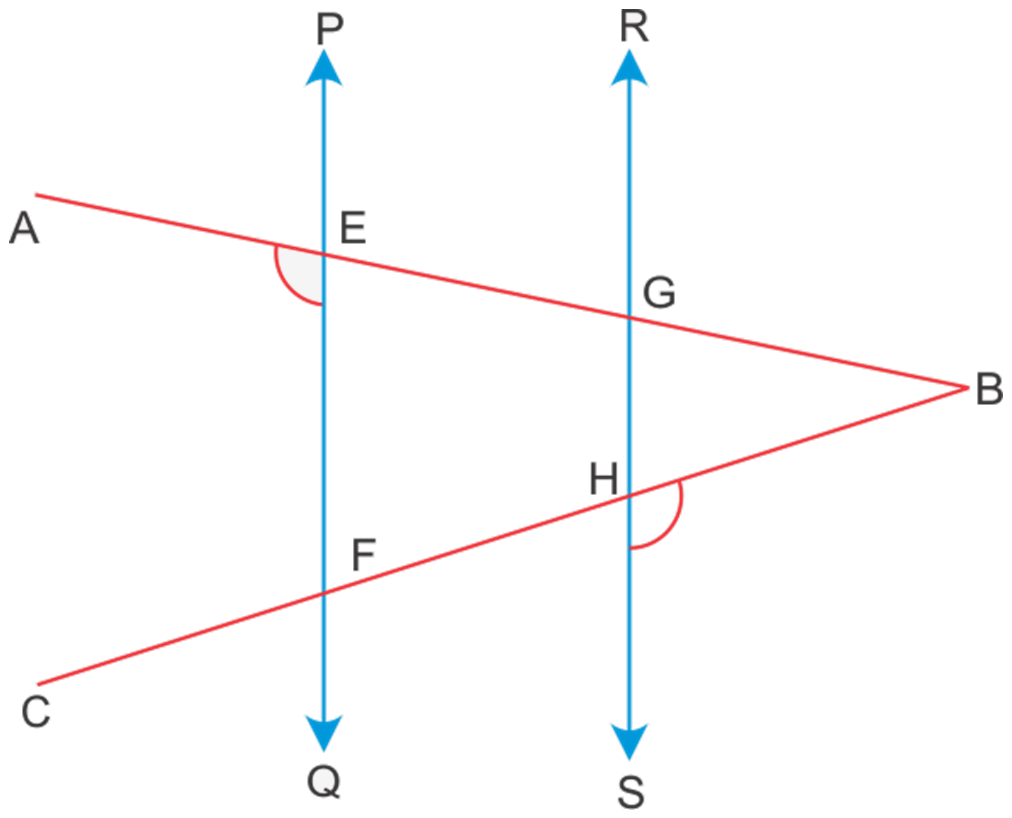
In figure, $PQ \| RS$, $\angle\text{AEF}=95^\circ,\angle\text{BHS}=110^\circ$ and $\angle\text{ABC}=\text{x}^\circ.$ Then the value of $x$ is:
  • A
    $15^\circ$
  • $25^\circ$
  • C
    $70^\circ$
  • D
    $35^\circ$
Answer
Correct option: B.
$25^\circ$

From figure,
$\angle\text{AEF}=\angle\text{EGH}$ [Corresponding angles]
$\Rightarrow\ \angle\text{EGH}=\angle\text{AEF}=95^\circ$
Also,
$\angle\text{BGH}+\angle\text{EGH}=180^\circ$
$\Rightarrow\ \angle\text{BGH}=180^\circ-\angle\text{EGH}=180^\circ-95^\circ$
$=85^\circ$
$\angle\text{BHS}=110^\circ$
Now,
$\angle\text{BHG}+\angle\text{BHS}=180^\circ$
$\Rightarrow\ \angle\text{BHG}=180^\circ-\angle\text{BHS}=180^\circ-110^\circ$
$=70^\circ$
Now, in $\triangle\text{BHG}$
$\angle\text{BGH}+\angle\text{BGH}+\text{x}=180^\circ$ [Sum of all angles of a $\triangle$ is 180°]
$\Rightarrow\ 85^\circ+70^\circ+\text{x}^\circ=180^\circ$
$\Rightarrow\ \text{x}^\circ=180^\circ-155^\circ=25^\circ$
View full question & answer
MCQ 681 Mark
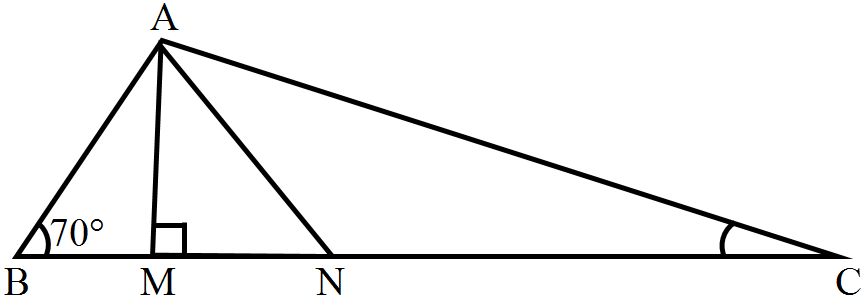
In the given figure, $\text{AM }\bot\text{ BC}$ and AN is the bisector of $\angle\text{A}.$ If $\angle\text{ABC}=70^\circ$ and $\angle\text{ACB}=20^\circ,$ then $MAN =?$
  • A
    $20^\circ$
  • B
    $30^\circ$
  • C
    $15^\circ$
  • $25^\circ$
Answer
Correct option: D.
$25^\circ$
In $\triangle\text{ABC}$
$\angle\text{BAC}+\angle\text{ABC}+\angle\text{BCA}=180^\circ$ (Angle sum property)
$\angle\text{BAC}=180^\circ-70^\circ-20^\circ$
$\angle\text{BAC}=90^\circ$
In $\triangle\text{ANC}$
$\angle\text{ANC}+\angle\text{NAC}+\angle\text{ACN}=180^\circ$ (Angle sum property)
$\angle\text{ANC}+45^\circ+20^\circ=180^\circ$ (AN is angle bisector of ∠A)
$\angle\text{ANC}=115^\circ$
In $\triangle\text{AMN}$
$\angle\text{AMN}+\angle\text{MAN}=\angle\text{ANC}$ (Measure of exterior angle is equla to the sum of two opposite interior angles)
$90^\circ+\angle\text{MAN}=115^\circ$
$\angle\text{MAN}=25^\circ.$
View full question & answer
MCQ 691 Mark
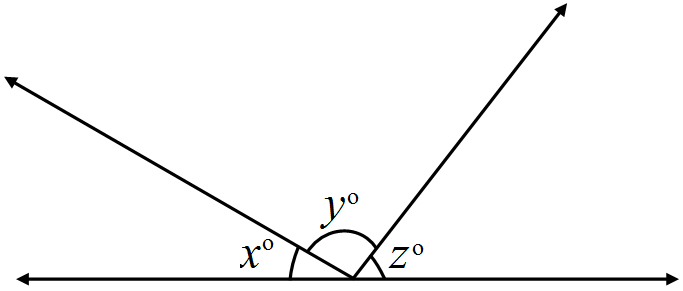
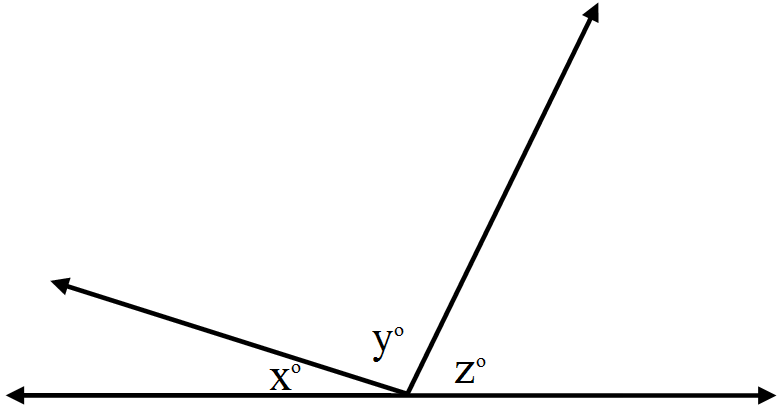
In figure, if $\frac{\text{y}}{\text{x}}=5$ and $\frac{\text{z}}{\text{x}}=4,$ then the value of $x$ is:
  • A
    $8^\circ$
  • $18^\circ$
  • C
    $12^\circ$
  • D
    $15^\circ$
Answer
Correct option: B.
$18^\circ$

From figure, we can see that
$\angle\text{x}^\circ+\angle\text{y}^\circ+\angle\text{z}^\circ=180^\circ\dots(1)$
Now,
$\frac{\text{y}}{\text{x}}=5\Rightarrow\ \text{y}=5\text{x}$
And,
$\frac{\text{z}}{\text{x}}=4,\text{z}=4\text{x}$
Substituting these value in equation (1), we have
$\angle\text{x}^\circ+\angle5\text{x}^\circ+\angle4\text{x}=180^\circ$
$\Rightarrow\ \angle10\text{x}^\circ=180^\circ$
$\Rightarrow\ \angle\text{x}^\circ=18^\circ$
View full question & answer
MCQ 701 Mark
In the given figure, $AB \| CD, CD \| EF$ and $y : z = 3 : 7$, then $x =?$
  • A
    $108^\circ$
  • B
    $162^\circ$
  • $126^\circ$
  • D
    $63^\circ$
Answer
Correct option: C.
$126^\circ$
$y : z = 3 : 7$
Let common ratio be a
$y = 3a$
$z = 7a$
$x = z$ (corresponding angle)
$x = 7a$
$x + y = 180^\circ $ (interior angle)
$7a + 3a = 180^\circ$
$10 a = 180^\circ$
$\text{a}=\frac{180}{10}$
$a = 18$
$x = 7a$
$x = 7 \times 18$
$x = 126^\circ .$
View full question & answer
MCQ 711 Mark
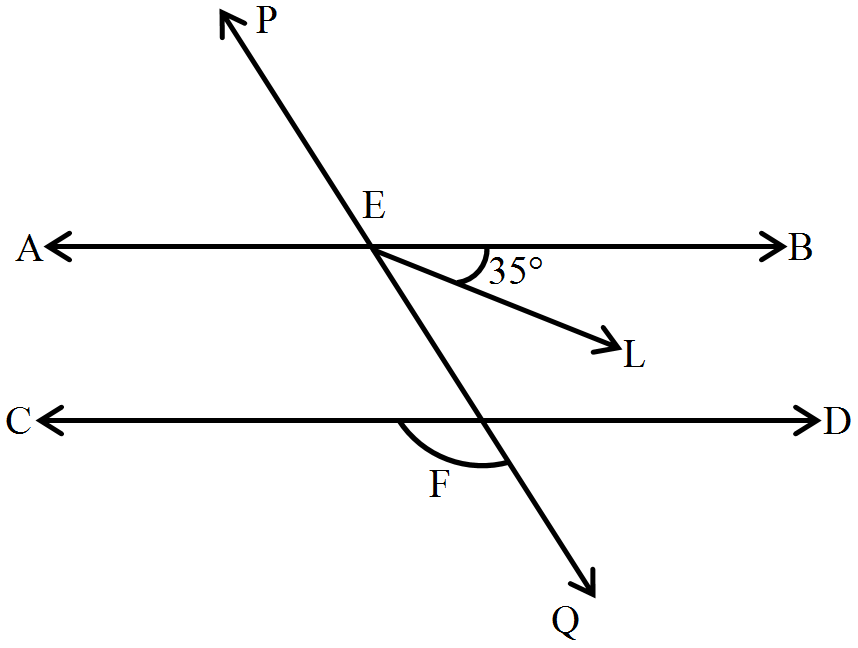
$AB$ and $CD$ are two parallel lines. $PQ$ cuts $AB$ and $CD$ at $E$ and $F$ respectively. $EL$ is the bisector of $\angle\text{FEB}.$ If $\angle\text{LEB}=35^\circ,$ then $\angle\text{CFQ}$ will be:
  • A
    $130^\circ$
  • B
    $70^\circ$
  • $110^\circ$
  • D
    $55^\circ$
Answer
Correct option: C.
$110^\circ$

It is given that, $AB \| CD$ with $PQ$ as transversal.
Also, $EL$ is the bisector $\angle\text{BEF}$ and $\angle\text{LEB}=35^\circ$
We need to find $\angle\text{CFQ}$
Therefore, $\angle\text{BEF}=2(\angle\text{LEB})$
$\angle\text{BEF}=2(35^\circ)$
$\angle\text{BEF}=70^\circ\text{ (i)}$
We have $AB \| CD$, $\angle\text{BEF}$ and $\angle\text{DEF}$ are consecutive interior angles, which must be supplementary.
$\angle\text{BEF}+\angle\text{DFE}=180^\circ$
From equation $(i)$, we get:
$70^\circ+\angle\text{DFE}=180^\circ$
$\angle\text{DFE}=180^\circ-70^\circ$
$\angle\text{DFE}=110^\circ\text{ (ii)}$
We have $\angle\text{CFQ}$ and $\angle\text{DFE}$ as vertically opposite angles.
Therefore,
$\angle\text{CFQ}=\angle\text{DFE}$
$\angle\text{CFQ}=110^\circ.$
View full question & answer
MCQ 721 Mark
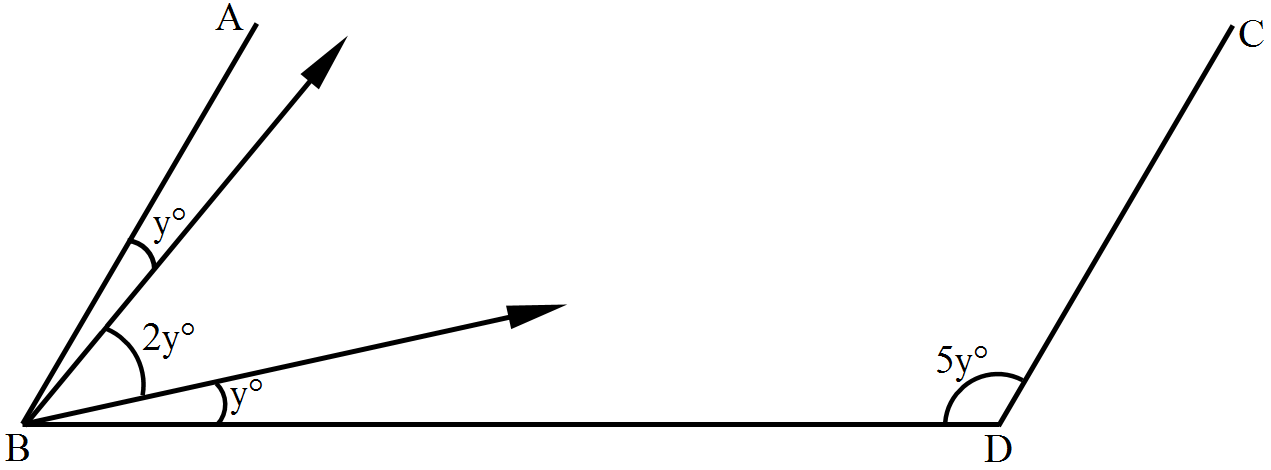
In Fig., if line segment $AB$ is parallel to the line segment $CD$, what is the value of $y?$
  • A
    $15$
  • B
    $12$
  • $20$
  • D
    $18$
Answer
Correct option: C.
$20$
Since, $AB \| CD$ And, $BD$ cuts them
$y + 2y + y + 5y = 180^\circ $ (Consecutive interior angle)
$9y = 180^\circ $
$y = 20^\circ .$
View full question & answer
MCQ 731 Mark
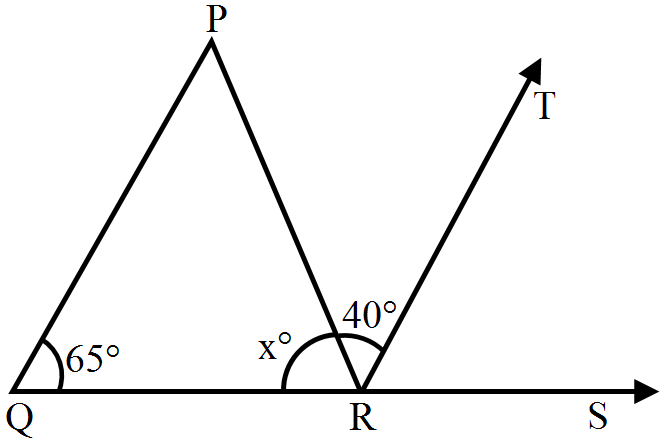
In the adjoining figure, if $QP \| RT$, then $x$ is equal to:
  • $75^\circ$
  • B
    $70^\circ$
  • C
    $65^\circ$
  • D
    $55^\circ$
Answer
Correct option: A.
$75^\circ$
$\angle\text{QPR}=\angle\text{PRT}=40^\circ$ (Alternate interior angles)
In $\triangle\text{QPR}$
$\angle\text{PQR}+\angle\text{QPR}+\angle\text{PRQ}=180^\circ$(Angle sum property)
$65^\circ + 40^\circ + x^\circ = 180^\circ$
$x^\circ = 180^\circ - 40^\circ - 65^\circ$
$x = 75^\circ .$
View full question & answer
MCQ 741 Mark
If one angle of a triangle is equal to the sum of the other two angles, then the triangle is:
  • A
    An isosceles triangle.
  • B
    An equilateral triangle.
  • A right triangle.
  • D
    An obtuse angled triangle.
Answer
Correct option: C.
A right triangle.
The sum of the angles of triangle is $180$ degrees.
Let the angles of triangle be $a, b, c$
we have given that one angle of a triangle is equal to the sum of the other two angles
So we have,
$c = a + b$
$a+ b + c = 180$
Substitute c for $a + b$
$c + c = 180$
$2c = 180$
$c = 90$
Therefore the triangle is a right triangle.
View full question & answer
MCQ 751 Mark
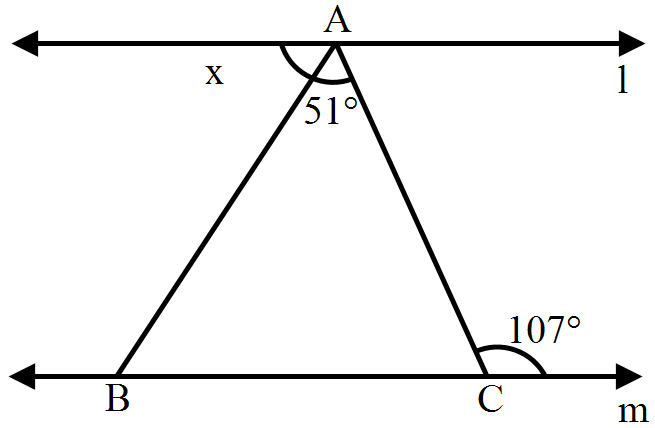
In the adjoining figure, l || m then $\angle\text{x}$ is equal to:
  • $56^\circ$
  • B
    $51^\circ$
  • C
    $66^\circ$
  • D
    $61^\circ$
Answer
Correct option: A.
$56^\circ$
$x + 51^\circ = 107^\circ $ (Alternate interior angles)
$x = 107^\circ - 51^\circ = 56^\circ .$
View full question & answer
MCQ 761 Mark
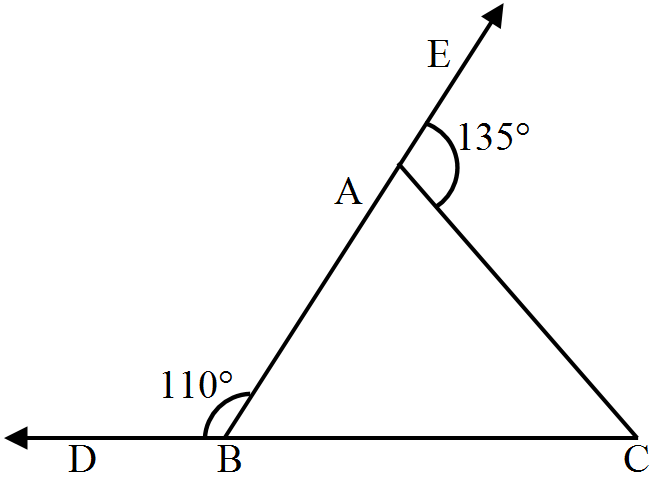
In the given figure, sides $CB$ and $BA$ of $\triangle\text{ABC}$ have been produced to D and E respectively such that $\angle\text{ABD}=110^\circ$ and $\text{CAE}=135^\circ.$ Then $\angle\text{ACB}=?$
  • A
    $45^\circ$
  • B
    $55^\circ$
  • C
    $35^\circ$
  • $65^\circ$
Answer
Correct option: D.
$65^\circ$
$\angle\text{EAC}+\angle\text{BAC}=180^\circ$ (Linear Pair)
$\angle\text{EAC}=135^\circ$
$135^\circ+\angle\text{BAC}=180^\circ$
$\angle\text{BAC}=180^\circ-135^\circ$
$\angle\text{BAC}=45^\circ$
$\angle\text{ABD}+\angle\text{ABC}=180^\circ$(Linear Pair)
$\angle\text{ABD}=110^\circ$
$110^\circ+\angle\text{ABC}=180^\circ$
$\text{ABC}=180^\circ-110^\circ$
$\angle\text{ABC}=70^\circ$
In $\triangle\text{ABC}$
$\angle\text{BAC}+\angle\text{ABC}+\angle\text{ACB}=180^\circ$
$45^\circ+70^\circ+\angle\text{ACB}=180^\circ$
$115^\circ+\angle\text{ACB}=180^\circ$
$\angle\text{ACB}=180^\circ-115^\circ$
$\angle\text{ACB}=65^\circ.$
View full question & answer
MCQ 771 Mark
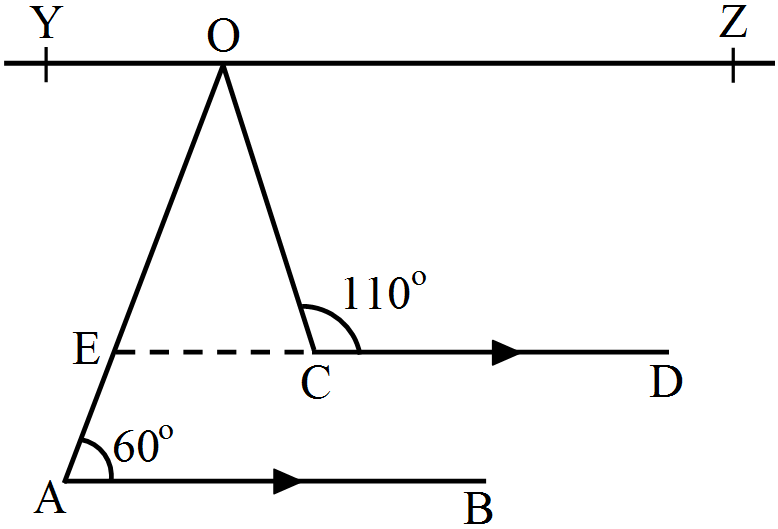
In the given figure, $AB \| CD$. If $\angle\text{BAO}=60^\circ$ and $\angle\text{OCD}=110^\circ$ then $\angle\text{AOC}=?$
  • A
    $70^\circ$
  • B
    $60^\circ$
  • $50^\circ$
  • D
    $40^\circ$
Answer
Correct option: C.
$50^\circ$
Let $\angle\text{AOC}=\text{x}^\circ$
Draw $YOZ \| CD \| AB.$

Now, $YO\| AB$ and $OA$ is the transversal.
$\Rightarrow\angle\text{YOA}=\angle\text{OAB}=60^\circ$ (alternate angles)
Again, $OZ \| CD$ and $OC$ is the transversal.
$\Rightarrow\angle\text{COZ}+\angle\text{OCD}=180^\circ$ (interior angles)
$\Rightarrow\angle\text{COZ}+110^\circ=180^\circ$
$\Rightarrow\angle\text{COZ}=70^\circ$
Now, $\angle\text{YOZ}=180^\circ$ (straight angle)
$\Rightarrow\angle\text{YOA}+\angle\text{AOC}+\angle\text{COZ}=180^\circ$
$\Rightarrow60^\circ+\text{x}+70^\circ=1806^\circ$
$\Rightarrow\text{x}=50^\circ$
$\Rightarrow\angle\text{AOC}=50^\circ$
View full question & answer
MCQ 781 Mark
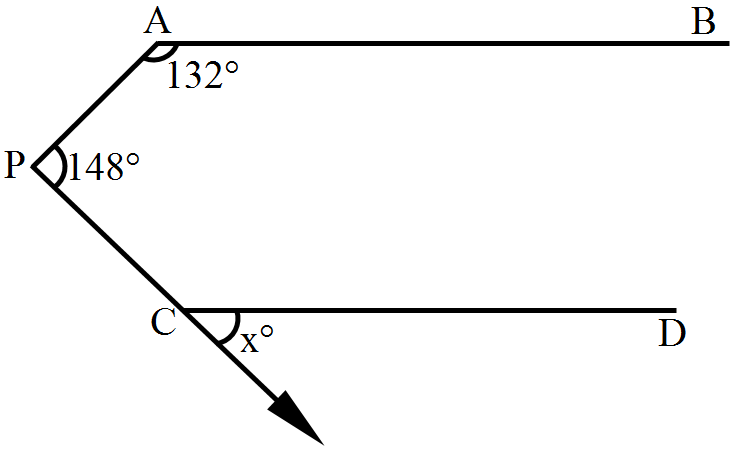
In Fig. if $AB \| CD$, then $x =$
  • A
    $105^\circ$
  • B
    $115^\circ$
  • $100^\circ$
  • D
    $110^\circ$
Answer
Correct option: C.
$100^\circ$
Given that,$AB \| CD$
Produce $P$ to $Q$ so that $PQ \| AB \| CD$
$​\angle\text{BAP}+\angle\text{APQ}=180^\circ$ (Interior angle)
$132^\circ+\angle\text{APQ}=180^\circ$
$\angle​​\text{APQ}=48^\circ\text{(i)}$
$\angle​​\text{APC}=\angle\text{APQ}+\angle​​\text{QPC}$
$148^\circ=48^\circ+\angle\text{QPC}$ [From (i)]
$\angle\text{QPC}=100^\circ$
$\angle​\text{QPC}+\angle\text{PCD}=180^\circ$ (Interior angles)
$100^\circ+\angle\text{PCD}=180^\circ$
$\angle​\text{PCD}=80^\circ$
$\angle​​\text{PCD}+\text{x}=180^\circ$(Linear pair)
$80^\circ+\text{x}=180^\circ$
$\text{x}=100^\circ.$
View full question & answer
MCQ 791 Mark
The angles of a triangle are in the ratio $5 : 3 : 7$, the triangle is:
  • A
    An isosceles triangle.
  • An acute angled triangle.
  • C
    An obtuse angled triangle.
  • D
    A right triangle.
Answer
Correct option: B.
An acute angled triangle.
Let the angles of the triange be $5x, 3x$ and $7x$
We know that the sum of the angles of a triangle is $180^\circ $
$5x + 3x + 7x = 180^\circ$
$15x = 180^\circ$
$x = 12^\circ$
Therefore the angles are
$5x = 5 \times 120 = 60^\circ$
$3x = 3 \times 120 = 36^\circ$
$7x = 7 \times 120 = 84^\circ$
Since all the angles are less than $90^\circ $, therefore it is a acute angled triangle.
View full question & answer
MCQ 801 Mark
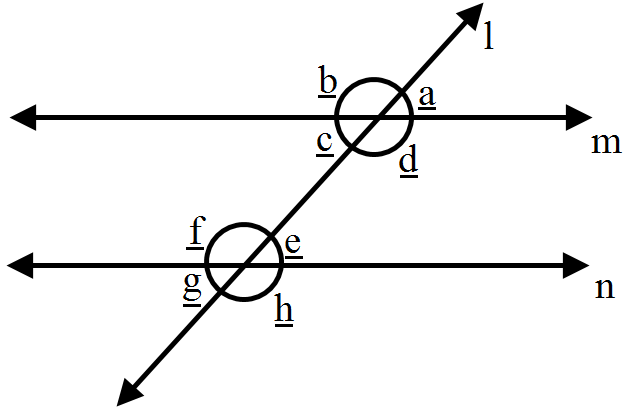
In the adjoining figure, $m \| n$. If $\angle\text{a}:\angle\text{b}=2:3,$ then the measure of $\angle\text{h}$ is:
  • A
    $72^\circ$
  • $108^\circ$
  • C
    $150^\circ$
  • D
    $120^\circ$
Answer
Correct option: B.
$108^\circ$
$\angle\text{a}+\angle\text{b}=180^\circ$ (Linear Pair)
$2\text{x}+3\text{x}=180^\circ$
$\text{x}=36^\circ$
$\angle\text{b}=36\times3=108^\circ$
$\angle\text{h}=\angle\text{b}=180^\circ$ (Alternate Exterior angle).
View full question & answer
MCQ 811 Mark
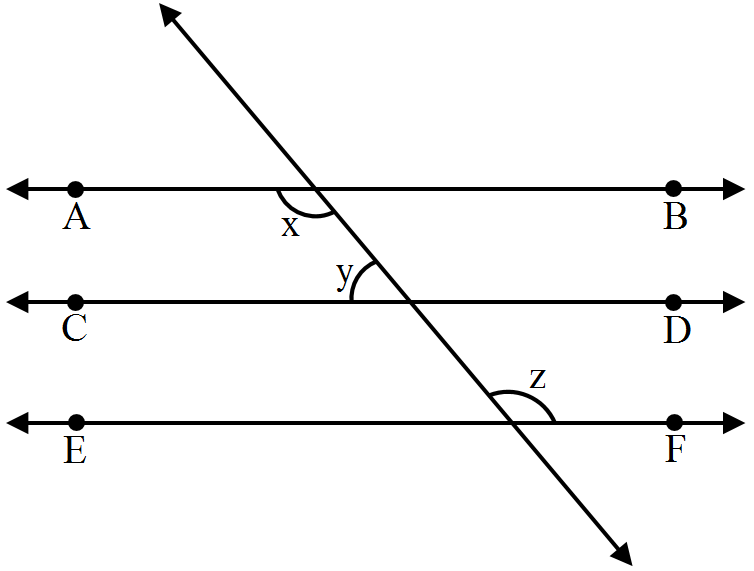
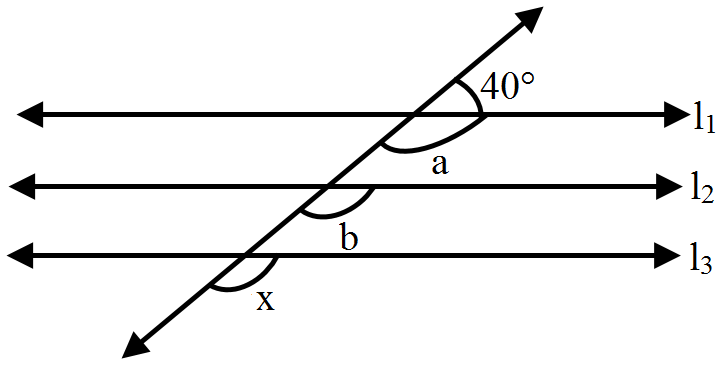
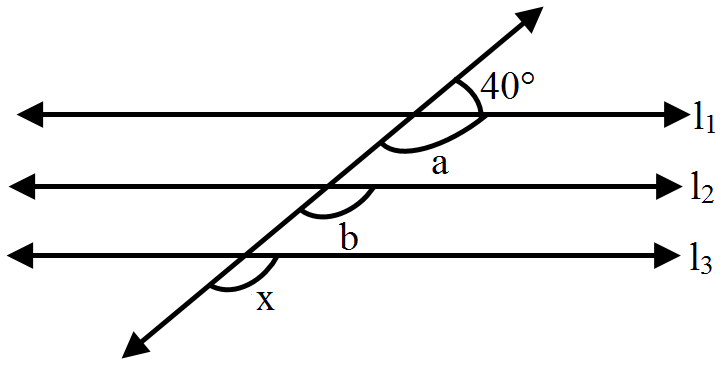
Given that lines $I_1, I_2$ and $I_3$ in figure are parallel. The value of $x$ is:
  • A
    40$^{\circ}$
  • 140$^{\circ}$
  • C
    80$^{\circ}$
  • D
    50$^{\circ}$
Answer
Correct option: B.
140$^{\circ}$

In the given figure
$40^\circ+\angle\text{a} = 180^\circ$(linear - pair)
Therefore $\angle\text{a}=180^\circ-40^\circ=140^\circ$
Now $\angle\text{a}=\angle\text{b}$ (corresponding - angles)
Similarly $\angle\text{b}=\angle\text{x}=140^\circ$
Therefore $\angle\text{x}=140^\circ.$
View full question & answer
MCQ 821 Mark
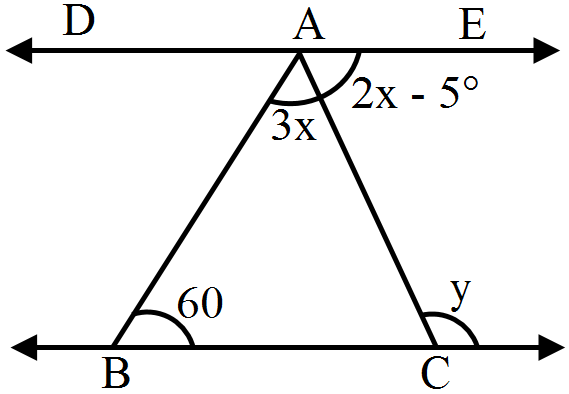
In the adjoining figure, if $DE \| BC$, then the values of $x$ and $y$ are:
  • A
    $x = 25^\circ , y = 85^\circ$
  • $x = 25^\circ , y = 135^\circ$
  • C
    $x = 260, y =1380$
  • D
    $x = 20^\circ , y = 120^\circ$
Answer
Correct option: B.
$x = 25^\circ , y = 135^\circ$
$\angle\text{EAB}+\angle\text{ABC}=180^\circ$ (Sum of supplementary angle)
$2x - 5^\circ + 3x + 60^\circ = 180^\circ$
$5x = 180^\circ - 60^\circ + 5^\circ$
$x = 25^\circ$
$\angle\text{EAC}+\text{y}=180^\circ$ (Sum of supplementary angle).
$2x - 5^\circ + y = 180^\circ$
$y = 180^\circ + 5^\circ - 50^\circ = 135^\circ .$
View full question & answer
MCQ 831 Mark
An exterior angle of a triangle is $110^\circ $ and its two interior opposite angles are equal. Each of these equal angles is:
  • A
    $70^\circ$
  • $55^\circ$
  • C
    $35^\circ$
  • D
    $27\frac{1^\circ}{2}$
Answer
Correct option: B.
$55^\circ$
Let each interior opposite angle be $x.$
Then, $x + x = 110^\circ $ (Exterior angle property of a triangle)
$\Rightarrow 2x = 110^\circ$
$\Rightarrow x = 55^\circ$
View full question & answer
MCQ 841 Mark
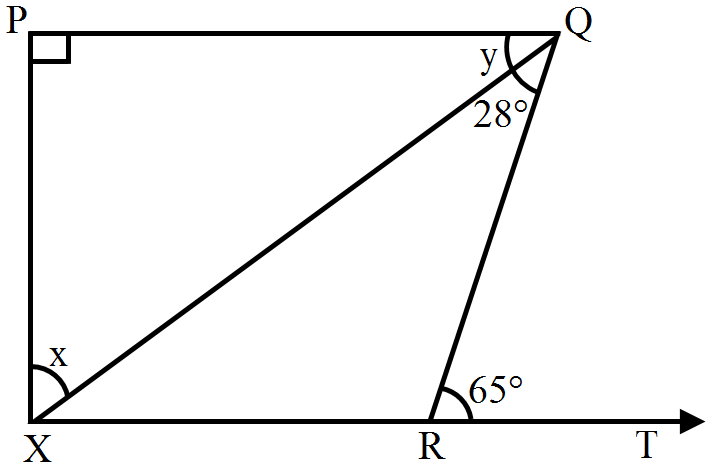
In the adjoining figure $PQ \| XR$. If $\text{QP}\bot\text{SP},$ then the values of $x$ and $y$ are:
  • A
    $x = 63^\circ , y = 27^\circ$
  • B
    $x = 37^\circ , y =53^\circ$
  • C
    $x = 43^\circ , y = 47^\circ$
  • $x = 53^\circ , y = 37^\circ$
Answer
Correct option: D.
$x = 53^\circ , y = 37^\circ$
In $\triangle\text{QXR}$
$28^\circ+\angle\text{QXR}=\angle\text{QRT}$ (Exterior angle property)
$\text{QXR}=65^\circ-28^\circ=37^\circ$
$\text{y}=\angle\text{QSR}=37^\circ$ (Alternate interior angles)
In $\triangle\text{PQX}$
$\angle\text{PQX}+\angle\text{QXP}+\angle\text{QPX}=180^\circ$ (Angle sum property)
$37^\circ + x + 90^\circ = 180^\circ$
$x = 53^\circ .$
View full question & answer
MCQ 851 Mark
If two supplementary angles are in the ratio $2 : 7$, then the angles are:
  • A
    $35^\circ , 145^\circ$
  • B
    $70^\circ , 110^\circ$
  • $40^\circ , 140^\circ$
  • D
    $50^\circ , 130^\circ$
Answer
Correct option: C.
$40^\circ , 140^\circ$
We know that supplementary angles are those angles whose sum is $180^\circ $
The two given supplementary angles are in the ratio $2 : 7$
Let the commom ratio be $x$
So angles are $2x$ and $7x$ respectively
$2x + 7x = 180^\circ$
$9x = 180^\circ$
$\text{x}=\frac{180^\circ}{9}=20^\circ$
$2x = 2 \times 40^\circ = 40^\circ$
$7x = 7 \times 20^\circ = 140^\circ$
View full question & answer
MCQ 861 Mark
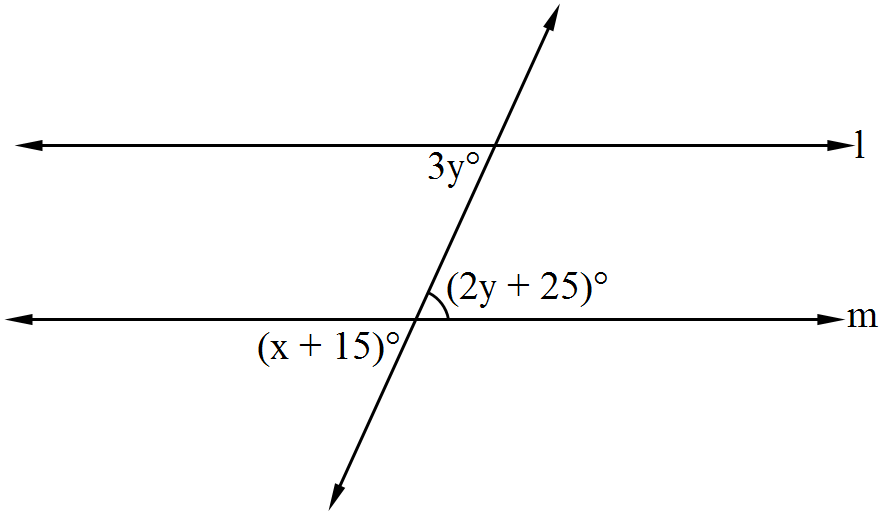
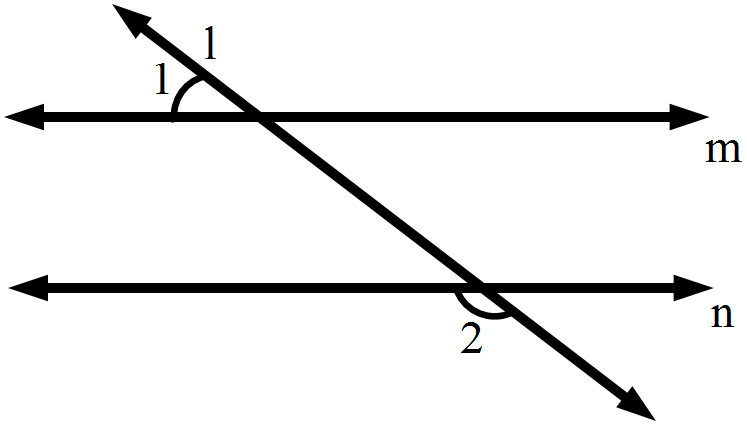
In Fig. if $l \| m$, what is the value of $x?$
  • A
    $50$
  • B
    $45$
  • $60$
  • D
    $30$
Answer
Correct option: C.
$60$
Given that,
$l \| m$
Let, ​​$\angle1=3\text{y}$
$​​\angle2=2\text{y}+25^\circ$
$​​\angle3=\text{x}+15^\circ$
$​​\angle1=\angle2$ (Alternate angle)
$3y = 2y + 25^\circ$
$y = 25^\circ$
$​\angle2=\angle3$ (Vertically opposite angle)
$x + 15^\circ = 2 (25^\circ ) + 25^\circ$
$x = 60^\circ .$
View full question & answer
MCQ 871 Mark
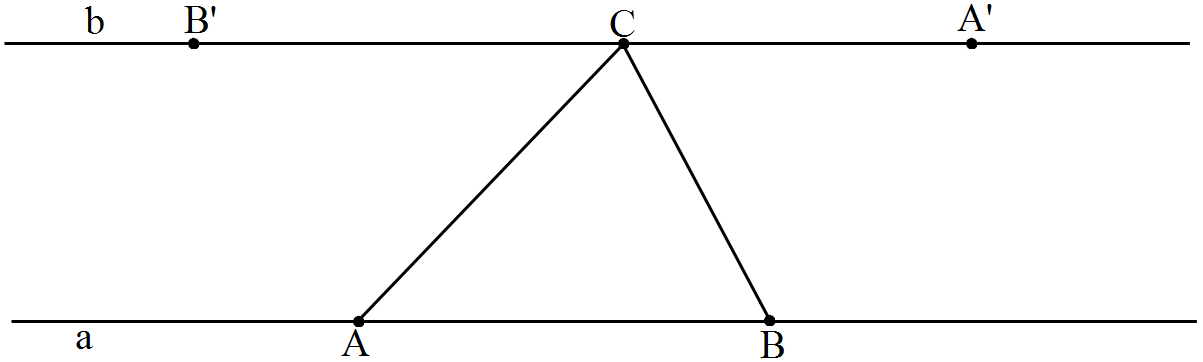
The sum of the angles of a triangle is:
  • $180^\circ$
  • B
    $0^\circ$
  • C
    $360^\circ$
  • D
    $90^\circ$
Answer
Correct option: A.
$180^\circ$

Line a and b are parallel.
$\angle\text{B'CA}=\angle\text{BAC} $ (Alternate interior angle)
$\angle\text{A'CB}=\angle\text{ABC}$ (Alternate interior angle)
$\angle\text{B'CA}+\angle\text{A'CB}+\angle\text{BCA}=180^\circ$(Linear Pair)
Therefore, $\angle\text{BAC}+\angle\text{ABC}+\angle\text{BCA}=180^\circ.$
View full question & answer
MCQ 881 Mark
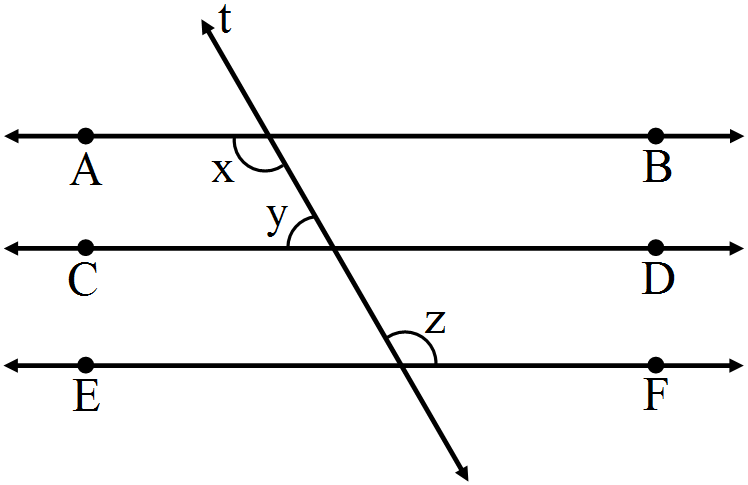
In the given figure $AB \| CD$ and $CD \| EF.$ If $y : z = 3 : 7$ then $x = ?$
  • A
    $108^\circ$
  • $126^\circ $
  • C
    $162^\circ$
  • D
    $63^\circ $
Answer
Correct option: B.
$126^\circ $
$AB \| CD$
$x + y = 180^\circ $ and $y = p$ (Vertically opposite angles)
Also, $CD \| EF$ and t is the transversal.
$\therefore p + z = 180^\circ $
$\Rightarrow y + z = 180^\circ $
$(\because\text{p}=\text{y})$
$\therefore x + y = y + z$
$\Rightarrow x = z$
But $y : z = 3 : 7$
$\therefore\text{y}=\Big(180\times\frac{3}{10}\Big)=54^\circ$ and $\text{z}=\Big(180\times\frac{7}{10}\Big)=126^\circ$
$x = 126^\circ $
$(\because\text{x}=\text{z})$
View full question & answer
MCQ 891 Mark
In the adjoining figure, $\text{m}\parallel\text{n}$ if $\angle1=50^\circ$ then $\angle2$ is equal to:
  • A
    $50^\circ$
  • B
    $40^\circ$
  • $130^\circ$
  • D
    $120^\circ$
Answer
Correct option: C.
$130^\circ$
$\angle2 = 180^\circ-\angle1$
$\angle2 = 180^\circ-50^\circ=130^\circ$
View full question & answer
MCQ 901 Mark
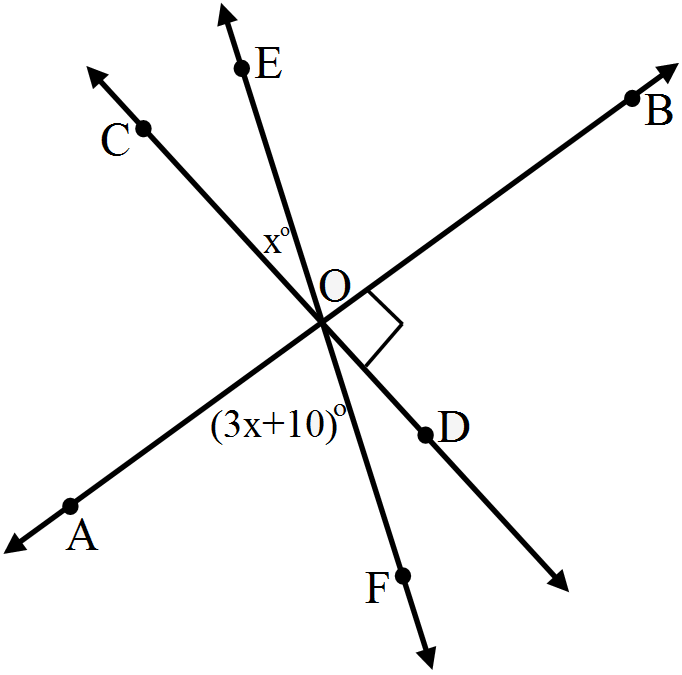
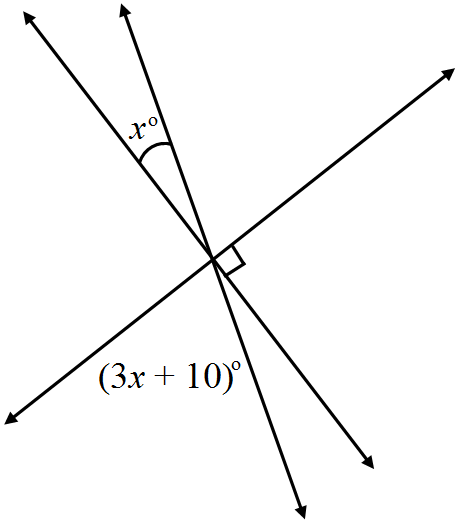
In figure, the value of $x$, is:
  • A
    $12$
  • B
    $15$
  • $20$
  • D
    $30$
Answer
Correct option: C.
$20$

From figure, we can see that
$\angle\text{BOD}+\angle\text{AOD}=180^\circ$
$\angle\text{BOD}=90^\circ$ [Given]
$\Rightarrow\ \angle\text{AOD}=180^\circ-90^\circ=90^\circ$
Now,
$\text{x}^\circ=\angle\text{COE}=\angle\text{FOD}$ [Opposite angles are equal]
Now,
$\angle\text{AOF}+\angle\text{FOD}=90^\circ=\angle\text{AOD}$
$\Rightarrow\ 3\text{x}^\circ+10^\circ+\text{x}^\circ=90^\circ$
$\Rightarrow\ 4\text{x}^\circ=80^\circ$
$\Rightarrow\ \text{x}^\circ=20^\circ$
View full question & answer
MCQ 911 Mark
The angles of a triangle are in the ration $3 : 5 : 7.$ The triangle is:
  • Acute-angled.
  • B
    Obtuse-angled.
  • C
    Right-angled.
  • D
    An isosceles triangle.
Answer
Correct option: A.
Acute-angled.
Let the angles measure $(3x)^\circ , (5x)^\circ $ and $(7x)^\circ .$
Then,
$3x + 5x + 7x = 180^\circ $
$\Rightarrow 15x = 180^\circ $
$\Rightarrow x = 12^\circ $
Therefore, the angles are $3(12)^\circ = 36^\circ , 5(12)^\circ = 60^\circ $ and $7(12)^\circ = 84^\circ .$
Hence, the triangle is acute-angled.
View full question & answer
MCQ 921 Mark
The difference between two complementary angles is $400$. The angles are:
  • A
    $70^{\circ}, 110^{\circ}$
  • B
    $65^{\circ}, 35^{\circ}$
  • $65^{\circ}, 25^{\circ}$
  • D
    $70^{\circ}, 30^{\circ}$
Answer
Correct option: C.
$65^{\circ}, 25^{\circ}$
We know that the sum of two complementary angles is $90^{\circ}$Let the two angles be $x$ and $y$
$x+y=90^{\circ}(1)$
We also know that the difference of the angles is $40^{\circ}$
Therefore, $x-y=40^{\circ}(2)$
Combining $(1)$ and $(2)$
We have
$x+y=90^{\circ}$
$x-y=40^{\circ}$
Solving as simultaneous equations we get
$2 x=130^{\circ}$
Hence $x=65^{\circ}$
Substituting this value of $x$ in either one of the equations $(1)$ or $(2)$
We get $y=25^{\circ}$.
View full question & answer
MCQ 931 Mark
An exterior angle of a triangle is 80$^{\circ}$ and the interior opposite angles are in the ratio $1 : 3$. Measure of each interior opposite angle is:
  • $20^{\circ}, 60^{\circ}$
  • B
    $40^{\circ}, 120^{\circ}$
  • C
    $30^{\circ}, 90^{\circ}$
  • D
    $30^{\circ}, 60^{\circ ^3}$
Answer
Correct option: A.
$20^{\circ}, 60^{\circ}$
Let the common ratio is $x$
The ratio of interior angles are $1 : 3$
So angles are $x$ and $3x$
$x + 3x = 80$
$4x = 80$
$\text{x}=\frac{80}{4}$
$x = 20$
So angles are $20^{\circ}$ and $60^{\circ}$.
View full question & answer
MCQ 941 Mark
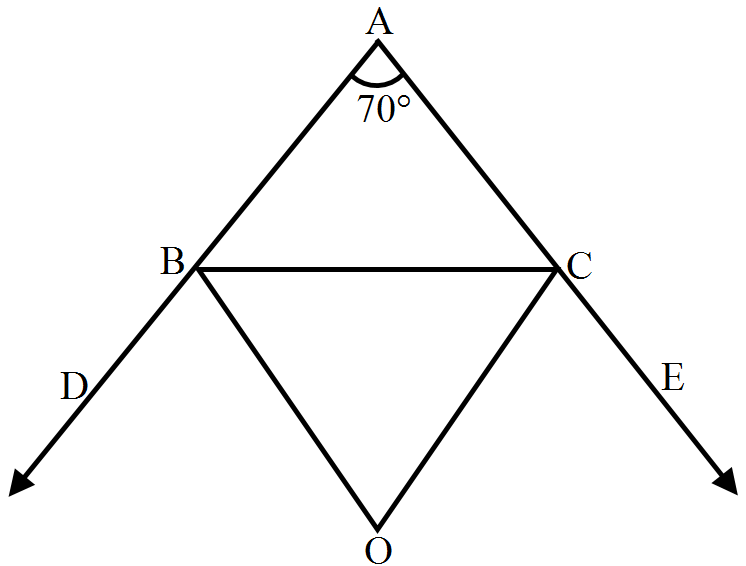
In the adjoining figure, the bisectors of $\angle\text{CBD}$ and $\angle\text{BCE}$ meet at the point $O$. If $\angle\text{BAC}=70^\circ,$ then $\angle\text{BOC}$ is equal to:
  • A
    $35^\circ$
  • B
    $11^\circ$
  • $55^\circ$
  • D
    $70^\circ$
Answer
Correct option: C.
$55^\circ$
$\angle\text{BOC}=90^\circ-\frac{1}{2}\angle\text{BAC}$
$\angle\text{BOC}=90^\circ-35^\circ=55^\circ.$
View full question & answer
MCQ 951 Mark
If a transversal intersects two parallel lines, then which of the following alternatives is not true?
  • A
    Each pair of corresponding angles is equal.
  • B
    Each pair of alternate interior angles is equal.
  • Each pair of co$-$interior angles is complementary.
  • D
    Each pair of co$-$interior angles is supplementary.
Answer
Correct option: C.
Each pair of co$-$interior angles is complementary.
Co$-$interior angles are supplementary, not complementary.
View full question & answer
MCQ 961 Mark
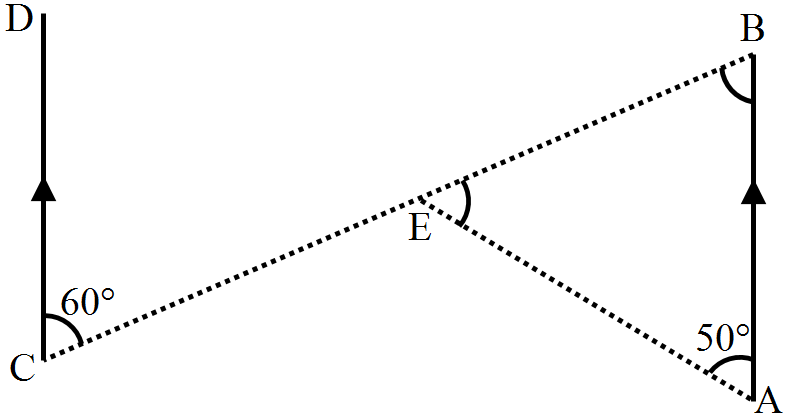
In the given figure, $AB \| CD$. If $\angle\text{EAB}=50^\circ$ and $\angle\text{ECD}=60^\circ,$ then $\angle\text{AEB}=?$
  • $70^\circ$
  • B
    $55^\circ$
  • C
    $60^\circ$
  • D
    $50^\circ$
Answer
Correct option: A.
$70^\circ$
$\angle\text{BCD}=\angle\text{ABE}=60^\circ$ (Vertically opposite angle)
In $\triangle\text{EAB}$
$\angle\text{EAB}+\angle\text{EBA}+\angle\text{AEB}+180^\circ$ (Angle sum property)
$50^\circ+60^\circ+\angle\text{AEB}=180^\circ$
$\text{AEB}=70^\circ.$
View full question & answer
MCQ 971 Mark
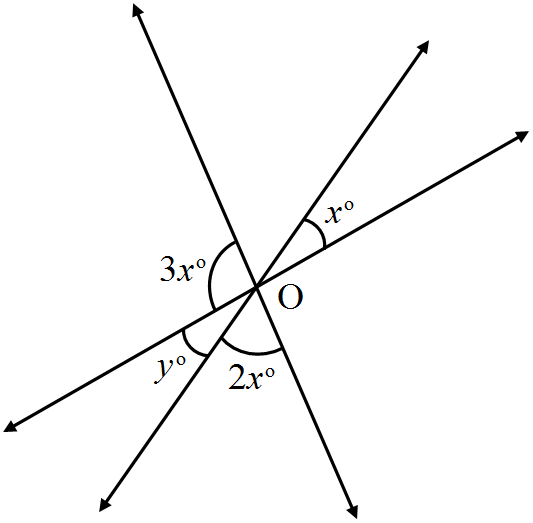
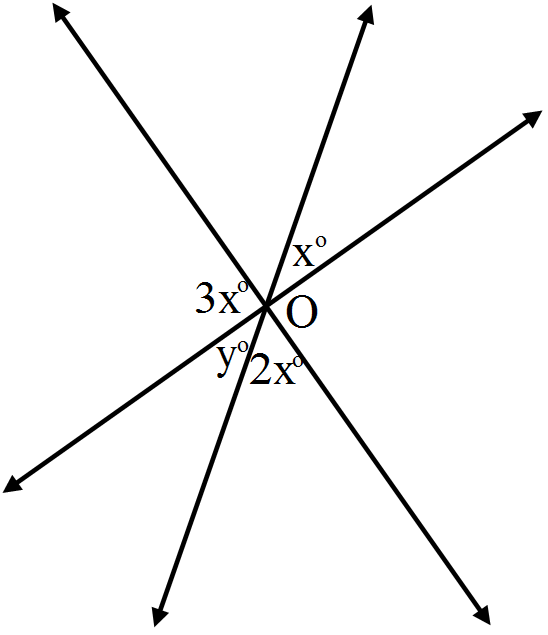
In figure, the value of $y$ is:
  • A
    $20^\circ$
  • $30^\circ$
  • C
    $45^\circ$
  • D
    $60^\circ$
Answer
Correct option: B.
$30^\circ$

From figure, we can see
$\angle\text{x}^\circ=\angle\text{y}^\circ$ [Vertically opposite angles]
Also,
$\angle\text{3}\text{x}^\circ+\angle\text{y}^\circ+\angle2\text{x}^\circ=180^\circ$
Now,
$\angle\text{x}^\circ=\angle\text{y}^\circ$
$\therefore\ \angle\text{3}\text{y}^\circ+\angle\text{y}^\circ+\angle2\text{y}^\circ=180^\circ$
$\Rightarrow\ \angle6\text{y}^\circ=180^\circ$
$\Rightarrow\ \angle\text{y}^\circ=180^\circ$
View full question & answer
MCQ 981 Mark
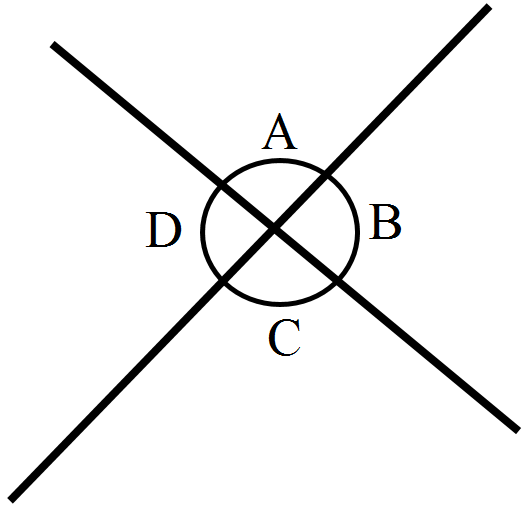
If two lines intersect each other then:
  • Vertically opposite angles are equal.
  • B
    Corresponding angles are equal.
  • C
    Co-interior angles are equal.
  • D
    Alternate interior angles are equal.
Answer
Correct option: A.
Vertically opposite angles are equal.

$\angle\text{A}+\angle\text{B}=180 ($Linear Pair$)$
$\angle\text{B}+\angle\text{C}=180 ($Linear Pair$)$
On equating ablove equations, we get
$\angle\text{A}+\angle\text{B}=\angle\text{B}+\angle\text{C}$
$\angle\text{A}=\angle\text{C}$
Similarly, $\angle\text{B}=\angle\text{D}.$
View full question & answer
MCQ 991 Mark
In the given figure, $AOB$ is a straight line. If $\angle\text{AOC}=(3\text{x}+10)^\circ$ and $\angle\text{BOC}=(4\text{x}−26)^\circ.$ then $\angle\text{BOC}=?$
  • A
    $76^\circ$
  • B
    $106^\circ$
  • C
    $96^\circ$
  • $86^\circ$
Answer
Correct option: D.
$86^\circ$
We have,
$\angle\text{AOC}+\angle\text{BOC}=180^\circ$ [Since $AOB$ is a straight line]
$\Rightarrow 3x + 10 + 4x - 26 = 180^\circ$
$\Rightarrow 7x = 196^\circ$
$\Rightarrow x = 28^\circ$
$\therefore\angle\text{BOC}=[4\times28−26]^\circ$
Hence, $\angle\text{BOC}=86^\circ.$
View full question & answer
MCQ 1001 Mark
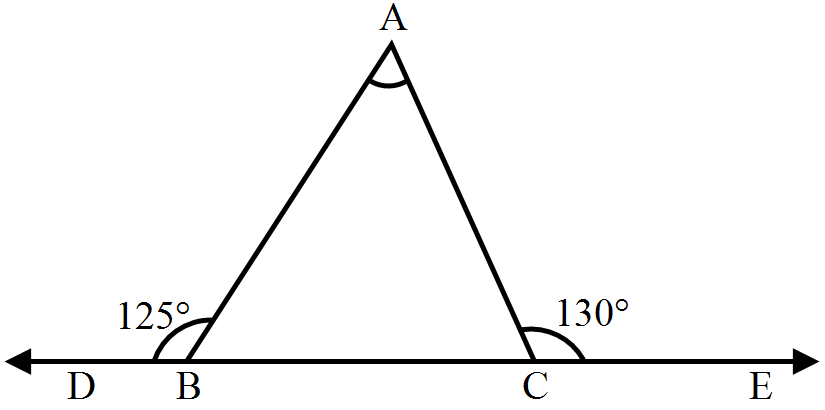
Side BC of $\triangle\text{ABC}$ has been produced to $D$ on left-hand side and to $E$ on right-hand side such that $\angle\text{ABD}=125^\circ$ and $\angle\text{ACE}=130^\circ.$ Then $\angle\text{A}=?$
  • A
    $50^\circ$
  • $75^\circ$
  • C
    $55^\circ$
  • D
    $65^\circ$
Answer
Correct option: B.
$75^\circ$
$\angle\text{ABD}+\angle\text{ABC}=180^\circ$ (Linear Pair)
$\angle\text{ABC}=180^\circ-125^\circ=55^\circ$
$\angle\text{ACE}+\angle\text{ACB}=180^\circ$ (Linear Pair)
$\angle\text{ACB}=180^\circ-130^\circ=50^\circ$
In $\triangle\text{ABC}$
$\angle\text{ABC}+\angle\text{ACB}+\angle\text{BAC}=180^\circ$ (Angle sum property)
$\angle\text{BAC}=180^\circ-50^\circ-55^\circ$
$\angle\text{BAC}=75^\circ.$
View full question & answer
M.C.Q - Page 2 - Maths STD 9 Questions - Vidyadip