MCQ 11 Mark
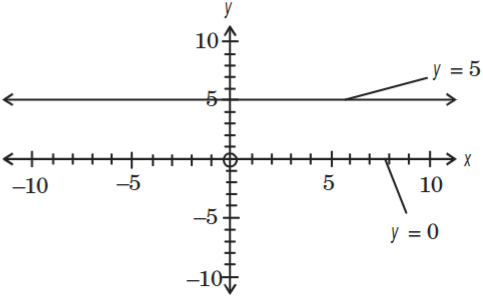
The pair of equations $y=0$ and $y=-5$ has
Answer(d)
Both the lines $y=0$ and $y=-5$ represent parallel lines. Hence they do not intersect and don't have a solution.
Hence, the correct option is (d). View full question & answer→MCQ 21 Mark
$x=2, y=3$ is a solution of the linear equation:
- ✓
$2 x+3 y-13=0$
- B
$3 x+2 y-31=0$
- C
$2 x-3 y+13=0$
- D
$2 x+3 y+13=0$
AnswerCorrect option: A. $2 x+3 y-13=0$
(a)
We have,
$
x=2 \text { and } y=3
$
Let us substitute the above values in the equation $2 x+3 y-13=0$, we get
$
\begin{aligned}
LHS & =(2 \times 2)+(3 \times 3)-13=4+9-13=13-13=0 \\
RHS & =0
\end{aligned}
$
Since, LHS $=$ RHS, the required linear equation is $2 x+3 y-13=0$.
Hence, the correct option is (a).
View full question & answer→MCQ 31 Mark
Which of the following is not a solution of the pair of equations $3 x-2 y=4$ and $6 x-4 y=8$ ?
- A
$x=2, y=1$
- B
$x=4, y=4$
- C
$x=6, y=7$
- ✓
$x=5, y=3$
AnswerCorrect option: D. $x=5, y=3$
(d)
The value of $y$ for $x=5$ is
$\frac{3}{2} x-2=\frac{3}{2}(5)-2=\frac{11}{2}$ which is not equal to given value is of.
Hence, the correct option is (d).
View full question & answer→MCQ 41 Mark
Two lines are given to be parallel. The equation of one of the lines is $3 x-2 y=5$. The equation of the second line can be
- A
$9 x+8 y=7$
- B
$-12 x-8 y=7$
- ✓
$-12 x+8 y=7$
- D
$12 x+8 y=7$
AnswerCorrect option: C. $-12 x+8 y=7$
(c)
$-12 x+8 y=7$The given equation is
$
3 x-2 y=5
$
According to the condition that if two lines $a_1 x+b_1 y+c_1=0$ and $a_2 x+b_2 y+c_2=0$ are parallel
then, $\frac{ a _1}{ a _2}=\frac{ b _1}{b_2} \neq \frac{ c _1}{ c _2}$
Taking option (c) and applying the above condition on it and in the given equation.
or $\frac{3}{-12}=\frac{-2}{8} \neq \frac{5}{7}$
View full question & answer→MCQ 51 Mark
The values of $x$ and $y$ satisfying the two equations $32 x+33 y=34,33 x+32 y=31$ respectively are :
- ✓
$-1,2$
- B
$-1,4$
- C
$1,-2$
- D
$-1,-4$
AnswerCorrect option: A. $-1,2$
The given equations are,
$32 x+33 y=24$
and $33 x+32 y=31$
Subtract eq. from eq. $(i)$
$-x+y=3$ or $y=3+x$
Put this value of $y$ in $(i),$ we get
$32 x+33(3+x)=34$
$\Rightarrow 32 x+99+33 x=34$
$\Rightarrow 65 x=34-99$
$\Rightarrow 65 x=-65$ or $x=-1$
Also, $y=3+x$
$y=3+(-1)$
Hence, the correct solution is $x=-1$ and $y=2$.
View full question & answer→MCQ 61 Mark
3 chairs and 1 table cost Rs. 900; whereas 5 chairs and 3 tables cost Rs. 2,100. If the cost of 1 chair is Rs. x and the cost of 1 table is Rs. y , then the situation can be represented algebraically as
- A
$3 x + y =900,3 x +5 y =2100$
- B
$x +3 y =900,3 x +5 y =2100$
- ✓
$3 x + y =900,5 x +3 y =2100$
- D
$x +3 y =900,5 x +3 y =2100$
AnswerCorrect option: C. $3 x + y =900,5 x +3 y =2100$
(c)
$3 x + y =900,5 x +3 y =2100$
View full question & answer→MCQ 71 Mark
The value of $k$ for which the system of linear equations $x +2 y =3,5 x + ky +7=0$ is inconsistent is
- A
$-\frac{14}{3}$
- B
$\frac{2}{5}$
- C
$5$
- ✓
$10$
Answer$x+2 y-3=0$
$5 x+k y+7=0$
For inconsistent solution,
$ \frac{a_1}{a_2}=\frac{b_1}{b_2} \neq \frac{c_1}{c_2}$
$\Rightarrow \frac{1}{5}=\frac{2}{k} \neq \frac{-3}{7}$
$\Rightarrow k=10$
View full question & answer→MCQ 81 Mark
The solution of the pair of linear equations $x=-5$ and $y=6$ is
- ✓
$(-5,6)$
- B
$(-5,0)$
- C
$(0,6)$
- D
$(0,0)$
AnswerCorrect option: A. $(-5,6)$
(a)
Given that $x =-5$ and $y =6$
The lines drawn for the given equations meet at $(-5,6)$ and thus $(-5,6)$ is the solution of the given equations.
View full question & answer→MCQ 91 Mark
The value of $k$ for which the pair of linear equations $3 x+5 y=8$ and $k x+15 y=24$ has infinitely many solutions, is
AnswerFor infinitely many solutions,
$\frac{a_1}{a_2}=\frac{b_1}{b_2}=\frac{c_1}{c_2}$
Here, $a _1=3, a _2= k , b _1=5, b_2=15, c _1=-8$,
$c_2=-24$
So, $\frac{3}{ k }=\frac{5}{15} \frac{-8}{-24}$
$\Rightarrow \frac{3}{k}=\frac{1}{3}$
$\Rightarrow k=9$
View full question & answer→MCQ 101 Mark
Perimeter of a rectangle whose length $( l )$ is $4 \ cm$ more than twice its breadth $(b)$ is $14 \ cm .$ The pair of linear equations representing the above information is
- A
$l+4=2 b$
$2(l+b)=14$
- B
$l-b=4$
$2(l+b)=14$
- C
$l=2 b+4$
$l+ b =14$
- ✓
$l=2 b+4$
$2(l+b)=14$
AnswerCorrect option: D. $l=2 b+4$
$2(l+b)=14$
$l=2 b+4$
$2(l+b)=14$
To solve the above question,
let us break the statement into parts.
It says that perimeter is $14 \ cm$
$\therefore 2(1+b)=14$
Also, length is $4 \ cm$ more than twice its breadth.
$\Rightarrow \text { Length }=2 \times \text { Breadth }+4$
$\therefore l=2 b+4$
View full question & answer→MCQ 111 Mark
The value of $k$, for the which the pair of linear equations $x+y-4=0,2 x+k y-3=0$ have no solution, is
Answer(b)
For no solution $\frac{a_1}{a_2}=\frac{b_1}{b_2} \uparrow \frac{c_1}{c_2}$Here, $a _1=1, a _2=2, b_1=1, b_2= k$,
$
c_1=-4, c_2=-3
$
So, $\frac{1}{2}=\frac{1}{ k }$
Therefore, $k =\frac{1 \times 2}{1}=2$
View full question & answer→MCQ 121 Mark
The pair of linear equations $x+2 y+5=0$ and $-3 x -6 y +1=0$ has :
- A
- B
- C
infinitely many solutions
- ✓
View full question & answer→MCQ 131 Mark
If the pair ot linear equations $x-y=1, x+k y=5$ has a unique solution $x=2, y=1$. then the value of $k$ is :
Answer(c)
Given that $x =2, y =1$ is a solution of given system of equation.
Put $x =2, y =1$ in equation $x + ky =5$, we obtain
$
2+k=5
$
$
\Rightarrow \quad k=5-2=3
$
View full question & answer→MCQ 141 Mark
If a pair of linear equations is consistent, then the lines represented by them are
- A
- ✓
intersecting or coincident
- C
- D
AnswerCorrect option: B. intersecting or coincident
(b)
Intersecting or Coincident
View full question & answer→MCQ 151 Mark
The larger of the two supplementary angles exceeds the smaller by $18^{\circ}$. Find smaller angle.
- ✓
$81^{\circ}$
- B
$70^{\circ}$
- C
$99^{\circ}$
- D
$80^{\circ}$
AnswerCorrect option: A. $81^{\circ}$
According to the question.
$x-y=18...(i)$
$x+y=180...(ii)$
Solving $eq. (i)$ and $(ii),$ we get
$x =99$ and $y =81$
$\therefore$ smaller angle $=81^{\circ}$.
View full question & answer→MCQ 161 Mark
The sum of the digits of a two-digit number is 15 . The number obtained by interchanging the digits exceeds the given number by 9 . The number is
Answer(d)
Let the ten's digit be x and the unit's digit be y . Then,
$
x+y=15 \quad \quad \ldots \ldots(i)
$
and $(10 y+x)-(10 x+y)=9$
$y - x =1$ $\quad \quad \ldots \ldots(ii)$
On solving eq. (i) and (ii), we get
$x =7$ and $y =8$
$\therefore$ Required number $10 x + y$
$
=10 \times 7+8=70+8=78
$
View full question & answer→MCQ 171 Mark
In a cyclic quadrilateral $\text{ABCD},$ it is being given that $\angle A =( x + y +10)^{\circ}, \angle B =( y +20)^{\circ} \angle C =( x + y -30)^{\circ}$ and $\angle D =( x + y )^{\circ}$. Then $\angle B = ?$
- A
$70^{\circ}$
- ✓
$80^{\circ}$
- C
$100^{\circ}$
- D
$110^{\circ}$
AnswerCorrect option: B. $80^{\circ}$
$\angle A+\angle C=180^{\circ}$
$x+y+10+x+y-30=180^{\circ} .$
$( \because \text{ABCD}$ is a cyclic quadrilateral$)$
$\Rightarrow 2 x+2 y-20=180$
$\Rightarrow x+y=\frac{200}{2}$
$\Rightarrow x+y=100......(i)$
and $\angle B +\angle D =180^{\circ}$
$y+20^{\circ}+x+y=180^{\circ}$
$\because \text{ABCD}$ is a cyclic quadrilateral
$\Rightarrow x+2 y=160^{\circ}....(ii)$
On solving eq. $(i)$ and $(ii)$
$x + y = 100$
$x + y = 160$
- - -
$- y = -60$
$\Rightarrow y = 60^\circ$
$\therefore x =100^{\circ}-60^{\circ}=40^{\circ}$
$\therefore \angle B = y +20^{\circ}=60+20=80^{\circ}$
View full question & answer→MCQ 181 Mark
In a $\triangle ABC , \angle C =3 \angle B=2(\angle A+\angle B )$, then $\angle B =$ ?
- A
$20^{\circ}$
- ✓
$40^{\circ}$
- C
$60^{\circ}$
- D
$80^{\circ}$
AnswerCorrect option: B. $40^{\circ}$
Let $C =3 B=2(A+ B )= x ^{\circ}$
Then, $c = x ^{\circ}, B =\left(\frac{ x }{3}\right)^{\circ}$ and $( A + B )=\left(\frac{ x }{2}\right)^{\circ}$
$(A+B)+C=180^{\circ} $
$\Rightarrow \frac{x}{2}+x=180^{\circ}$
$\Rightarrow 3 x=360 $
$\Rightarrow x=\frac{360}{3}=120^{\circ}$
$\therefore \angle B=\left(\frac{120}{3}\right)^{\circ}$
$=40^{\circ}$
View full question & answer→MCQ 191 Mark
The graphs of the equations $6 x-2 y+9=0$ and $3 x - y +12=0$ are two lines which are
- A
- ✓
- C
intersecting exactly at one point
- D
perpendicular to each other
Answer(b)
$\frac{ a _1}{ a _2}=\frac{6}{3}=\frac{2}{1}, \frac{b_1}{b_2}=\frac{-2}{-1}=\frac{2}{1}$ and $\frac{ c _1}{ c _2}=\frac{9}{12}=\frac{3}{4}$
$
\therefore \frac{a_1}{a_2}=\frac{b_1}{b_2} \neq \frac{c_1}{c_2}
$
So, the system is inconsistent and hence the lines are parallel.
View full question & answer→MCQ 201 Mark
If a pair of linear equations is inconsistent then their graph lines will be
- ✓
- B
- C
- D
intersecting or coincident
Answer(a)
If a pair of linear equations is inconsistent then their graph lines will be parallel.
View full question & answer→MCQ 211 Mark
If a pair of linear equations is consistent then their graph lines will be
- A
- B
- C
- ✓
intersecting or coincident
AnswerCorrect option: D. intersecting or coincident
(d)
If a pair of linear equations is consistent, then their graph lines will be intersecting or coincident.
View full question & answer→MCQ 221 Mark
The sum of two numbers is 1000 and the difference between their squares is 256000 . Find the largest number.
Answer(a)
Let the larger number be x and the smaller number be y .
Then, $x + y =1000 \ldots$ (i)
and $x ^2- y ^2=256000......(ii)$.
On dividing eq. (ii) by (i), we get
$\frac{ x ^2- y ^2}{ x + y }=\frac{256000}{1000}$$
\Rightarrow x-y=256.....(iii)
$
On solving eq. (i) and (iii), we get
$
x=628 \text { and } y=372
$
Hence, larger number $=628$.
View full question & answer→MCQ 231 Mark
The coach of a cricket team buys $7$ bats and $6$ balls for $Rs. 13200.$ Later be buys $3$ bats and $5$ balls for $Rs. 5900.$ Finds the cost of each bat.
- A
$Rs. 1700$
- B
$Rs. 1600$
- ✓
$Rs. 1800$
- D
$Rs. 1000$
AnswerCorrect option: C. $Rs. 1800$
Let the cost of each bat be $Rs. x$ and cost of each ball be $Rs. y.$
Then, $7 x +6 y =13200$
and $3 x+5 y=5900$
On multiplying $(i)$ by $5$ , $(ii)$ by $6$ and subtracting the results,
we get $35 x-18 x=66000-35400$
$\Rightarrow 17 x=30600$
$\Rightarrow x=\frac{30600}{17}=\text { Rs. }1800$
View full question & answer→MCQ 241 Mark
$8$ chair and $5$ tables for a classroom cast $Rs. 10500$ , while $5$ chairs and $3$ tables cost $Rs. 6450$ . The cost of each chair will be.
- A
$Rs. 900$
- ✓
$Rs. 750$
- C
$Rs. 600$
- D
AnswerCorrect option: B. $Rs. 750$
Let the cost of each chair be $Rs. x$ and that of each table be $Rs. y.$
Then, $8 x +5 y =10500$
and $5 x+3 y=6450$
On multiplying $(ii)$ by $5$ and $(i)$ by $3$ and subtracting the results,
we get $25 x-24 x=32250-31500$
$\Rightarrow x=750$
Hence, the cost of each chair $= Rs. 750$
View full question & answer→MCQ 251 Mark
If $2^{x+y}=2^{x-y}=\sqrt{8}$ then the value of $y$ is
- A
$\frac{1}{2}$
- B
$\frac{3}{2}$
- ✓
$0$
- D
Answer$2^{ x + y }=2^{ x - y }=2^{\frac{3}{2}}$
$\Rightarrow x + y =\frac{3}{2}.....(1)$
$\text { and } x - y =\frac{3}{2}......(2)$
On solving $eq(i)$ and $(ii),$ we get
$x=\frac{3}{2} \text { and } y=0$
View full question & answer→MCQ 261 Mark
The system $Kx - y =2$ and $6 x -2 y =3$ has a unique solution only when
- A
$K =0$
- B
$K \neq 0$
- C
$K =3$
- ✓
$K \neq 3$
AnswerCorrect option: D. $K \neq 3$
For a unique solution, we have
$\frac{a_1}{a_2} \neq \frac{b_1}{b_2}$
$\therefore \frac{K}{6} \neq \frac{-1}{-2} $
$\Rightarrow K \neq 3$
View full question & answer→MCQ 271 Mark
The pair of equations $2 x+3 y=5$ and $4 x+6 y=15$ has
- A
- B
- C
infinitely many solutions
- ✓
AnswerHere,
$\frac{a_1}{a_2}=\frac{2}{4}=\frac{1}{2}$
$\frac{b_1}{b_2}=\frac{3}{6}=\frac{1}{2} \text { and }$
$\frac{c_1}{c_2}=\frac{-5}{-15}=\frac{1}{3}$
So, the given system has no solution.
View full question & answer→MCQ 281 Mark
The pair of equations $x+2 y+5=0$ and $-3 x-6 y+$ $1=0$
- A
- B
- C
infinitely many solutions
- ✓
AnswerHere, $\frac{ a _1}{ a _2}=\frac{ a _1}{ a _2}=\frac{1}{-3}=\frac{-1}{3}$,
$\frac{b_1}{b_2}=\frac{2}{-6}=-\frac{1}{3} \text { and } \frac{c_1}{c_2}=\frac{5}{1}=5$
$\therefore \frac{a_1}{a_2}=\frac{b_1}{b_2} \neq \frac{c_1}{c_2} .$
So, the given system has no solution.
View full question & answer→MCQ 291 Mark
For what value of $K$ do the equations $kx -2 y =3$ and $3 x+y=5$ represent two lines intersecting at an unique point?
AnswerCorrect option: D. all real values except$-6$
For a unique intersecting point, we have
$\frac{a_1}{a_2} \neq \frac{b_1}{b_2}$
$\therefore \frac{K}{3} \neq \frac{-2}{1}$
$\Rightarrow K \neq-6$
Hence, correct answer is $(d).$
View full question & answer→MCQ 301 Mark
If the lines given by $3 x+2 k y=2$ and $2 x+5 y+1$ $=0$ are parallel then the value of $K$ is
- A
$-\frac{5}{4}$
- B
$\frac{2}{5}$
- C
$\frac{3}{2}$
- ✓
$\frac{15}{4}$
AnswerCorrect option: D. $\frac{15}{4}$
For parallel lines, we have
$\frac{a_1}{a_2}=\frac{b_1}{b_2} \neq \frac{c_1}{c_2}$
$\therefore \frac{3}{2}=\frac{2 K}{5} \neq \frac{-2}{1}$
$\Rightarrow K=\frac{15}{4} \text { and } K \neq 5$
View full question & answer→MCQ 311 Mark
The system $x -2 y =3$ and $3 x + Ky =1$ has a unique solution only when
- ✓
$K =-6$
- B
$K \neq-6$
- C
$K =0$
- D
$K \neq 0$
AnswerCorrect option: A. $K =-6$
(a)
For a unique solution,
We have, $\frac{ a _1}{ a _2} \neq \frac{ b _1}{b_2}$
So $\frac{1}{3} \neq \frac{-2}{K} \Rightarrow K \neq-6$
View full question & answer→MCQ 321 Mark
If $4 x+6 y=3 x y$ and $8 x+9 y=5 x y$ then.
- A
$x =2, y =3$
- B
$x =1, y =2$
- ✓
$x =3, y =4$
- D
$x =1, y =-1$
AnswerCorrect option: C. $x =3, y =4$
Divide throughout by $xy$ and put $\frac{1}{ x }= u$ and
$\frac{1}{y}=v$ to get
$4 v+6 u=3$
and $ 8 v+9 u=5$
On solving $eq. (i)$ and $(ii),$ we get
$u=\frac{1}{3} $ and $ v=\frac{1}{4}$
$\because \frac{1}{x}=u$
$\therefore x=\frac{1}{u}=\frac{1}{\frac{1}{3}}=3$
and $\frac{1}{ y }= v , y =\frac{1}{ v }=\frac{1}{\frac{1}{4}}=4$
$\therefore x =3$ and $y =4$
View full question & answer→MCQ 331 Mark
If $\frac{2 x+y+2}{5}=\frac{3 x-y+1}{3}=\frac{3 x+2 y+1}{6}$ then
- ✓
$x =1, y =1$
- B
$x =-1, y =-1$
- C
$x =1, y =2$
- D
$x =2, y =1$
AnswerCorrect option: A. $x =1, y =1$
$\frac{2 x+y+2}{5}=\frac{3 x-y+1}{3}=\frac{3 x+2 y+1}{6}$
$\therefore \frac{2 x+y+2}{5}=\frac{3 x-y+1}{3}$
$\Rightarrow 6 x+3 y+6=15 x-5 y+5$
$\Rightarrow 9 x-8 y=1 \ldots . .(i)$
and $\frac{3 x-y+1}{3}=\frac{3 x+2 y+1}{6}$
$\Rightarrow 18 x-6 y+6=9 x+6 y+3$
$\Rightarrow 9 x-12 y=-3 \ldots(\text { ii })$
On solving eq $(i)$ and $(ii)$
We get, $x=1, y=1$
View full question & answer→MCQ 341 Mark
If $\frac{1}{x}+\frac{2}{y}=4$ and $\frac{3}{y}-\frac{1}{x}=11$ then
AnswerCorrect option: D. $x =-\frac{1}{2}, y =\frac{1}{3}$
Putting $\frac{1}{ x }= u$ and $\frac{1}{ y }= v$
$\therefore u+2 v=4 \ldots \ldots(i)$
and $3 v-u=11$
$-u+3 v=11 \ldots \ldots(ii)$
On solving eq. $(i)$ and $(ii)$
$u+2 v=4$
$-u+3 v=11$
$5 v=15$
$\Rightarrow v=\frac{15}{5}=3$
Putting the value of $v$ in eq. $(i)$
$u+2 \times 3=4$
$\Rightarrow u =4-6=-2$
$\because \frac{1}{ x }= u$
$\Rightarrow x =\frac{1}{ u }=\frac{1}{-2}=-\frac{1}{2}$ and
$\frac{1}{ y }= v$
$\Rightarrow y =\frac{1}{ v }=\frac{1}{3}$
$\therefore x =-\frac{1}{2}$ and $y =\frac{1}{3}$
View full question & answer→MCQ 351 Mark
If $\frac{2 x}{3}-\frac{y}{2}+\frac{1}{6}=0$ and $\frac{x}{2}+\frac{2 y}{3}=3$ then
- ✓
$x =2, y =3$
- B
$x =-2, y =3$
- C
$x =2, y =-3$
- D
$x=-2, y=-3$
AnswerCorrect option: A. $x =2, y =3$
$\frac{2x}{3}-\frac{y}{2}=-\frac{1}{6}$
$\Rightarrow \frac{4 x-3 y}{6}=-\frac{1}{6}$
$\Rightarrow 4 x-3 y=-1 \ldots \ldots(i)$
and $\frac{x}{2}+\frac{2 y}{3}=3$
$\Rightarrow \frac{3 x+4 y}{6}=3$
$\Rightarrow 3 x+4 y=18 \ldots \ldots(ii)$
On solving $eq. (i)$ and $(ii)$
$x=2, y=3
$
View full question & answer→