Questions

6 Marks Question

🎯

Test yourself on this topic

27 questions · timed · auto-graded

Question 16 Marks
Pass the Journal entries rectifying the following errors:
  1. Purchases of ₹ 10,000 was omitted to be recorded.
  2. Purchases of office furniture of ₹ 10,000 was recorded in Purchases Book.
  3. Office Rent of ₹ 15,000 was debited to the Personal Account of the landlord.
  4. Old machine sold for ₹ 5,000 was credited to Sales Account.
  5. Bill for ₹ 800 received from Mukesh for repair of machinery was entered in the Purchases Book as ₹ 700.
Answer
Coming Soon
View full question & answer
Question 26 Marks
Give rectifying Journal entries for the following errors:
  1. Sales of goods to Madan ₹ 6,000 were entered in the Sales Book as ₹ 600.
  2. Credit purchase of ₹ 1,500 from Ajay has been wrongly passed through the Sales Book.
  3. Repairs to building ₹ 300 were debited to Building Account.
  4. ₹ 2,050 paid to Rohit is posted to the debit of Mohit’s Account as ₹ 5,020.
  5. Purchases Return Book is overcasted by ₹ 400.
View full question & answer
Question 36 Marks
What are the different classes of errors? Which of them do not affect a Trial Balance?
Answer
Keeping in view their nature, errors can be classified into following four categories:
  1. Errors of Omission.
  2. Errors of Commission.
  3. Errors of Principle.
  4. Compensating Errors.
Errors not affecting the Trial Balance or Two-sided Errors are those errors which do not affect the agreement of Trial Balance. Such errors are not disclosed by the Trial Balance. Following are the examples of such errors:
  1. Errors of Principle, i.e., errors which arise due to incorrect application of principles of accounting. Suppose on purchase of a typewriter or printer, Office Expenses Account is debited, Trial Balance will still match.
  2. Compensating Errors: If the effect of one error is cancelled by the effect of some other error or errors, Trial Balance will still match. Suppose, an amount of ₹ 10 received from A is not credited to his account and the total of the Sales Book is ₹ 10 in excess, the omission of credit to A's Account will be made up by the increased credit to the Sales Account; the Trial Balance will still match.
  3. Errors of complete omission.
  4. Posting correct amount on the correct side but in wrong account.
  5. Recording wrong amount in the books of original entry (but the recorded amount is correctly debited and credited).
  6. Recording both aspects of a transaction twice in the books of account.
View full question & answer
Question 46 Marks
Rectify the following errors:
  1. Wages paid for the construction of office debited to the Wages Account, ₹ 5,000.
  2. Machinery purchased for ₹ 35,000 was passed through the Purchases Book.
  3. Old furniture sold for ₹ 1,000, passed through the Sales Book.
  4. ₹ 2,000 paid to Mehta Bros. against acceptance were debited to Malhotra Bros. Account.
  5. Sales of ₹ 204 to Ram debited to his account as ₹ 402 and purchases of ₹ 1,012 from Shyam credited to his account as ₹ 1,210.
View full question & answer
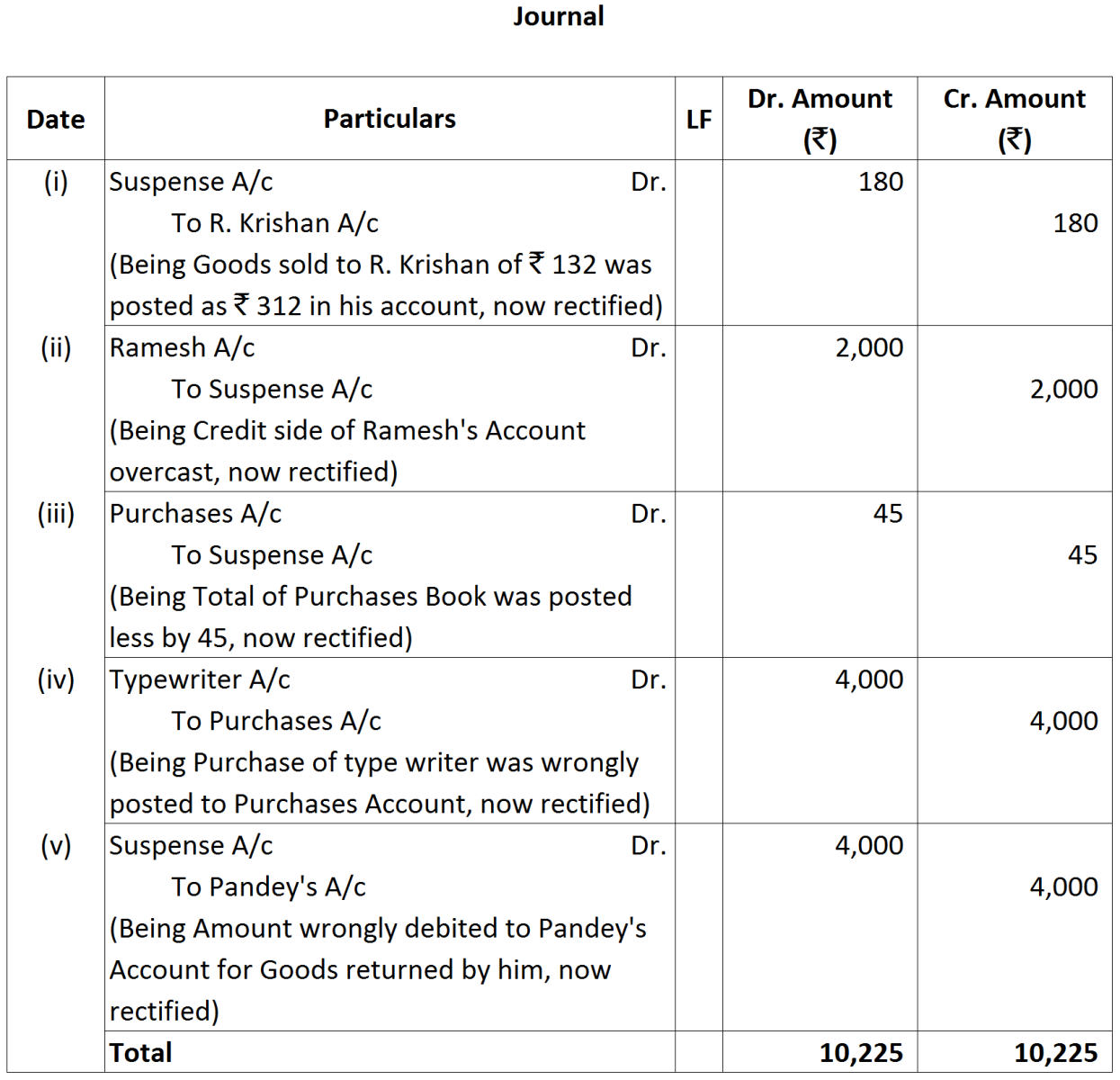
Question 56 Marks
Correct the following errors in Hari’s Books:
  1. Credit sale of ₹ 132 to R. Krishan correctly entered in Sales Journal but posted to his account as ₹ 312.
  2. The total of the credit side of Ramesh’s Account was overcasted by ₹ 2,000.
  3. Total of the Purchases Journal of ₹ 5,250 has been posted to Purchases Account as ₹ 5,205.
  4. Printer purchased from R. Ltd. for ₹ 4,000 on credit was entered in the Purchases Book.
  5. An item of ₹ 2,000 entered in the Sales Return Book was posted to the debit of Pandey who had returned the goods.
Answer
Solution is as follows:
View full question & answer
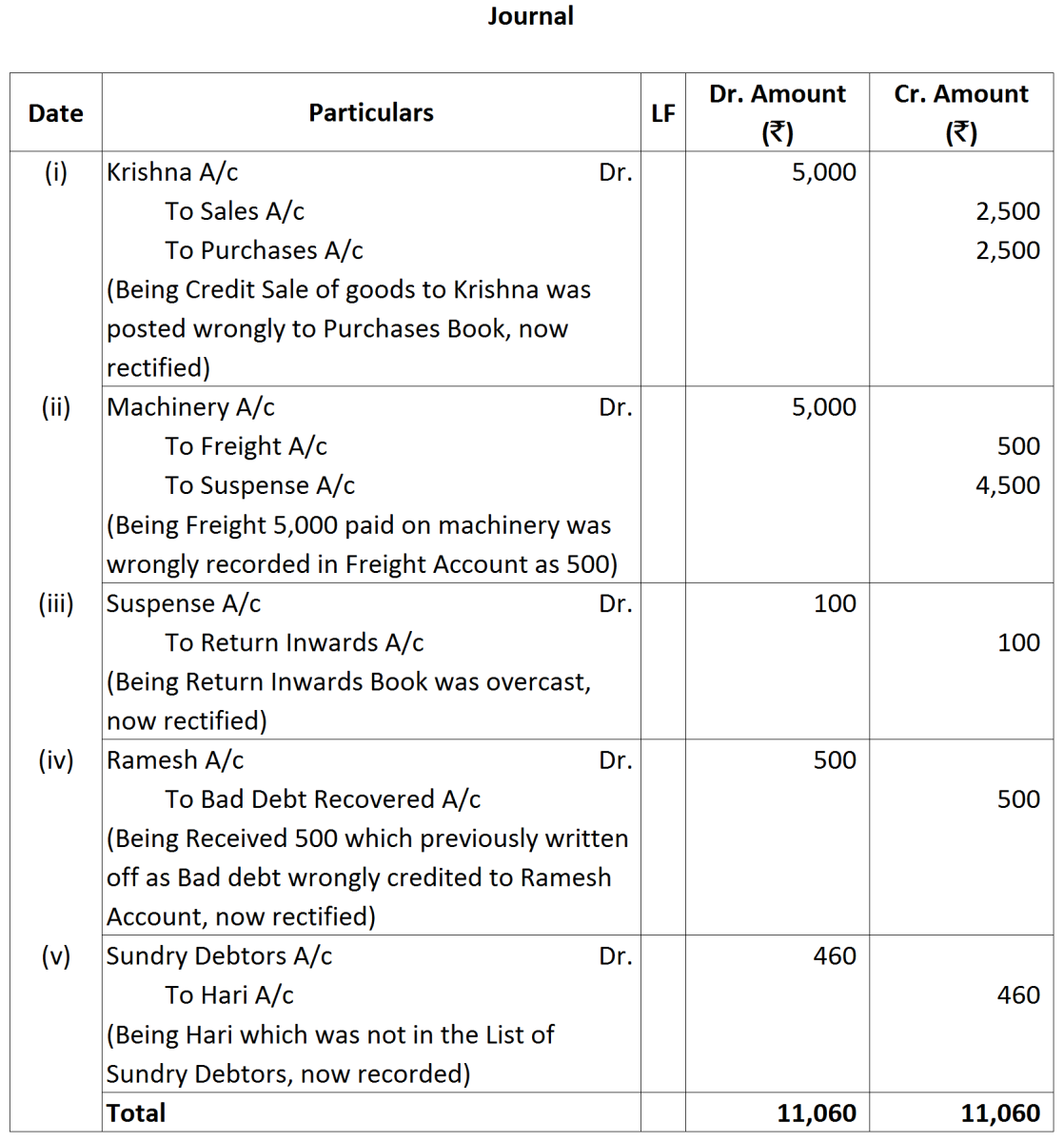
Question 66 Marks
  1. What are the different causes that make a Trial Balance incorrect?
  2. Pass the rectifying Journal entries:
  1. A credit sale of goods for ₹ 2,500 to Krishna has been wrongly passed through the Purchases Book.
  2. ₹ 5,000 paid for freight on machinery purchased was debited to the Freight Account as ₹ 500.
  3. The Returns Inward Book has been wrongly overcasted by ₹ 100.
  4. An amount of ₹ 500 due from Ramesh which had been written off as bad debt in previous year was recovered and had been posted to the Personal Account of Ramesh.
  5. A sum of ₹ 460 owed by Hari had not been included in the list of debtors.
Answer
  1. The following are the causes that make a Trial Balance incorrect.
  1. Incomplete posting of Journal Entry.
  2. Posting in the wrong side of Account.
  3. Wrong totalling of Subsidiary Books.
  4. Wrong balance of Account.
  5. Omission of total of Subsidiary book into Account.
  6. Wrong totalling of the Trial Balance.
  1.  
View full question & answer
Question 76 Marks
Correct the following errors in Mohan Lal’s Book:
  1. A payment of ₹ 5,000 for salaries (to Mr. Ram) has been posted twice to the Salaries Account.
  2. ₹ 750 received from Rajesh are entered on the debit side of the Cash Book. No posting was done in Rajesh’s Account.
  3. Sales Book was overcasted by ₹ 3,000.
  4. Goods (Cost ₹ 2,000, Sales Price ₹ 2,500) distributed as samples among prospective customers were not recorded anywhere.
  5. A sum of ₹ 1,500 written off as depreciation on furniture was not debited to Depreciation Account.
Answer
Coming Soon
View full question & answer
Question 86 Marks
Rectify the following errors:
  1. Total of one page of the Sales Book was carried forward to the next page as ₹ 2,785 instead of ₹ 2,587.
  2. A cheque of ₹ 400 received from Mohan was dishonoured and had been posted to the debit side of the ‘Allowance Account’.
  3. Return of goods worth ₹ 5,000 by a customer was entered in the Purchases Return Book.
  4. Sum of ₹ 200 owed by ‘X’ has been included in the list of Sundry Creditors.
  5. Sale of old furniture worth ₹ 430 was credited to the Sales Account as ₹ 340.
View full question & answer
Question 96 Marks
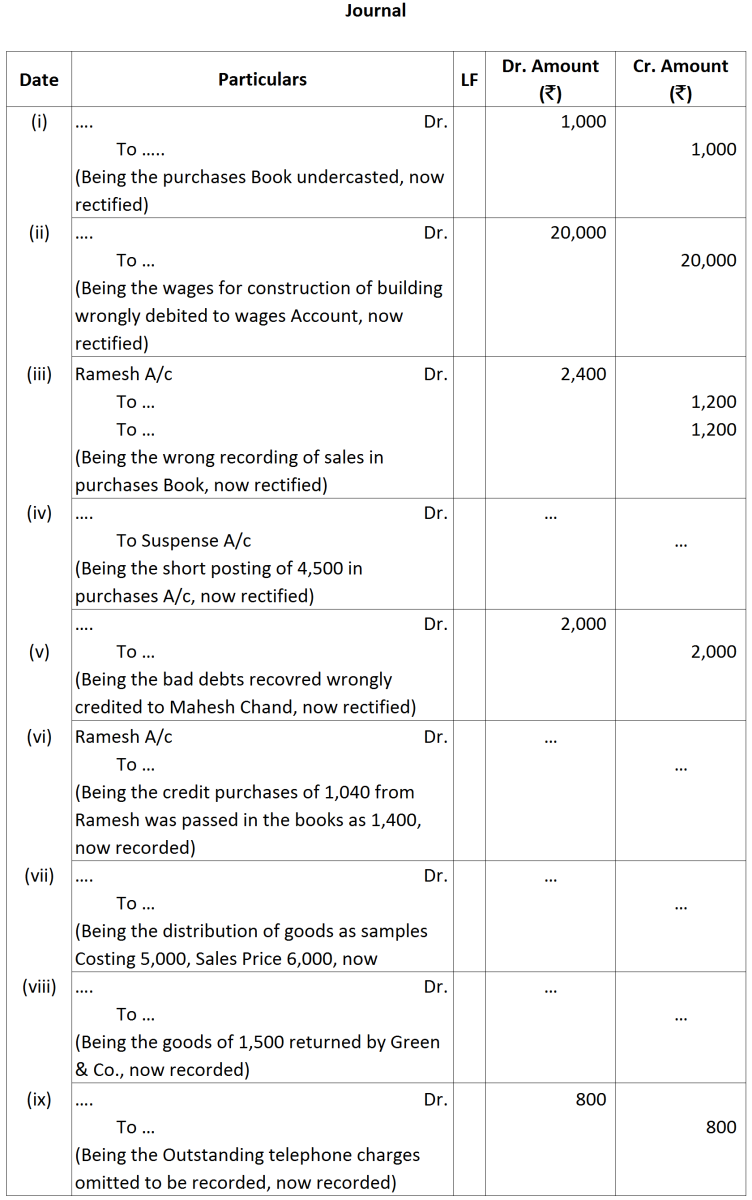
Rectifying the following errors:
  1. Sales Book has been totalled ₹ 1,000 short.
  2. Goods worth ₹ 1,500 returned by Green & Co. have not been recorded anywhere.
  3. Goods purchased worth ₹ 2,500 have been posted to the debit of the supplier, Gupta & Co.
  4. Furniture purchased from Gulab & Co. worth ₹ 10,000 has been entered in Purchases Book.
  5. Cash received from A ₹ 2,500 has not been posted in his account.
View full question & answer
Question 106 Marks
There was an error in the Trial Balance of Ram Gopal on 31st March, 2018 and the difference in books was carried to the Suspense Account. On going through the books, you find that:
  1. ₹ 540 received from Mayank was posted to the debit side of his account.
  2. ₹ 100 being purchases return was posted to the debit of the Purchases Account.
  3. Discount of ₹ 300 received was posted to the debit of the Discount Account.
  4. ₹ 374 paid for motor car repairs was debited to the Motor Car Account as ₹ 174.
  5. ₹ 400 paid to Naman was debited to the account of Manan.
Pass the Journal entries to rectify the above errors and state what amount was carried to the Suspense Account.
View full question & answer
Question 116 Marks
Pass the rectifying entries for the following:
  1. Sales of goods ₹ 6,000 to Madan were recorded as ₹ 600 in the Sales Book.
  2. Credit purchase of goods from Mohan amounting to ₹ 2,000 has been wrongly passed through the Sales Book.
  3. Return of goods worth ₹ 500 by a customer was entered in ‘Purchases Return Book’.
  4. Cheque of ₹ 400 received from Ranjan was dishonoured and debited to the Discount Account.
  5. Bill for ₹ 820 received from Ramesh for repair of machinery was entered in the Purchases Book as ₹ 720.
View full question & answer
Question 126 Marks
The accountant of a firm finds that the Trial Balance as on 31st March, 2019 is out by an excess debit of ₹ 283. He placed the amount in the Suspense Account. In the first week of April, 2019, he discovered the following errors. Pass the Journal entries necessary to rectify these errors and show the Suspense Account as it would appear at the end of the week. Have you any comment to make?
  1. Cash paid to Amar Nath, ₹ 75, was posted to the credit of Amar Singh's Account as ₹ 57.
  2. Discount allowed by Brijesh of ₹ 5 was not entered in the Cash Book but Brijesh stands debited correctly.
  3. No entry was made for goods worth ₹ 40 taken away by proprietor for personal use.
  4. ₹ 500 received from Jhaveri Bros. for interest on loan advanced to them were recorded in the Cash Book. But the entry was not posted in the Ledger.
  5. The total of Returns Outward Book was short by ₹ 100.
View full question & answer
Question 136 Marks
Pass Journal entries to rectify the errors in the following cases:
  1. A purchase of goods from David amounting to ₹ 150 has been wrongly passed through the Sales Book.
  2. A credit sale of goods of ₹ 120 to Peter has been wrongly passed through the Purchases Book.
  3. ₹ 200, salary paid to Cashier, Bimal, stands wrongly debited to his Personal Account.
  4. A credit sale of ₹ 4,230 to Krishan entered as purchase from Kishan ₹ 4,320.
  5. Ramesh's Account was credited with ₹ 840 twice instead of once.
View full question & answer
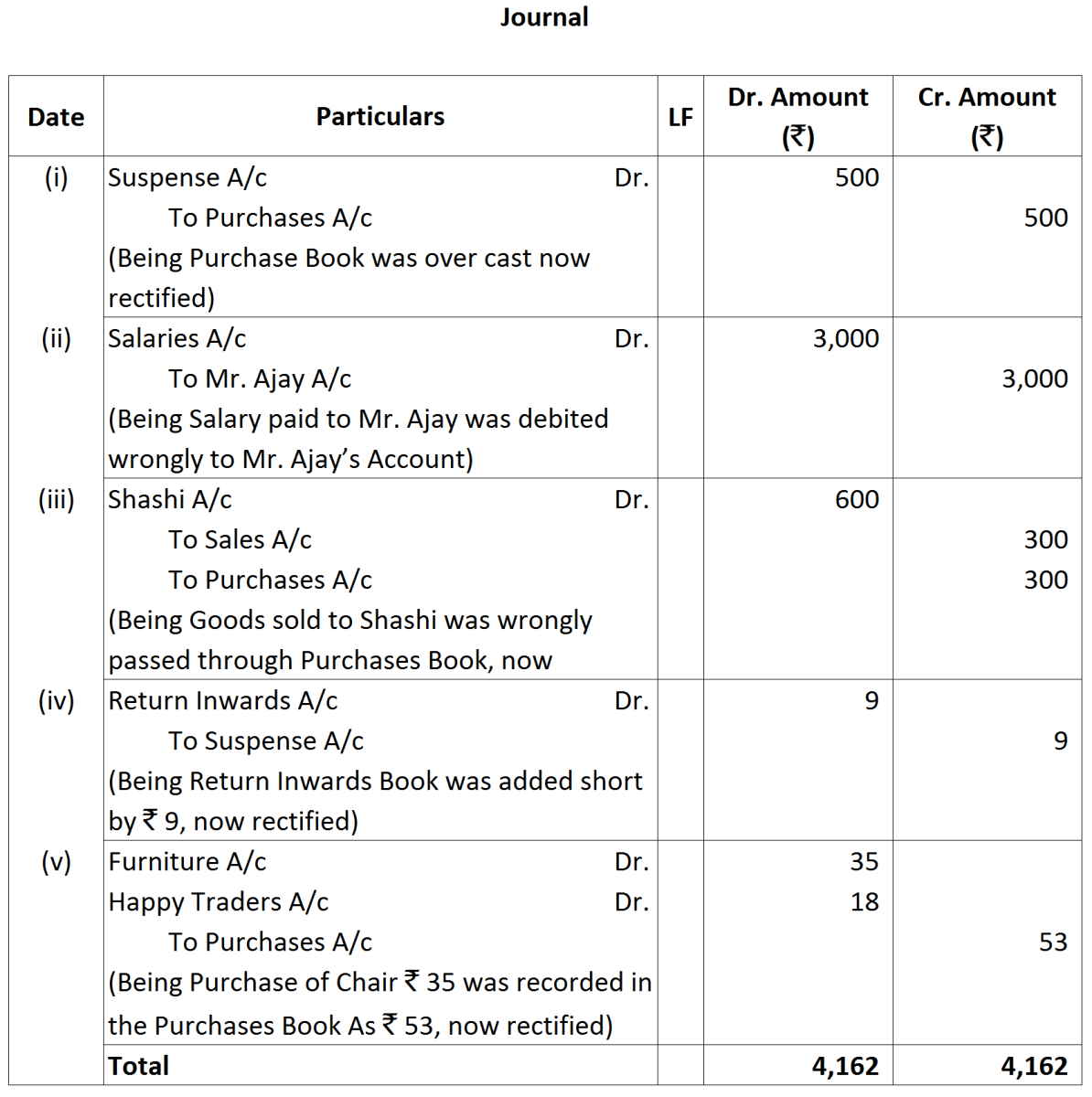
Question 146 Marks
Rectify the following errors:
  1. Purchases Book is overcast by ₹ 500.
  2. Salary paid to an employee, Mr. Ajay, is debited to his Personal account ₹ 3,000.
  3. Goods sold to Shashi on credit ₹ 300 have been wrongly passed through the Purchases Book.
  4. Total of Returns Inward Book has been added ₹ 9 short.
  5. Purchase of chair from Happy Traders for ₹ 35 has been entered in the Purchases Book as ₹ 53.
Answer
Solution is as follows:
View full question & answer
Question 156 Marks
Rectify the following errors found in the books of Bheem. Trial Balance had ₹ 930 excess credit. The difference has been posted to a Suspense Account:
  1. The total of Returns Inward Book has been cast ₹ 1,000 short.
  2. The purchase of an office table costing ₹ 3,000 has been passed through the Purchases Book.
  3. ₹ 3,750 paid for wages to workmen for making showcases had been charged to the Wages Account.
  4. A purchase of ₹ 670 had been posted to the Creditors' Account as ₹ 600.
  5. A cheque for ₹ 2,000 received from Nakul had been dishonoured and was passed to the debit of the Allowances Account.
  6. An amount of ₹ 15,720 due from Prasad written off as had in a previous year, was recovered and credited to the Personal Account of Prasad.
After rectification reflect the transactions in the Suspense Account.
View full question & answer
Question 166 Marks
Trial Balance of a bookkeeper shows an excess of debits over credits by ₹ 261. This difference is placed in a Suspense Account to facilitate books closure. Later on the following errors were discovered:
  1. A credit item of ₹ 349 has been debited to a Personal Account as ₹ 439.
  2. A sum of ₹ 625 written off from fixtures as depreciation has not been posted to the Depreciation Account.
  3. ₹ 9,000 paid for furniture bought have been charged to the Purchases Account.
  4. A discount allowed to a customer has been credited to him as ₹ 145 in place of ₹ 154.
  5. A sale of ₹ 594 was posted as ₹ 495 in the Sales Account.
  6. The total of Returns Inward Book has been added ₹ 10 short.
Pass the Journal entries to correct these errors and prepare the Suspense Account.
View full question & answer
Question 176 Marks
What is a Trial Balance? Name the errors that are disclosed by a Trial Balance.
Answer
Trial Balance: Trial Balance is a statement of accounts which appears in the Ledger and Cash Book showing either the balances or the total amounts of debit and credit items.
Errors Disclosed by a Trail Balance.
  1. Posting of wrong amount: Sometimes, wrong amount is posted in one of the two accounts. For example goods sold of $ 500 are correctly entered in credit side of sales account but it was debited in cash account as $ 550. There is a difference in amount of $ 50. As a result trial balance shows the disagreement.
  2. Posting on the wrong side: When an item is by mistake posted on the wrong side of an account in the ledger, it would cause disagreement in the trial balance. Suppose, wages paid of $1500. In this case, wages account must be debited by $ 1500. But wages account was debited accurately however cash account was also debited instead of crediting it. It created the excess amount in debit side.
  3. Wrong totaling of subsidiary books: When there is error in totaling of subsidiary books, that will cause disagreement of trial balance. Suppose sales book has been totaled $ 1000 instead of $ 1050.
  4. Wrong totaling or balancing of ledger account: Sometimes, errors may be committed in writing totaling or balancing of ledger account the trial balance will disagree.
  5. Ommission to post an amount into ledger: When an aspect of transaction is omitted to post in ledger account, the trial balance shows disagreement. For example, cash paid for interest $ 200. Interest account was debited by the same amount but it was omitted to credit in cash account.
  6. Ommission to enter an amount in trial balance: If an amount is omitted to enter in trial balance while transferring from ledger balances, then the trial balance shows disagreement.
View full question & answer
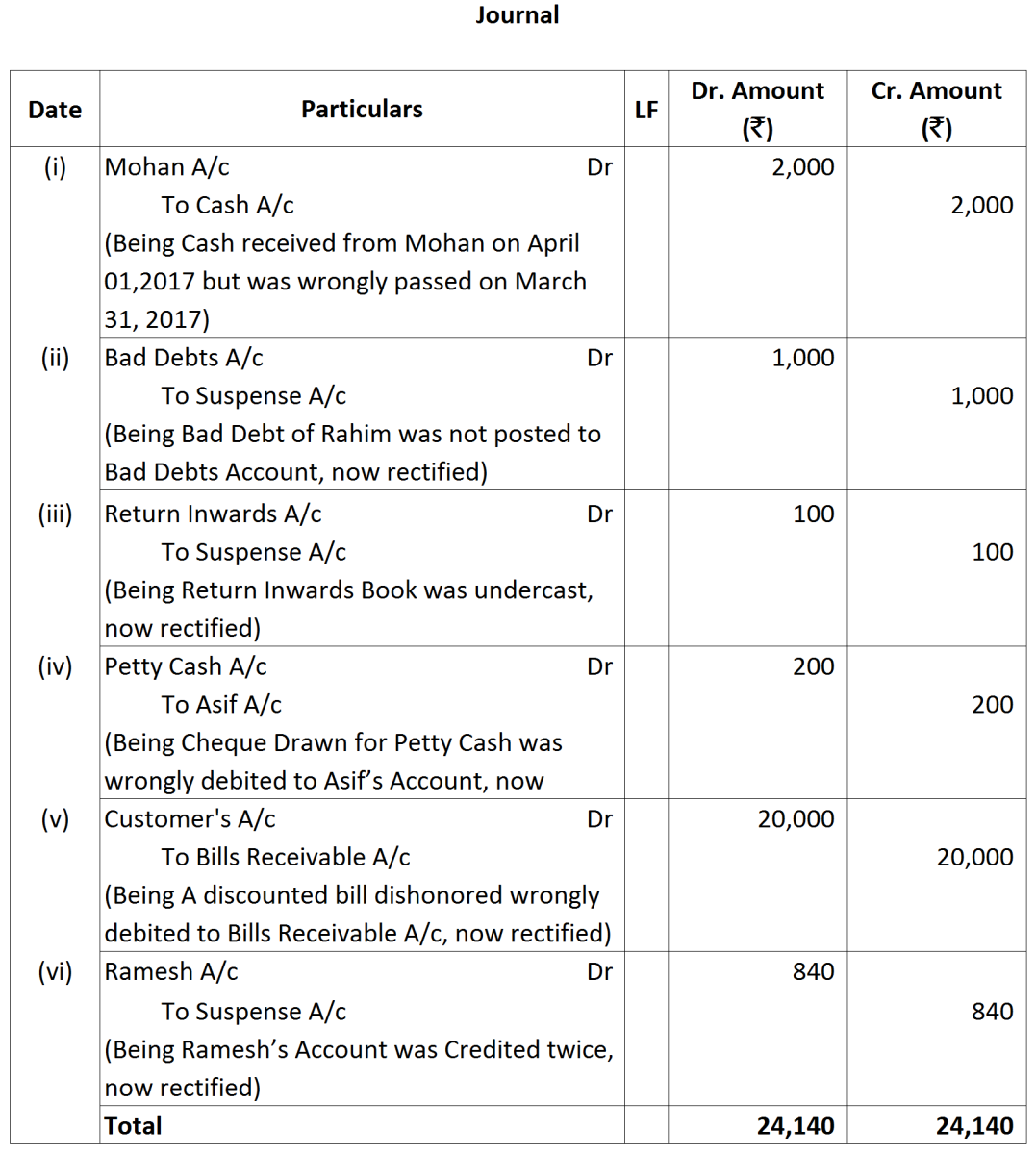
Question 186 Marks
Pass the rectification entries for the following transactions:
  1. An amount of ₹ 2,000 received from Mohan on 1st April, 2019 had been entered in the Cash Book as having been received on 31st March, 2019.
  2. The balance in the account of Rahim ₹ 1,000 had been written off as bad but no other account has been debited.
  3. An addition in the Returns Inward Book had been cast ₹ 100 short.
  4. A cheque for ₹ 200 drawn for the Petty Cash Account has been posted in the account of Asif.
  5. A discounted Bill of Exchange for ₹ 20,000 returned by the firm's bank had been credited to the Bank Account and debited to Bills Receivable Account. A cheque was received later from the customer for ₹ 20,000 and duly paid.
  6. Ramesh's Account was credited with ₹ 840 twice instead of once.
Answer
Solution is as follows.
View full question & answer
Question 196 Marks
The bookkeeper of a firm found that his Trial Balance was out (excess credit) by ₹ 742. He placed the amount in a Suspense Account and subsequently found the following errors:
  1. A discount of ₹ 178 was allowed to Ramesh but in his account only ₹ 100 is recorded.
  2. The total of the Purchases Book was ₹ 1,000 short.
  3. A sale of ₹ 375 to Kohli was entered in the Sales Book as ₹ 735.
  4. From the Purchases Book, Bose’s Account was debited with ₹ 175.
  5. Cash ₹ 250 received from Maitra against debt previously written off was credited to his account.
  6. Purchase of office furniture worth ₹ 750 on credit from Delhi Furnitures was entered in the Purchases Book.
  7. While carrying forward the total of the Sales Book from one page to another the amount of ₹ 11,358 was written as ₹ 11,538.
  8. The proprietor took goods of the value of ₹ 150 for his domestic consumption. No record of it has been made in the books.
  9. Repairs bill of ₹ 410 for the proprietor’s personal car, has been paid by the firm and debited to the Repairs Account.
  10. A sale to Kassim of ₹ 700 has been entered in the Purchases Book.
  11. Rectify the errors by means of suitable Journal entries and show the Suspense Account.
View full question & answer
Question 206 Marks
Pass the necessary Journal entries to rectify the following errors:
  1. Credit sale of ₹ 850 to Kishan was posted to Krishan's Account.
  2. Cash sale of ₹ 850 to Meenu was posted to the credit of Meena.
  3. Amount of ₹ 1,500 withdrawn from bank by the proprietor for his personal use was debited to Purchases Account.
  4. Credit sale of old furniture to Mohan for ₹ 1,700 was posted as ₹ 7,100.
  5. Credit sale of old furniture to Babu Ram for ₹ 3,000 was credited to Sales Account.
  6. Cheque of ₹ 1,280 received from Farid was dishonoured and has been posted to the debit of Sales Return Account.
View full question & answer
Question 216 Marks
Pass the necessary Journal entries to rectify the following errors:
  1. Credit sale of ₹ 570 to Mohan was recorded as ₹ 750.
  2. Credit sale of ₹ 850 to Sohan was recorded as sale to Mohan.
  3. Credit sale of ₹ 850 to Meenu was recorded as sale to Meena as ₹ 580.
  4. Credit sale of ₹ 850 to Ram was recorded in the Purchases Book.
  5. Credit sale of old machinery to Sohan for ₹ 1,700 was entered in the Sales Book as ₹ 7,100.
  6. Bill Receivable for ₹ 5,000 accepted by Mahinder recorded as acceptance given to Mahinder for ₹ 6,000.
View full question & answer
Question 236 Marks
What do you mean by Suspense Account? When is it opened?
Answer
Suspense Account: Suspense Account is the account to which the amount being the difference in trial balance is temporarily placed. If the total of debit side is short, Suspense Account will show debit balance. And if, the total of credit side is short, Suspense Account will show credit balance. The difference is placed in the Suspense Account so that final accounts are prepared without delay. As a result of this, Trial Balance will appear to agree.. However, the errors still remain in the Trial Balance which are identified and rectified.
Suspense Account is used for rectifying all One-Sided Errors: It is opened Due to errors any error in journal entries especially one-sided errors, There may be cases when Trial balance does not match i.e when the total of the debit column does not match that of the credit column, then the difference of the Trial Balance is transferred to a temporary account in order to avoid delay in preparation of the financial statements. This temporary account is termed as Suspense Account and it is prepared only in case of one-sided errors in the books of accounts.
View full question & answer
Question 246 Marks
The Trial Balance of S. Sen did not agree and the difference in books was carried to a Suspense Account. Pass the entries required to rectify the following errors which accounted for the difference. Also, prepare the Suspense Account:
  1. A Sales Invoice for ₹ 1,000 for goods sold on credit to B. Basu was entered in the Purchases Book but in the Ledger, the amount was correctly debited to the account of B. Basu.
  2. Goods bought on credit from Ram Lal for ₹ 1,500 were wrongly debited to his account as ₹ 5,100
  3. An amount of ₹ 275 was posted as ₹ 325 to the debit side of the Commission Account.
  4. The Sales Book for the month of April was undercasted by ₹ 100.
  5. ₹ 460 paid for building repairs was debited to the Building Account as ₹ 640.
View full question & answer
Question 256 Marks
Pass the rectification entries for the following transactions:
  1. Repairs to plant amounting to ₹ 2,000 had been charged to Plant and Machinery Account.
  2. Wages paid to the firm's workmen for making certain additions to machinery amounting to ₹ 1,340 were debited to Wages Account.
  3. A cheque for ₹ 7,500 received from Sandesh was credited to the account of Ramesh.
  4. Goods to the value of ₹ 7,000 returned by Prateek were included in closing stock, but no entry was made in the books.
  5. (v) Goods costing ₹ 5,000 were purchased for various members of the staff and the cost was included in 'Purchases'. A similar amount was deducted from the salaries of the staff members concerned and the net payments to them debited to Salaries Account.
  6. Credit purchase of old machinery from Sohan for ₹ 1,70,000 was entered in the Purchase Book as purchase from Mohan for ₹ 7,10,000. ₹ 30,000 paid as repairing charges on the reconditioning of a newly purchased second hand machinery were debited to General Expenses Account.
  7. Debit and Credit totals of discount columns in the Cash Book which come to ₹ 400 and ₹ 370 respectively have not been posted to Discount Accounts.
View full question & answer
Question 276 Marks
Pass the necessary Journal entries to rectify the following errors:
  1. ₹ 15,000 paid as wages for the construction of office building debited to Salaries Account.
  2. ₹ 20,000 spent on the purchases of material for the construction of building debited to Purchases Account.
  3. ₹ 50,000 spent on the extension of building was debited to Building Repairs Account.
  4. ₹ 25,000 spent on whitewash of a new building was charged to Building Repairs Account.
  5. ₹ 1,000 paid as installation charges for newly purchased second hand machinery posted to Cartage Account.
  6. ₹ 10,000 paid as repairing charges on the reconditioning of a newly purchased second hand machinery debited to General Expenses Account.
  7. ₹ 5,000 paid as repairing charges of an existing machine in use charged to Machinery Account.
  8. ₹ 10,000 paid by cheque for a printer was charged to the Office Expense Account.
View full question & answer
6 Marks Question - Account STD 11 Commerce Questions - Vidyadip