Question 13 Marks
A solid cylinder rolls up an inclined plane of angle of inclination 30°. At the bottom of the inclined plane the centre of mass of the cylinder has a speed of 5m/s.
- How far will the cylinder go up the plane?
- How long will it take to return to the bottom?
Answer
- A solid cylinder rolling up an inclination is shown in the following figure:
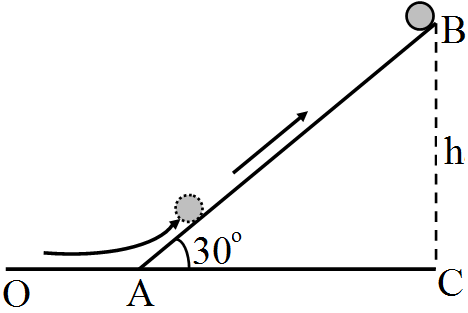
Initial velocity of the solid cylinder, v = 5m/s
Angle of inclination, $\theta=30^{\circ}$
Height reached by the cylinder = h Energy of the cylinder at point A
$\text{KE}_{\text{root}}=\text{KE}_{\text{trans}}$
$\frac{1}{2}\text{I}\omega^2=\frac{1}{2}\text{mv}^2$
Energy of the cylinder at point B = mgh
Using the law of conservation of energy, we can write,
$\frac{1}{2}\text{I}\omega^2=\frac{1}{2}\text{mv}^2=\text{mgh}$
Moment of inertia of the solid cylinder, $\text{I}=\frac{1}{2}\text{mr}^2$
$\therefore\ \frac{1}{2}\Big(\frac{1}{2}\text{mr}^2\Big)\omega^2+\frac{1}{2}\text{mv}^2=\text{mgh}$
$\frac{1}{4}\text{mr}^2\omega^2+\frac{1}{2}\text{mv}^2=\text{mgh}$
But we have the relation, $\text{v}=\text{r}\omega$
$\therefore\ \frac{1}{4}\text{v}^2+\frac{1}{2}\text{v}^2=\text{gh}$
$\frac{3}{4}\text{v}^2=\text{gh}$
$\therefore\ \text{h}=\frac{3}{4}\frac{\text{v}^2}{\text{g}}$
$=\frac{3}{4}\times\frac{5\times5}{9.8}=1.91\text{m}$
- In $\Delta\text{ABC}$
$\sin\theta=\frac{\text{BC}}{\text{AB}}$
$\sin30^{\circ}=\frac{\text{h}}{\text{AB}}$
$\text{AB}=\frac{1.91}{0.5}=3.82\text{m}$
Hence, the cylinder will travel 3.82m up the inclined plane. For radius of gyration K, the velocity of the cylinder at the instance when it rolls back to the bottom is given by the relation. View full question & answer→Question 23 Marks
Show that the area of the triangle contained between the vectors a and b is one half of the magnitude of a × b.
AnswerConsider two vectors OK = vector |a| and OM = vector |b|, inclined at an angle $\theta,$ as shown in the following figure.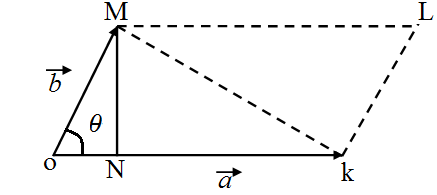 In $\Delta\text{OMN},$ using the relation,
$\sin\theta=\frac{\text{MN}}{\text{OM}}=\frac{\text{MN}}{|\vec{\text{b}}|}$ $\text{MN}=|\vec{\text{b}}|\sin\theta$ $|\vec{\text{a}}\times\vec{\text{a}}|=|\vec{\text{a}}||\vec{\text{b}}|\sin\theta$ $=\text{OK}\times\text{MN}\times\frac{2}{2}$ $=2\times{\text{Area of }}\Delta\text{ OMK}$ $\therefore{\text{ Area of }}\Delta\text{ OMK}=\frac{1}{2}|\vec{\text{a}}\times\vec{\text{b}}|$ Area of the triangle contained between the vectors a and b is one-half of the magnitude of a × b. View full question & answer→Question 33 Marks
A solid cylinder of mass $20kg$ rotates about its axis with angular speed $100rads^{-1}$. The radius of the cylinder is $0.25m$. What is the kinetic energy associated with the rotation of the cylinder? What is the magnitude of angular momentum of the cylinder about its axis?
AnswerMass of the cylinder, m = 20kg Angular speed, $\omega= 100\text{rads}^{-1}$ Radius of the cylinder, r= 0.25m The moment of inertia of the solid cylinder, $\text{I}=\frac{\text{mr}^2}{2}$
$=\frac{1}{2}\times20\times(0.25)^2$
$=0.625\text{kgm}^2$
$\therefore$ Kinetic energy $=\frac{1}{2}\text{I}\omega^2$
$=\frac{1}{2}\times6.25\times100^2=3125\text{J}$
$\therefore$ Angular momentum, $\text{L} = \text{I}\omega = 6.25\times100 = 62.5\text{Js}$
View full question & answer→Question 43 Marks
Find the moment of inertia of a sphere about a tangent to the sphere, given the moment of inertia of the sphere about any of its diameters to be $2MR^2/ 5$, where M is the mass of the sphere and R is the radius of the sphere.
AnswerThe moment of inertia (M.I.) of a sphere about its diameter $=\frac{2}{5}\text{MR}^2$
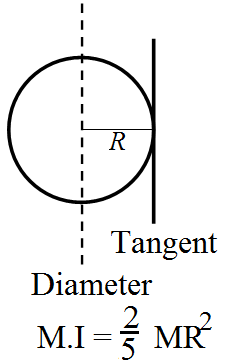
According to the theorem of parallel axes, the moment of inertia of a body about any axis is equal to the sum of the moment of inertia of the body about a parallel axis passing through its centre of mass and the product of its mass and the square of the distance between the two parallel axes. The M.I. about a tangent of the sphere $=\frac{2\text{MR}^2}{5}+\text{MR}^2=\frac{7\text{MR}^2}{5}$ View full question & answer→Question 53 Marks
Given the moment of inertia of a disc of mass M and radius R about any of its diameters to be $\frac{\text{MR}^2}{4},$ find its moment of inertia about an axis normal to the disc and passing through a point on its edge.
AnswerThe moment of inertia of a disc about its diameter $=\frac{\text{MR}^2}{4}$ According to the theorem of perpendicular axis, the moment of inertia of a planar body (lamina) about an axis perpendicular to its plane is equal to the sum of its moments of inertia about two perpendicular axes concurrent with perpendicular axis and lying in the plane of the body. The M.I. of the disc about its centre $=\frac{\text{MR}^2}{4}+\frac{\text{MR}^2}{4}=\frac{\text{MR}^2}{2}$ The situation is shown in the given figure: 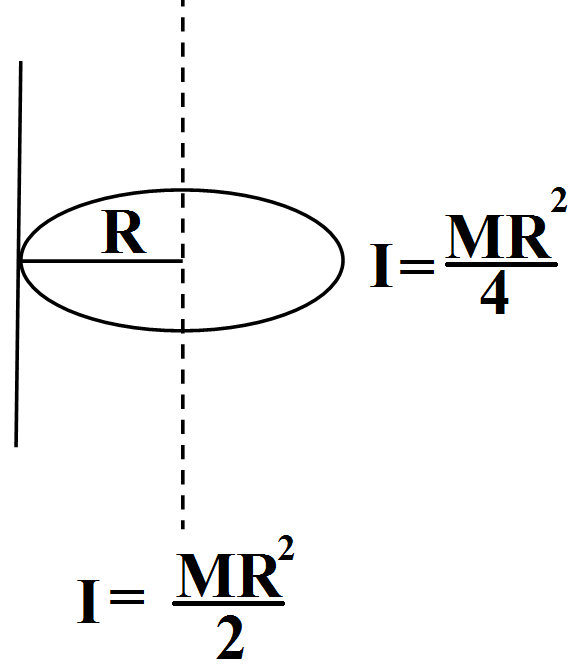 Applying the theorem of parallel axes, The moment of inertia about an axis normal to the disc and passing through a point on its edge $=\frac{\text{MR}^2}{2}+\text{MR}^2=\frac{3\text{MR}^2}{2}$
 View full question & answer→Question 63 Marks
To maintain a rotor at a uniform angular speed of $200rad s^{-1}$, an engine needs to transmit a torque of 180Nm. What is the power required by the engine? (Note: uniform angular velocity in the absence of friction implies zero torque. In practice, applied torque is needed to counter frictional torque). Assume that the engine is 100% efficient.
AnswerAngular speed of the rotor, $\omega=200\text{rad/s}$ Torque required, $\tau=180\text{Nm}$
The power of the rotor (P) is related to torque and angular speed by the relation,
$\text{P}=\tau\omega$
$= 180 \times 200 = 36 \times 103 = 36kW$
Hence, the power required by the engine is 36kW.
View full question & answer→Question 73 Marks
Show that the child’s new kinetic energy of rotation is more than the initial kinetic energy of rotation. How do you account for this increase in kinetic energy?
AnswerFinal K.E. = 2.5 Initial K.E. Final kinetic rotation, $\text{E}_\text{F}=\frac{1}{2}\text{I}_2\omega_2^2$ Initial kinetic rotation, $\text{E}_\text{I}=\frac{1}{2}\text{I}_1\omega_1^2$ $\frac{\text{E}_\text{F}}{\text{E}_\text{I}}=\frac{\frac{1}{2}\text{I}_2\omega_2^2}{\frac{1}{2}\text{I}_1\omega_1^2}$ $=\frac{2}{5}\times\frac{100\times100}{40\times40}$ $=\frac{5}{2}=2.5$ $\therefore\text{ E}_{\text{F}}=2.5\text{E}_1$ The increase in the rotational kinetic energy is attributed to the internal energy of the boy.
View full question & answer→Question 83 Marks
A rope of negligible mass is wound round a hollow cylinder of mass $3kg$ and radius $40cm$. What is the angular acceleration of the cylinder if the rope is pulled with a force of $30N$? What is the linear acceleration of the rope? Assume that there is no slipping.
AnswerMass of the hollow cylinder, $\mathrm{m}=3 \mathrm{~kg}$ Radius of the hollow cylinder, $\mathrm{r}=40 \mathrm{~cm}=0.4 \mathrm{~m}$ Applied force, $\mathrm{F}=30 \mathrm{~N}$ The moment of inertia of the hollow cylinder about its geometric axis, $\mathrm{I}=\mathrm{mr}^2=3 \times(0.4)^2=0.48 \mathrm{kgm}^2$ Torque, $\mathrm{T}=\mathrm{F} \times \mathrm{r}$ $=30 \times 0.4=12 \mathrm{Nm}$ For angular acceleration $\alpha$, torque is also given by the relation, $\tau=l \alpha \alpha=\frac{\pi}{1}$ $=\frac{12}{0.48}=25 \mathrm{reds}^{-2}$ Linear acceleration $=\tau \alpha=0.4 \times 25=10 \mathrm{~ms}^{-2}$
View full question & answer→Question 93 Marks
A child sits stationary at one end of a long trolley moving uniformly with a speed V on a smooth horizontal floor. If the child gets up and runs about on the trolley in any manner, what is the speed of the CM of the (trolley + child) system?
AnswerThe child is running arbitrarily on a trolley moving with velocity v. However, the running of the child will produce no effect on the velocity of the centre of mass of the trolley. This is because the force due to the boy’s motion is purely internal. Internal forces produce no effect on the motion of the bodies on which they act. Since no external force is involved in the boy-trolley system, the boy’s motion will produce no change in the velocity of the centre of mass of the trolley.
View full question & answer→Question 103 Marks
A child stands at the centre of a turntable with his two arms outstretched. The turntable is set rotating with an angular speed of $40rev/min$. How much is the angular speed of the child if he folds his hands back and thereby reduces his moment of inertia to $2/5$ times the initial value? Assume that the turntable rotates without friction.
Answer100rev/min Initial angular velocity, $\omega_1=40\text{rev/min}$ Final angular velocity $=\omega_2$ The moment of inertia of the boy with stretched hands = $I_1$ The moment of inertia of the boy with folded hands = $I_2$ The two moments of inertia are related as, $\text{I}_2=\Big(\frac{2}{5}\Big)\text{I}_1$ Since no external force acts on the boy, the angular momentum L is a constant. Hence, for the two situations, we can write, $\text{I}_2\omega_2=\text{I}_1\omega_1$
$\omega_2=\frac{\text{I}_1}{\text{I}_2}\omega_1$
$=\frac{\text{I}_1}{\frac{2}{5}\text{I}_1}\times40=\frac{5}{2}\times40$
$=100\text{rev/min}$
View full question & answer→Question 113 Marks
A bullet of mass $10g$ and speed $500m/s$ is fired into a door and gets embedded exactly at the centre of the door. The door is $1.0m$ wide and weighs $12kg$. It is hinged at one end and rotates about a vertical axis practically without friction. Find the angular speed of the door just after the bullet embeds into it. (Hint: The moment of inertia of the door about the vertical axis at one end is $ML^2/3$).
AnswerAngular momentum imparted by the bullet $\text{L}=\text{mv}\times\text{r}$
$=(10\times10^{-3})\times500\times\frac{1}{2}$
$=2.5$ Also, $\text{I}=\frac{\text{Mb}^2}{3}$
$=\frac{12\times1.0^2}{3}$
$=4\text{kg.m}^2$ As $\text{L}=\text{I}\omega$
$\therefore\ \omega=\frac{\text{L}}{\text{I}}=\frac{2.5}{4}=0.625\text{rad/sec}$
View full question & answer→Question 123 Marks
A solid cylinder rolls up an inclined plane of angle of inclination 30°. At the bottom of the inclined plane the centre of mass of the cylinder has a speed of 5m/s.
- How far will the cylinder go up the plane?
- How long will it take to return to the bottom?
Answer
- A solid cylinder rolling up an inclination is shown in the following figure:
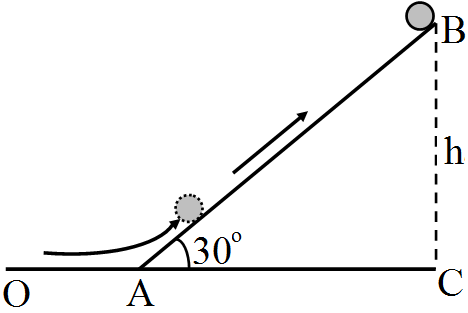
Initial velocity of the solid cylinder, v = 5m/s
Angle of inclination, $\theta=30^{\circ}$
Height reached by the cylinder = h Energy of the cylinder at point A
$\text{KE}_{\text{root}}=\text{KE}_{\text{trans}}$
$\frac{1}{2}\text{I}\omega^2=\frac{1}{2}\text{mv}^2$
Energy of the cylinder at point B = mgh
Using the law of conservation of energy, we can write,
$\frac{1}{2}\text{I}\omega^2=\frac{1}{2}\text{mv}^2=\text{mgh}$
Moment of inertia of the solid cylinder, $\text{I}=\frac{1}{2}\text{mr}^2$
$\therefore\ \frac{1}{2}\Big(\frac{1}{2}\text{mr}^2\Big)\omega^2+\frac{1}{2}\text{mv}^2=\text{mgh}$
$\frac{1}{4}\text{mr}^2\omega^2+\frac{1}{2}\text{mv}^2=\text{mgh}$
But we have the relation, $\text{v}=\text{r}\omega$
$\therefore\ \frac{1}{4}\text{v}^2+\frac{1}{2}\text{v}^2=\text{gh}$
$\frac{3}{4}\text{v}^2=\text{gh}$
$\therefore\ \text{h}=\frac{3}{4}\frac{\text{v}^2}{\text{g}}$
$=\frac{3}{4}\times\frac{5\times5}{9.8}=1.91\text{m}$
- In $\Delta\text{ABC}$
$\sin\theta=\frac{\text{BC}}{\text{AB}}$
$\sin30^{\circ}=\frac{\text{h}}{\text{AB}}$
$\text{AB}=\frac{1.91}{0.5}=3.82\text{m}$
Hence, the cylinder will travel 3.82m up the inclined plane. For radius of gyration K, the velocity of the cylinder at the instance when it rolls back to the bottom is given by the relation. View full question & answer→Question 133 Marks
Two equal and opposite forces act on a rigid body. Under what conditions will the body (i) rotate (ii) not rotate?
AnswerTwo equal and opposite forces acting on a rigid body such that their lines of action do not coincide, constitute a couple. This couple produces the turning effect on the body. Hence the rigid body will rotate. If two equal and opposite forces act in such a way that their lines of action coincide, then these forces cancel out the effect of each other. Hence the body will not rotate.
View full question & answer→Question 143 Marks
A solid sphere of mass 2kg is rolling down an inclined plane of angle of inclination 30°. What is the agent which supplies the external torque for the rotational motion of the sphere? Calculate its value. Also find the value of the torque if radius of sphere is 40cm.
AnswerWhen a solid sphere rolls down an inclined plane then the force of friction between the sphere and the inclined plane supplies the external torque. Force of friction for a body rolling down an inclined plane is given by $\text{F}=\frac{\text{Ig}\sin\theta}{\text{R}^2\Big[1+\frac{\text{I}}{\text{MR}^2}\Big]}$ For solid sphere, $\text{I}=\frac{2}{5}\text{MR}^2$ $\therefore\text{F}=\frac{2}{7}\text{Mg}\times\sin\theta$ $=\frac{2}{7}\times2\times10\times\sin30^\circ$ $=\frac{20}{7}=2.86\text{N}$ Torque = FR = 2.86 × 0.4 = 1.44Nm.
View full question & answer→Question 153 Marks
The centre of gravity of a body on the earth coincides with its centre of mass for a ‘small’ object whereas for an ‘extended’ object it may not. What is the qualitative meaning of ‘small’ and ‘extended’ in this regard? For which of the following the two coincides? A building, a pond, a lake, a mountain?
AnswerMain concept used: Centre of gravity is the centre of it’s Geometry but centre of mass is the point where the whole mass of body can be considered. When the vertical height or Geometric centre of object is very near to surface of earth the object is called small. If it is larger then it is called extended objects.
- Building (high), pond are small objects.
- Mountain and lake are big objects so their geometrical centre will be above and below the surface of earth respectively, with appreciable distances, so called extended objects.
View full question & answer→Question 163 Marks
Is friction necessary for a body to roll? What is the minimum friction required for a disc of mass M and radius r to roll on an inclined plane?
AnswerYes. Frictional force is required for a body to roll since it can get the required torque to bring rotational motion.Force of friction, $\text{F}_{\text{f}}-\mu\text{N}=\mu\text{mg}\cos\theta$
Acceleration down the plane a
$=\frac{\text{g}\sin\theta}{\big(1+\frac{\text{k}^2}{\text{R}^2}\big)}$
Torque $\tau=\text{I}\alpha=\text{I}\frac{\text{a}}{\text{R}}$
$\therefore\mu\text{ Mg}\ \cos\theta\text{ R}=\text{I}\frac{\text{I.g}\sin\theta}{\text{R}\Big(1+\frac{\text{K}^2}{\text{R}^2}\Big)}$
$\mu\text{ Mg}\cos\theta=\frac{\text{ Mg }^2}{2}\Bigg[\frac{\text{g}\sin\theta}{\text{R}^2\Big(\frac{\text{R}^2+\text{K}^2}{\text{R}^2}\Big)}\Bigg]$
$\text{F}_{\text{f}}=\frac{\text{g }\sin\theta\text{ MR}^2}{\text{R}^2+\text{K}^2}$
$=\frac{\text{MR}^2\text{g }\sin \theta}{\text{R}^2+\frac{\text{R}^2}{2}}$
$=\frac{2}{3}\text{ Mg}\sin\theta=\text{MR}^2$
Minimum frictional coefficient $=\mu$
$=\frac{\tan\theta\text{R}^2}{\text{R}^2+\text{K}^2}$
$\text{i.e.,}\mu=\frac{\tan\theta\text{R}^2}{\text{R}^2+\frac{\text{R}^2}{2}}=\frac{2}{3}\tan\theta$
View full question & answer→Question 173 Marks
Obtain an expression for position vector of centre of mass of a two particle system.
AnswerConsider a system of two masses m, and m, with position vectors $r_1$ and $r_2$. The net force experienced by the system will be, $F = F_{1e}+F_{2e}$ (Since, internal forces cancel each other)
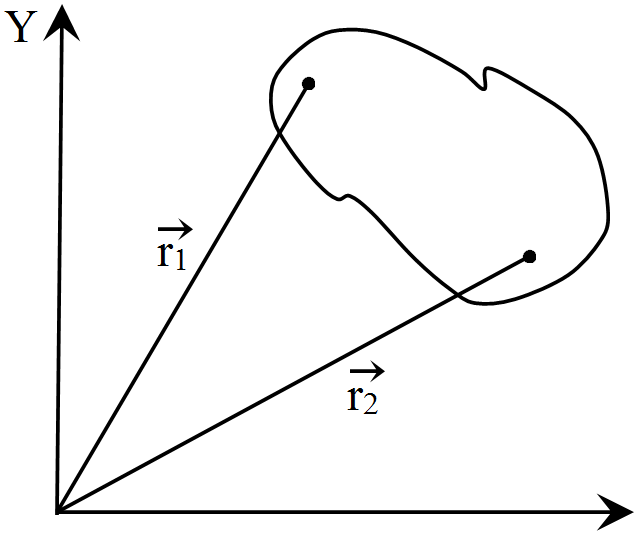
Let the total mass ($m_1+ m_2$_) be concentrated at the centre of mass, whose position vector is r cm. Then, $(\text{m}_1+\text{m}_2)\text{a}_{\text{cm}}=\text{m}_a1_1+\text{m}_2\text{a}_2$
$\text{a}_{\text{cm}}=\frac{\text{m}_1\text{a}_1+\text{m}_2\text{a}_2}{\text{m}_1+\text{m}_2}$ Since $\text{a}=\frac{\text{d}^2}{\text{dt}^2}(\text{r}),\text{we have,}$
$\frac{\text{d}^2\text{r}_{\text{cm}}}{\text{dt}^2}\frac{1}{(\text{m}_1+\text{m}_2)}$
$\Big(\text{m}_1\frac{\text{d}^2\text{r}_1}{\text{dt}^2}+\text{m}_2\frac{\text{d}^2\text{r}_2}{\text{dt}^2}\Big)$
$\therefore\text{r}_{\text{cm}}=\frac{1}{(\text{m}_1+\text{m}_2)}(\text{m}_1\text{r}_1+\text{m}_2\text{r}_2).$ View full question & answer→Question 183 Marks
Three particles, each of mass $200g$, are kept at the corners of an equilateral triangle of side $10cm$. Find the moment of inertia of the system about an axis:
- Joining two of the particles.
- Passing through one of the particles and perpendicular to the plane of the particles.
Answer
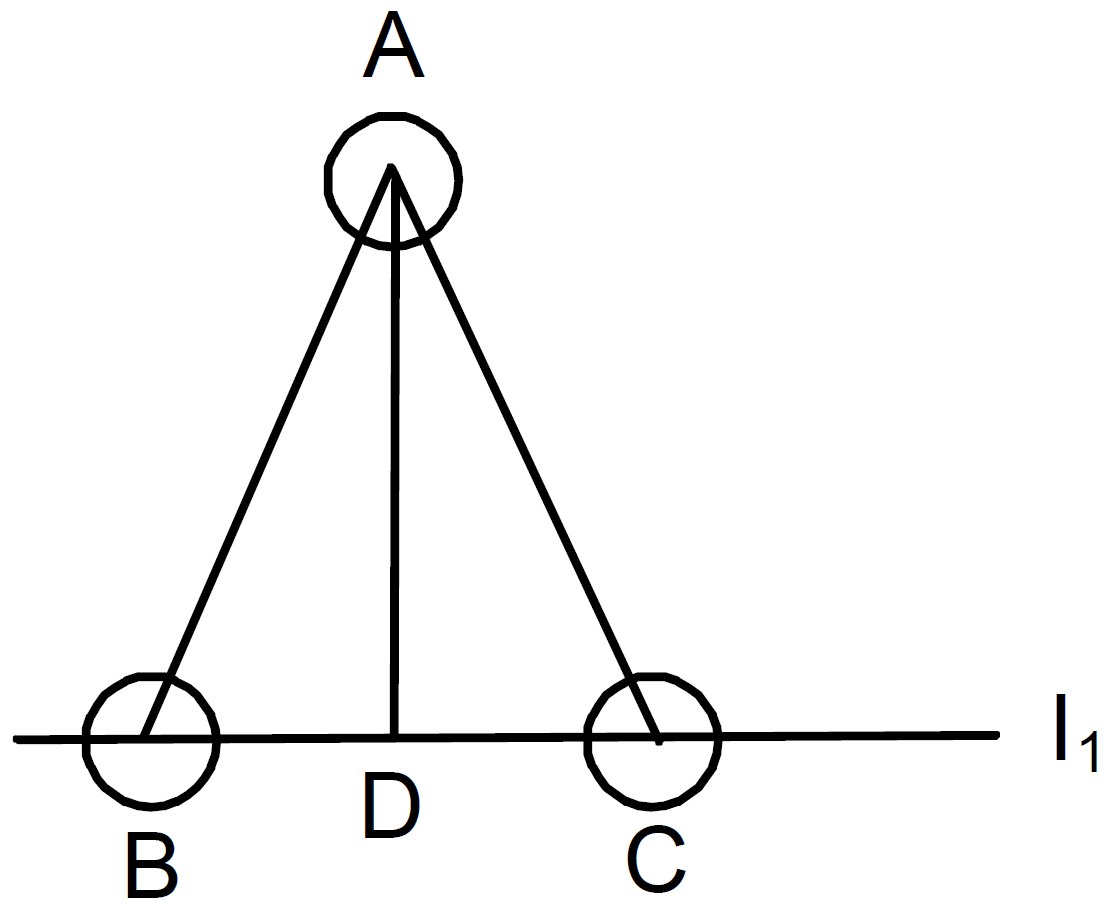
- Therefore, the $\perp$ distance from the axis $(\text{AD})=\frac{\sqrt3}{2}\times10=5\sqrt3\text{cm}.$
Therefore moment of inertia about the axis BC will be
$\text{I}=\text{mr}^2=200\text{k}\big(5\sqrt3\big)^2=200\times25\times3$
$=15000\text{gm}-\text{cm}^2=1.5\times10^{-3}\text{kg}-\text{m}^2$
- The axis of rotation let pass through A and $\perp$ to the plane of triangle
Therefore the torque will be produced by mass B and C
Therefore net moment of inertia = $I = mr^2 + mr^2$
$= 2 \times 200 \times 10^2 = 40000gm-cm^2$
$= 4 \times 10^{-3}kg-m^2$. View full question & answer→Question 193 Marks
Mathematically establish the third equqtion of rotational motion $\omega^2-\omega^2_0=2\alpha\theta$
AnswerWe know that angular acceleration is defined as $\alpha=\frac{\text{d}\omega}{\text{dt}}.$ $\therefore\alpha=\frac{\text{d}\omega}{\text{d}\theta}.\frac{\text{d}\theta}{\text{dt}}=\omega\frac{\text{d}\omega}{\text{d}\theta}$ $[\because\omega=\frac{\text{d}\theta}{\text{dt}}]$ or $\alpha.\text{d}.\theta=\omega\text{d}\omega$ On integrating, we have $\int\limits^\theta_0\alpha\text{d}\theta=\int\limits^{\omega}_{\omega_0}\omega\text{d}\omega$ $\therefore[\alpha\theta]^\theta_0=\Big[\frac{\omega^2}{2}\Big]^{\omega}_{\omega_{0}}$ $\text{or }\alpha(\theta-0)=\frac{\omega^2}{2}-\frac{\omega^2_0}{2}$ $\Rightarrow\omega^2-\omega^2_0=2\alpha\theta, $ which is the requisite relation.
View full question & answer→Question 203 Marks
A thin spherical shell lying on a rough horizontal surface is hit by a cue in such a way that the line of action passes through the centre of the shell. As a result, the shell starts moving with a linear speed v without any initial angular velocity. Find the linear speed of the shell after it starts pure rolling on the surface.
Answer
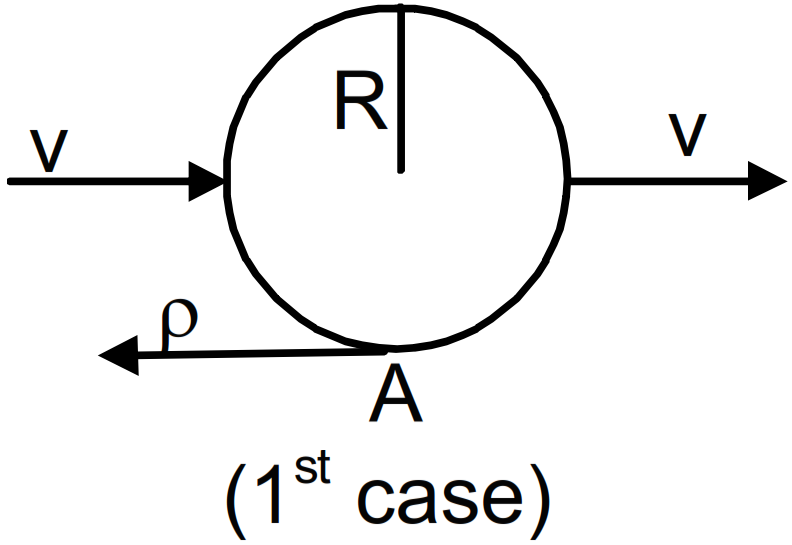
The shell will move with a velocity nearly equal to v due to this motion a frictional force well act in the background direction, for which after some time the shell attains a pure rolling. If we consider moment about A, then it will be zero.
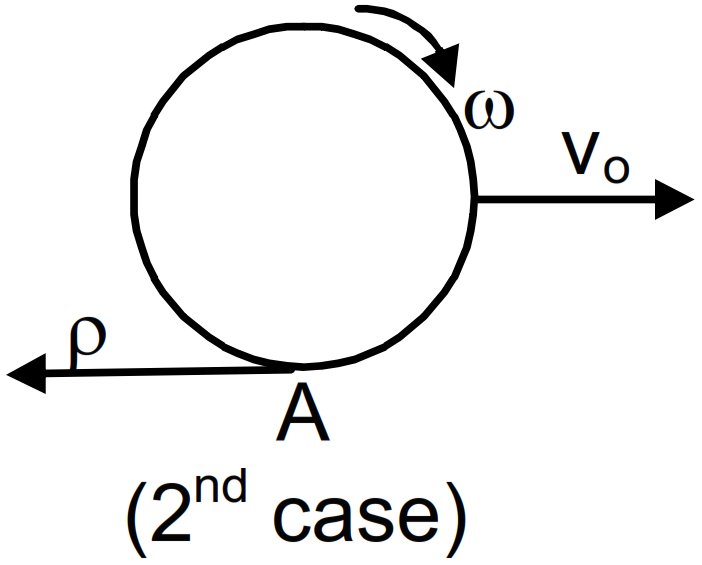
Therefore, Net angular momentum about A before pure rolling = net angular momentum after pure rolling.
Now, angular momentum before pure rolling about A = M(V × R) and angular momentum after pure rolling:
$\Big(\frac{2}{3}\Big)\text{MR}^2\times\Big(\frac{\text{V}_0}{\text{R}}\Big)+\text{MV}_0\text{R}$
($V_0$ = velocity after pure rolling)
$\Rightarrow\text{MVR}=\frac{2}3{}\text{MV}_0\text{R}+\text{MV}_0\text{R}$
$\Rightarrow\Big(\frac{5}{3}\Big)\text{V}_0=\text{V}$
$\Rightarrow\text{V}_0=\frac{3\text{V}}{5}$ View full question & answer→Question 213 Marks
Show that the area of the triangle contained between the vectors a and b is one half of the magnitude of a × b.
AnswerConsider two vectors OK = vector |a| and OM = vector |b|, inclined at an angle $\theta,$ as shown in the following figure.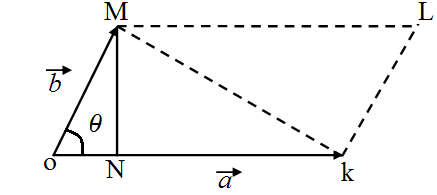 In $\Delta\text{OMN},$ using the relation,
$\sin\theta=\frac{\text{MN}}{\text{OM}}=\frac{\text{MN}}{|\vec{\text{b}}|}$ $\text{MN}=|\vec{\text{b}}|\sin\theta$ $|\vec{\text{a}}\times\vec{\text{a}}|=|\vec{\text{a}}||\vec{\text{b}}|\sin\theta$ $=\text{OK}\times\text{MN}\times\frac{2}{2}$ $=2\times{\text{Area of }}\Delta\text{ OMK}$ $\therefore{\text{ Area of }}\Delta\text{ OMK}=\frac{1}{2}|\vec{\text{a}}\times\vec{\text{b}}|$ Area of the triangle contained between the vectors a and b is one-half of the magnitude of a × b. View full question & answer→Question 223 Marks
A cylinder rotating at an angular speed of $50rev/s$ is brought in contact with an identical stationary cylinder. Because of the kinetic friction, torques act on the two cylinders, accelerating the stationary one and decelerating the moving one. If the common magnitude of the acceleration and deceleration be one revolution per second square, how long will it take before the two cylinders have equal angular speed?
AnswerA cylinder is moving with an angular velocity 50rev/s brought in contact with another identical cylinder in rest. The first and second cylinder has common acceleration and deacceleration as $1rad/s^2$ respectively.
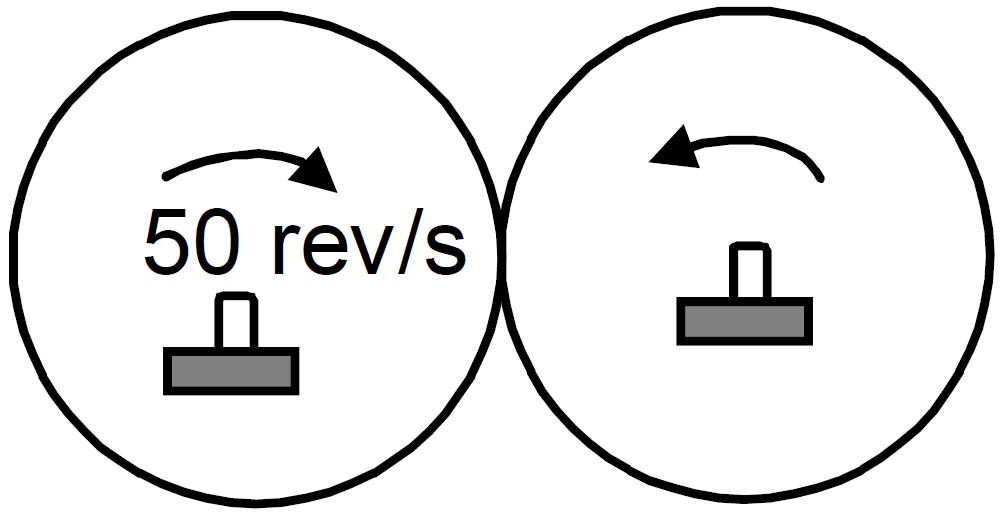
Let after t sec their angular velocity will be same $'\omega'.$ For the first cylinder $\omega=50-\alpha\text{t}$ $\Rightarrow\text{t}=\frac{(\omega-50)}{-1}$ And for the $2^{nd}$ cylinder $\omega=\alpha_2\text{t}$
$\text{t}=\frac{\omega}{\text{l}}$ So, $\omega=\frac{(\omega-50)}{-1}$ $\Rightarrow2\omega=50$
$\Rightarrow\omega=25\text{rev/s}.$ $\Rightarrow\text{t}=\frac{25}{1}\text{sec}=25\text{sec}$ View full question & answer→Question 233 Marks
A solid cylinder of mass $20kg$ rotates about its axis with angular speed $100rads^{-1}$. The radius of the cylinder is $0.25m$. What is the kinetic energy associated with the rotation of the cylinder? What is the magnitude of angular momentum of the cylinder about its axis?
AnswerMass of the cylinder, m = 20kg Angular speed, $\omega= 100\text{rads}^{-1}$ Radius of the cylinder, r= 0.25m The moment of inertia of the solid cylinder, $\text{I}=\frac{\text{mr}^2}{2}$
$=\frac{1}{2}\times20\times(0.25)^2$
$=0.625\text{kgm}^2$
$\therefore$ Kinetic energy $=\frac{1}{2}\text{I}\omega^2$
$=\frac{1}{2}\times6.25\times100^2=3125\text{J}$
$\therefore$ Angular momentum, $\text{L} = \text{I}\omega = 6.25\times100 = 62.5\text{Js}$
View full question & answer→Question 243 Marks
Asolid disc and a ring, both of radius 10cm are placed on a horizontal table simultaneously, with initial angular speed equal to $10\pi\ rad\ s^{-1}?.$ Which of the two will start to roll earlier? The coefficient of kinetic friction is
AnswerAs motion starts due to friction, F = ma $\Rightarrow\mu_{\text{k}}\text{mg}=\text{ma}$
$\Rightarrow\text{a}=\mu_{\text{k}}\text{g}$ Torque due to friction $\tau=\text{I}\alpha$ $\Rightarrow\mu_{\text{k}}\text{mgR}=\text{I}\alpha$
$\Rightarrow\alpha=\frac{\mu_{\text{k}}\text{mgR}}{\text{I}}$ Rolling begins, when $\text{v}=\omega\text{R}$But $\text{v}=0+\alpha\text{t}$
$\Rightarrow\text{v}=\mu_{\text{k}}\text{gt}$
and $\omega=\omega_0+\alpha\text{t}$
$\omega=\omega_0-\frac{\mu_{\text{k}}\text{mgR}}{\text{I}}\text{t}$
$\Rightarrow\frac{\text{v}}{\text{R}}=\omega_0\frac{\mu_{\text{k}}\text{mgR}}{\text{I}}\text{t}$
$\Rightarrow\text{t}=\frac{\text{R}\omega_0}{\mu_{\text{k}}\text{g}\Big(\frac{\text{I}+\text{mR}^2}{\text{I}}\Big)}$ For disc, $\text{I}=\text{mR}^2$
$\Rightarrow\text{t}=0.53\text{s}$ For ring, $\text{I}=\text{mR}^2$ $\Rightarrow\text{t}=0.80\text{s}$Thus, disc begins to roll earlier.
View full question & answer→Question 253 Marks
Calculate the ratio of the angular momentum of the earth about its axis due to its spinning motion to that about the sun due to its orbital motion. Radius of the earth = $6400km$ and radius of the orbit of the earth about the sun = $1.5 \times 10^8km$.
AnswerAngular momentum of the earth about its axis is $=\frac{2}{5}\text{mr}^2\times\Big(\frac{2\pi}{85400}\Big)\ \Big($Because, $\text{l}=\frac{2}{5}\text{mr}^2\Big)$ Angular momentum of the earth about sun’s axis $=\text{mR}^2\times\Big(\frac{2\pi}{86400\times365}\Big)$ (Because, $l = mR^2$) Therefore, ratio of the angular momentum $=\frac{\frac{2}{5}\text{mr}^2\times\big(\frac{2\pi}{86400}\big)}{\text{mR}^2\times\frac{2\pi}{(86400\times365)}}$ $\Rightarrow\frac{(\text{2r}^2\times365)}{5\text{R}^2}$
$\Rightarrow\frac{(2.990\times10^{10})}{1.125\times10^{17}}=2.65\times10^{-7}$
View full question & answer→Question 263 Marks
Establish a relation between angular momentum and moment of inertia of a rigid body. Define moment of inertia in terms of it.
AnswerWe know $\text{L}=\text{r}\times\text{p}=\text{r}\times\text{mv}$ Since $\text{v}=\text{r}\omega$ we have $\text{ L}=\text{r}\times\text{mr }\omega=\text{mr}^2\omega=\text{I}\omega$ Moment of inertia is the angular momentum of a rigid body with unit angular velocity.
View full question & answer→Question 273 Marks
The centre of mass is defined as $\overrightarrow{\text{R}}=\frac{1}{\text{M}}\sum\limits_\text{i}\text{m}_\text{i}\overrightarrow{\text{r}_{\text{i}}}.$ Suppose we define "centre of charge" as $\overrightarrow{\text{R}}_\text{c}=\frac{1}{\text{Q}}\sum\limits_\text{i}\text{q}_\text{i}\overrightarrow{\text{r}_{\text{i}}}$ where $q_i$ represents the $i^{th}$ charge placed at $\overrightarrow{\text{r}_\text{i}}$ and Q is the total charge of the system.
- Can the centre of charge of a two-charge system be outside the line segment joining the charges?
- If all the charges of a system are in X-Y plane, is it necessary that the centre of charge be in X-Y plane?
- If all the charges of a system lie in a cube, is it necessary that the centre of charge be in the cube?
Answer
- Center of charge can lie away from line segment joining two charges in case both charges are unequal and are of same charge. but eventually would lie on the axis joining two charges.
- Yes in case all charge particles are in same plane the center of charge would lie on same plane.
- Yes in case all charges are in cube in that case center of charge would lie on the same cube.
View full question & answer→Question 283 Marks
State work energy theorem for rotational motion.
AnswerAccording to work energy theorem, work done will be reflected as change in rotational kinetic energy. Work done for a small angular displacement $\text{d}\theta\text{ is },\text{dW}=\tau\text{d}\theta$ $\text{W}=\int\tau\text{ d }\theta=\int\text{I }\alpha\text{ d }\theta$ $=\int\text{I }\text{d }\omega\frac{\text{d }\theta}{\text{dt}}=\int\text{I }\omega\text{ d }\omega$ $\text{W}=\int^\limits{\omega\text{f}}_\limits{\omega\text{f}}\text{I }\omega\text{ d }\omega=\text{I}\Bigg|\frac{\omega^2}{2}\Bigg|^{\omega\text{f}}_{\omega\text{i}}$ $\text{W}=\frac{1}{2}\text{I}(\omega^2_{\text{f}}-\omega^2_{\text{i}})$ It is the change in rotational kinetic energy.
View full question & answer→Question 293 Marks
State parallel axes theorem. Apply this theorem to find the moment of Inertia of a solid sphere about the tangent of its surface.
AnswerParallel axes theorem: According to this theorem, the moment of inertia of a rigid body about any axis AB is equal to the moment of inertia of the body about another axis KL passing through the centre of mass C of the body in a direction parallel to AB plus the product of total mass M of the body and square of the perpendicular distance between the two parallel axes.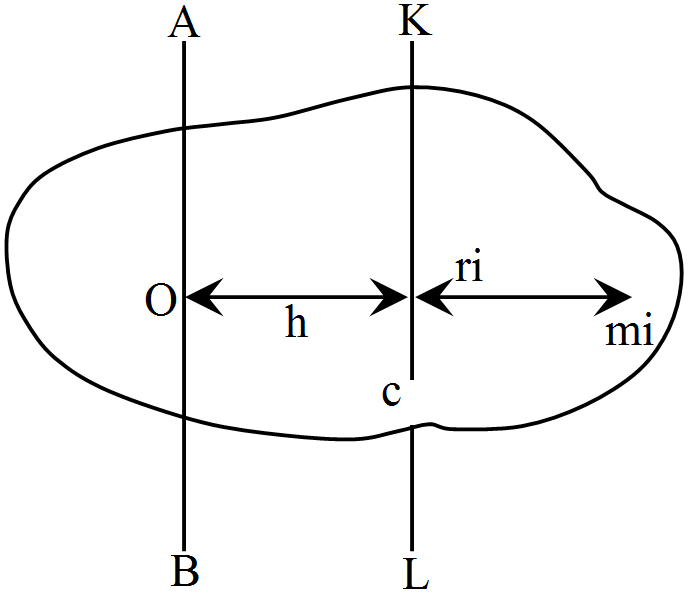
$\text{I}_{\text{AB}}=\text{I}_{\text{KL}}+\text{Mh}^2$ Where h is the perpendicular distance between the axes AB and KL. For solid sphere, Using parallel axes theorem, $\text{I}_{\text{CD}}=\text{I}_{\text{AB}}+\text{MR}^2$ $=\frac{2}{5}\text{MR}^2+\text{MR}^2$ $=\frac{7}{5}\text{MR}^2$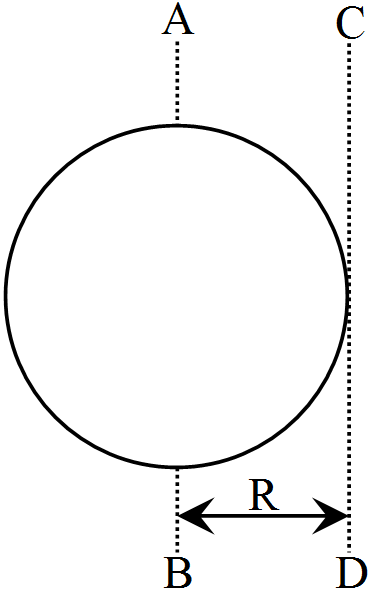
View full question & answer→Question 303 Marks
A particle of 10kg mass is moving in a circle of 4m radius with a constant speed of 5 m/ sec. What is its angular momentum about (i) the centre of circle (ii) a point on the axis of the circle and 3m distant from its centre?
Answer
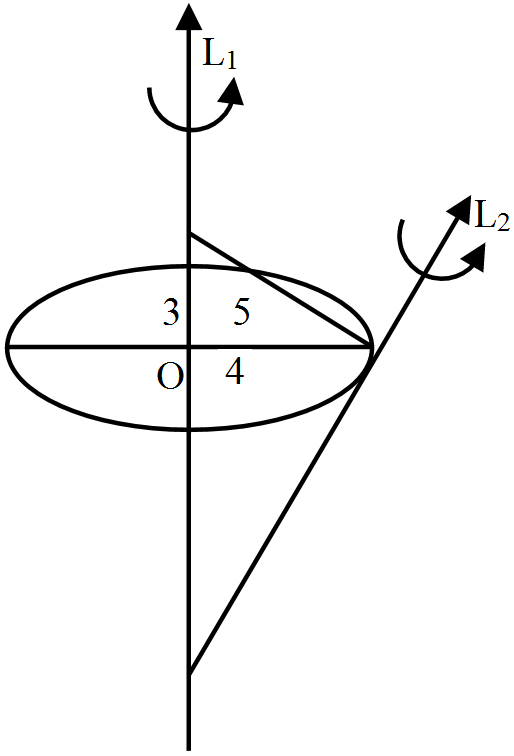 The situation is shown in Fig.
- We know that $\vec{\text{L}}=\times\vec{\text{r}}\times\text{m}\vec{\text{v}} $
$\text{L}=\text{m v r }\sin\theta$
Here, $\text{m}=10\text{kg},\text{r}=4\text{m,}$
$\text{v}=5\ \text{m}/\text{sec}\ \text{and}\ \theta=90^\circ$
$\therefore\ \text{L}=10\times5\times4\times\sin90^\circ$
$=200\ \text{kg}-\text{m}^2/\text{sec}.$
- In this case, $\text{r}=\sqrt{4^2+3^2}=5\text{m}$
$\therefore\ \text{L}=10\times5\times5\sin90^\circ$
$=250\ \text{kg}\text{m}^2/\text{sec.}$ View full question & answer→Question 313 Marks
Why does a solid sphere have smaller moment of inertia than a hollow cylinder of same mass and radius, about an axis passing through their axes of symmetry?
Answer$\text{I}=\sum\limits^{\text{n}}_{\text{i}=1}\text{m}_\text{i}\text{r}^2_\text{i}$ Moment of inertia is directly proportional to the square of distance of mass from the axis of rotation. In solid sphere whole mass is distributed from centre to radius of sphere R. But it hollow sphere whole mass is concentrated near the periphery or surface of the sphere so average value of $r_i$ becomes larger in hollow sphere as compared to solid sphere. So MI of hollow sphere becomes larger than solid sphere.
View full question & answer→Question 323 Marks
What is a couple? What effect does it have on a body? Show that moment of couple is same irrespective of the point of rotation of the body.
AnswerCouple: When equal parallel forces act on the body in opposite direction at two different points, they form a couple. The net force due to couple is zero, but they exert a torque and produce rotational motion. Let us consider a couple acting on a rigid body at a point A and B with position vectors $\vec{\text{r}}_1$ and $\vec{\text{r}}_2$ with respect to origin O $\vec{\text{F}}$ and $-\vec{\text{F}}$ are forces acting on A and B respectively.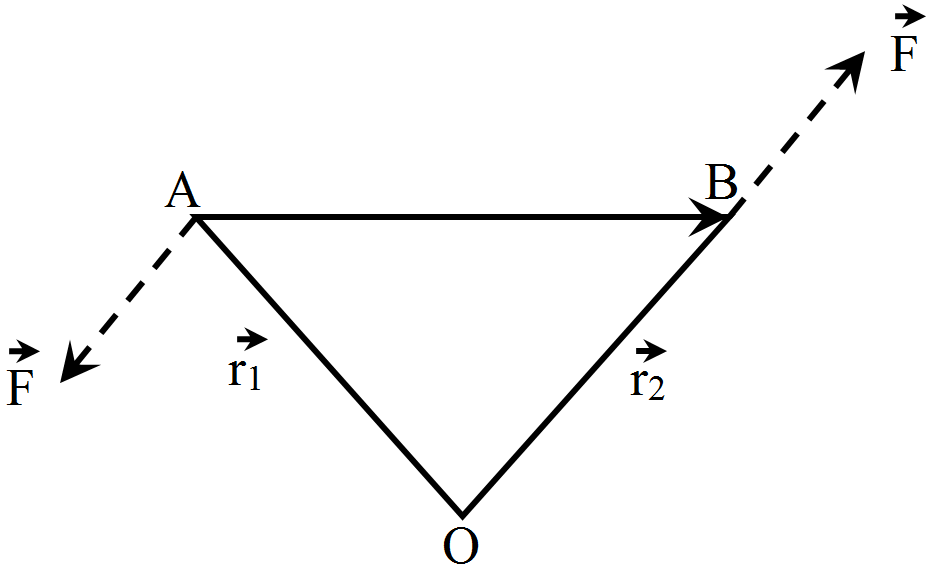
The moment of couple = moment of force at A + moment of force at B $=\vec{\text{r}}_1\times(-\vec{\text{F}})+\vec{\text{r}}_2\times\vec{\text{F}}=(\vec{\text{r}}_2-\vec{\text{r}}_1)\times\vec{\text{F}}$ But $\vec{\text{r}}_1+\overrightarrow{\text{AB}}=\vec{\text{r}}_2$ $\Rightarrow\overrightarrow{\text{AB}}=\vec{\text{r}}_2-\vec{\text{r}}_1$ $\therefore$ moment of couple $=\overrightarrow{\text{AB}}\times\vec{\text{F}},$ which shows it is independent of point of rotation. View full question & answer→Question 333 Marks
Find the angular velocity of a body rotating with an acceleration of $2 rev/s^2$ as it completes the $5^{th}$ revolution after the start.
Answer$\theta=5\text{rev},\ \alpha=2\text{rev/s}^2,\ \omega_0=0;\ \omega=?$
$\omega^2=(2\alpha\theta)$
$\Rightarrow\omega=\sqrt{2\times2\times5}=2\sqrt5\text{rev/s}.$ or $\theta=10\pi\text{rad},\ \alpha=4\pi\text{rad/s}^2,\ \omega_0=0,\ \omega=?$ $\omega=\sqrt{2\alpha\theta}=2\times4\pi\times10\pi$
$=4\pi\sqrt5\text{rad/s}=2\sqrt5\text{rev/s}$
View full question & answer→Question 343 Marks
Find the moment of inertia of a uniform square plate of mass m and edge a about one of its diagonals.
AnswerLet a small cross sectional area is at a distance x from xx axis. Therefore mass of that small section $=\frac{\text{m}}{\text{a}^2} \times\text{axdx}$ Therefore moment of inertia about xx axis
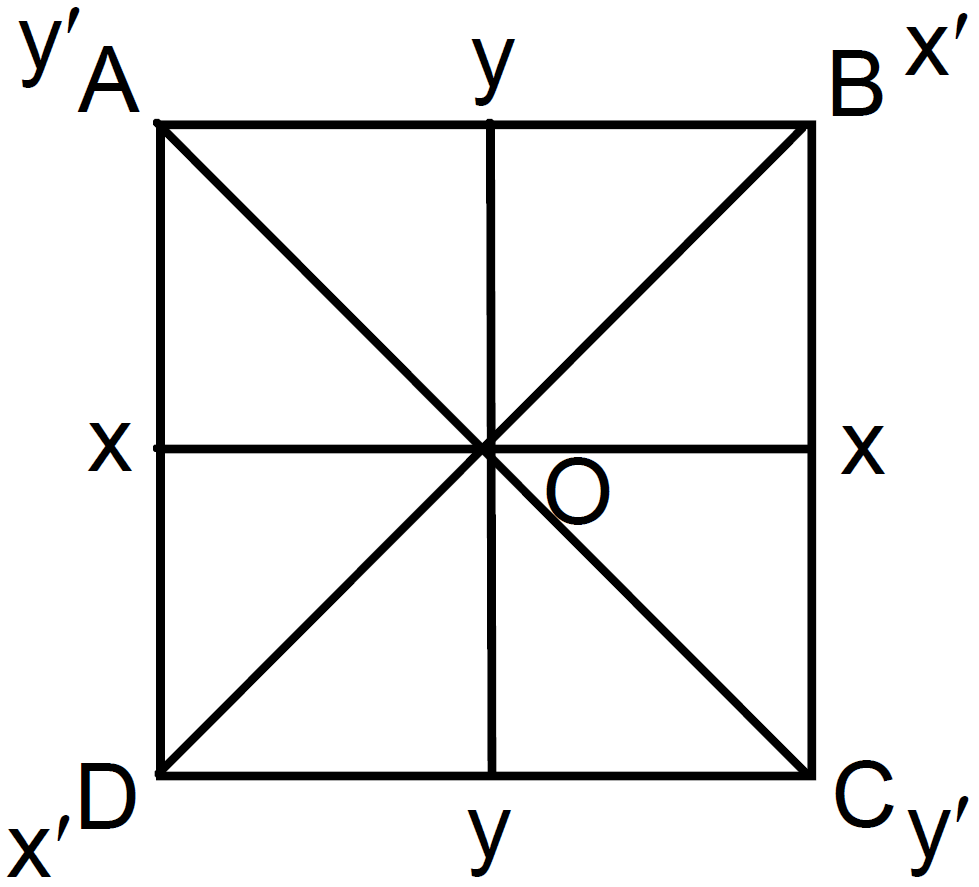
$=\text{I}_{\text{xx}}=2\int_\limits{0}^{\frac{\text{a}}{2}}\Big(\frac{\text{m}}{\text{a}^2}\Big)\times(\text{adx})\times\text{x}^2$
$=\Big[2\times\Big(\frac{\text{m}}{\text{a}}\Big)\Big(\frac{\text{x}^3}{3}\Big)\Big]^{\frac{\text{a}}2{}}_0$
$=\frac{\text{ma}^2}{12}$ Therefore $\text{l}_{\text{xx}}=\text{l}_{\text{xx}}+\text{l}_ {\text{yy}}$
$=2\times\frac{\text{ma}^2}{12}=\frac{\text{ma}^2}{6}$ Since the two diagonals are $\perp$ to each other Therefore $\text{l}_{\text{zz}}=\text{l}_{\text{x}'\text{x}'}+\text{l}_{\text{y}'\text{y}'}$
$\Rightarrow\frac{\text{ma}^2}{6}=2\times\text{l}_{\text{x}'\text{x}'}$ (because $I_{x’x’} = I_{y’y’}$) $\Rightarrow\text{l}_{\text{x}'\text{x}'}=\frac{\text{ma}^2}{12}$ View full question & answer→Question 353 Marks
If earth contracts to half its radius. What would be the length of the day?
AnswerThe moment of inertia $\Big(\text{I}=\frac{2}{5}\text{MR}^2\Big)$ of the earth about its own axis will become one-fourth and so its angular velocity will become four times $(\text{L}=\text{I}\omega=$constant). Hence, the time period will reduce to one-fourth $\Big(\text{T}=\frac{2\pi}{\omega}\Big)\text{ i,.e. }6\text{ hours.}$
View full question & answer→Question 363 Marks
Angular momentum of a system is conserved if its M.I. is changed. Is its rotational K.E. also conserved?
AnswerKinetic energy of rotation $=\frac{1}{2}\text{I}\omega^2=\frac{1}{2}(\text{I}\omega)\omega=\frac{1}{2}\text{L}\omega$ $\text{L}=\text{l}\omega$ is constant if moment of inertia (I) of the system changes. It means as I changes, then w also changes to keep $\text{l}\omega$ = constant. Hence K.E. of rotation also changes with the change in I. In other words, rotation K.E. is not conserved.
View full question & answer→Question 373 Marks
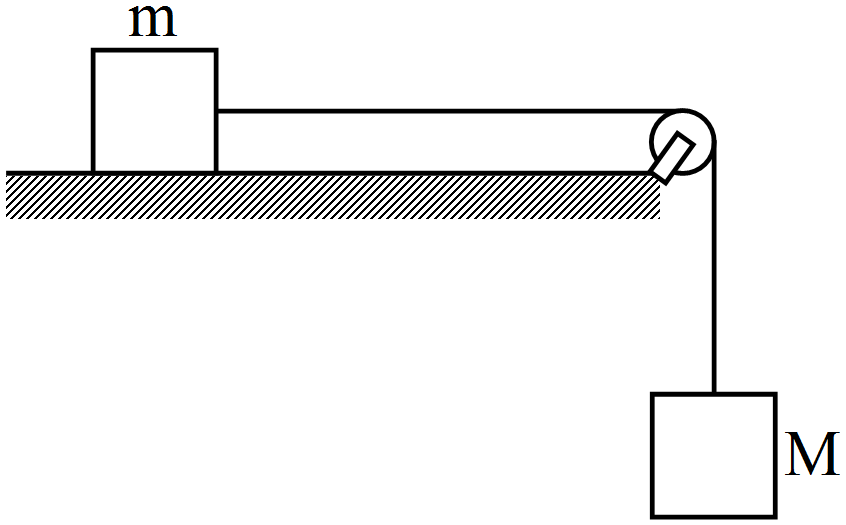
Figure shows two blocks of masses m and M connected by a string passing over a pulley. The horizontal table over which the mass m slides is smooth. The pulley has a radius r and moment of inertia I about its axis and it can freely rotate about this axis. Find the acceleration of the mass M assuming that the string does not slip on the pulley.
AnswerAccording to the question 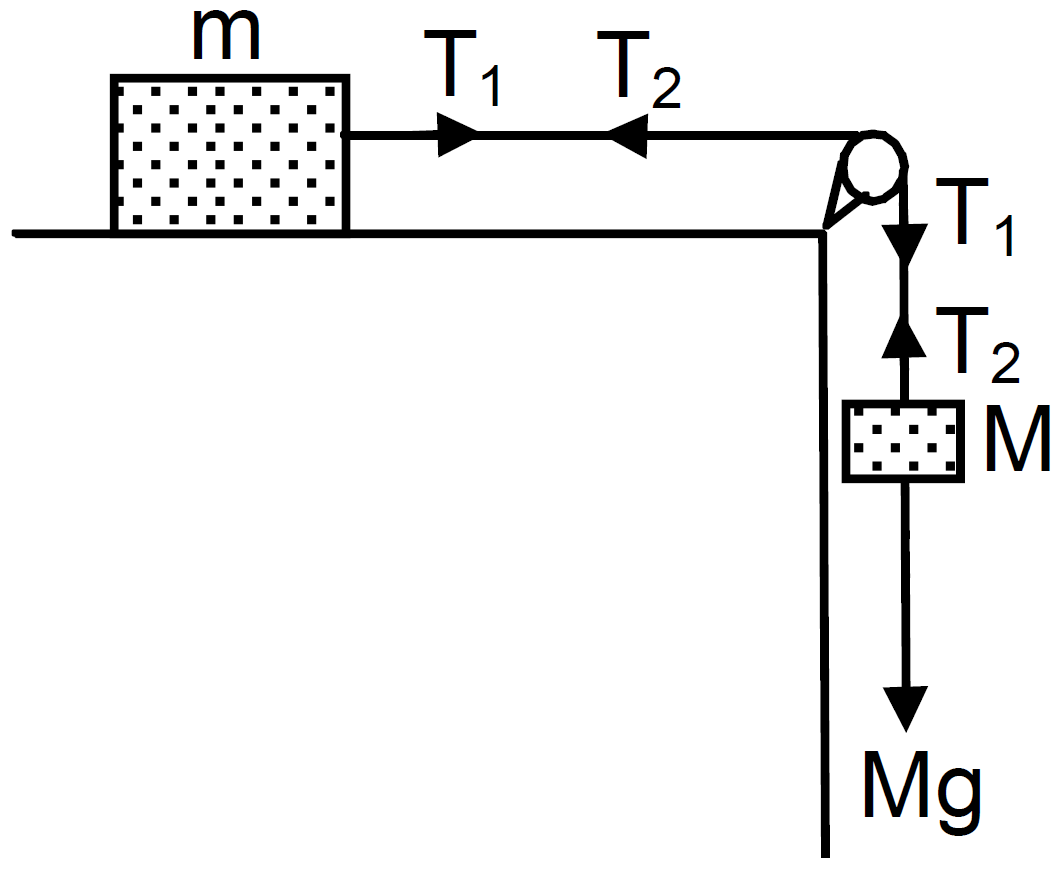 $\text{Mg}-\text{T}_1=\text{ma}\ \dots(1)$ $\text{T}_2=\text{ma}\ \dots(2)$ $\big(\text{T}_1-\text{T}_2\big)=\frac{1\text{a}}{\text{r}^2}\ \dots(3)$ $[$ because $\text{a}=\text{r}\alpha]\ \dots\ \Big[\text{T}.\text{r}=\text{l}\Big(\frac{\text{a}}{\text{r}}\Big)\Big]$ If we add the equation 1 and 2 we will get $\text{Mg}+(\text{T}_2-\text{T}_1)=\text{ma}+\text{ma}\ \dots(4)$ $\Rightarrow\text{Mg}-\frac{\text{la}}{\text{r}^2}=\text{Ma}+\text{ma}$ $\Rightarrow\Big(\text{M}+\text{m}+\frac{\text{l}}{\text{r}^2}\Big)\text{a}=\text{Mg}$ $\Rightarrow\text{a}=\frac{\text{Mg}}{\big(\text{M}+\text{m}+\frac{\text{l}}{\text{r}^2}\big)}$
 View full question & answer→Question 383 Marks
Find the moment of inertia of a sphere about a tangent to the sphere, given the moment of inertia of the sphere about any of its diameters to be $2MR^2/ 5$, where M is the mass of the sphere and R is the radius of the sphere.
AnswerThe moment of inertia (M.I.) of a sphere about its diameter $=\frac{2}{5}\text{MR}^2$
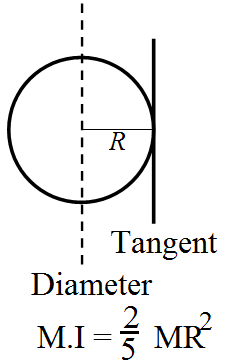
According to the theorem of parallel axes, the moment of inertia of a body about any axis is equal to the sum of the moment of inertia of the body about a parallel axis passing through its centre of mass and the product of its mass and the square of the distance between the two parallel axes. The M.I. about a tangent of the sphere $=\frac{2\text{MR}^2}{5}+\text{MR}^2=\frac{7\text{MR}^2}{5}$ View full question & answer→Question 393 Marks
State and prove the perpendicular axis theorem.
AnswerAccording to perpendicular axis theorem, the sum of the moment of inertia about x and y axes is equal to the moment of inertia about z-axis. The mass m has co-ordinates $(x, y)$.
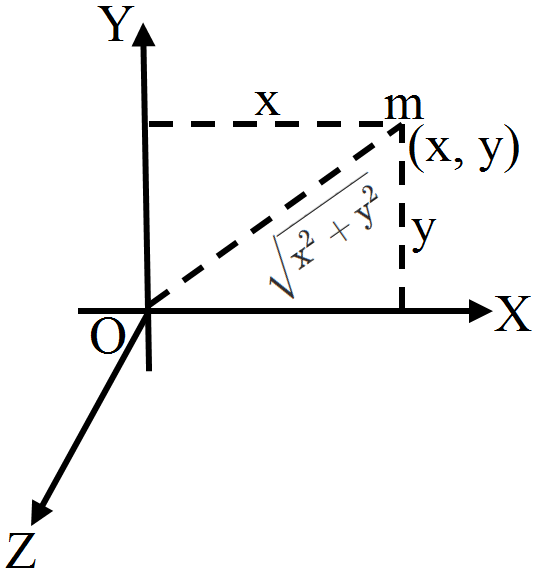
The moment of inertia about x-axis,
$\mathrm{I}_{\mathrm{x}}=\mathrm{my}^2$
$\text { about } \mathrm{y} \text {-axis, } \mathrm{I}_{\mathrm{y}}=m \mathrm{x}^2$
$ \mathrm{I}_{\mathrm{x}}+\mathrm{I}_{\mathrm{y}}=\mathrm{m}\left(\mathrm{x}^2+\mathrm{y}^2\right)$
$=\text{m}(\sqrt{\text{x}^2+\text{y}^2})^2$
$=\text{I}_{\text{x}}+\text{I}_{\text{y}}=\text{m}(\bot\text{distance from z-axis})^2$
$=\text{I}_{\text{x}}+\text{I}_{\text{y}}=\text{I}_{\text{z}}$ View full question & answer→Question 403 Marks
A wheel of moment of inertia $0.10kg-m^2$ is rotating about a shaft at an angular speed of $160rev/ minute$. A second wheel is set into rotation at $300rev/ minute$ and is coupled to the same shaft so that both the wheels finally rotate with a common angular speed of $200rev/ minute$. Find the moment of inertia of the second wheel.
Answer
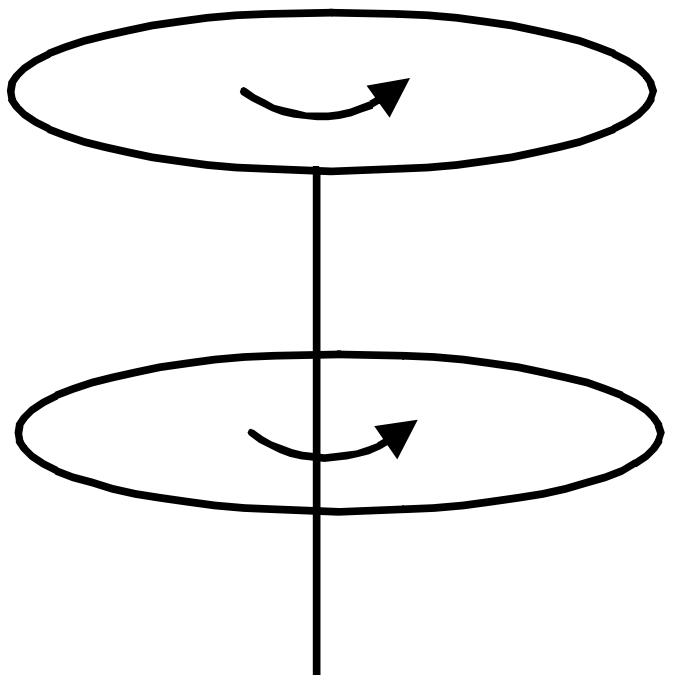
Wheel (1) has
$\text{l}_1=0.10\text{kg-m}^2$
$\omega_1=160\text{rev/min}$
Wheel (2) has
$\text{l}_2=?$
$\omega_2=300\text{rev/min}$
Given that after they are coupled, $\omega=200\text{rev/min}$
Therefore if we take the two wheels to bean isolated system
Total external torque = 0
Therefore, $\text{l}_1\omega_1+\text{l}_2\omega_2=(\text{l}_1+\text{l}_2)\omega$
$\Rightarrow0.10\times160+\text{l}_2\times300=(0.10+\text{l}_2)\times200$
$\Rightarrow\text{5l}_2=1-0.8$
$\Rightarrow\text{l}_2=0.04\text{Kg-m}^2$ View full question & answer→Question 413 Marks
Find a relation for kinetic energy of a rolling body.
AnswerRolling means rotation and translation together. If a mass has its centre of mass translating with velocity v, the radius r and angular velocity of rotation is $\omega$ then Translation K.E. $=\frac{1}{2}\text{mv}^2,$ Rotational K.E. $=\frac{1}{2}\text{I}\omega^2$ Total K.E. $=\frac{1}{2}\text{mv}^2+\frac{1}{2}\text{I}\omega^2$
View full question & answer→Question 423 Marks
The radius of gyration of a uniform disc about a line perpendicular to the disc equals its radius. Find the distance of the line from the centre.
AnswerThe moment of inertia about the center and $\perp$ to the plane of the disc of radius r and mass $m$ is = $mr^2$. 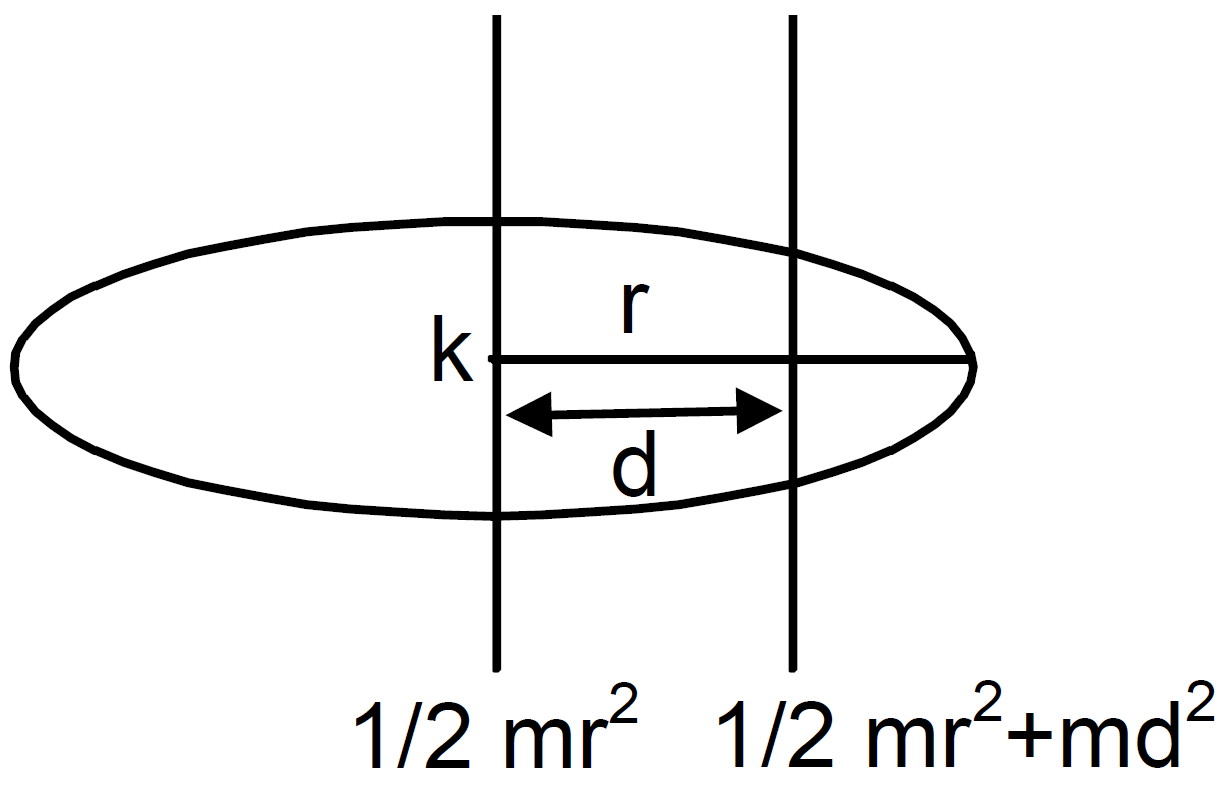
According to the question the radius of gyration of the disc about a point = radius of the disc. Therefore $\text{mk}^2=\frac{1}2{}\text{mr}^2+\text{md}^2$ (K = radius of gyration about acceleration point, d = distance of that point from the centre) $\Rightarrow\text{k}^2=\frac{\text{r}^2}{2}+\text{d}^2$
$\Rightarrow\text{r}^2=\frac{\text{r}^2}{2}+\text{d}^2$
$(\because\text{K}=\text{r})$
$\Rightarrow\frac{\text{r}^2}{2}=\text{d}^2$
$\text{d}=\frac{\text{r}}{\sqrt2}$ View full question & answer→Question 433 Marks
Explain that torque is only due to transverse component of force. Radial component has nothing to do with torque.
AnswerTorque is defined as the moment of force. 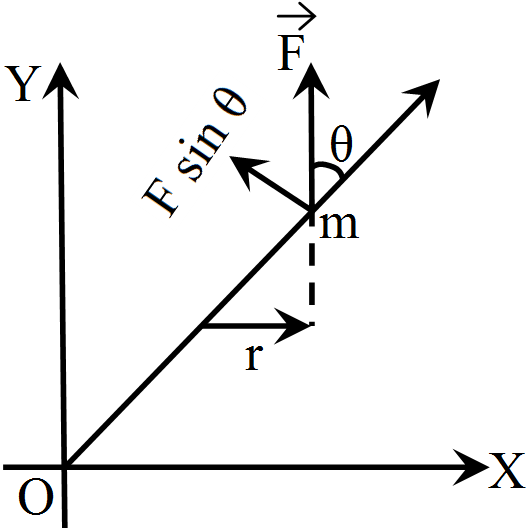 $\tau=\vec{\text{r}}\times\vec{\text{F}}=\text{r}\text{ F}\sin\theta\ \hat{\text{n}}.\hat{\text{n}}$ is along axis of rotation. If a force $\vec{\text{F}}$ acts at an angle $\theta$ to the position vector i then $\text{F}\sin\theta$ acts perpendicularly to the position- vector. Therefor $\tau=\text{r}_{\bot}\text{F}$ and so the radial component does not bring any influence on the torque.
 View full question & answer→Question 443 Marks
Suppose the rod in the previous problem has a mass of $1kg$ distributed uniformly over its length:
- Find the initial angular acceleration of the rod.
- Find the tension in the supports to the blocks of mass $2kg$ and $5kg$.
AnswerIn this problem the rod has a mass 1kg.
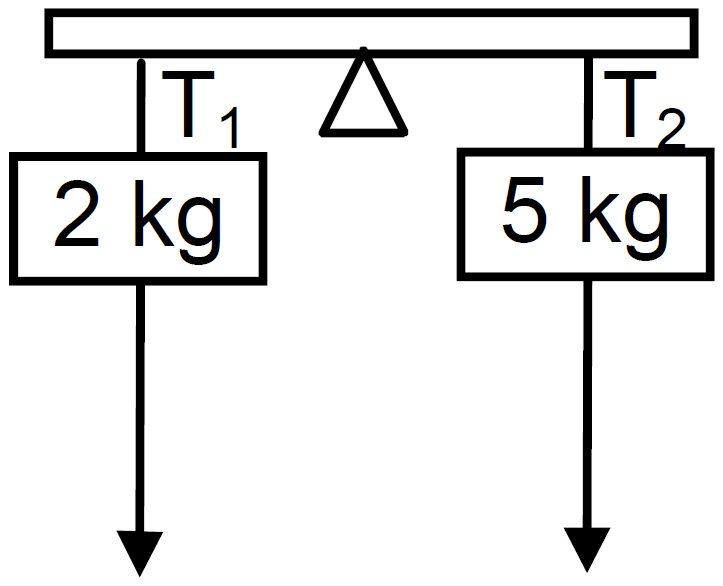
- $\tau_{\text{net}}=\text{I}_{\text{net}}\times\alpha$
$\Rightarrow5\times10\times10.5-2\times10\times0.5$
$=\Big[5\times\Big(\frac{1}{2}\Big)^2+2\times\Big(\frac{1}{2}\Big)^2+\frac{1}{12}\Big]\times\alpha$
$\Rightarrow15=(1.75+0.084)\alpha$
$\Rightarrow\alpha=\frac{1500}{(175+8.4)}=\frac{1500}{183.4}=8.1\text{rad/s}^2$ $(\text{g}=10)$
$=8.01\text{rad/s}^2$ (if g = 9.8)
- $\text{T}_1-\text{m}_1\text{g}=\text{m}_1\text{a}$
$\Rightarrow\text{T}_1=\text{m}_1\text{a}+\text{m}_1\text{g}=2(\text{a}+\text{g})$
$=2(\alpha\text{r}+\text{g})=2(8\times0.5+9.8)$
= 27.6N on the first body.
In the second body
$\Rightarrow m_2g - T_2 = m_2a$
$\Rightarrow T_2 = m_2g - m_2a$
$\Rightarrow T_2 = 5(g - a) = 5(9.8 - 8 \times 0.5) = 29N.$ View full question & answer→Question 453 Marks
Given the moment of inertia of a disc of mass M and radius R about any of its diameters to be $\frac{\text{MR}^2}{4},$ find its moment of inertia about an axis normal to the disc and passing through a point on its edge.
AnswerThe moment of inertia of a disc about its diameter $=\frac{\text{MR}^2}{4}$ According to the theorem of perpendicular axis, the moment of inertia of a planar body (lamina) about an axis perpendicular to its plane is equal to the sum of its moments of inertia about two perpendicular axes concurrent with perpendicular axis and lying in the plane of the body. The M.I. of the disc about its centre $=\frac{\text{MR}^2}{4}+\frac{\text{MR}^2}{4}=\frac{\text{MR}^2}{2}$ The situation is shown in the given figure: 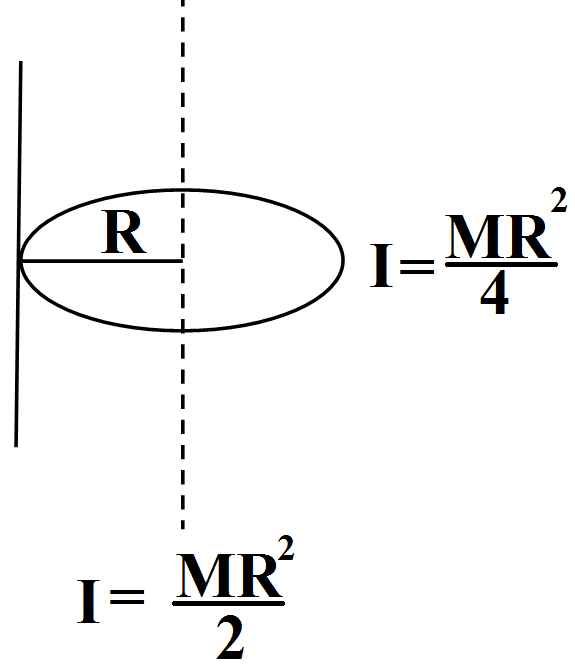 Applying the theorem of parallel axes, The moment of inertia about an axis normal to the disc and passing through a point on its edge $=\frac{\text{MR}^2}{2}+\text{MR}^2=\frac{3\text{MR}^2}{2}$
 View full question & answer→Question 463 Marks
What is the difference between rotational kinetic energy and rolling kinetic energy? Show that rolling kinetic energy of a rolling body is given by $\frac{1}{2}\text{mv}^2\Big(\frac{\text{K}^2}{\text{r}^2}+1\Big)$ where r is radius of the body and K is the radius of gyration of the body.
AnswerRotational K.E. is only due to the rotational motion, while K.E. under rolling is the sum of the rotational and translational kinetic energies. K.E. in Rolling = Rotational K.E. + Translational K.E. $=\frac{1}{2}\text{ I }\omega^2+\frac{1}{2}\text{mv}^2$ $=\frac{1}{2}\text{mK}^2\omega^2+\frac{1}{2}\text{mv}^2$ $=\frac{1}{2}\text{m}\frac{\text{K}^2}{\text{r}^2}\text{v}^2+\frac{1}{2}\text{mv}^2$ K.E. in rolling $=\frac{1}{2}\text{mv}^2\Big(1+\frac{\text{K}^2}{\text{r}^2}\Big)$
View full question & answer→Question 473 Marks
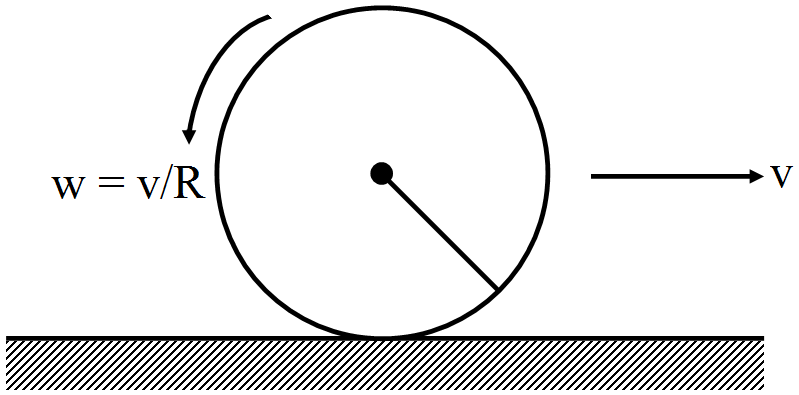
A solid sphere is set into motion on a rough horizontal surface with a linear speed v in the forward direction and an angular speed $\frac{\text{v}}{\text{R}}$ in the anticlockwise direction as shown in figure. Find the linear speed of the sphere:
- When it stops rotating.
- When slipping finally ceases and pure rolling starts.
Answer
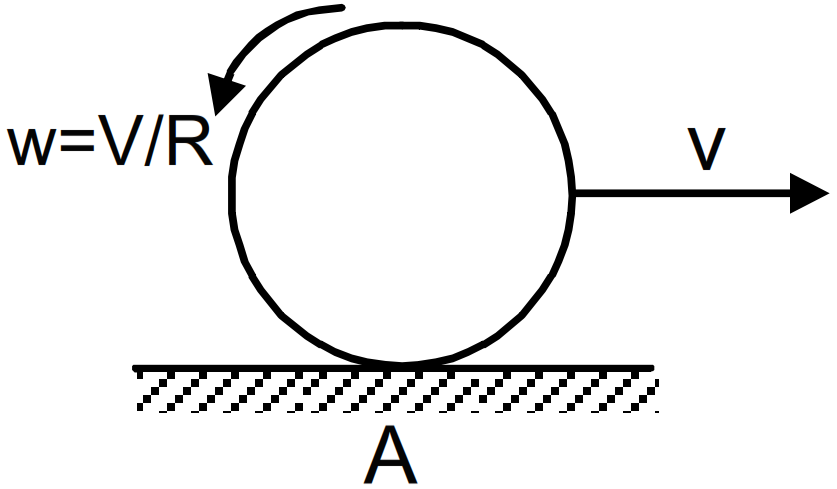
- If we take moment at A then external torque will be zero.
Therefore, the initial angular momentum = the angular momentum after rotation stops (i.e. only leniar velocity exits)
$\text{Mv}\times\text{R}-\ell\omega=\text{Mv}_0\times\text{R}$
$\Rightarrow\text{MvR}-\frac{2}{5}\times\frac{\text{MR}^2\text{V}}{\text{R}}=\text{Mv}_0\text{R}$
$\Rightarrow\text{v}_0=\frac{\text{3V}}{5}$
- Again, after some time pure rolling starts
Therefore,
$\Rightarrow\text{M}\times\text{v}_0\times\text{R}=\Big(\frac{2}{5}\Big) \text{MR}^2\times\Big(\frac{\text{V}'}{\text{R}}\Big)+\text{Mv}'\text{R}$
$\Rightarrow\text{m}\times\Big(\frac{\text{3V}}{5}\Big)\times\text{R}=\Big(\frac{2}{5}\Big)\text{Mv}'\text{R}+\text{Mv}'\text{R}$
$\Rightarrow\text{V}'=\frac{3\text{V}}{7}$ View full question & answer→Question 483 Marks
- State the theorem of parallel axis. Using it derive an expression to find the moment of inertia of a rod of mass M, length 1 about an axis perpendicular to it passing through one of its ends.
- Find the centre of mass of a uniform L shaped lamina (a thin flat plate) with dimension as shown in fig. The mass of lamina is $3kg$.
Answer
- Parallel axis theorem: According to this theorem, the moment of inertia of a rigid body about an axis AB is equal to the sum of moments of inertia of the body about another axis KL passing through the centre of mass C of the body in a direction parallel to AB and the product of total mass M of the body and square of the perpendicular distance between the two parallel axes.
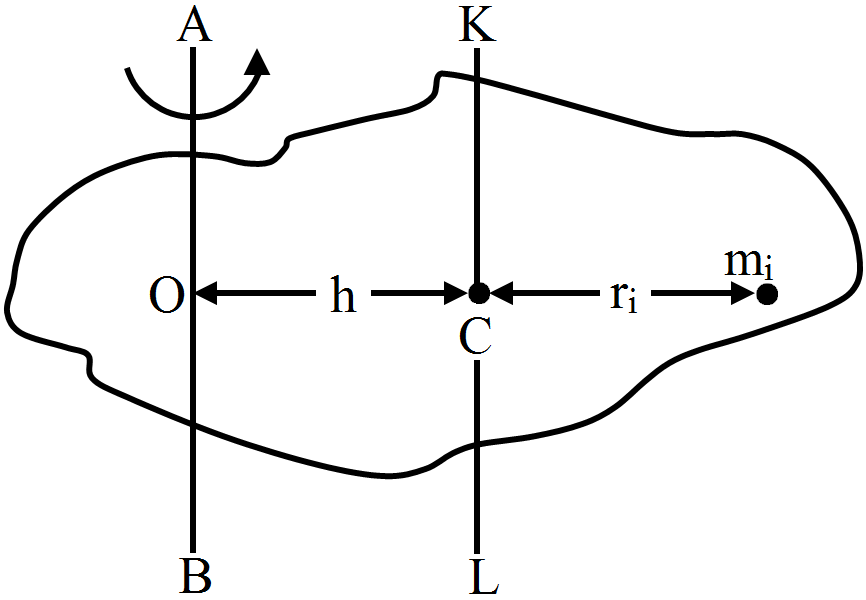
Let the mass of the rod m,
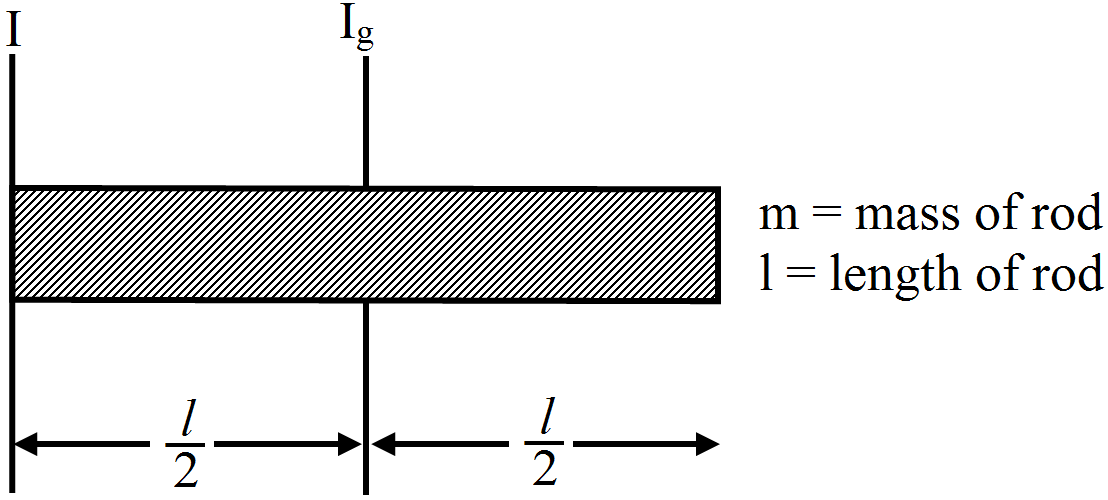
According to the theorem of parrallel axis
$\text{I}=\text{I}_{\text{g}}+\text{mL}^2$
$\because\text{I}_{\text{g}}=\frac{\text{ml}^2}{12}$
$\text{and }\text{L}=\frac{\text{l}}{2}$
$\Rightarrow\text{I}=\frac{\text{ml}^2}{12}+\text{m}\Big(\frac{\text{l}}{2}\Big)^2$
$\text{I}=\frac{\text{ml}^2}{12}+\frac{\text{ml}^2}{4}=\frac{\text{ml}^2}{3}$
- Choosing the X and Y axes as shown in the figure, the coordinates of the vertices of the L-shaped lamina are given in the figure.
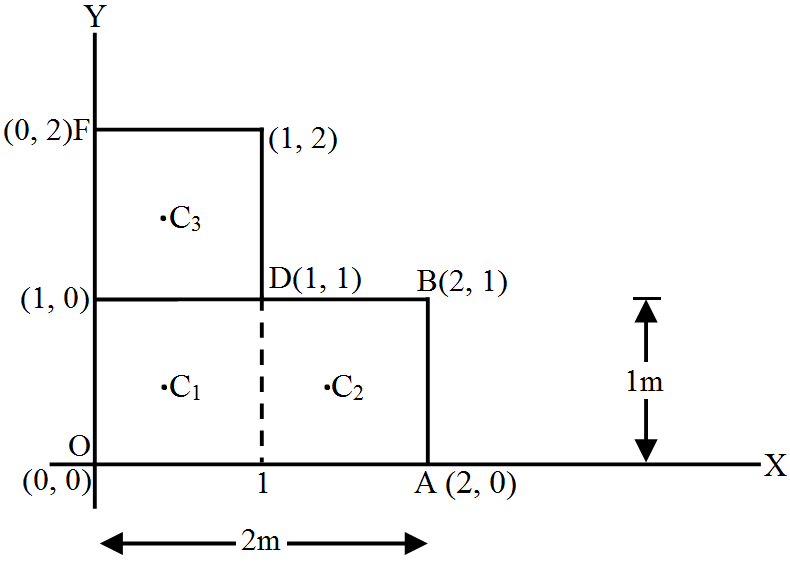
The L-shaped lamina consists of three squares each of side 1m and mass 1kg ($\because$ the lamina is uniform). By symmetry the centres of mass $C_1,C_2,C_3$ of the squares are their geometric centres and have coordiantes $\text{C}_1\Big(\frac{1}{2},\frac{1}{2}\Big),\text{C}_2\Big(\frac{3}{2},\frac{1}{2}\Big)$ and $\text{C}_3\Big(\frac{1}{2},\frac{3}{2}\Big)$ taking the masses of the square of be concentrated at these points, the coordinates of the centres of mass are caculated as
$\text{x}=\frac{\text{m}-1\text{x}_1+\text{m}_2\text{x}_2+\text{m}_3\text{x}_3}{\text{m}_1+\text{m}_2+\text{m}_3}$
$=\frac{1\times\frac{1}{2}+1\times\frac{3}{2}+1\times\frac{1}{2}}{1+1+}=\frac{5}{6}\text{m}$
$\text{y}=\frac{\text{m}_1\text{y}_1+\text{m}_2\text{y}_2+\text{m}_3\text{y}_3}{\text{m}_1+\text{m}_2+\text{m}_3}$
$=\frac{1\times\frac{1}{2}+1\times\frac{1}{2}+1\times\frac{3}{2}}{1+1+1}=\frac{5}{6}\text{m}.$ View full question & answer→Question 493 Marks
To maintain a rotor at a uniform angular speed of $200rad s^{-1}$, an engine needs to transmit a torque of $180Nm$. What is the power required by the engine? (Note: uniform angular velocity in the absence of friction implies zero torque. In practice, applied torque is needed to counter frictional torque). Assume that the engine is 100% efficient.
AnswerAngular speed of the rotor, $\omega=200\text{rad/s}$ Torque required, $\tau=180\text{Nm}$ The power of the rotor (P) is related to torque and angular speed by the relation, $\text{P}=\tau\omega$ = 180 × 200 = 36 × 103 = 36kW Hence, the power required by the engine is 36kW.
View full question & answer→Question 503 Marks
A rod of weight W is supported by two parallel knife edges A and B and is in equilibrium in a horizontal position. The distance between the knife edges is d and the centre of mass of the rod is at a distance x from A. Find the value of normal reactions at the knife edges A and B.
AnswerThe situation is shown in Fig
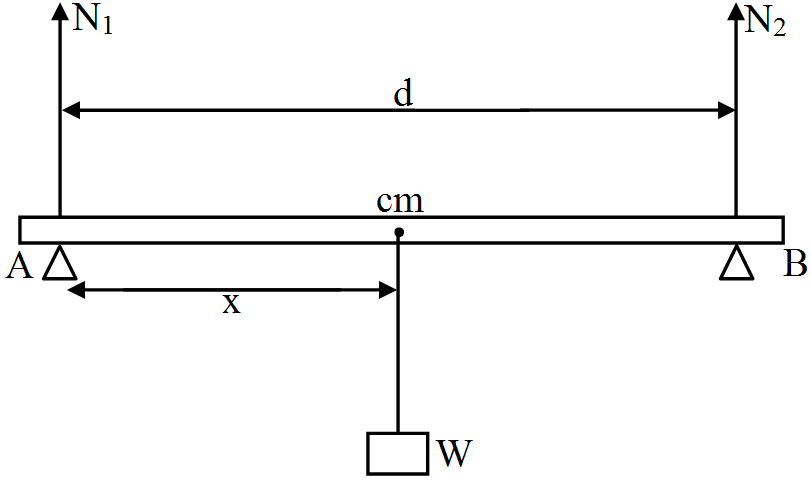
Let reactions on two knife edges be $N_1$ and $N_2$ respectively. Then $N_1 + N_2= W ...(1)$ and from principle of moments, taking moments at point A, we have $N_2 × d = W × x ...(2)$ Equation (2) leads $\text{N}_2=\frac{\text{W}_{\text{x}}}{\text{d}}$ and substituting this value in (i),
we get $\text{N}_1=\text{W}-\text{N}_2=\text{W}-\frac{\text{Wx}}{\text{d}}$ $=\text{W}\Big(1-\frac{\text{x}}{\text{d}}\Big).$ View full question & answer→