MCQ 1511 Mark
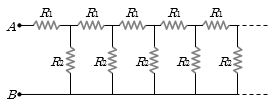
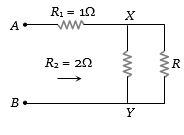
An infinite sequence of resistance is shown in the figure. The resultant resistance between $A$ and $B$ will be, when ${R_1} = 1\,ohm$ and ${R_2} = 2\,ohm$ ............. $\Omega$
Answerc
Let the resultant resistance be $R$. If we add one more branch, then the resultant resistance would be the same because this is an infinite sequence.
$\therefore \frac{{R{R_2}}}{{R + {R_2}}} + {R_1} = R \Rightarrow 2R + R + 2 = {R^2} + 2R$
$ \Rightarrow {R^2} - R - 2 = 0 \Rightarrow R = - 1$ or $R = 2\,ohm$
View full question & answer→MCQ 1521 Mark
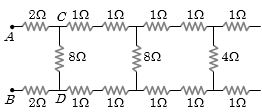
In the figure shown, the total resistance between $A$ and $B$ is ............. $\Omega$
Answerd
The last two resistance are out of circuit.
Now $8\,\Omega $ is in parallel with $(1 + 1 + 4 + 1 + 1)\,\Omega $.
$\therefore R = 8\,\Omega ||8\,\Omega = \frac{8}{2} = 4\,\Omega $ $ \Rightarrow $ ${R_{AB}} = 4 + 2 + 2 = 8\,\Omega $
View full question & answer→MCQ 1531 Mark
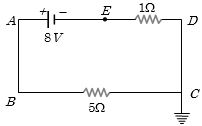
In the given circuit, the potential of the point $E$ is
- A
- B
$ - \,8\,V$
- ✓
$ - \,4/3\,V$
- D
$4/3 \,V$
AnswerCorrect option: C. $ - \,4/3\,V$
c
The current in the circuit $ = \frac{8}{{5 + 1}} = \frac{4}{3}$
Now ${V_C} - {V_E} = \frac{4}{3} \times 1$ $ \Rightarrow $ ${V_E} = - \frac{4}{3}\,V$
View full question & answer→MCQ 1541 Mark
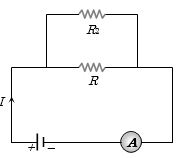
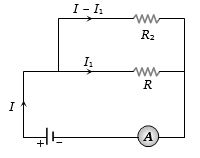
If a resistance ${R_2}$ is connected in parallel with the resistance $R$ in the circuit shown, then possible value of current through $R$ and the possible value of ${R_2}$ will be
- A
$\frac{I}{3},\,R$
- B
$I,\,2R$
- C
$\frac{I}{3},\,2R$
- ✓
$\frac{I}{2},\,R$
AnswerCorrect option: D. $\frac{I}{2},\,R$
d
(d) According to the figure, $(I - {I_1}){R_2} = {I_1}R$
Only two values satisfying the above relation are $\frac{I}{2}$ and $R$
View full question & answer→MCQ 1551 Mark
Four wires $AB,\,\,BC,\,\,CD,\,\,DA$ of resistance $4\, \Omega$ each and a fifth wire $BD$ of resistance $8\, \Omega$ are joined to form a rectangle $ABCD$ of which $BD$ is a diagonal. The effective resistance between the points $A$ and $B$ is
- A
$24\, ohm$
- B
$16\, ohm$
- C
$\frac{4}{3}\,ohm$
- ✓
$\frac{8}{3}\,ohm$
AnswerCorrect option: D. $\frac{8}{3}\,ohm$
d
(d) Effective resistance between the points $A$ and $B$ is $R = \frac{{32}}{{12}} = \frac{8}{3}\,\Omega $
View full question & answer→MCQ 1561 Mark
Three resistances, each of $1\, ohm$, are joined in parallel. Three such combinations are put in series, then the resultant resistance will be ............. $ohm$
- A
$9$
- B
$3$
- ✓
$1$
- D
$\frac{1}{3}$
Answerc
$\frac{1}{R} = \frac{1}{1} + \frac{1}{1} + \frac{1}{1} = \frac{3}{1}$ $ \Rightarrow $ $R = \frac{1}{3}\,ohm$
Now such three resistance are joined in series,
hence total $R = \frac{1}{3} + \frac{1}{3} + \frac{1}{3} = 1\,ohm$
View full question & answer→MCQ 1571 Mark
A copper wire of resistance $R$ is cut into ten parts of equal length. Two pieces each are joined in series and then five such combinations are joined in parallel. The new combination will have a resistance
- A
$R$
- B
$\frac{R}{4}$
- C
$\frac{R}{5}$
- ✓
$\frac{R}{{25}}$
AnswerCorrect option: D. $\frac{R}{{25}}$
d
$R \propto l$
Hence every new piece will have a resistance $\frac{R}{{10}}.$
If two pieces are connected in series, then their resistance $ = \frac{{2R}}{{10}} = \frac{R}{5}$
If $5$ such combinations are joined in parallel, then net resistance $ = \frac{R}{{5 \times 5}} = \frac{R}{{25}}$
View full question & answer→MCQ 1581 Mark
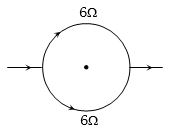
A wire has resistance $12\,\Omega $. It is bent in the form of a circle. The effective resistance between the two points on any diameter is equal to ................ $\Omega$
Answerc
(c) ${R_{eq}} = \frac{6}{2} = 3\,\Omega $
View full question & answer→MCQ 1591 Mark
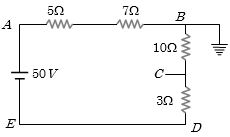
In the circuit shown, the point ‘$B$’ is earthed. The potential at the point ‘$A$’ is ............. $V$
Answerb
Current in the given circuit $i = \frac{{50}}{{(5 + 7 + 10 + 3)}} = 2\,A$
Potential difference between $A$ and $B$ ${V_A} - {V_B} = 2 \times 12$
$ \Rightarrow $ ${V_A} - 0 = 24\,V$ $ \Rightarrow $ ${V_A} = 24\,V$
View full question & answer→MCQ 1601 Mark
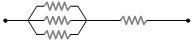
Three resistors each of $4\,\Omega $ are connected together to form a network. The equivalent resistance of the network cannot be ............ $\Omega$
Answerb
(b) If all are in series then ${R_{eq}} = 12\,\Omega $
If all are in parallel then ${R_{eq}} = \frac{4}{3}\Omega = 1.33\,\Omega $
If two are in series then parallel with third, ${R_{eq}} = \frac{8}{3} = 2.6\,\Omega $
If two are in parallel then series with third, ${R_{eq}} = 6\,\Omega $
View full question & answer→MCQ 1611 Mark
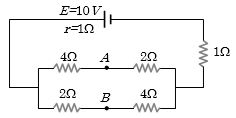
In the circuit shown below, the cell has an $e.m.f.$ of $10\,V$ and internal resistance of $1\, ohm$. The other resistances are shown in the figure. The potential difference ${V_A} - {V_B}$ is ................ $V$
AnswerCorrect option: D. $ - 2$
d
Equivalent external resistance of the given circuit ${R_{eq}} = 4\,\Omega $
Current given by the cell $i = \frac{E}{{{R_{eq}} + r}} = \frac{{10}}{{(4 + 1)}} = 2\,A$
Hence, $({V_A} - {V_B}) = \frac{i}{2} \times ({R_2} - {R_1}) = \frac{2}{2}(2 - 4) = - 2\,V.$
View full question & answer→MCQ 1621 Mark
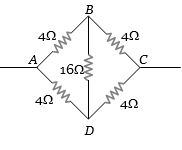
A uniform wire of $16\,\Omega $ is made into the form of a square. Two opposite corners of the square are connected by a wire of resistance $16\,\Omega $. The effective resistance between the other two opposite corners is ............... $\Omega$
Answerd
According to the principle of Wheatstone’s bridge, the effective resistance between the given points is $4\,\Omega$.
View full question & answer→MCQ 1631 Mark
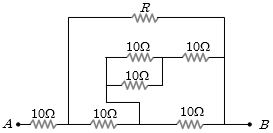
For what value of $R$ the net resistance of the circuit will be $18\, ohms$ ............... $\Omega$
Answerc
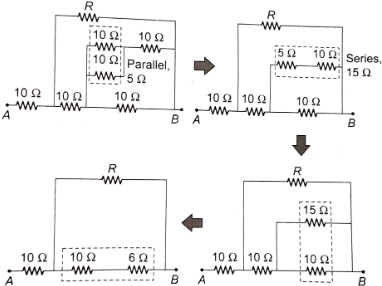
(c) $R_{e q}=10+\frac{16 R}{16+R}$
$18=10+\frac{16 R}{16+R} \Rightarrow 8=\frac{16 R}{16+R}$
$128+8 R=16 R \Rightarrow 8 R=128$
$R=16 \Omega$
View full question & answer→MCQ 1641 Mark
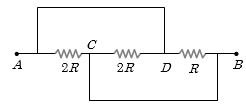
What is the equivalent resistance between $A$ and $B$
- A
$\frac{2}{3}R$
- B
$\frac{3}{2}R$
- ✓
$\frac{R}{2}$
- D
$2R$
AnswerCorrect option: C. $\frac{R}{2}$
c
(c) The circuit consists of three resistances $(2R, 2R$ and $R) $ connected in parallel.
View full question & answer→MCQ 1651 Mark
What is the equivalent resistance of the circuit ............. $\Omega$
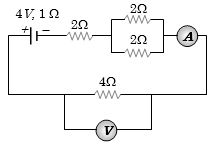
Answerc
The voltmeter is assumed to have infinite resistance. Hence $(1 + 2 + 1) + 4 = 8$ $\Omega$.
View full question & answer→MCQ 1661 Mark
The potential drop across the $3$ $\Omega$ resistor is ............... $V$
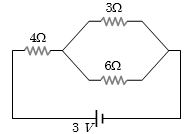
Answera
Equivalent resistance $R = 4 + \frac{{3 \times 6}}{{3 + 6}} = 6\,\Omega $ and main current $i = \frac{E}{R} = \frac{3}{6} = 0.5\,A$
Now potential difference across the combination of $3$ $\Omega$ and $6$ $\Omega$, $V = 0.5 \times \left( {\frac{{3 \times 6}}{{3 + 6}}} \right) = 1\,Volt$
The same potential difference, also develops across $3$ $\Omega$ resistance.
View full question & answer→MCQ 1671 Mark
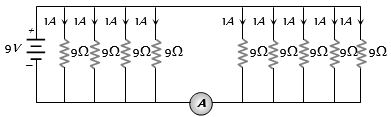
If each resistance in the figure is of $9\,\Omega$ then reading of ammeter is ............ $A$
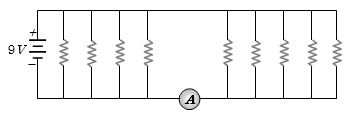
Answera
Equivalent resistance $R = \frac{9}{9} = 1\,\Omega $
Current $i = \frac{9}{1} = 9\,A$
Current passes through the ammeter $= 5\,A$.
View full question & answer→MCQ 1681 Mark
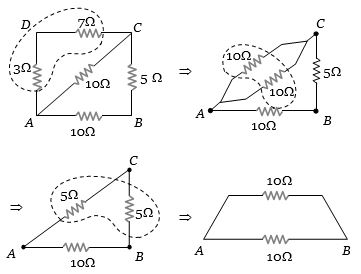
Four resistances $10$ $\Omega$, $5$ $\Omega$, $7$ $\Omega$ and $3$ $\Omega$ are connected so that they form the sides of a rectangle $AB$, $BC$, $CD$ and $DA$ respectively. Another resistance of $10$ $\Omega$ is connected across the diagonal $AC$. The equivalent resistance between $A$ and $B $ is .............. $\Omega$
Answerb
The figure can be drawn as follows
$ \Rightarrow $ ${R_{AB}} = 5\,\Omega $.
View full question & answer→MCQ 1691 Mark
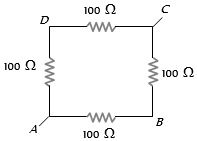
Four resistances of $100$ $\Omega$ each are connected in the form of square. Then, the effective resistance along the diagonal points is .............. $\Omega$
- A
$200$
- B
$400$
- ✓
$100$
- D
$150$
Answerc
The figure can be drawn as follows
${R_{AC}} = \frac{{200 \times 200}}{{200 + 200}} = 100\,\Omega $.
View full question & answer→MCQ 1701 Mark
Two wires of the same material and equal length are joined in parallel combination. If one of them has half the thickness of the other and the thinner wire has a resistance of $8\, ohms$, the resistance of the combination is equal to
- A
$\frac{5}{8}\,\,ohms$
- ✓
$\frac{8}{5}\,\,ohms$
- C
$\frac{3}{8}\,\,ohms$
- D
$\frac{8}{3}\,\,ohms$
AnswerCorrect option: B. $\frac{8}{5}\,\,ohms$
b
$\rho - {\rm{same, }}\,l - {\rm{same, }}\,{A_2} = \frac{1}{4}{A_1}$ (as ${r_2} = \frac{{{r_1}}}{2}$)
By using $R = \rho \frac{l}{A} \Rightarrow \frac{{{R_1}}}{{{R_2}}} = \frac{{{A_2}}}{{{A_1}}} \Rightarrow \frac{{{R_1}}}{8} = \frac{1}{4} \Rightarrow {R_1} = 2\,\Omega $
Hence, ${R_{eq}} = \frac{{{R_1}{R_2}}}{{{R_1} + {R_2}}} = \frac{{2 \times 8}}{{(2 + 8)}} = \frac{8}{5}\,\Omega .$
View full question & answer→MCQ 1711 Mark
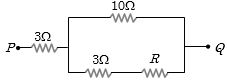
In the circuit shown here, what is the value of the unknown resistor $R$ so that the total resistance of the circuit between points $P$ and $Q$ is also equal to $R$
- A
$3\, ohms$
- B
$\sqrt {39} \,ohms$
- ✓
$\sqrt {69} \,ohms$
- D
$10\, ohms$
AnswerCorrect option: C. $\sqrt {69} \,ohms$
c
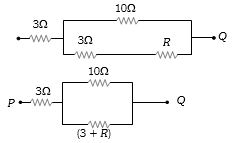
The given circuit can be simplified as follows
$R = 3 + \frac{{10 \times (3 + R)}}{{10 + 3 + R}}$ $ = 3 + \frac{{30 + 10R}}{{13 + R}}$
$R = \frac{{39 + 3R + 30 + 10R}}{{13 + R}} = \frac{{69 + 13R}}{{13 + R}}$
$13R + {R^2} = 69 + 13R$ $ \Rightarrow $ $R = \sqrt {69}\, \Omega $.
View full question & answer→MCQ 1721 Mark
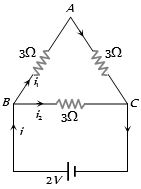
A uniform wire of resistance $9$ $\Omega$ is cut into $3$ equal parts. They are connected in the form of equilateral triangle $ABC$. A cell of $e.m.f.$ $2\,V$ and negligible internal resistance is connected across $B$ and $C$. Potential difference across $AB$ is ............... $V$
Answera
The circuit can be drawn as follows
Equivalent resistance $R = \frac{{3 \times (3 + 3)}}{{3 + (3 + 3)}} = 2\,\Omega $
Current $i = \frac{2}{2} = 1\,A.$ So,${i_1} = 1 \times \left( {\frac{3}{{3 + 6}}} \right) = \frac{1}{3}\,A$.
Potential difference between $A$ and $B =\frac{1}{3} \times 3 = 1\,volt.$
View full question & answer→MCQ 1731 Mark
Two resistance wires on joining in parallel the resultant resistance is $\frac{6}{5}\,ohms$. One of the wire breaks, the effective resistance is $2\,ohms$. The resistance of the broken wire is ............ $ohm$
- A
$\frac{3}{5}$
- B
$2 $
- C
$\frac{6}{5}$
- ✓
$3$
Answerd
Suppose resistance of wires are ${R_1}$ and ${R_2}$ then $\frac{6}{5} = \frac{{{R_1}{R_2}}}{{{R_1} + {R_2}}}$. If ${R_2}$ breaks then ${R_1} = 2\,\Omega $
Hence, $\frac{6}{5} = \frac{{2 \times {R_2}}}{{2 + {R_2}}} \Rightarrow {R_2} = 3\,\Omega $.
View full question & answer→MCQ 1741 Mark
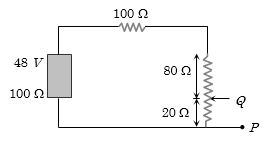
In the circuit, the potential difference across $PQ$ will be nearest to .............. $V$
- A
$9.6$
- B
$6.6$
- C
$4.8$
- ✓
$3.2 $
AnswerCorrect option: D. $3.2 $
d
Potential difference across $PQ$ i.e. p.d. across the resistance of $20$
$\Omega$, which is $V = i × 20$ and $i = \frac{{48}}{{(100 + 100 + 80 + 20)}} = 0.16\,A$
$V = 0.16 \times 20 = 3.2\,V$.
View full question & answer→MCQ 1751 Mark
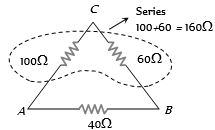
Three resistors are connected to form the sides of a triangle $ABC$, the resistance of the sides $AB$, $BC$ and $CA$ are $40\,ohms$, $60\,ohms$ and $100\,ohms$ respectively. The effective resistance between the points $A$ and $B$ in $ohms$ will be
Answera
(a) $R = \frac{{160 \times 40}}{{160 + 40}} = 32\,\Omega $.
View full question & answer→MCQ 1761 Mark
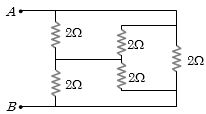
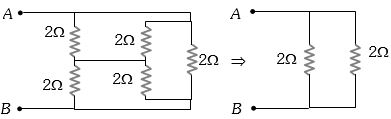
Find the equivalent resistance across $AB$ .............. $\Omega$
Answera
(a) ${R_{AB}} = \frac{{2 \times 2}}{{2 + 2}} = 1\,\Omega $.
View full question & answer→MCQ 1771 Mark
Three unequal resistors in parallel are equivalent to a resistance $1\, ohm$. If two of them are in the ratio $1 : 2$ and if no resistance value is fractional, the largest of the three resistances in $ohms$ is
Answerb
Two resistance are in ratio $1 : 2$ and third resistance is $R$
So, $\frac{1}{x} + \frac{1}{{2x}} + \frac{1}{R} = 1 \Rightarrow x = \frac{3}{2}\left( {\frac{R}{{R - 1}}} \right)$
As, resistance is not fractional $ \Rightarrow $ $\frac{R}{{R - 1}} = 2$
$ \Rightarrow $ $x = 3,\,R = 2,\,2x = 6$
Hence, the value of largest resistance $= 6\,\Omega$.
View full question & answer→MCQ 1781 Mark
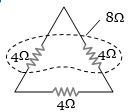
A wire has a resistance of $12\, ohm$. It is bent in the form of equilateral triangle. The effective resistance between any two corners of the triangle is
- A
$9\, ohms$
- B
$12\, ohms$
- C
$6\, ohms$
- ✓
$8/3\, ohms$
AnswerCorrect option: D. $8/3\, ohms$
d
(d) As resistance $\propto$ Length
Resistance of each arm $ = \frac{{12}}{3} = 4\,\Omega $
${R_{effective}} = \frac{{4 \times 8}}{{4 + 8}} = \frac{8}{3}\Omega $
View full question & answer→MCQ 1791 Mark
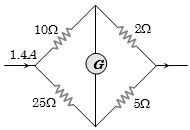
In the circuit shown in the figure, the current flowing in $2\,\Omega $ resistance ............... $A$
Answerd
Current through $2\, \Omega $ $ = 1.4\left\{ {\frac{{(25 + 5)}}{{(10 + 2) + (25 + 5)}}} \right\} = 1\,A$
View full question & answer→MCQ 1801 Mark
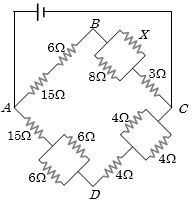
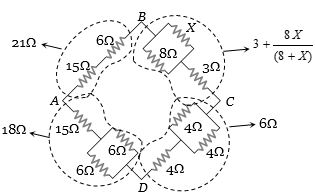
In the figure given the value of $X$ resistance will be, when the $p.d.$ between $B$ and $D$ is zero ................... $ohm$
Answerc
(c) Potential difference between $B$ and $D$ is zero, it means Wheatstone bridge is in balanced condition
So $\frac{P}{Q} = \frac{R}{S}$
$==>$ $\frac{{21}}{{3 + \frac{{8X}}{{(8 + X)}}}} = \frac{{18}}{6}$
$==>$ $X = 8\,\Omega $
View full question & answer→MCQ 1811 Mark
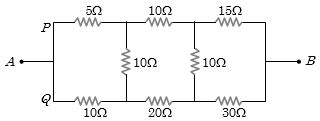
In the arrangement of resistances shown below, the effective resistance between points $A$ and $B$ is ............... $\Omega$
Answera
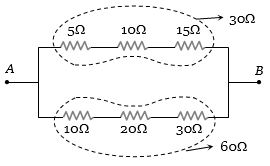
(a) By the concept of balanced Wheatstore bridge, the given circuit can be redrawn as follows
$ \Rightarrow $ ${R_{AB}} = \frac{{30 \times 60}}{{(30 + 60)}} = 20\,\Omega $
View full question & answer→MCQ 1821 Mark
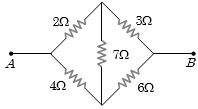
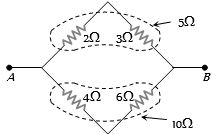
Five resistances are connected as shown in the figure. The effective resistance between the points $A$ and $B$ is
- ✓
$\frac{{10}}{3}\,\Omega $
- B
$\frac{{20}}{3}\,\Omega $
- C
$15\,\Omega $
- D
$6\,\Omega $
AnswerCorrect option: A. $\frac{{10}}{3}\,\Omega $
a
The given circuit is a balanced Wheatstone bridge type, hence it can be simplified as follows
$R_{AB}=\frac {10}{3}\,\Omega $
View full question & answer→MCQ 1831 Mark
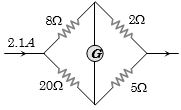
In the given figure, when galvanometer shows no deflection, the current (in $A$) flowing through $5\,\Omega $ resistance will be
Answerb
Let current through $5\,\Omega $ resistance be $i$.
Then $i \times 25 = (2.1 - i)\,10$
$i = \frac{{10}}{{35}} \times 2.1 = 0.6\,A$
View full question & answer→MCQ 1841 Mark
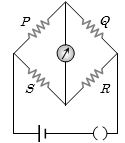
In the Wheatstone's bridge shown, $P = 2\,\Omega ,$ $Q = 3\,\Omega ,$ $R = 6\,\Omega $ and $S = 8\,\Omega $. In order to obtain balance, shunt resistance across '$S$' must be .............. $\Omega$
Answerd
(d) Let the value of shunt be $r$. Hence the equivalent resistance of branch containing $S$ will be $\frac{{Sr}}{{S + r}}$
In balance condition, $\frac{P}{Q} = \frac{{Sr/(S + r)}}{R}$. This gives $r = 8\,\Omega $
View full question & answer→MCQ 1851 Mark
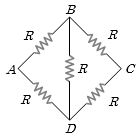
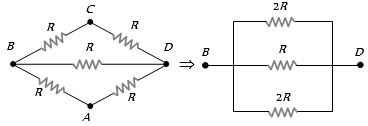
Five equal resistances each of value $R$ are connected in a form shown alongside. The equivalent resistance of the network
- A
Between the points $B$ and $D$ is $ R$
- B
Between the points $B$ and $D$ is $\frac{R}{2}$
- C
Between the points $A$ and $C$ is $R$
- ✓
Both $(b)$ and $(c)$
AnswerCorrect option: D. Both $(b)$ and $(c)$
d
$\frac{1}{{{R_{BD}}}} = \frac{1}{{2R}} + \frac{1}{R} + \frac{1}{{2R}} \Rightarrow {R_{BD}} = \frac{R}{2}$
Between $A$ and $C$ circuit becomes equivalent to balanced Wheatstone bridge so ${R_{AC}} = R$.
View full question & answer→MCQ 1861 Mark
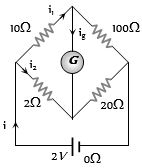
In the circuit shown below the resistance of the galvanometer is $20\, \Omega$ . In which case of the following alternatives are the currents arranged strictly in the decreasing order
- A
$i, i_1, i_2, i_g$
- ✓
$i, i_2, i_1, i_g$
- C
$i, i_2, i_g, i_1$
- D
$i, i_1, i_g, i_2$
AnswerCorrect option: B. $i, i_2, i_1, i_g$
b
(b) $i \propto \frac{1}{R}$
$P+Q>R+S$
$i=i_{1}+i_{2}$
$i>i_{2}>i_{1}>i_{g}$
View full question & answer→MCQ 1871 Mark
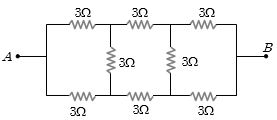
Calculate the equivalent resistance between $A$ and $B$
- ✓
$\frac{9}{2}\,\Omega $
- B
$3 \,\Omega$
- C
$6 \, \Omega$
- D
$\frac{5}{3}\,\Omega $
AnswerCorrect option: A. $\frac{9}{2}\,\Omega $
a
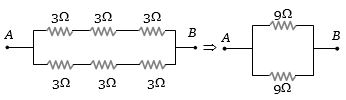
No current flow through vertical resistances ${R_{AB}} = \frac{9}{2}\,\Omega $.
View full question & answer→MCQ 1881 Mark
Which arrangement of four identical resistances should be used to draw maximum energy from a cell of voltage $V$
Answerb
(b) For maximum energy equivalent resistance of combination should be minimum.
View full question & answer→MCQ 1891 Mark
A wire has a resistance of $6 \,\Omega$. It is cut into two parts and both half values are connected in parallel. The new resistance is ................ $\Omega$
AnswerCorrect option: B. $1.5 $
b
Given $R = 6\,\Omega $.
When resistor is cut into two equal parts and connected in parallel, then
${R_{eq}} = \frac{{R/2}}{2}$ $ = \frac{R}{4} = \frac{6}{4} = 1.5\,\Omega $
View full question & answer→MCQ 1901 Mark
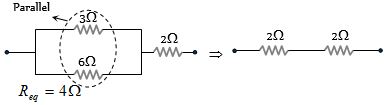
If you are provided three resistances $2 \,\Omega$, $3 \,\Omega$ and $6 \,\Omega$. How will you connect them so as to obtain the equivalent resistance of $4 \,\Omega$
Answerc
(c) ${R_{eq}} = 4\,\Omega $
View full question & answer→MCQ 1911 Mark
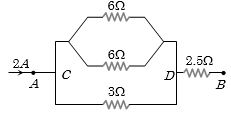
The equivalent resistance and potential difference between $A$ and $B$ for the circuit is respectively
- ✓
$4 \,\Omega$, $8\, V$
- B
$8 \,\Omega, \,\,4\, V$
- C
$2 \,\Omega$, $2\, V$
- D
$16 \,\Omega$, $8\, V$
AnswerCorrect option: A. $4 \,\Omega$, $8\, V$
a
The equivalent resistance between $C$ and $D$ is
$\frac{1}{{R'}} = \frac{1}{6} + \frac{1}{6} + \frac{1}{3} = \frac{2}{3}$ or $R' = \frac{3}{2} = 1.5\,\Omega $
Now the equivalent resistance between $A$ and $B$ as $R' = 1.5\,\Omega $ and $2.5\,\Omega $ are connected in series, so
Now by ohm's law, potential difference between $A$ and $B$ is given by ${V_A} - {V_B} = iR = 2 \times 4.0 = 8\,\,volt$
View full question & answer→MCQ 1921 Mark
The current in a simple series circuit is $5.0\, amp$. When an additional resistance of $2.0\, ohms$ is inserted, the current drops to $4.0\, amp$. The original resistance of the circuit in $ohms$ was
Answerb
(b) $i \propto \frac{1}{R}\, \Rightarrow \,\frac{{{i_1}}}{{{i_2}}} = \frac{{{R_2}}}{{{R_1}}}$ $ \Rightarrow $ $\frac{5}{4} = \frac{{(R + 2)}}{R}$ $ \Rightarrow $ $R = 8 \,\Omega$
View full question & answer→MCQ 1931 Mark
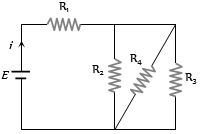
In the circuit given $E = 6.0 \,V, R_1 = 100\, ohms, R_2 = R_3 = 50\, ohms, R_4 = 75\, ohms$. The equivalent resistance of the circuit, in $ohms$, is
- A
$11.875$
- B
$26.31$
- ✓
$118.75$
- D
AnswerCorrect option: C. $118.75$
c
(c) In given circuit three resistance ${R_2},{R_4}$ and ${R_3}$ are parallel.
$\frac{1}{R} = \frac{1}{{{R_2}}} + \frac{1}{{{R_4}}} + \frac{1}{{{R_3}}}$
$ = \frac{1}{{50}} + \frac{1}{{50}} + \frac{1}{{75}}$
$ = \frac{{75 + 75 + 50}}{{50 \times 75}}$
$R = \frac{{50 \times 75}}{{75 + 75 + 50}} = \frac{{50 \times 75}}{{200}} = \frac{{75}}{4}\,\Omega = 18.75\,\Omega $
This resistance is in series with ${R_1}$
${R_{{\rm{resultant}}}} = {R_1} + R = 100 + 18.75 = 118.75\,\Omega $
View full question & answer→MCQ 1941 Mark
By using only two resistance coils-singly, in series, or in parallel one should be able to obtain resistances of $3$, $4$, $12$ and $16\, ohms$. The separate resistances of the coil are
- A
$3$ and $4$
- ✓
$4$ and $12$
- C
$12$ and $16$
- D
$16$ and $3$
AnswerCorrect option: B. $4$ and $12$
b
When resistances $4\,\Omega $ and $12\,\Omega $ are connected in series $ = 4 + 12 = 16\,\Omega $
When these resistance are connected in parallel.
$\frac{1}{{{R_P}}} = \frac{1}{4} + \frac{1}{{12}}$ $ \Rightarrow \,\,\,{R_P} = \frac{{4 \times 12}}{{4 + 12}} = \frac{{4 \times 12}}{{16}} = 3\,\Omega $
View full question & answer→MCQ 1951 Mark
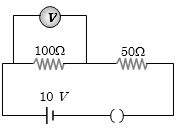
In the given circuit, the voltmeter records $5\, volts$. The resistance of the voltmeter in $ohms$ is
Answerb
(b) Since voltmeter records $5\,V$, it means the equivalent. Resistance of voltmeter and $100 \,\Omega$ must be $50$, because in series grouping if resistances are equal, they share equal potential difference. It conclude that resistance of voltmeter must be $100 \,\Omega$.
View full question & answer→MCQ 1961 Mark
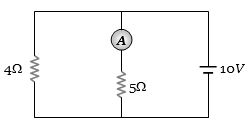
if the internal resistance of the battery is $1\, ohm$, then what is the reading of ammeter
- A
$5/3\, A$
- ✓
$40/29\, A$
- C
$10/9\, A$
- D
$1\, A$
AnswerCorrect option: B. $40/29\, A$
b
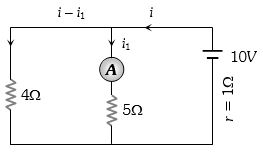
Applying Kirchhoff law in the first mesh
$10 = 5{i_1} + i$..... $(i)$
Applying in the second mesh
$5{i_1} = 4i - 4{i_1}$...... $(ii)$
Solving equation $(i)$ and $(ii)$, we get
${i_1} = \frac{{40}}{{29}}\,A$
View full question & answer→MCQ 1971 Mark
$50\,\Omega $ and $100\,\Omega $ resistors are connected in series. This connection is connected with a battery of $2.4\, volts$. When a voltmeter of $100\,\Omega $ resistance is connected across $100\,\Omega $ resistor, then the reading of the voltmeter will be ............. $V$
Answerc
Equivalent resistance of the circuit ${R_{eq}} = 100\,\Omega $
current through the circuit $i = \frac{{2.4}}{{100}}\,A$
$P.D.$ across combination of voltmeter and $100\,\Omega$ resistance $ = \frac{{2.4}}{{100}} \times 50 = 1.2\,V$
Since the voltmeter and $100\,\Omega$ resistance are in parallel, so the voltmeter reads the same value i.e. $1.2\,V.$
View full question & answer→MCQ 1981 Mark
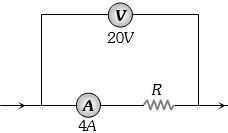
In the diagram shown, the reading of voltmeter is $20\, V$ and that of ammeter is $4\, A$. The value of $R$ should be (Consider given ammeter and voltmeter are not ideal)
- A
Equal to $5\,\Omega $
- B
Greater from $5\,\Omega $
- ✓
Less than $5\,\Omega $
- D
Greater or less than $5\,\Omega $ depends on the material of $R$
AnswerCorrect option: C. Less than $5\,\Omega $
c
If resistance of ammeter is $r$ then
$20 = (R + r)4$ $ \Rightarrow $ $R + r = 5$ $ \Rightarrow $ $R < 5\,\Omega $
View full question & answer→MCQ 1991 Mark
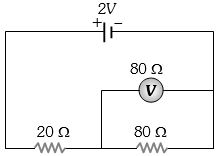
In the adjoining circuit, the $e.m.f.$ of the cell is $2\, volt$ and the internal resistance is negligible. The resistance of the voltmeter is $80 \,ohm$. The reading of the voltmeter will be ............. $volt$
- A
$0.80$
- B
$1.60$
- ✓
$1.33$
- D
$2$
AnswerCorrect option: C. $1.33$
c
(c) Total resistance of the circuit $ = \frac{{80}}{2} + 20 = 60\,\Omega $
$ \Rightarrow $ Main current $i = \frac{2}{{60}} = \frac{1}{{30}}A$
Combination of voltmeter and $80$ $\Omega$ resistance is connected in series with $20$ $\Omega$, so current through $20$ $\Omega$ and this combination will be same $ = \frac{1}{{30}}A$.
Since the resistance of voltmeter is also $80$ $\Omega$, so this current is equally distributed in $80$ $\Omega$ resistance and voltmeter (i.e.$\frac{1}{{60}}A$ through each)
$P.D.$ across $80$ $\Omega$ resistance $ = \frac{1}{{60}} \times 80 = 1.33\,V$
View full question & answer→MCQ 2001 Mark
If the ammeter in the given circuit reads $2\, A$, the resistance $R$ is ............ $ohm$
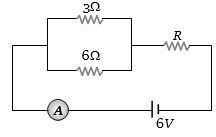
Answera
(a) $i = \frac{V}{R} \Rightarrow \,2 = \frac{6}{{\frac{{6 \times 3}}{{6 + 3}} + R}} = \frac{6}{{2 + R}}$
$ \Rightarrow $ $R = 1\,\,\Omega $.
View full question & answer→