Questions · Page 5 of 34

M.C.Q (1 Marks)

MCQ 2011 Mark
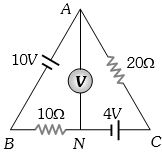
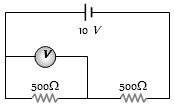
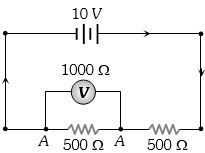
What is the reading of voltmeter in the following figure .............. $V$
  • A
    $3$
  • B
    $2$
  • C
    $5$
  • $4$
Answer
Correct option: D.
$4$
d
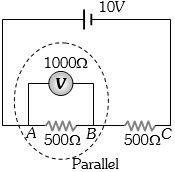
(d) Resistance between $A$ and $B$ $ = \frac{{1000 \times 500}}{{(1500)}} = \frac{{1000}}{3}$
So, equivalent resistance of the circuit
${R_{eq}}$ $ = 500 + \frac{{1000}}{3} = \frac{{2500}}{3}$
 Current drawn from the cell
$i = \frac{{10}}{{(2500/3)}} = \frac{3}{{250}}A$
Reading of voltmeter i.e.
potential difference across $AB = \frac{3}{{250}} \times \frac{{1000}}{3} = 4\,V$
View full question & answer
MCQ 2021 Mark
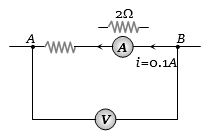
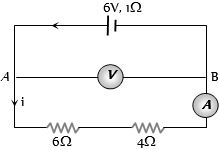
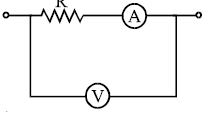
If resistance of voltmeter is $10000 \,\Omega$ and resistance of ammeter is $2 \,\Omega$ then find $R$ when voltmeter reads $12\,V$ and ammeter reads $0.1\, A$ ...............  $\Omega$
  • $118 $
  • B
    $120$
  • C
    $124 $
  • D
    $114$
Answer
Correct option: A.
$118 $
a
(a) According to following figure
Reading of voltmeter = Potential difference between $A$ and $B$ = $i (R + 2)$

$ \Rightarrow $ $12 = 0.1 (R + 2)$

$ \Rightarrow $ $R = 118\,\Omega$.

View full question & answer
MCQ 2031 Mark
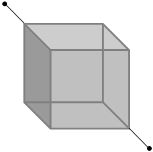
Twelve wires of equal length and same cross-section are connected in the form of a cube. If the resistance of each of the wires is $R$, then the effective resistance between the two diagonal ends would be
  • A
    $2\,R$
  • B
    $12\,R$
  • $\frac{5}{6}R$
  • D
    $8\,R$
Answer
Correct option: C.
$\frac{5}{6}R$
c
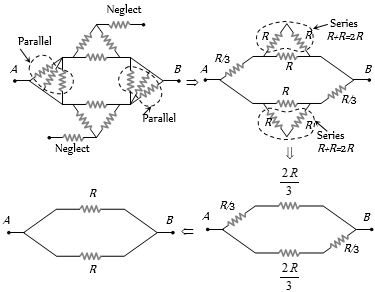
(c) The given circuit can be simplified as follows
${R_{AD}} = \frac{{5R}}{6}$
View full question & answer
MCQ 2041 Mark
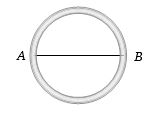
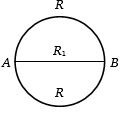
The resistance of a wire is ${10^{ - 6}}\,\Omega $ per meter. It is bend in the form of a circle of diameter $2\,m$. A wire of the same material is connected across its diameter. The total resistance across its diameter $AB$ will be
  • A
    $\frac{4}{3}\pi \times {10^{ - 6}}\,\Omega $
  • B
    $\frac{2}{3}\pi \times {10^{ - 6}}\,\Omega $
  • $0.88 \times {10^{ - 6}}\,\Omega $
  • D
    $14\pi \times {10^{ - 6}}\,\Omega $
Answer
Correct option: C.
$0.88 \times {10^{ - 6}}\,\Omega $
c
Resistance across $AB = \frac{1}{{R'}} = \frac{1}{R} + \frac{1}{R} + \frac{1}{{{R_1}}}$ ${R_1} = 2 \times {10^{ - 6}}\,\Omega $

and $R = \pi \times 1 \times {10^{ - 6}}\,\Omega $

On solving, $R' = 0.88 \times {10^{ - 6}}\,\Omega $

View full question & answer
MCQ 2051 Mark
There are three resistance coils of equal resistance. The maximum number of resistances you can obtain by connecting them in any manner you choose, being free to use any number of the coils in any way is
  • A
    $3$
  • $4$
  • C
    $6$
  • D
    $5$
Answer
Correct option: B.
$4$
b
(b)Maximum number of resistance $ = {2^{n - 1}} = {2^{3 - 1}} = 4$
View full question & answer
MCQ 2061 Mark
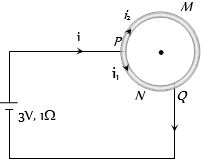
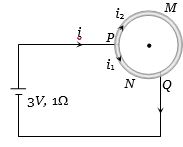
A wire of resistance $10$ $\Omega$ is bent to form a circle. $P$ and $Q$ are points on the circumference of the circle dividing it into a quadrant and are connected to a Battery of $3\, V$ and internal resistance $1$ $\Omega$ as shown in the figure. The currents in the two parts of the circle are
  • $\frac{6}{23}\,A$ and $\frac{18}{23}\,A$
  • B
    $\frac{5}{{26}}A$ and $\frac{{15}}{{26}}A$
  • C
    $\frac{4}{{25}}A$ and $\frac{{12}}{{25}}A$
  • D
    $\frac{3}{{25}}A$ and $\frac{9}{{25}}A$
Answer
Correct option: A.
$\frac{6}{23}\,A$ and $\frac{18}{23}\,A$
a
 In the following figure Resistance of part $PNQ$;

${R_1} = \frac{{10}}{4} = 2.5\,\Omega $ and

Resistance of part $PMQ$;

${R_2} = \frac{3}{4} \times 10 = 7.5\,\Omega $

${R_{eq}} = \frac{{{R_1}{R_2}}}{{{R_1} + {R_2}}} = \frac{{2.5 \times 7.5}}{{(2.5 + 7.5)}} =\frac{{15}}{8}\,\Omega $.

Main Current $i =$ $\frac{3}{{\frac{{15}}{8} + 1}} = \frac{{24}}{{23}}A$

So, $i_1= i \times \left( {\frac{{{R_2}}}{{{R_1} + {R_2}}}} \right) = \frac{{24}}{{23}} \times \left( {\frac{{7.5}}{{2.5 + 7.5}}} \right) = \frac{{18}}{{23}}A$

and ${i_2} = i - {i_1} = \frac{{24}}{{23}} - \frac{{18}}{{23}} = \frac{6}{{23}}A$.

View full question & answer
MCQ 2071 Mark
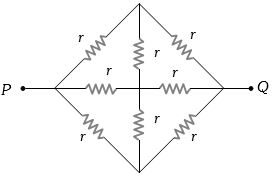
The equivalent resistance between the points $P$ and $Q$ in the network given here is equal to  ................ $\Omega$ (given $r = \frac{3}{2}\Omega $)
  • A
    $\frac{1}{2}$
  • $1$
  • C
    $\frac{3}{2}$
  • D
    $2$
Answer
Correct option: B.
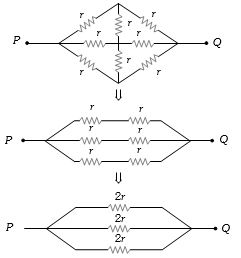
$1$
b
(b) The given circuit can be simplifies as follows
$R' = \frac{{2r}}{3} = \frac{2}{3} \times \frac{3}{2} = 1\Omega $.
View full question & answer
MCQ 2081 Mark
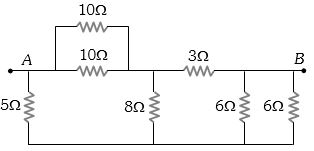
Seven resistances are connected as shown in the figure. The equivalent resistance between $A$ and $B$ is ............... $\Omega$
  • A
    $3$ 
  • $4$ 
  • C
    $4.5$ 
  • D
    $5$ 
Answer
Correct option: B.
$4$ 
b
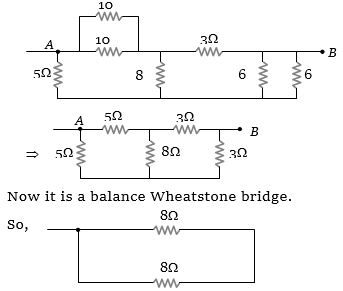
(b) The given circuit can be simplified as follows
So,  ${R_{AB}} = \frac{{8 \times 8}}{{8 + 8}} = \frac{{64}}{{16}} = 4\Omega $
View full question & answer
MCQ 2091 Mark
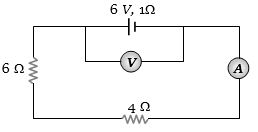
In the circuit shown here, the readings of the ammeter and voltmeter are
  • A
    $6\, A$, $ 60\, V$
  • B
    $0.6\, A$, $ 6\, V$
  • $6/11\, A$, $ 60/11\, V$
  • D
    $11/6\, A$, $  11/60\, V$
Answer
Correct option: C.
$6/11\, A$, $ 60/11\, V$
c
The given circuit can be redrawn as follows

Current $i = \frac{6}{{6 + 4 + 1}} = \frac{6}{{11}}A$

P.D. between $A$ and $B$,   $V = \frac{6}{{11}} \times 10 = \frac{{60}}{{11}}V$.

View full question & answer
MCQ 2101 Mark
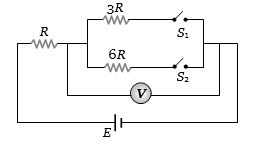
In the circuit shown in figure reading of voltmeter is $V_1$ when only $S_1$ is closed, reading of voltmeter is $ V_2$ when only $S_2$ is closed and reading of voltmeter is $V_3$ when both $S_1$ and $S_2$ are closed. Then
  • A
    $V_3 > V_2 > V_1$
  • $V_2 > V_1 > V_3$
  • C
    $V_3 > V_1 > V_2$
  • D
    $V_1 > V_2 > V_3$
Answer
Correct option: B.
$V_2 > V_1 > V_3$
b
In series : Potential difference $\propto$ $R$

When only $S_1$ is closed ${V_1} = \frac{3}{4}E = 0.75\,E$

When only $ S_2$ is closed ${V_2} = \frac{6}{7}E = 0.86\,E$
and when both $S_1$ and $S_2$ are closed combined resistance of $6R$ and $3R$ is $2R$

${V_3} = \left( {\frac{2}{3}} \right)E = 0.67\,E$ $\Rightarrow $ ${V_2} > {V_1} > {V_3}$

View full question & answer
MCQ 2111 Mark
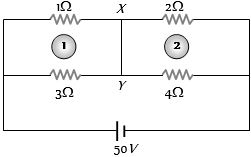
Current through wire $XY$ of circuit shown is ................ $A$
  • A
    $1$
  • B
    $4$
  • $2 $
  • D
    $3 $
Answer
Correct option: C.
$2 $
c
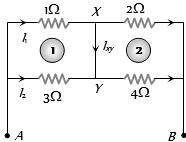
$ - \,{i_1} + 0 \times {i_{xy}} + 3{i_2} = 0$  i.e. ${i_1} = 3{i_2}$ ...... $(i)$

Also $ - 2({I_1} - {I_{xy}}) + 4({I_2} + {I_{xy}}) = 0$

i.e. $2{I_1} - 4{I_2} = 6{I_{xy}}$ .... $(ii)$

Also ${V_{AB}} - 1 \times {i_1} - 2({i_1} - {i_{xy}}) = 0$  $\Rightarrow $ $50 = {i_1} + 2({i_1} - {i_{xy}})$

$ = 3{I_1} - 2{I_{xy}}$ .... $(iii)$

Solving $(i)$, $(ii)$ and $(iii)$, ${i_{xy}} = 2\,A$

View full question & answer
MCQ 2121 Mark
The reading of the ideal voltmeter in the adjoining diagram will be ................. $V$
  • A
    $4$
  • $8$
  • C
    $12$
  • D
    $14 $
Answer
Correct option: B.
$8$
b
Current flowing in the circuit $i = \frac{E}{R} = \frac{{10 - 4}}{{20 + 10}} = \frac{1}{5}\,A$

$P.D.$  across $AC $$ = \frac{1}{5} \times 20 = 4\,V$
$P.D.$  across $AN = 4 + 4 = 8\,V$

View full question & answer
MCQ 2131 Mark
A battery of $e.m.f.$ $3\, volt$ and internal resistance $1.0\, ohm$ is connected in series with copper voltameter. The current flowing in the circuit is $1.5\, amperes$. The resistance of voltameter will be ........... $ohm$
  • A
    $0$
  • $1$
  • C
    $1.5$
  • D
    $2$
Answer
Correct option: B.
$1$
b
(b) $3 = 1.5\,(1 + r)$ $ \Rightarrow $ $r = 1$ $\Omega$
View full question & answer
MCQ 2141 Mark
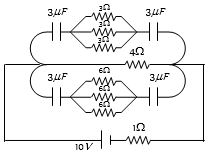
In the following figure, the charge on each condenser in the steady state will be.....$\mu C$
  • A
    $3$
  • B
    $6$
  • C
    $9$
  • $12$
Answer
Correct option: D.
$12$
d
(d) In steady state current flows through $4\, \Omega$  resistance only and it is $i = \frac{{10}}{{(4 + 1)}} = 2\,amp$.

Potential difference across $4\, \Omega$  resistance is $V = 2 \times 4 = 8\,volt$
Hence, potential difference across each capacitor is $4\,V$
So charge on each capacitor $Q = 3 \times 4 = 12 \,\mu C$.

View full question & answer
MCQ 2151 Mark
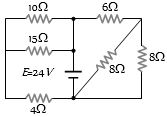
Find the equivalent resistance across the terminals of source of $e.m.f$. $24\, V$ for the circuit shown in figure .............. $\Omega$
  • A
    $15$
  • B
    $10$
  • $5 $
  • D
    $4$
Answer
Correct option: C.
$5 $
c
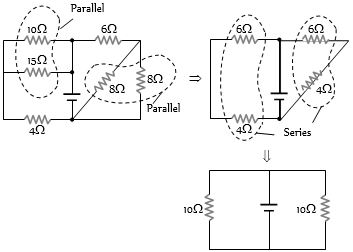
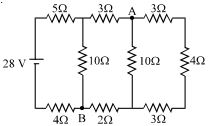
(c) Given circuit can be reduced to a simple circuit as shown in figures below
i.e. ${R_{eq}} = 5\,\Omega $.
View full question & answer
MCQ 2161 Mark
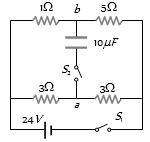
In the circuit shown in figure, switch $S_1$ is initially closed and $S_2$ is open. Find $V_a -V_b$ .............. $V$
  • A
    $4$
  • $8$
  • C
    $12$
  • D
    $16$
Answer
Correct option: B.
$8$
b
Switch ${S_2}$ is open so capacitor is not in circuit.

Current through $3\,\Omega $ resistor $ = \frac{{24}}{{3 + 3}} = 4\;A$

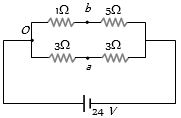
Let potential of point $‘O’$ shown in fig. is ${V_O}$
then using ohm’s law

${V_O} - {V_a} = 3 \times 4 = 12\,V$  .... $(i)$

Now current through $5\,\Omega $ resistor $ = \frac{{24}}{{5 + 1}} = 4\,A$

So ${V_0} - {V_b} = 4 \times 1 = 4\,V$  ..... $(ii)$
From equation $(i)$ and $(ii)$ ${V_b} - {V_a} = 12 - 4 = 8\,V.$

View full question & answer
MCQ 2171 Mark
A voltmeter of resistance $1000\,\Omega$ is connected across a resistance of $500\, \Omega$ in the given circuit. What will be the reading of voltmeter .............. $V$
  • A
    $1$
  • B
    $2$
  • C
    $6$
  • $4$
Answer
Correct option: D.
$4$
d
Total current through the circuit

$i = \frac{{10}}{{\frac{{1000}}{3} + 500}} = \frac{3}{{250}}\,A$

Now voltmeter reading $ = {i_v} \times {R_V}$ $ = \frac{2}{3} \times \frac{3}{{250}} \times 500 = 4\,V.$

View full question & answer
MCQ 2181 Mark
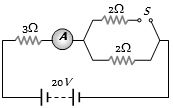
In the circuit shown, the reading of ammeter when switch $S$ is open and when switch $S$ is closed respectively are
  • A
    $3\, A$ and $4\, A$
  • $4\, A$ and $5\, A$
  • C
    $5\, A$ and $6\, A$
  • D
    $6\, A$ and $7\, A$
Answer
Correct option: B.
$4\, A$ and $5\, A$
b
When switch $S$ is open total current through ammeter.

$i = \frac{{20}}{{(3 + 2)}} = 4\,A$.

When switch is closed $i = \frac{{20}}{{3 + (2||2)}} = 5\,A$.

View full question & answer
MCQ 2191 Mark
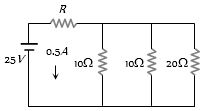
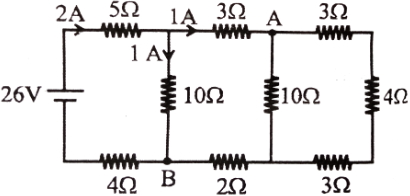
In the circuit as shown in figure the
  • A
    Resistance $R = 46 \,\Omega$
  • B
    Current through $20\,\Omega$ resistance is $0.1 \,A$
  • C
    Potential difference across the middle resistance is $2\, V$
  • All option are correct
Answer
Correct option: D.
All option are correct
d
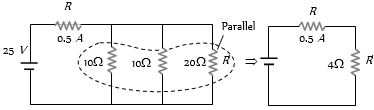
$\frac{1}{{R'}} = \frac{1}{{10}} + \frac{1}{{10}} + \frac{1}{{20}}$$ \Rightarrow R' = \frac{{20}}{5} = 4\;\Omega $

Now using ohm’s law $i = \frac{{25}}{{R + R'}}$$ \Rightarrow 0.5 = \frac{{25}}{{R + 4}}$

$ \Rightarrow R + 4 = \frac{{25}}{{0.5}} = 50$ $ \Rightarrow R = 50 - 4 = 46\;\Omega $

Current through $20\,\Omega $ resistor $ = \frac{{0.5 \times 5}}{{20 + 5}} = \frac{{2.5}}{{25}} = 0.1\,A$

Potential difference across middle resistor
$=$ Potential difference across $20\,\Omega $$ = 20 \times 0.1 = 2\,V$
View full question & answer
MCQ 2201 Mark
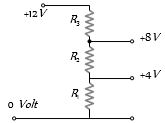
A potential divider is used to give outputs of $4\, V$ and $8\, V$ from a $12\, V$ source. Which combination of resistances, $(R_1, R_2, R_3)$ gives the correct voltages ? $R_1 : R_2 : R_3$
  • A
    $2 : 1 : 2$
  • $1 : 1 : 1$
  • C
    $2 : 2 : 1$
  • D
    $1 : 1 : 2$
Answer
Correct option: B.
$1 : 1 : 1$
b
(b) Resistors are connected in series. So current through each resistor will be same
$ \Rightarrow i = \frac{{12 - 8}}{{{R_3}}} = \frac{{8 - 4}}{{{R_2}}} = \frac{{4 - 0}}{{{R_1}}}$ $ \Rightarrow \frac{4}{{{R_3}}} = \frac{4}{{{R_2}}} = \frac{4}{{{R_1}}}$
So, ${R_1}:{R_2}:{R_3}::\;1:1:1$.
View full question & answer
MCQ 2211 Mark
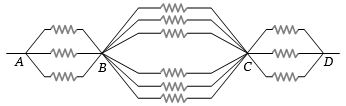
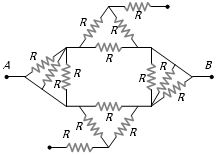
Find equivalent resistance between $A$ and $B$
  • A
    $R$
  • B
    $\frac{{3R}}{4}$
  • $\frac{R}{2}$
  • D
    $2R$
Answer
Correct option: C.
$\frac{R}{2}$
c
(c) Given circuit can be redrawn as follows
$ \Rightarrow {R_{eq}} = \frac{R}{2}$
View full question & answer
MCQ 2221 Mark
A storage battery is connected to a charger for charging with a voltage of $12.5\,\,Volts$. The internal resistance of the storage battery is $1\,\,\Omega$ . When the charging current is $0.5\,\,A$, the emf of the storage battery is: ............... $volts$
  • A
    $13$
  • B
    $12.5$
  • $12$
  • D
    $11.5$
Answer
Correct option: C.
$12$
c
Resistance of the charger,

$R=\frac{V}{I}$

$R=\frac{12.5}{0.5}=25 \Omega$

Now

$E=I R=\frac{V}{R+r}(R)$

$E=\frac{12.5}{25+1}(25)=(0.48)(25)=12 V$

View full question & answer
MCQ 2231 Mark
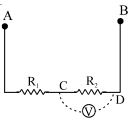
Resistances $R_1$ and $R_2$ each $60\,\Omega$ are connected in series as shown in figure. The Potential difference between $A$ and $B$ is kept $120$ volt. Then what ............. $V$ will be the reading of voltmeter connected between the point $C$ and $D$ if resistance of voltmeter is $120\,\Omega .$
  • $48$
  • B
    $24$
  • C
    $40$
  • D
    None
Answer
Correct option: A.
$48$
a
According to the above problem,

the voltmeter with resistance $R_{v}=120$ ohm and resistor $R_{2}=60$

ohm are in parallel, hence equivalent resistance between them is

$R_{e}=\frac{R_{2} R_{v}}{R_{2}+R_{v}}$

$R_{e}=\frac{(60)(120)}{60+120}=40 \Omega$

Now the reading of voltmeter can be obtain by

$V_{v}=V\left(\frac{R_{e}}{R_{1}+R_{e}}\right)$

$V_{v}=120\left(\frac{40}{60+40}\right)$

$V_{v}=40\left(\frac{6}{5}\right)=48 \mathrm{V}$

View full question & answer
MCQ 2241 Mark
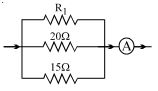
In the given circuit the current flowing through the resisitance $20$ $\mathrm{ohms}$ is $0.3$ $\mathrm{ampere}$ while the ammeter reads $0.8$ $\mathrm{ampere}.$ What is the value of $R_1$? ................ $\mathrm{ohm}$
  • A
    $30$ 
  • B
    $40$ 
  • C
    $50$ 
  • $60$ 
Answer
Correct option: D.
$60$ 
d
Total current in ammeter is $0.8 \mathrm{A}$

Current through $20\, ohm$ resistor is $0.3 \mathrm{A},$ hence the voltage across it is

$V=0.3 \times 20=6 V$

Current through $15 \,ohm$ resistor is

$I=\frac{V}{R}=\frac{6}{15}=0.4 A$

Hence current through $\mathrm{R} 1$ is, $\mathrm{I}^{\prime}=0.8-(0.3+0.4)=0.1 \mathrm{A}$

Therefore,

$R 1=\frac{V}{I^{\prime}}=\frac{6}{0.1}=60 \Omega$

View full question & answer
MCQ 2251 Mark
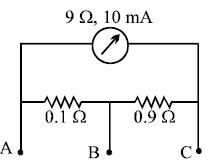
A milliammeter of range $10\, mA$ and resistance $9\, \Omega$ is joined in a circuit as shown. The meter gives full-scale deflection for current $I$ when $A$ and $B$ are used as its terminals, i.e., current enters at $A$ and leaves at $B$ ($C$ is left isolated). The value of $I$ is
  • A
    $100\, mA$
  • B
    $900\, mA$
  • $1\, A$
  • D
    $1.1\, A$
Answer
Correct option: C.
$1\, A$
c
$i_{g}=10 m A=0.01 A$

$V_{A}-V_{B}=\left(I-i_{g}\right) 0.1=i_{g}(9+0.9)$

or $I=\frac{10 \times 0.01}{0.1}=1 A$

View full question & answer
MCQ 2261 Mark
In the circuit shown the resistance of voltmeter is $10,000\, ohm$ and that of ammeter is $20\,ohm$. The ammeter reading is $0.10\,Amp$ and voltmeter reading is $12$ $\mathrm{volt}.$ Then $R$ is equal to .............. $\Omega$
  • A
    $122$
  • B
    $140$
  • C
    $116$
  • $100$
Answer
Correct option: D.
$100$
d
$\mathrm{V}=\mathrm{i}(\mathrm{r}+\mathrm{R})$

$12=0.1(20+r) \Rightarrow r=100 \Omega$

View full question & answer
MCQ 2271 Mark
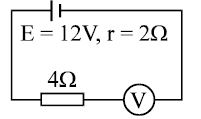
By error, a student places moving-coil voltmeter $V$ (nearly ideal) in series with the resistance in a circuit in order to read the current, as shown. The voltmeter reading will be ............ $V$
  • A
    $0$
  • B
    $4$
  • C
    $6$
  • $12$
Answer
Correct option: D.
$12$
d
So if connected in series, a very small current will flow or no current will flow. An ideal voltmeter draws $0$ current from the circuit. So when we arrange it in series, It doesn't work as a voltmeter but as resistance and also the reading is shown by the voltmeter is the voltage across its terminals.

The voltmeter reading will be $12 V$.

View full question & answer
MCQ 2281 Mark
Two identical fuses are rated at $10\,A$. If they are joined
  • A
    in parallel, the combination acts as a fuse of rating $20\,A$
  • B
    in parallel, the combination acts as a fuse of rating $5\,A$
  • C
    in series, the combination acts as a fuse of rating $10\,A.$
  • Both $(A)$ and $(C)$
Answer
Correct option: D.
Both $(A)$ and $(C)$
d
A fuse is a piece of wire resistance which acts in a way such that if the voltage in a circuit exceeds the rating of the fuse then the fuse wire melts and the circuit becomes an open circuit, thereby breaking the circuit and preventing the components from getting damaged due to short circuit. Now, if two fuses are in series, the melting of a single fuse can break the circuit and so in series the rating will be $10 \mathrm{A}$. However, in parallel, even if one fuse is melted, the other fuse still works and so the net rating will be $20 \mathrm{A}$.
View full question & answer
MCQ 2291 Mark
Consider the circuit shown in the figure
  • the current in the $5\, \Omega$ resistor is $2\, A$
  • B
    the current in the $5\, \Omega$ resistor is $1\, A$
  • C
    the potential difference $V_A - V_B$ is $10\, V$
  • D
    the potential difference $V_A- V_B$ is $5\, V$
Answer
Correct option: A.
the current in the $5\, \Omega$ resistor is $2\, A$
a
$R_{e q}=14 \Omega$

$I=\frac{28}{14}=2 A m p$

$V_{A}+3 \times 1-10 \times 1=V_{B}$

$V_{A}-V_{B}=7$ volt

View full question & answer
MCQ 2301 Mark
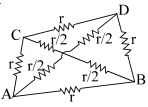
The figure shows a tetrahedron, each side of which has a resistance $r$ If a battery is connected between any two points of the tetrahedron, then identify the correct statement $(s)$.
  • A
    The potentials of the other two points are always equal.
  • B
    There always exists a branch through which no current flows.
  • C
    The current coming out of the battery in each case is same.
  • All of the above
Answer
Correct option: D.
All of the above
d
View full question & answer
MCQ 2311 Mark
The given figure shows $a$ network of resistances and $a$ battery. Identify the correct statement $(s)$
  • A
    The circuit satisfies the condition of a balanced Wheatstone bridge.
  • B
    $V_B - V_D = 0$
  • $V_B - V_D = 8$
  • D
    no current flows in the branch $BD$
Answer
Correct option: C.
$V_B - V_D = 8$
c
View full question & answer
MCQ 2321 Mark
The given figure shows $a$ network of resistances and $a$ battery. Which of the two batteries is getting charged?
  • A
    $8\,V$ battery
  • B
    $12\, V$ battery
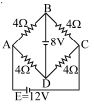
  • none
  • D
    can't be said
Answer
Correct option: C.
none
c
View full question & answer
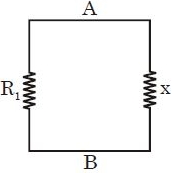
MCQ 2331 Mark
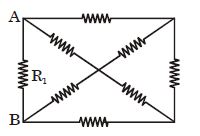
As shown, the circuit is made of $8$ different resistors. It is found that when $R_1 = 4\,\,\Omega,$ the resistance between $A$ and $B$ is $2\,\,\Omega.$ Now replace $R_1$ by a $6\,\,\Omega$ resistor, what is the resistance between $A$ and $B$?
  • A
    $1$
  • B
    $2$
  • C
    $6$
  • $2.4$
Answer
Correct option: D.
$2.4$
d
$(i)$ $\frac{\mathrm{R}_{1} \times \mathrm{x}}{\mathrm{R}_{1}+\mathrm{x}}=2$

$\Rightarrow x=4$

$(ii)$ $\mathrm{R}_{1}=6$

Now $\mathrm{R}_{\mathrm{AB}}=\frac{\mathrm{R}_{1} \times \mathrm{x}}{\mathrm{R}_{1}+\mathrm{x}}=\frac{6 \times 4}{10}=2.4$

View full question & answer
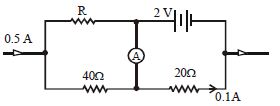
MCQ 2341 Mark
In the circuit shown in the figure, no current flows through the ideal ammeter. If the internal resistance of the cell is negligible, the value of unknown resistance $R $ is .............. $\Omega$
  • A
    $5 $
  • B
    $8$
  • $10 $
  • D
    None of these.
Answer
Correct option: C.
$10 $
c
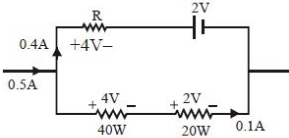
If no current flows through the ammeter $(1),$ potential on the $20 \mathrm{\,W}$ resistance becomes $2 \mathrm{\,V}.$

$\Rightarrow \mathrm{R}=\frac{4 \mathrm{V}}{0.4 \mathrm{\,A}}=10\, \Omega$

View full question & answer
MCQ 2351 Mark
Find current through the branch $ad$ of the circuit shown in figure. :-............. $A$
  • A
    $1.77$
  • B
    $0.67$
  • $1.1$
  • D
    $0$
Answer
Correct option: C.
$1.1$
c
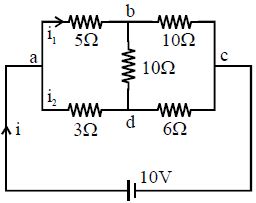
This is a balanced wheatstone bridge circuit. Therefore, we can drop $10 \,\Omega$ resistance across points band d for the further analysis of the bridge. In This case, combination of resistances in upper and lower branches are in series with equivalent resistances $15 \,\Omega$ and $9 \,\Omega$ respectively. These equivalent resistances are connected in parallel across junction $\mathrm{a}$ and $\mathrm{c}.$ Thus equivalent resistance of the circuit $-$

$\frac{1}{\mathrm{R}_{\mathrm{eq}}}=\frac{1}{15}+\frac{1}{9}$ or $\quad \mathrm{R}_{\mathrm{eq}}=\frac{(15)(9)}{15+9}=\frac{135}{24}=5.62\, \Omega$

Current through circuit i $=\frac{10}{5.62}=1.78 \mathrm{\,A}$

If current through upper and lower branches of the network are $\mathrm{i}_{1}$ and $\mathrm{i}_{2}$, then according to Kirchoff's function law $-$

$\mathrm{i}_{1}+\mathrm{i}_{2}=1.78 \mathrm{\,A}$

and $\left(\mathrm{V}_{\mathrm{a}}-\mathrm{V}_{\mathrm{b}}\right)+\left(\mathrm{V}_{\mathrm{b}}-\mathrm{V}_{\mathrm{c}}\right)=\left(\mathrm{V}_{\mathrm{a}}-\mathrm{V}_{\mathrm{d}}\right)+\left(\mathrm{V}_{\mathrm{d}}-\mathrm{V}_{\mathrm{c}}\right)$

or $\quad \mathrm{i}_{1}(5+10)^{3 / 4}\, \mathrm{i}_{2}(3.0+6.0)$ or $(15) \mathrm{i}_{1}=(9.0) \mathrm{i}_{2}$

On solving, we get $-$ $\mathrm{i}_{1}=0.67 \mathrm{\,A}$ and $\mathrm{i}_{2}=1.1 \mathrm{\,A}$

View full question & answer
MCQ 2361 Mark
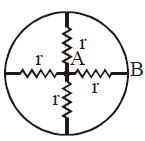
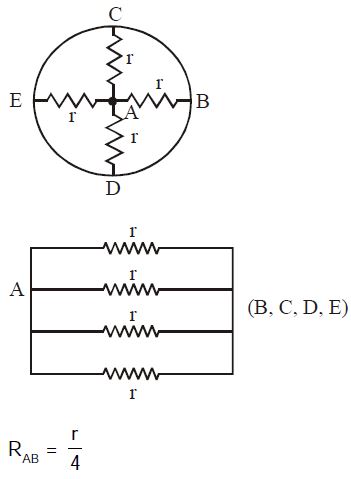
The equivalent resistance betweent point $A$ and $B$
  • A
    $4r$
  • B
    $2r$
  • C
    $r$
  • $\frac{r}{4}$
Answer
Correct option: D.
$\frac{r}{4}$
d

View full question & answer
MCQ 2371 Mark
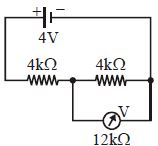
The percentage error in the reading of the voltmeter in the figure shown here is nearly ............ $\%$
  • $14$
  • B
    $28$
  • C
    $7$
  • D
    $0.71$
Answer
Correct option: A.
$14$
a
$\%$  error $=\frac{V-V^{\prime}}{V}=\frac{2-\frac{12}{7}}{2} \times 100 \Rightarrow 14 \%$
View full question & answer
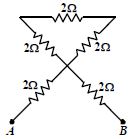
MCQ 2381 Mark
For the circuit shown in the figure , the equivalent resistance between $A$ and $B$ is ............. $\Omega$
  • A
    $10$
  • B
    $8$
  • C
    $6$
  • $4$
Answer
Correct option: D.
$4$
d
When a battery is connected between $\mathrm{A}$ and $\mathrm{B}.$ no current will pass through the upper triangle and the equivalent resistance between $\mathrm{A}$ and $\mathrm{B}$ is $4\, \Omega.$
View full question & answer
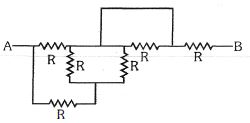
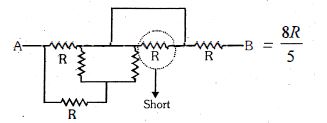
MCQ 2391 Mark
What is the equivalent resistance between  $A$ and $B$
  • $\frac{{8R}}{5}$
  • B
    $\frac{{5R}}{3}$
  • C
    $\frac{{3R}}{2}$
  • D
    $\frac{{R}}{2}$
Answer
Correct option: A.
$\frac{{8R}}{5}$
a

View full question & answer
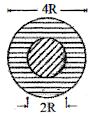
MCQ 2401 Mark
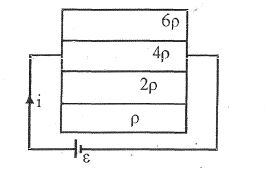
A wire of circular cross section has inner portion of radius $R$ made of material of resisitivity $\rho$ and is surrounded by an outer portion of thickness $R$ made of a material of double resisitivity. Find the resistance of length $l$ of such wire
  • A
    $\frac{{5\rho l}}{{3\pi {R^2}}}$
  • B
    $\frac{5}{{12}}\frac{{\rho l}}{{\pi {R^2}}}$
  • C
    $\frac{3}{{2}}\frac{{\rho l}}{{\pi {R^2}}}$
  • $\frac{2}{{5}}\frac{{\rho l}}{{\pi {R^2}}}$
Answer
Correct option: D.
$\frac{2}{{5}}\frac{{\rho l}}{{\pi {R^2}}}$
d
${\rm{R}} = \frac{{{{\rm{R}}_1}{{\rm{R}}_2}}}{{{{\rm{R}}_1} + {{\rm{R}}_2}}} = \frac{{\frac{{\rho  \times l}}{{\pi {{\rm{R}}^2}}} \times \frac{{2\rho  \times l}}{{\pi \left( {{{(2{\rm{R}})}^2} - {{\rm{R}}^2}} \right)}}}}{{\frac{{\rho l}}{{\pi {{\rm{R}}^2}}} + \frac{{2\rho l}}{{\left( {{{(2{\rm{R}})}^2} - {{\rm{R}}^2}} \right)}}}}$

$\frac{{\frac{{2{p^2}{l^2}}}{{3\pi {{\rm{R}}^4}}}}}{{\frac{{\rho l}}{{\pi {{\rm{R}}^2}}}\left( {1 + \frac{2}{3}} \right)}} = \frac{{2\rho {\rm{l}}}}{{3\pi {{\rm{R}}^2}}} \times \frac{3}{5}$

View full question & answer
MCQ 2411 Mark
If resistivity of all four wire connected in parallel is different as given in figure and all other dimensions of wire are same then current $i$ is (resistance of wire having resistivity $\rho $ is $R_0$ )
  • $\frac{{23\varepsilon }}{{12{R_0}}}$
  • B
    $\frac{{13\varepsilon }}{{12{R_0}}}$
  • C
    $\frac{{25\varepsilon }}{{16{R_0}}}$
  • D
    $\frac{{13\varepsilon }}{{6{R_0}}}$
Answer
Correct option: A.
$\frac{{23\varepsilon }}{{12{R_0}}}$
a
$\mathrm{R}_{0}=\frac{\rho \mathrm{L}}{\mathrm{A}}=\frac{1}{\mathrm{R}}=\frac{1}{\mathrm{R}_{0}}+\frac{1}{2 \mathrm{R}_{0}}+\frac{1}{4 \mathrm{R}_{0}}+\frac{1}{6 \mathrm{R}_{0}}$

$=\frac{12+6+3+2}{12 R_{0}}$

$R=\frac{12 R_{0}}{23} \quad i=\frac{\varepsilon}{\left(\frac{2 R_{0}}{23}\right)}=\frac{23 \varepsilon}{12 R_{0}}$

View full question & answer
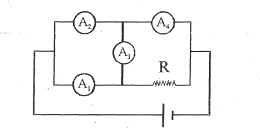
MCQ 2421 Mark
Four ammeters with identical internal resistance $r$ and a resistor $R$ are connected to a current source as given. if reading of $A_1$ and $A_2$ is $3\ A$ and $5\ A$ respectively then the reading $A_4$ is ............. $A$
  • A
    $1$
  • B
    $3$
  • C
    $5$
  • $7$
Answer
Correct option: D.
$7$
d
$\mathrm{V}_{1}=5 \mathrm{\,r}$

$\mathrm{V}_{2}=3 \mathrm{\,r}$

$\mathrm{V}_{1}-\mathrm{V}_{2}=2 \mathrm{\,r}$

curront in middle one is $2 \mathrm{\,A}$ so reading should be $7 \mathrm{\,A}$

View full question & answer
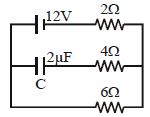
MCQ 2431 Mark
Charge on the capacitor in the given circuit in steady state condition is :- ............... $\mu C$
  • A
    $12$
  • B
    $15$
  • $18$
  • D
    $6$
Answer
Correct option: C.
$18$
c
At steady state, no current through the capacitor hence

current in circuit $=\frac{12}{8}=\frac{3}{2} \mathrm{\,A}$

$\mathrm{V}_{\mathrm{A}}-\mathrm{V}_{\mathrm{B}}=9 \mathrm{V}$

$\mathrm{q}=\mathrm{C}\left(\mathrm{V}_{\mathrm{A}}-\mathrm{V}_{\mathrm{B}}\right)$

$=2 \times 9=18\, \mu \mathrm{C}$

View full question & answer
MCQ 2441 Mark
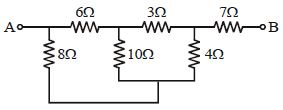
The equivalent resistance between the points $A$ and $B$ is :-
  • A
    $\frac{36}{7}\, \Omega$
  • B
    $10\,  \Omega$
  • $\frac{85}{7}\, \Omega$
  • D
    None of these
Answer
Correct option: C.
$\frac{85}{7}\, \Omega$
c
$R_{A B}=\frac{9 \times 12}{9+12}+7$

$=\frac{85}{7}$

View full question & answer
MCQ 2451 Mark
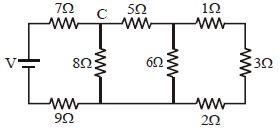
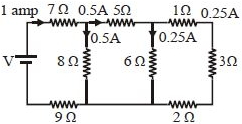
In the ladder network shown, current through the resistor $3\, \Omega$ is $0.25\,A$. The input voltage $'V'$ is equal to:- ........... $V$
  • A
    $10$
  • $20$
  • C
    $5$
  • D
    $7.2$
Answer
Correct option: B.
$20$
b
$\mathrm{R}_{\mathrm{eq}}=7+4+9=20\, \Omega$

$\mathrm{V}=\mathrm{IR}_{\mathrm{eq}}=1 \times 20=20 \mathrm{\,V}$

View full question & answer
MCQ 2461 Mark
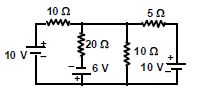
The value of current through the $20\,\Omega $ resistor is ............ $amp$
  • $0.6$
  • B
    $0.8$
  • C
    $1.2$
  • D
    $1.8$
Answer
Correct option: A.
$0.6$
a
$\frac{x-10}{10}+\frac{x+6}{20}+\frac{x}{10}+\frac{x-10}{5}=0$

$\Rightarrow \mathrm{x}=6 \mathrm{\,V}$

$\therefore \mathrm{I}_{20 \Omega}=\frac{6+6}{20}=0.6 \mathrm{\,Amp}$

View full question & answer
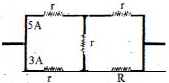
MCQ 2471 Mark
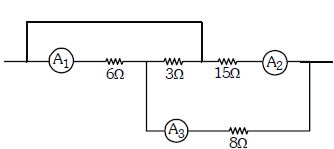
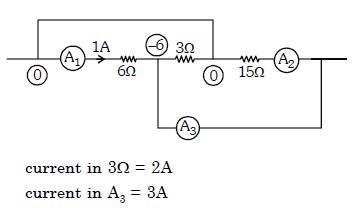
A part of circuit is shown in figure. All the ammeters are ideal. If reading of ammeter $A_1$ is $1.0\ A$ , then
  • A
    reading of $A_3$ is $2A$
  • reading of $A_3$ is $3A$
  • C
    reading of $A_2$ is $3A$
  • D
    reading of $A_2$ is $1A$
Answer
Correct option: B.
reading of $A_3$ is $3A$
b

View full question & answer
MCQ 2481 Mark
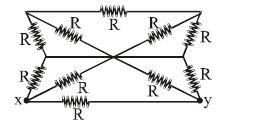
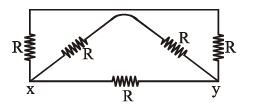
What will be equivalent resistance of circuit between $x$ and $y$ 
  • A
    $R$
  • $\frac {R}{2}$
  • C
    $\frac {8R}{3}$
  • D
    $\frac {13R}{5}$
Answer
Correct option: B.
$\frac {R}{2}$
b

View full question & answer
MCQ 2491 Mark
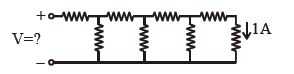
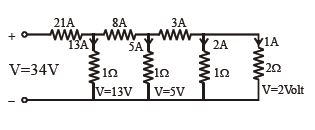
Each element in the finite chain of resistors shown in the figure is $\,1\,\Omega $ . A current of $1\, A$ flows through the final element. Then what is the potential difference $V$ across input terminals of the chain .................. $\mathrm{volt}$
  • A
    $12$
  • $34$
  • C
    $1$
  • D
    $16$
Answer
Correct option: B.
$34$
b

View full question & answer
MCQ 2501 Mark
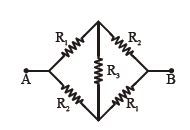
The equivalent resistance between ends $A$ and $B$ is
  • A
    Greater than $\frac{{{R_{1\,}}\, + \,{R_2}}}{2}$
  • B
    Less than $\frac{{2{R_1}{R_2}}}{{{R_{1\,}}\, + \,{R_2}}}$
  • C
     Equal to $R_3$ 
  • Depends on $R_1, R_2$ and $R_3$
Answer
Correct option: D.
Depends on $R_1, R_2$ and $R_3$
d
$\frac{2 \mathrm{R}_{1} \mathrm{R}_{2}}{\mathrm{R}_{1}+\mathrm{R}_{2}} \leq \mathrm{R}_{\mathrm{AB}} \leq \frac{\mathrm{R}_{1}+\mathrm{R}_{2}}{2}$

Also $\mathrm{R}_{\mathrm{AB}}$ depends upon $\mathrm{R}_{1}, \mathrm{R}_{2}$ and $\mathrm{R}_{3}$

View full question & answer