MCQ 1011 Mark
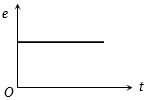
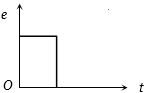
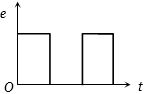
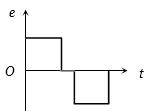
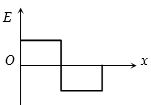
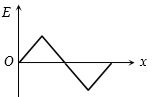
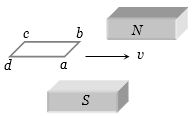
A horizontal loop $abcd$ is moved across the pole pieces of a magnet as shown in fig. with a constant speed $v$. When the edge ab of the loop enters the pole pieces at time $t = 0$ sec. Which one of the following graphs represents correctly the induced emf in the coil
Answerd
(d)When loop enters in field between the pole pieces, flux linked with the coil first increases (constantly) so a constant emf induces, when coil entered completely within the field, no flux change so $e = 0.$
When coil exit out, flux linked with the coil decreases, hence again emf induces, but in opposite direction.
View full question & answer→MCQ 1021 Mark
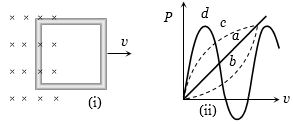
Figure $(i)$ shows a conducting loop being pulled out of a magnetic field with a speed $v$. Which of the four plots shown in figure $(ii)$ may represent the power delivered by the pulling agent as a function of the speed $v$
Answerb
(b)$P = Fv = Bil \times v = B\,\left( {\frac{{Bvl}}{R}} \right)\;l \times v = \frac{{{B^2}{v^2}{l^2}}}{R} \Rightarrow P \propto {v^2}$
View full question & answer→MCQ 1031 Mark
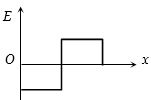
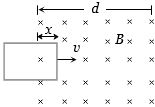
A rectangular loop is being pulled at a constant speed $v$, through a region of certain thickness $d$, in which a uniform magnetic field $B$ is set up. The graph between position $x$ of the right hand edge of the loop and the induced emf $E$ will be
Answerb
(b) As x increases so $\frac{{dB}}{{dt}}$increases i.e. induced $emf$ $(e)$ is negative. When loop completely entered in the magnetic field, emf =$0$
When it exit out $x$ increases but $\frac{{dB}}{{dt}}$ decreases i.e. $e$ is positive.
View full question & answer→MCQ 1041 Mark
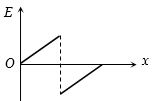
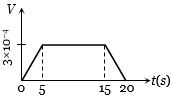
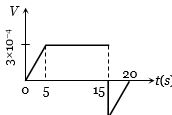
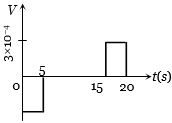
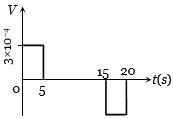
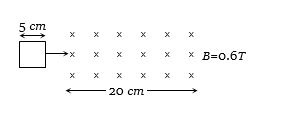
A square loop of side $5 \,cm$ enters a magnetic field with $1$ cms $-1$. The front edge enters the magnetic field at $t = 0$ then which graph best depicts emf
Answerc
(c) When loop is entering in the field, magnetic flux (i.e. ?) linked with the loop increases so induced emf in it $e = Bvl$=$0.6 \times {10^{ - 2}} \times 5 \times {10^{ - 2}} = 3 \times {10^{ - 4}}V$ (Negative) .
When loop completely entered in the field (after $5\, sec$) flux linked with the loop remains constant so $e = 0.$
After $15\, sec$, loop begins to exit out, linked magnetic flux decreases so induced emf $e = 3 \times {10^{ - 4}}V$ (Positive).
View full question & answer→MCQ 1051 Mark
The horizontal component of the earth’s magnetic field at a place is $3 × 10^{-4} T$ and the dip is . A metal rod of length $0.25\, m$ placed in the north-south position and is moved at a constant speed of $10\, cm/s$ towards the east. The emf induced in the rod will be......$ \mu V$
Answerd
(d) Rod is moving towards east, so induced $emf$ across it’s end will be $e = B_Vvl$ $ = ({B_H}\tan \phi )\,vl$
$\therefore \,e = 3 \times {10^{ - 4}} \times \frac{4}{3} \times (10 \times {10^{ - 2}}) \times 0.25 = {10^{ - 5}}V$=$10\mu V$
View full question & answer→MCQ 1061 Mark
A copper disc of radius $0.1\, m$ rotates about its centre with $10$ revolutions per second in a uniform magnetic field of $0.1$ Tesla. The emf induced across the radius of the disc is
- A
$\frac{\pi }{{10}}V$
- B
$\frac{{2\pi }}{{10}}V$
- ✓
$10\, \pi \,mV$
- D
$20\, \pi \,mV$
AnswerCorrect option: C. $10\, \pi \,mV$
c
(c) The induced $emf$ between centre and rim of the rotating disc is
$E = \frac{1}{2}B\omega {R^2} = \frac{1}{2} \times 0.1 \times 2\pi \times 10 \times {(0.1)^2} = 10\pi \times {10^{ - 3}}volt$
View full question & answer→MCQ 1071 Mark
A coil of Cu wire (radius $-r$, self inductance $-L$) is bent in two concentric turns each having radius The self inductance now
- ✓
$2L$
- B
$L$
- C
$4\, L$
- D
$L / 2$
Answera
(a) $\because$ $L \propto {N^2}r$; $\frac{{{L_1}}}{{{L_2}}} = {\left( {\frac{{{N_1}}}{{{N_2}}}} \right)^2} \times \frac{{{r_1}}}{{{r_2}}}$
==> $\frac{L}{{{L_2}}} = {\left( {\frac{1}{2}} \right)^2} \times \left( {\frac{r}{{r/2}}} \right) = \frac{1}{2}$; $L_2 = 2L$
View full question & answer→MCQ 1081 Mark
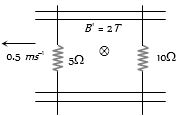
A pair of parallel conducting rails lie at right angle to a uniform magnetic field of $2.0\, T$ as shown in the fig. Two resistors $10 \Omega$ and $5 \Omega$ are to slide without friction along the rail. The distance between the conducting rails is $0.1\, m$. Then
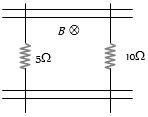
- A
Induced current directed clockwise if $10 \Omega$ resistor is pulled to the right with speed $0.5\, ms^{-1}$ and resistor is held fixed
- B
Induced current directed anti-clockwise if $10 \Omega$ resistor is pulled to the right with speed $0.5\, ms^{-1}$ and resistor is held fixed
- C
Induced current directed clockwise if $5 \Omega$ resistor is pulled to the left at $0.5 ms^{-1}$ and $10 \Omega$ resistor is held at rest
- ✓
Induced current directed anti-clockwise if $5 \Omega$ resistor is pulled to the left at $0.5 ms^{-1}$ and $10 \Omega$ resistor is held at rest
AnswerCorrect option: D. Induced current directed anti-clockwise if $5 \Omega$ resistor is pulled to the left at $0.5 ms^{-1}$ and $10 \Omega$ resistor is held at rest
d
(d) When $5\Omega $ resistor is pulled left at $0.5\, m/sec$ induced $emf.$, in the said resistor = $e = vBl = 0.5 \times 2 \times 0.1 = 0.1\,V$
Resistor $10\Omega $ is at rest so induced $emf$ in it $(e = vBl)$ be zero.
Now net $emf.$,
in the circuit $ = 0.1V$
and equivalent
resistance of the circuit
$R = 15 \Omega$
Hence current $i = \frac{{0.1}}{{15}}amp = \frac{1}{{150}}amp$
And its direction will be anti-clockwise (according to Lenz’s law)
View full question & answer→MCQ 1091 Mark
$A$ thin wire of length $2m$ is perpendicular to the $xy$ plane. It is moved with velocity $\vec v = (2\hat i + 3\hat j + \hat k)\,m/s$ through $a$ region of magnetic induction $\vec B = (\hat i + 2\hat j)\,\,Wb/{m^2}$. Then potential difference induced between the ends of the wire :........$volts$
Answera
Induced emf $\varepsilon=\int_{0}^{l}(\vec{v} \times \vec{B}) \cdot \overrightarrow{d l}=\int_{0}^{l}(\overrightarrow{d l} \times \vec{v}) \cdot \vec{B}$
$=(2 \hat{k} \times(2 \hat{i}+3 \hat{j}+\hat{k})) \cdot(\hat{i}+2 \hat{j})$
$=(-6 \hat{i}+4 \hat{j}) \cdot(\hat{i}+2 \hat{j})$
$=-6+8=2 V$
View full question & answer→MCQ 1101 Mark
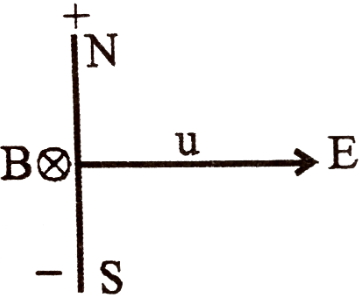
$A$ long metal bar of $30\,cm$ length is aligned along a north south line and moves eastward at a speed of $10\, ms^{-1}$. $A$ uniform magnetic field of $4.0\,T$ points vertically downwards. If the south end of the bar has a potential of $0\,V$, the induced potential at the north end of the bar is.....$V$
- ✓
$+ 12$
- B
$- 12$
- C
$0$
- D
cannot be determined since there is not closed circuit
AnswerCorrect option: A. $+ 12$
a
$e=B l v=4 \times 0.3 \times 10$
$=12$ volt
View full question & answer→MCQ 1111 Mark
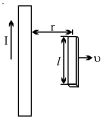
$A$ conducting rod moves with constant velocity $\upsilon$ perpendicular to the long, straight wire carrying a current $I$ as shown compute that the $emf$ generated between the ends of the rod.
- A
$\frac{{{\mu _0}\upsilon I{\text{l}}}}{{\pi {\text{r}}}}$
- ✓
$\frac{{{\mu _0}\upsilon I{\text{l}}}}{{2\pi {\text{r}}}}$
- C
$\frac{{2{\mu _0}\upsilon I{\text{l}}}}{{\pi {\text{r}}}}$
- D
$\frac{{{\mu _0}\upsilon I{\text{l}}}}{{4\pi {\text{r}}}}$
AnswerCorrect option: B. $\frac{{{\mu _0}\upsilon I{\text{l}}}}{{2\pi {\text{r}}}}$
b
The magnetic field near the conducting rod due to long current carrying wire is
$B=\frac{\mu_{0} I}{2 \pi r}\left(\text { using Ampere's law, } \int B . d l=\mu_{0} I\right)$
Now, induced emf due to moving rod is $e=B l v=\frac{\mu_{0} I}{2 \pi r} \times l v=\frac{\mu_{0} v I l}{2 \pi r}$
View full question & answer→MCQ 1121 Mark
$A$ square loop of side $a$ and resistance $R$ is moved in the region of uniform magnetic field $B$ (loop remaining completely insidefield) ,with a velocity $v$ through $a$ distance $x$ . The work done is :
- A
$\frac{{B{\ell ^2}vx}}{R}$
- B
$\frac{{2{B^2}{\ell ^2}vx}}{R}$
- C
$\frac{{4{B^2}{\ell ^2}vx}}{R}$
- ✓
Answerd
Since the loop remain completly inside the magnetic field and the area of the loop is also cons tan $t$ then induced EMF will be zero and their will be no opp sin $g$ force.
Hence the workdone is zero.
Option $D$ is correct.
View full question & answer→MCQ 1131 Mark
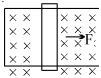
$A$ rod closing the circuit shown in figure moves along a $U$ shaped wire at a constant speed $v$ under the action of the force $F$. The circuit is in a uniform magnetic field perpendicular to the plane. Calculate $F$ if the rate of heat generation in the circuti is $Q$.
- A
$F = Qv$
- ✓
$F = \frac{Q}{v}$
- C
$F =\frac{v}{Q}$
- D
$F = \sqrt {Qv} $
AnswerCorrect option: B. $F = \frac{Q}{v}$
b
$Q=E I=(B l v) I=F v=F=\frac{Q}{v}$
View full question & answer→MCQ 1141 Mark
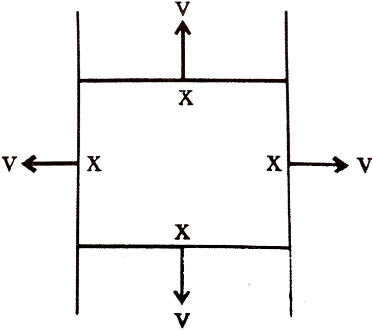
Two parallel long straight conductors lie on a smooth surface. Two other parallel conductors rest on them at right angles so as to form a square of side a initially. $A$ uniform magnetic field $B$ exists at right angles to the plane containing the conductors. They all start moving out with a constant velocity $v$. If $r$ is the resistance per unit length of the wire the current in the circuit will be
- ✓
$\frac{{Bv}}{r}$
- B
$\frac{{Bv}}{v}$
- C
$Bvr$
- D
$Bv$
AnswerCorrect option: A. $\frac{{Bv}}{r}$
a
$\frac{d \phi}{d t}=B \frac{d A}{d t}$
$=B .4 x \frac{d x}{d t}$
$e=4 B x v$
$I=\frac{e}{R}=\frac{4 B x v}{4 x r}=\frac{B v}{r}$
View full question & answer→MCQ 1151 Mark
$A$ curren of $2\,A$ is increasing at $a$ rate of $4\, A/s$ through a coil of inductance $2\,H$. The energy stored in the inductor per unit time is....$J/s$
Answerc
Potential difference across coil is $V=L \frac{d i}{d t}$
or $V=(2)(4)=8$ volt
Now energy stored per unit time
$=$power $=V i$
$=(8)(2)$
$=16 J / s$
View full question & answer→MCQ 1161 Mark
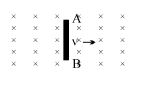
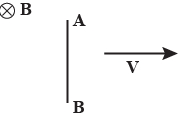
Arod $AB$ moves with a uniform velocity $v$ in a uniform magnetic field as shown in figure.
AnswerCorrect option: B. The end $A$ becomes positively charged.
b
Force on positive charges in the rod will be in direction given by $q \vec{v} \times \vec{B},$ i.e., towards $\mathrm{A}$. Hence force on electron will be in opposite direction i.e., towards $B.$ So negative charge will move towards $B.$
Therefore $B$ will be negatively charged and $A$ will be positively charged.
View full question & answer→MCQ 1171 Mark
The horizontal component of the earth’s magnetic field at a place is $3 × 10^{-4}\ T$ and the dip is $tan^{-1}(4/3)$ . A thin metal rod of length $0.25\ m$ placed in the north-south position is moved at a constant speed of $10\ cm/s$ towards the east. Find the $e.m.f.$ induced in the rod across its ends....$\mu\ V$
Answerc
$\varepsilon=\mathrm{B}_{\mathrm{v}} \ell \mathrm{v}$
$\varepsilon=\left(\mathrm{B}_{\mathrm{H}} \tan \delta\right) \ell \mathrm{v}$
$\varepsilon=3 \times 10^{-4} \times \frac{4}{3} \times 0.25 \times 10 \times 10^{-2}$
$\varepsilon=10 \times 10^{-6} \mathrm{v}=10\, \mu \mathrm{V}$
View full question & answer→MCQ 1181 Mark
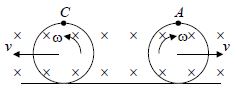
Two metallic rings of radius $R$ are rolling on a metallic rod. $A$ magnetic field of magnitude $B$ is applies in the region. The magnitude of potential difference between point $A$ and point $C$ on the two rings (as shown), will be :-
- A
$0$
- ✓
$4B \omega R^2$
- C
$8B \omega R^2$
- D
$2B \omega R^2$
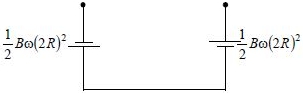
AnswerCorrect option: B. $4B \omega R^2$
b
We can consider a rolling ring as a rod of length $2R$ rotating with angular velocity $\omega .$ Drawing the circuit
View full question & answer→MCQ 1191 Mark
A thin wire of length $2\,m$ is placed perpendicular to the $x-y$ plane. It is moved with velocity $\overrightarrow v = \left( {2\hat i + 3\hat j + \hat k} \right)\,m/s$ through a region of magnetic induction $\overrightarrow B = \left( {\hat i + 2\hat j} \right)\,wb/{m^2} .$ The potential difference induced between the ends of the wire is......$volts$
Answera
${\rm{e}} = (\overrightarrow {\rm{v}} \times \overrightarrow {\rm{B}} ) \cdot \overrightarrow \ell $
$(\overrightarrow {\rm{v}} \times \overrightarrow {\rm{B}} ) = \left| {\begin{array}{*{20}{c}}
{\widehat {\rm{i}}}&{\widehat {\rm{j}}}&{\widehat {\rm{k}}}\\
2&3&1\\
1&2&0
\end{array}} \right| = - 2\widehat {\rm{i}} + \widehat {\rm{j}} + \widehat {\rm{k}}$
$\overrightarrow \ell = 2\widehat {\rm{k}}\,{\rm{m}}$
$\therefore $ $\mathrm{e}=(-2 \hat{\mathrm{i}}+\hat{\mathrm{j}}+\mathrm{k}) \cdot(2 \hat{\mathrm{k}})=2 \mathrm{\,volt}$
View full question & answer→MCQ 1201 Mark
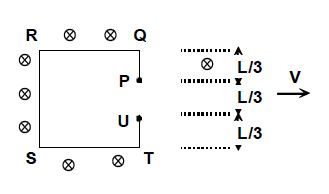
A wire frame $PQRSTU$ is moving horizontally with velocity $v$ in a uniform magnetic field $B$ acting perpendicular to its plane as shown in the figure. Choose the $INCORRECT$ statement
- ✓
the magnitude of induced emf between $P$ and $Q$ is $Bv\left( {\frac{{2L}}{3}} \right)$
- B
the magnitude of induced emf between $P$ and $Q$ is $Bv\left( {\frac{L}{3}} \right)$
- C
The electric field in the portion $RS$ of wire is non-zero
- D
The electric field in the portion $QP$ of wire is non-zero
AnswerCorrect option: A. the magnitude of induced emf between $P$ and $Q$ is $Bv\left( {\frac{{2L}}{3}} \right)$
View full question & answer→MCQ 1211 Mark
A string of length $3\ m$ and linear mass density $0.0025\ kg/m$ is fixed at both ends. One of its resonance frequency is $252\ Hz$. The next higher resonance frequency is $336\ Hz$. Then the fundamental frequency will be ..... $Hz$
Answera
$f_{n}=n f_{1}=252 \mathrm{Hz} ; f_{n+1}=(n+1) \mathrm{f}_{1}=336 \mathrm{Hz}$
Now $\frac{f_{n}}{f_{n+1}}=\frac{n}{n+1}=\frac{252}{336}$
$\Rightarrow n=3 \quad \therefore f_{1}=\frac{252}{3}=84 \mathrm{Hz}$
View full question & answer→MCQ 1221 Mark
The loop shiwn moves with a constant velocity $'V'$ in uniform magnetic field of magnetic $'B'$ directed in to the paper. The potential difference between $P$ and $Q$ is

- A
$e = \frac{3}{4}BLV,Q$ is positive with respect to $P$
- ✓
$e = \frac{1}{4}BLV,P$ is positive with respect to $Q$
- C
$e=0$
- D
$e = \frac{1}{4}BLV,Q$ is positive with respect to $P$
AnswerCorrect option: B. $e = \frac{1}{4}BLV,P$ is positive with respect to $Q$
b
The system can be assumed as the wire of length $\frac{1}{4}$ moving in the direction of the velocity shown in figure
View full question & answer→MCQ 1231 Mark
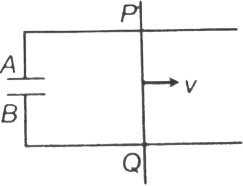
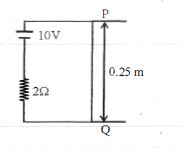
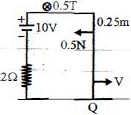
A metal wire $PQ$ slides on parallel metallic rails having separation $0.25\ m$ , each having negligible resistance .There is a $2\,\Omega $ resistor and $10\ V$ battery as shown in figure . There is a uniform magnetic field directed into the plane of the paper of magnitude $0.5\ T$ . A force of $0.5\ N$ to the left is required to keep the wire $PQ$ moving with constant speed to the right. With what speed is the wire $PQ$ moving ?........$m/s$ (Neglect self inductance of the loop)
Answerb
Induced $\mathrm{e}.$ $\mathrm{m.} \mathrm{f}.$ $=\mathrm{B} \ell \mathrm{v}=0.125 \mathrm{\,V}$
current $1=\frac{10-\mathrm{e}}{\mathrm{R}}=\frac{10-0.125 \mathrm{\,V}}{2}$
Force $B1\ell $
$=0.5\left(\frac{10-0.125 \mathrm{V}}{2}\right) 0.25=0.5 \mathrm{\,N}$ (given)
Solving $\mathrm{V}=16 \mathrm{\,m} / \mathrm{\,s}$
View full question & answer→MCQ 1241 Mark
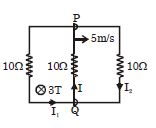
A rectangular loop has a sliding connector $PQ$ of length $2\ m$ and resistance $10\Omega $ and it is moving with a speed $5\ m/s$ as shown. The set-up is placed in a uniform magnetic field $3T$ going into the plane of the paper. The three currents $I_1$ , $I_2$ and $I$ are
- A
$I_1 = I_2 = 3A, I = 1A$
- B
$I_1 = I_2 = 5A, I = 2A$
- ✓
$I_1 = I_2 = 1A, I = 2A$
- D
$I_1 = I_2 = I = 2A$
AnswerCorrect option: C. $I_1 = I_2 = 1A, I = 2A$
c
$I=\frac{B V \ell}{15}$
$I_{1}=I_{2}=\frac{I}{2}$
View full question & answer→MCQ 1251 Mark
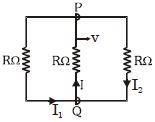
A rectangular loop has a sliding connector $PQ$ of length $l$ and resistance $R\, \Omega$ and it is moving with a speed $v$ as shown. The set-up is placed in a uniform magnetic field going into the plane of the paper. The three currents $I_1, I_2$ and $I$ are:-
- A
${I_1} = {I_2} = \frac{{Blv}}{{6R}},I = \frac{{Blv}}{{3R}}$
- B
${I_1} = {-I_2} = \frac{{Blv}}{{R}},I = \frac{{2Blv}}{{R}}$
- ✓
${I_1} = {I_2} = \frac{{Blv}}{{3R}},I = \frac{{2Blv}}{{3R}}$
- D
${I_1} = {I_2} = I = \frac{{Blv}}{R}$
AnswerCorrect option: C. ${I_1} = {I_2} = \frac{{Blv}}{{3R}},I = \frac{{2Blv}}{{3R}}$
c
$\mathrm{R}_{\mathrm{eq}}=\mathrm{R}+\mathrm{R} / 2=3 \mathrm{R} / 2$
$I=2 \frac{B \ell v}{3 R}$
$\mathrm{I}_{1}=\mathrm{I}_{2}=\frac{\mathrm{B} \ell \mathrm{v}}{3 \mathrm{R}}$
View full question & answer→MCQ 1261 Mark
The magnetic flux through a coil perpendicular to its plane and directed into paper is varying according to relation $\phi = 5t^2 + 10t + 5$ milli weber. The $e.m.f.$ induced in the loop after $5\, sec$ is .....$volt$
- A
$0.03 $
- ✓
$0.06$
- C
$0.08$
- D
$0.02 $
AnswerCorrect option: B. $0.06$
b
$\phi=\left(5 t^{2}+10 t+5\right) \times 10^{-3} \mathrm{\,Wb}$
as $\mathrm{e}=\frac{\mathrm{d} \phi}{\mathrm{dt}}$ (in magnitude)
$\frac{\mathrm{d}}{\mathrm{dt}}\left(5 \mathrm{t}^{2}+10 \mathrm{t}+5\right) \times 10^{-3} \mathrm{\,Wb} \sec ^{-1}$
$=(10 t+10) 10^{-3}$ $\mathrm{\,volt}$
$\therefore \mathrm{e}=(10 \mathrm{x} 5+10) \times 10^{-3}=0.06 \mathrm{\,volt}$
View full question & answer→MCQ 1271 Mark
A train is moving with a speed of $30\, m \,s^{-1}$ in north-south direction on the rails separated by $2 \,m$. If the vertical component of earth’s field is $8 \times 10^{-5} \,T$, the $e.m.f.$ is
- ✓
$0.0048 \,V$
- B
$0.048\, V$
- C
$0.48\, V$
- D
$4.8\, V$
AnswerCorrect option: A. $0.0048 \,V$
a
$ \mathrm{e} =\mathrm{Blv}=30 \times 2 \times 8 \times 10^{-5} $
$=0.0048 \mathrm{\,V} $
View full question & answer→MCQ 1281 Mark
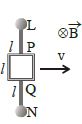
A square frame of metallic wire is moving in a uniform magnetic field $(\vec{B})$ acting perpendicular to the paper inward as shown. $LP$ and $QN$ are also metallic wires then find the potential difference between $L$ and $N$
- A
$zero$
- B
$Bv\ell $
- C
$2\,Bv\ell $
- ✓
$3\,Bv\ell $
AnswerCorrect option: D. $3\,Bv\ell $
d
$e = B\,v\,\ell _{eff}$
= $B\,v\,(3\ell )$
= $3\,B\,v\ell $
View full question & answer→MCQ 1291 Mark
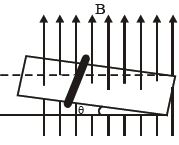
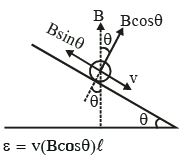
A rod of length $l$, mass $m$, and resistance $R$ slidesn without friction down parallel conducting rails as shown in Fig. The rails are connected together at the bottom. The plane of the rail makes an angle $\theta$ with the horizontal and a uniform vertical magnetic field $B$ exist throughout the region. Then the induced $emf$ in the loop, at the time the rod slides down with a speed $v$, is
- A
$B\,l\,v$
- B
$B\,l\,v\,sin\,\theta$
- ✓
$B\,l\,v\,cos\,\theta$
- D
AnswerCorrect option: C. $B\,l\,v\,cos\,\theta$
c
View full question & answer→MCQ 1301 Mark
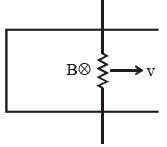
A conducting bar is pulled with a constant speed $v$ on a smooth conducting rail. The region has a steady magnetic field of induction $B$ as shown in the figure. If the speed of the bar is doubled then the rate of heat dissipation will
- A
- B
Become quarter of the initial value
- ✓
- D
Answerc
$\mathrm{E}=\mathrm{B} l v$
$\mathrm{P}=\frac{\mathrm{E}^{2}}{\mathrm{R}}=\frac{\mathrm{B}^{2} \ell^{2} \mathrm{v}^{2}}{\mathrm{R}}$
$P^{\prime}=\frac{B^{2} \ell^{2}(2 v)^{2}}{R}=4 \,P$
View full question & answer→MCQ 1311 Mark
A uniform magnetic field exists in region given by $\vec B = 3\hat i + 4\hat j + 2\hat k$. A conducting rod of length $5\,m$ is placed along $y-$ axis is moved along $x-$ axis with constant speed $1\,m/sec$. The $emf$ induced in the rod will be......$V$
Answerb
$\varepsilon = \overrightarrow l \cdot (\overrightarrow {\rm{v}} \times \overrightarrow {\rm{B}} )$
$ = 5\hat j \cdot (\hat i \times (3\hat i + 4\hat j + 5\hat k)) = 10\,\,V$
View full question & answer→MCQ 1321 Mark
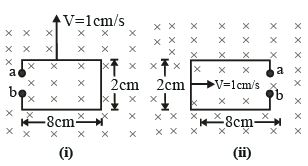
A rectangular conducting loop of sides $8\, cm$ and $2\, cm$ with a small cut is moving out a region of uniform magnetic field of magnitude $0.3\, T$ directed normal to the loop as shown in fig $(i)$ and $(ii)$. If the velocity of loop is $1\,cm\, s^{-1}$, then the ratio of voltage developed across ab in case $(i)$ to case $(ii)$ is......$V$
Answerc
In case $(i)$ $V_{1}=B \ell v \quad(\ell=8 \mathrm{\,cm})$
In case $(iii)$ $\mathrm{V}_{2}=\mathrm{B}$ $. bv$ $\quad(\mathrm{b}=2 \mathrm{\,cm})$
$\therefore \frac{\mathrm{V}_{1}}{\mathrm{V}_{2}}=\frac{\mathrm{B} \ell \mathrm{v}}{\mathrm{Bbv}}=\frac{\ell}{\mathrm{b}}=\frac{8}{2}=4$
View full question & answer→MCQ 1331 Mark
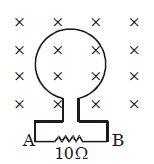
Figure shows a conducting loop placed in magnetic field. The flux through the loop changes due to change in magnetic field according to the equation $\phi = 5t - 10{t^2}$. What is direction and magnitude of induced current at $t = 0.25\, s$ ?
- A
$0.5\,A,\, A\to B$
- B
$0.5\,A,\, B\to A$
- C
$1.5\,A,\, A\to B$
- ✓
Answerd
$\mathrm{Emf}=\frac{-\mathrm{d} \phi}{\mathrm{dt}}=-[5-20 \mathrm{t}]=-\left[5-20 \times \frac{1}{4}\right]=0$
Induced current $=0$
View full question & answer→MCQ 1341 Mark
A vertical rod of length $l$ is moved with constant velocity $v$ towards east if vertical component of earth's magnetic field is $B$ and angle of dip is $\theta$ then induced $emf$ in rod
- ✓
$Blv \cot \theta$
- B
$Blv \sin \theta$
- C
$Blv \tan \theta$
- D
$Blv \cos \theta$
AnswerCorrect option: A. $Blv \cot \theta$
a
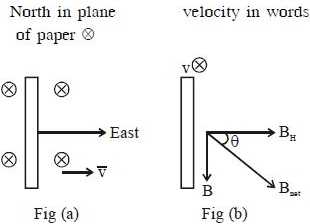
Rod moving inwards in plane of paper cutting $\mathrm{B}_{\mathrm{H}}$ at $90^{\circ}$
As shown in figure $(b)$ rod will cut horizontal component of earth's magnetic field.
Now $\tan \theta=\frac{B}{B_{H}} \Rightarrow B_{H}=B \cot \theta$
induced $\mathrm{emf}$ ${\rm{e}} = {{\rm{B}}_{\rm{H}}}{\rm{v}}\ell = {\rm{Bv}}\ell \cot \theta $
View full question & answer→MCQ 1351 Mark
A cycle wheel contains $24$ spokes of $0.5\, m$ length. It is rotated in horizontal plane with $120\, revolution/min.$ in the effect of earth magnetic field. If total magnetic field of earth is $10^4\, G$, then dynamic $emf$ across centre and rim of the wheel (angle of dip is $30^o$)
- ✓
$\frac{\pi}{4} \,volt$
- B
$\frac{\pi}{2} \,volt$
- C
$\frac{\pi}{8} \,volt$
- D
$2\pi \,volt$
AnswerCorrect option: A. $\frac{\pi}{4} \,volt$
a
$\mathrm{emf}$ will be induced due to vertical component
$\mathrm{B}_{\mathrm{v}}$ only and $\mathrm{B}_{\mathrm{v}}=\mathrm{B} \sin \delta=\mathrm{B} \sin 30^{\circ}$
$=\frac{B}{2}=\frac{1}{2}$
$10^{4}$ Gauss $=1 \mathrm{\,T}$
$\mathrm{e}=\frac{1}{2} \mathrm{B}_{\mathrm{v}} \omega \ell^{2}$
$=\frac{1}{2} \times \frac{1}{2} \times \frac{2 \pi \times 120}{60} \times\left(\frac{1}{2}\right)^{2}$
$=\frac{\pi}{4} \mathrm{\,volt}$
View full question & answer→MCQ 1361 Mark
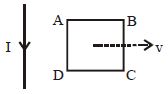
A metallic frame moves with constant velocity $v$ near a infinite length current carrying wire. At any instant induced emf in sides $AD$ and $BC$ are $5\,V$ and $2\,V$ respectively. If resistance of frame is $6\,\Omega$ then magnitude and direction of induced current in it
- A
$2\, A, ACW$
- ✓
$0.5\, A, ACW$
- C
- D
$0.5 \,A, CW$
AnswerCorrect option: B. $0.5\, A, ACW$
View full question & answer→MCQ 1371 Mark
If $B = \frac{\alpha}{t^2};$ where $\alpha$ is constant then nature of charge on plate $A$ of capacitor is
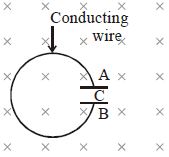
- ✓
$+ve$
- B
$-ve$
- C
- D
First $-ve$ then $+ve$
Answera
$\mathrm{e}=\mathrm{B} \ell \quad \mathrm{v} \sin 30^{\circ}$
$e=2 \times 1 \times 4 \times \frac{1}{2}=4 \mathrm{\,V}$
View full question & answer→MCQ 1381 Mark
A conducting rod $AB$ of length $l = 1\,M$ is moving at a velocity $v = 4 \,m/sec$. Making an angle $30^o$ with it's length A uniform magnetic field $B = 2\,T$ exists in a direction perpendicular to plane of motion then
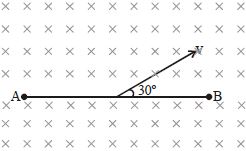
- A
$V_A -V_B = 8\,V$
- ✓
$V_A -V_B = 4\,V$
- C
$V_B -V_A = 8\,V$
- D
$V_B -V_A = 4\,V$
AnswerCorrect option: B. $V_A -V_B = 4\,V$
b
${\rm{e}} = v{\rm{B}}\ell \sin \theta $
$=4 \times 2 \times 1 \times \frac{1}{2}=4$ $\mathrm{volt}$
View full question & answer→MCQ 1391 Mark
Consider the situation shown in figure. The wire $PQ$ has a negligible reisistance and is made to slide on the three rails with a constant speed of $5\, cm/s$. Find the current in the $10\,\Omega$ resister when the switch $S$ is thrown to middle rail.......$mA$
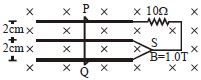
- ✓
$0.1 $
- B
$0.2$
- C
$0.4 $
- D
$0.3 $
AnswerCorrect option: A. $0.1 $
a
Induced emf in wire $\mathrm{PQ}$ will be along $2 \mathrm{\,cm}$ length because $\mathrm{p.d.}$ across middle rail and rail below the middle rail is zero.
$I=\frac{B V \ell}{R}$
$I=\frac{1 \times 5 \times 10^{-2} \times 2 \times 10^{-2}}{10}$
$\mathrm{I}=0.1 \mathrm{\,mA}$
View full question & answer→MCQ 1401 Mark
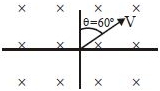
A wire of length $10\, cm$ translates in a direction making an angle of $60^o$ with its length. The plane of motion is perpendicular to a uniform magnetic field of $1.0\, T$ that exists in the space. Find the $emf$ induced between the ends of the rod if the speed of translation is $20\, cm/s.$
- ✓
$17 \times 10^{-3} \,V$
- B
$27 \times 10^{-3} \,V$
- C
$7 \times 10^{-3} \,V$
- D
$57 \times 10^{-3} \,V$
AnswerCorrect option: A. $17 \times 10^{-3} \,V$
a
$\mathrm{e} =\mathrm{Bv} \ell \sin \theta $
$=\theta=60^{\circ} $
$=1 \times 20 \times 10^{-2} \times 10 \times 10^{-2} \times \sqrt{3} / 2 $
$=17 \times 10^{-3} \mathrm{\,V} $
View full question & answer→MCQ 1411 Mark
A wire of length $10\, cm$ translates in a direction making an angle of $60^o$ with its length. The plane of motion is perpendicular to a uniform magnetic field of $1.0 \,T$ that exists in the space. Find the $emf$ induced between the ends of the rod if the speed of translation is $20\, cm/s$.
- ✓
$17 \times 10^{-3} \,V$
- B
$27 \times 10^{-3} \,V$
- C
$7 \times 10^{-3} \,V$
- D
$57 \times 10^{-3} \,V$
AnswerCorrect option: A. $17 \times 10^{-3} \,V$
a
$1=10 cm =0.1 m ; \theta=60^{\circ} ; B=1 T ; V =20 m / s =0.2 m / s$
$E = Bv 1 \sin 60^{\circ}$
As we know to take that component of length vector which is perpendicular to the velocity vector
$=1 \times 0.2 \times 0.1 \times \sqrt{3} / 2$
$=17.32 \times 10^{-3}\,V$
View full question & answer→MCQ 1421 Mark
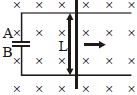
A conducting rod of length $L = 0.1\, m$ is moving with a uniform speed $v = 0.2\, m/s$ on conducting rails in a magnetic field $B = 0.5 \,T$ as shown. On one side, the end of the rails is connected to a capacitor of capacitance $C = 20\, \mu F$. Then the charges on the capacitor plates are
- A
$q_A = 0 = q_B$
- B
$q_A = +20\, \mu C$ and $q_B = -20 \, \mu C$
- ✓
$q_A = +20\, \mu C$ and $q_B = -0.2 \, \mu C$
- D
$q_A = -0.2\, \mu C$ and $q_B = -0.2 \, \mu C$
AnswerCorrect option: C. $q_A = +20\, \mu C$ and $q_B = -0.2 \, \mu C$
c
From right hand rule, we can see that
$V_{A}>V_{B}$
$\therefore q_{A}$ is positive and $q B$ negative $q=C V=C=(B v l)$
$=\left(20 \times 10^{-6}\right)(0.5)(0.1)$
$=0.2 \times 10^{-6} C=0.2 \mu C$
View full question & answer→MCQ 1431 Mark
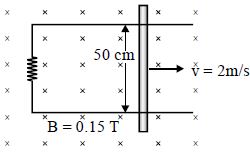
As shown in the figure a metal rod makes contact and complete the circuit. The circuit is perpendicular to the magnetic field with $B = 0.15\,tesla$ . If the resistance is $3\,\Omega $ , force needed to move the rod as indicated with a constant speed of $2\,m/sec$ is
- ✓
$3.75 \times 10^{-3}\,N$
- B
$3.75 \times 10^{-2}\,N$
- C
$3.75 \times 10^{2}\,N$
- D
$3.75 \times 10^{-4}\,N$
AnswerCorrect option: A. $3.75 \times 10^{-3}\,N$
a
Induced current in the circuit $i=\frac{B v l}{R}$ Magneticforceactingonthewire $\left.F_{m}=b i l=B \frac{B v l}{R}\right) l$
$\Rightarrow F_{m}=\frac{B^{2} v l^{2}}{R}$ External force needed to move the rod with constant velocity
$\left(F_{m}\right)=\frac{B^{2} v l^{2}}{R}=\frac{(0.15)^{2} \times(2) \times(0.5)^{2}}{3}$
$=3.75 \times 10^{-3} N$
View full question & answer→MCQ 1441 Mark
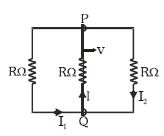
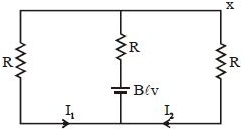
A rectangular loop has a sliding connector $PQ $of length $l$ and resistance $R\,\Omega $ and it is moving with a speed $v$ as shown. The set-up is placed in a uniform magnetic field going into the plane of the paper. The three currents $I_1$, $I_2$ and $I$ are
- A
${I_1} = {I_2} = \frac{{Blv}}{{6R}},\,I = \frac{{Blv}}{{3R}}$
- B
${I_1} = - {I_2} = \frac{{Blv}}{R},\,I = \frac{{2Blv}}{R}$
- ✓
${I_1} = {I_2} = \frac{{Blv}}{{3R}},\,I = \frac{{2Blv}}{{3R}}$
- D
${I_1} = {I_2} = \,I = \frac{{Blv}}{R}$
AnswerCorrect option: C. ${I_1} = {I_2} = \frac{{Blv}}{{3R}},\,I = \frac{{2Blv}}{{3R}}$
c
$\mathrm{R}_{\mathrm{eq}}=\mathrm{R}+\mathrm{R} / 2=3 \mathrm{R} / 2$
$I=2 \frac{B \ell v}{3 R}$
$I_{1}=I_{2}=\frac{B \ell v}{3 R}$
View full question & answer→MCQ 1451 Mark
A horizontal straight wire $20\, m$ long extending from east to west is falling with a speed of $5.0\, m/s$, at right angles to the horizontal component of the earth's magnetic field $0.30 \times 10^{-4}\, Wb/m^2$. The instantaneous value of the $e.m.f.$ induced in the wire will be.....$mV$
Answerb
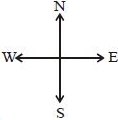
$\ell=\underset{\uparrow^{B_{x}}}{2^{B_{x}}} \,m$
Rod will cut $B_H$
$\mathrm{e}=\mathrm{B}_{\mathrm{H}} v \ell$
$\mathrm{e}=0.3 \times 10^{-4} \times 5 \times 20$
$\mathrm{e}=3\, \mathrm{m}$ $volt$
View full question & answer→MCQ 1461 Mark
The horizontal component of earth's magnetic field at a certain place is $3 \times 10^{-5}\,T$ and direction of the field is from geographic south to geographic north. A very long straigh conductor is carrying steady current of $1\,A$ then calculate the force per unit length on it if the direction of current is from east to west (In $N/m$ )
- A
$0$
- ✓
$3 \times 10^{-5}$
- C
$1.5 \times 10^{-5}$
- D
AnswerCorrect option: B. $3 \times 10^{-5}$
b
$\theta=90^{\circ}$
so $\mathrm{f}=\frac{\mathrm{f}}{\ell}=\mathrm{I} \mathrm{B} \sin \theta$
$f=1 \times 3 \times 10^{-5}$
$=3 \times 10^{-5} \,\mathrm{N} / \mathrm{m}$
View full question & answer→MCQ 1471 Mark
A jat plane is travelling towards west at a speed of $1800\, km/h$. What is the voltage difference developed between the ends of the wing having a span of $25\,m$, if the Earth's magnetic field at the location has a magnitude of $5\times10^{-4}\, T$ and the dip angle is $30^o$
- ✓
$3.125\, V$
- B
$6.250\, V$
- C
$1.44\, V$
- D
AnswerCorrect option: A. $3.125\, V$
a
Speed of the jet plane, $v=1800 \mathrm{km} / \mathrm{h}=500 \mathrm{m} / \mathrm{s}$
Wing spanof jet plane, $l=25 \mathrm{m}$ Earth's magnetic field strength, $\mathrm{B}=5.0 \times 10^{-4} \mathrm{T}$
Angle of dip, $\delta=30^{\circ}$
Vertical component of Earth's magnetic field,
$\mathrm{Bv}=\mathrm{B} \sin \delta$
$=5 \times 10^{-4} \sin 30^{\circ}$
$=2.5 \times 10^{-4} \mathrm{T}$
Voltage difference between the ends of the wing can be calculated as:
$e=\left(B_{V}\right) \times l \times v$
$=2.5 \times 10^{-4} \times 25 \times 500$
$=3.125 \mathrm{V}$
Hence, the voltage difference developed between the ends of the wings is $3.125 \mathrm{V}$
View full question & answer→MCQ 1481 Mark
A rod of length $l$ rotates with a uniform angular velocity $\omega $ about an axis passing through its middle point but normal to its length in a uniform magnetic field of induction $B$ with its direction parallel to the axis of rotation. The induced $emf$ between the two ends of the rod is
Answerb
Length of the rod between the axis of rotation and end of the rod $=\frac{\ell}{2}$
Area swept out in one rotation $=\pi\left(\frac{\ell}{2}\right)^{2}=\left(\frac{\pi \ell^{2}}{4}\right)$
Angular velocity $=\omega$ $rad$ $s^{-1}$
Frequency of revolution $=\frac{\omega}{2 \pi}$
Area swept out per second $=\frac{\pi \ell^{2}}{4}\left(\frac{\omega}{2 \pi}\right)=\frac{\ell^{2} \omega}{8}$
Magnetic induction $=\mathrm{B}$
Rate of change of magnetic flux $=\left(\frac{\mathrm{B} \ell^{2} \omega}{8}\right)$
Magnitude of induced $\mathrm{emf}$ $=\frac{\mathrm{B} \ell^{2} \omega}{8}$
Magnitude of induced $\mathrm{emf}$ between the axis and the other end is also $\left(\frac{\mathrm{B} \ell^{2} \omega}{8}\right) .$ These two $\mathrm{emf's}$ are in opposite directions. Hence, the potential difference between the two ends of the rod is zero.
View full question & answer→MCQ 1491 Mark
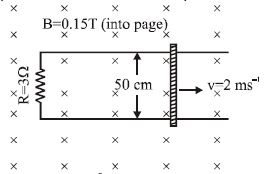
As shown in the figure, a metal rod makes contact with a partial circuit and completes the circuit. The circuit area is perpendicular to a magnetic field with $B = 0.15\, T$. If the resistance of the total circuit is $3\,\Omega $, the force needed to move the rod as indicated with a constant speed of $2\, ms^{-1}$ will be equal to:-
- ✓
$3.75\times10^{-3}\, N$
- B
$2.75\times10^{-3}\, N$
- C
$6.57\times10^{-4}\, N$
- D
$4.36\times10^{-4}\, N$
AnswerCorrect option: A. $3.75\times10^{-3}\, N$
a
The $emf$ induced in the rod causes a current to flow anticlockwise direction in the circuit. Because of this current in the rod, it experiences a force to the left due to the magnetic field. In order to pull the rod to the right with constant speed, this force must be balanced by the puller.
$F=\frac{\ell^{2} B^{2} v}{R} ;$ where $V=2 \,m / \sec$
$B=.15 \,T$
$C=50 \mathrm{cm}=.5$ $\mathrm{meter}$
$F=3.75 \times 10^{-3} \,N$
View full question & answer→MCQ 1501 Mark
The total charge induced in a conducting loop when it is moved in magnetic field depend on
- A
the rate of change of magnetic flux
- B
initial magnetic flux only
- ✓
the total change in magnetic flux and resistance
- D
AnswerCorrect option: C. the total change in magnetic flux and resistance
c
${\rm{q}} = \int {{\rm{ldt}}} = \frac{1}{{\rm{R}}}\int {\varepsilon {\rm{dt}}} = \frac{1}{{\rm{R}}}\int {\frac{{{\rm{d}}\phi }}{{{\rm{dt}}}}} {\rm{dt}} = \frac{1}{{\rm{R}}}\int {\rm{d}} \phi $
Hence total charge induced in the conducting loop depend upon the total change in magnetic flux and resistance.
View full question & answer→