MCQ 1011 Mark
A constant voltage is applied between the two ends of a uniform metallic wire. Some heat is developed in it. The heat developed is doubled if.
- A
Both the length and the radius of the wire are halved.
- ✓
Both the length and the radius of the wire are doubled.
- C
The radius of the wire is doubled.
- D
The length of the wire is doubled.
AnswerCorrect option: B. Both the length and the radius of the wire are doubled.
View full question & answer→MCQ 1021 Mark
Which of these relation holds good for an Ohmic conductor?
- A
$V-I$ relationship is non-linear.
- ✓
The straight$-$line $V-I$ graph pass through the origin.
- C
$V-I$ relationship is non-unique.
- D
$V-I$ relationship depends on the sign of $V$ for the same absolute value of $V.$
AnswerCorrect option: B. The straight$-$line $V-I$ graph pass through the origin.
The conductors which obey $Ohm’s$ law are called Ohmic conductors. The linear relationship between voltage and current for these conductors hold good. The resistance $(\text{R}=\frac{\text{V}}{\text{I}})$is independent of the current through the conductor. The magnitude of current changes linearly with voltage. Hence the $V-I$ graph for ohmic conductors is a straight line passing through the origin.
View full question & answer→MCQ 1031 Mark
What is the study of electric charges in motion called?
AnswerThe study of motion or dynamics of charges constitute an electric current. Therefore, the study of electric charges in motion is called current electricity.
View full question & answer→MCQ 1041 Mark
Identify the wrong statement describing the color code for carbon resistors.
- A
The first band indicates the first significant figure.
- B
The second band indicates the second significant figure.
- ✓
The third band indicates the third significant figure.
- D
The fourth band indicates the possible variation in the percent of the indicated value.
AnswerCorrect option: C. The third band indicates the third significant figure.
The third band indicates the power of ten with which the first and second significant figures must be multiplied to get the resistance value in ohms. All the other statements are valid.
View full question & answer→MCQ 1051 Mark
A potentiometer wire is $100\ cm$ long and a constant potential difference is maintained across it. Two cells are connected in series first to support one another and then in opposite direction. The balance points are obtained at $50\ cm$ and $10\ cm$ from the positive end of the wire in the two cases. The ratio of emf's is:
- A
$5 : 1.$
- B
$5 : 4.$
- C
$3 : 4.$
- ✓
$3 : 2.$
AnswerCorrect option: D. $3 : 2.$
View full question & answer→MCQ 1061 Mark
Potentiometer measures potential more accurately because:
- ✓
It measures potential in open circuit.
- B
It uses sensitive galvanometer for null deflection.
- C
It uses high resistance potentiometer wire.
- D
It measures potential in closed circuit.
AnswerCorrect option: A. It measures potential in open circuit.
View full question & answer→MCQ 1071 Mark
Pick out the correct statement from the following about parallel combination of resistors.
- A
The current across the resistors are the same.
- B
The resistance offered by all resistors are the same.
- ✓
The potential difference is same across each resistor.
- D
The equivalent overall resistance is larger than the largest resistor.
AnswerCorrect option: C. The potential difference is same across each resistor.
In parallel combination, the resistors are connected together at one end, and are also all connected together at the other end. So, the potential difference across the resistors will not change and thus, remains the same.
View full question & answer→MCQ 1081 Mark
Which of the following is not a valid reason for using alloys to make standard resistors?
- A
Alloys have a high value of resistivity.
- B
They are least affected by air and moisture.
- ✓
Alloys have a large temperature coefficient.
- D
Their contact potential with copper is small.
AnswerCorrect option: C. Alloys have a large temperature coefficient.
Alloys have a high value of resistivity. They have a very small temperature coefficient. So their resistance does not change appreciably even for several degrees rise of temperature. That leaves the answer $–$ alloys have a large temperature coefficient.
View full question & answer→MCQ 1091 Mark
Identify the type of conductors whose $V-I$ relationship is linear.
- A
- B
Non$-$ohmic conductors
- ✓
- D
AnswerThe conductors which obey Ohm’s law are called Ohmic conductors. The linear relationship between voltage and current for these conductors hold good.
View full question & answer→MCQ 1101 Mark
At temperature $0K,$ the germanium behaves as a/ an:
View full question & answer→MCQ 1111 Mark
Current density is a $.......$.
AnswerCurrent density is a vector quantity.
View full question & answer→MCQ 1121 Mark
Which of the following is not true for wire wound resistor?
AnswerCorrect option: A. It has a lower order of stability and reliability.
A wire wound resistor is an electrical passive component that limits current. The resistive element exists out of an insulated metallic wire that is winded around a core of non$-$conductive material. The wire material has a high resistivity, and is usually made of an alloy such as Nickel$-$chromium $($Nichrome$)$ or a copper$-$nickel$-$manganese alloy called Manganin. Common core materials include ceramic, plastic and glass. It has a lower order of stability and reliability is not true for wire wound resistor.
View full question & answer→MCQ 1131 Mark
Identify the type of conductor in which the variation of current with potential difference may depend upon the sign of the potential difference applied.
AnswerCorrect option: D. $p-n$ junction diode
p-n junction diode consists of $p-$type and $n-$type semiconductors. The $V-I$ relationship is non-linear. When a voltage is applied across junction, very little current flows for the fairly high negative voltage and a current begins to flow for much smaller positive $($forward$)$ bias. The magnitude of variation depends upon the sign of potential difference applied across it.
View full question & answer→MCQ 1141 Mark
The equation $\rightarrow ∑e = ∑IR$ is applicable to which law?
- ✓
- B
Kirchhoff’s junction rule.
- C
- D
AnswerThe equation $\rightarrow ∑e = ∑IR$ is applicable to Kirchhoff’s second law. This law is also known as Kirchhoff’s loop rule. This expression tells us that in a closed loop, the algebraic sum of the emfs is equal to the algebraic sum of the products of the resistance and currents flowing through them.
View full question & answer→MCQ 1151 Mark
Kirchoff's first law, i.e., $\sum\text{i}=0$ at a junction, deals with the conservation of:
AnswerThe principle of conservation of electric charge implies that: at any node $($junction$)$ in an electrical circuit , the sum of currents flowing into that node is equal to the sum of currents flowing out of that node. This is known as Kirchhoff's current law.
View full question & answer→MCQ 1161 Mark
Which of these is a correct definition of conventional current?
- A
Current that flows from lower potential to higher potential.
- B
The current which remains static.
- C
Current constituted by the flow of ions.
- ✓
Current that flows from higher potential to lower potential.
AnswerCorrect option: D. Current that flows from higher potential to lower potential.
The current that flows from a point at the higher $($positive$)$ potential to a point at lower $($negative$)$ potential is called conventional current. The direction of motion of positive charges is taken as the direction of electric current.
View full question & answer→MCQ 1171 Mark
$\text{E.M.F.}$ ofa cell is expressed in:
Answer$\text{E.m.f}$ of a cell is defined as the maximum potential difference across the cell when no current flows through the circuit.
View full question & answer→MCQ 1181 Mark
How many resistances are used in a Wheatstone bridge?
AnswerWheatstone bridge is an arrangement of four resistors $\text{P, Q, R,}$ and $S$, such that if we know the value of the resistances of any three of them, we can obtain the value of fourth unknown resistance. Therefore, there are $4$ resistances in a Wheatstone bridge.
View full question & answer→MCQ 1191 Mark
- ✓
The maximum potential difference between the terminals of a cell when no current is drawn from the cell.
- B
The force required to push the electrons in the circuit.
- C
The potential difference between the positive and negative terminal of a cell in a closed circuit.
- D
Less than terminal potential difference of the cell.
AnswerCorrect option: A. The maximum potential difference between the terminals of a cell when no current is drawn from the cell.
View full question & answer→MCQ 1201 Mark
$1 kWh =............. ?$
- ✓
$3.6 \times 10^6$ J
- B
$3.6 \times 10^5 J$
- C
$0.36 \times 10^6 J$
- D
$0.36 \times 10^5 J$
AnswerCorrect option: A. $3.6 \times 10^6$ J
a. $3.6 \times 10^6 J$
Explanation:
The commercial unit of electric energy is kilowatt-hour $(kWh)$.
$1 kWh =1000 Wh =3.6 \times 10^6 J=$ one unit of electricity consumed.
The electric energy used in factories, industries and houses are measured in $kWh$ .
View full question & answer→MCQ 1211 Mark
Identify the definition of sensitivity of a galvanometer from the following.
- A
Ratio of unit change in unknown resistance to the deflection in the galvanometer.
- B
Ratio of unit change in unknown resistance to twice the deflection in the galvanometer.
- ✓
Ratio of deflection in the galvanometer to the unit change in unknown resistance.
- D
Ratio of deflection in the galvanometer to half the unit change in unknown resistance.
AnswerCorrect option: C. Ratio of deflection in the galvanometer to the unit change in unknown resistance.
Sensitivity of a galvanometer is defined as ratio of deflection in the galvanometer to the unit change in unknown resistance. Sensitivity of a galvanometer can be increased by increasing the number of turns, increasing the area of the coil, or using a strong magnet.
View full question & answer→MCQ 1221 Mark
A cell of internal resistance $r$ is connected to an external resistance $R.$ The current will be maximum in $R$, if:
AnswerCorrect option: A. $\text{R}=\text{r}$
View full question & answer→MCQ 1231 Mark
Which of the following relation is significant for metals when the temperature increases?
- ✓
Resistivity increases and conductivity decreases.
- B
Resistivity decreases and conductivity decreases.
- C
Resistivity and conductivity do not change with temperature.
- D
Temperature dependence is non-linear.
AnswerCorrect option: A. Resistivity increases and conductivity decreases.
The resistivity of a metal increases and the conductivity decreases with the increase in temperature. With an increase in temperature, the free electrons collide more frequently with the metal ions. The mean collision time also decreases.
View full question & answer→MCQ 1241 Mark
Find the false statement.
AnswerCorrect option: C. Kirchhoff’s $2^{nd}$ law is applied at nodes.
Kirchhoff’s $2^{nd}$ year is applied in a closed loop. Kirchhoff’s $2^{nd}$ law supports the law of conservation of energy. This means that energy is neither created nor destroyed in the closed loop. Whatever energy enters the loop, same amount leaves the loop.
View full question & answer→MCQ 1251 Mark
The current density $($number of free electrons per $m ^3 )$ in metallic conductor is of the order of:
- A
$10^{22}$
- B
$10^{24}$
- C
$10^{26}$
- ✓
$10^{28}$
AnswerCorrect option: D. $10^{28}$
View full question & answer→MCQ 1261 Mark
A constant current i is maintained in a solenoid. Which of the following quantities will increase if an iron rod is inserted in the soleniod along axis?
- A
Magnetic field at the centre.
- B
Mangetic flux linked with the solenoid.
- C
Self-inductance of the solenoid.
- ✓
View full question & answer→MCQ 1271 Mark
Which of the following statements is false?
- A
A rheostat can be used as a potential divider.
- B
Kirchhoff's second law represents energy conservation.
- C
Wheatstone bridge is the most sensitive when all the four resistances are of the same order of magnitude.
- ✓
In a balanced wheatstone bridge if the cell and the galvanometer are exchanged, the null point is disturbed.
AnswerCorrect option: D. In a balanced wheatstone bridge if the cell and the galvanometer are exchanged, the null point is disturbed.
View full question & answer→MCQ 1281 Mark
Two solenoids have identical geometrical construction but one is made of thick wire and the other of thin wire. Which of the following quantities are different for the two solenoids?
- A
- B
Rate of Joule heating if the same current goes through them.
- C
Magnetic field energy if the same current goes through them.
- D
Time constant if one solenoid is connected to one battery and the other is connected to another battery.
Answerb. Rate of Joule heating if the same current goes through them.
d. Time constant if one solenoid is connected to one battery and the other is connected to another battery.
Explanation:
$R =\frac{\rho l }{ A }$
A - Crossectional Area
Thick wire "A" is large than thin wire.
$R_{\text {thick }}$ wire $ $p$ time constant
$p \tau=\frac{ L }{ R }$
p Power dissipatedin Heating $= I ^2 R$
View full question & answer→MCQ 1291 Mark
In the experiment of potentiometer, at balance point, there is no current in the:
- A
- ✓
- C
- D
Both main and galvanometer circuits.
View full question & answer→MCQ 1301 Mark
A metallic resistor is connected across a battery. If the number of collisions of the free electrons with the lattice is somehow decreased in the resistor (for example, by cooling it), the current will:
Answera. Increase.
Explanation:
If the number of collisions of the free electrons with the lattice is decreased, then the drift velocity of the electrons increases.
Current i is directly proportional to the drift velocity ' $V_d$ ' and is given by the following relation: $i = neAV _{ d }$
View full question & answer→MCQ 1311 Mark
A resistance $R$ is to be measured using a meter bridge. Student chooses the standard resistance $S$ to be $100 \Omega$. He finds the null point at $I _1=2.9 \ cm$. He is told to attempt to improve the accuracy. Which of the following is a useful way?
- A
He should measure $I_1$ more accurately.
- B
He should change S to $1000 \Omega$ and repeat the experiment.
- ✓
He should change $S$ to $3 \Omega$ and repeat the experiment.
- D
He should give up hope of a more accurate measurement with a meter bridge.
AnswerCorrect option: C. He should change $S$ to $3 \Omega$ and repeat the experiment.
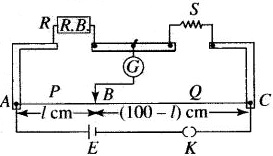 Key concept: In this problem, the concept of balanced Wheatstone bridge is to be used.
Condition of balanced wheat stone bridge: The bridge is said to be balanced if the ratio of the resistances in same branch is equal $\frac{R}{S}=\frac{I_1}{\left(100-I_1\right)}$.
Wheatstone bridge is an arrangement of four resistances which can be used to measure one unknown resistance of them in terms of rest.
The percentage error in $R$ can be minimised by adjusting the balance point near the middle of the bridge, i.e., when is close to $50 \ cm $. This requires a suitable choice of $S$.
Since, $\frac{R}{S}=\frac{I_1}{\left(100-I_1\right)}$
Since here, $R: S=2.9: 97.1$
Then the value of $S$ is nearly $33$ times to that of $R$. In order to make this ratio $1: 1$, it is necessary to reduce the value of $S$ nearly $\frac{1}{33}$ times, i.e., nearly $3 \Omega$.
View full question & answer→MCQ 1321 Mark
An Aluminium $(Al)$ rod with area of cross-section $4 \times 10^{-6} m^2$ has a current of $5$ ampere. Flowing through it. Find the drift velocity of electron in the rod. Density of $AI =2.7 \times 10^3 kg / m ^3$ and Atomic wt. $=27$. Assume that each AI atom provides one electron:
- A
$8.6 \times 10^{-4} m / s$.
- ✓
$1.29 \times 10^{-4} m / s$.
- C
$2.8 \times 10^{-2} m / s$.
- D
$3.8 \times 10^{-3} m / s$.
AnswerCorrect option: B. $1.29 \times 10^{-4} m / s$.
b. $1.29 \times 10^{-4} m / s$.
View full question & answer→MCQ 1331 Mark
The SI unit of electrical energy is $.......$?
- A
Kilojoule $(KJ)$
- ✓
Joules $(J)$
- C
Watt $(W)$
- D
Kilowatt $(KW)$
AnswerCorrect option: B. Joules $(J)$
Electric energy is defined as the total electric work done or energy supplied by the source of emf in maintaining the current in an electric circuit for a given time. The $SI$ unit of electrical energy is joule $(J).$ The commercial unit of electric energy is kilowatt$-$hour $(kWh).$
View full question & answer→MCQ 1341 Mark
Under what condition will the strength of current in a wire of resistance $R$ be the same for connection is series and in parallel of n identical cells each of the internal resistance r?
AnswerCorrect option: C. $\text{R}=\text{r}$
View full question & answer→MCQ 1351 Mark
In comparing $e.m.f.s$ of $2$ cells with the help of potentiometer, at the balance point, the current flowing through the wire is taken from:
- A
- B
- ✓
Battery in the main circuit.
- D
AnswerCorrect option: C. Battery in the main circuit.
emf of secondary cell $= I r l$
where
$I -$ current in the main circuit from battery.
$r -$ resistance per unit length of wire.
$l -$ balancing length.
View full question & answer→MCQ 1361 Mark
Consider the following two statements:
- Kirchhoff's junction law follows from conservation of charge.
- Kirchhoff's loop law follows from conservative nature of electric field.
- ✓
Both $A$ and $B$ are correct.
- B
$A$ is correct but $B$ is wrong.
- C
$B$ is correct but $A$ is wrong.
- D
Both $A$ and $B$ are wrong.
AnswerCorrect option: A. Both $A$ and $B$ are correct.
$\phi$ Kirchhoff's Junction Law follows from conservation of charge.
$\phi$ Kirchhoff's loop law fallows from conservation nature of electric field.
View full question & answer→MCQ 1371 Mark
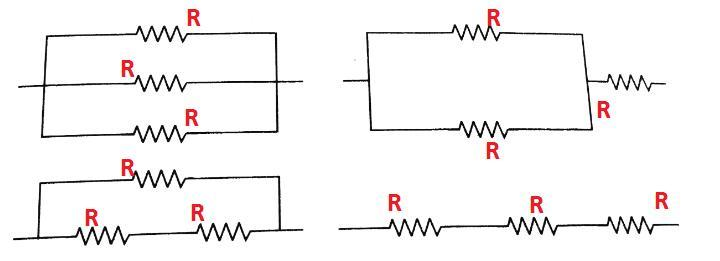
Your are given three equal resistances. In how many combinations can they be arranged?
AnswerThree equal resistances can be connected in four different combinations:
All three in parallel.
Two in parallel and third in series.
Two in series and third in parallel of both.
All three in series.
View full question & answer→MCQ 1381 Mark
In the equation $AB = C$, A is the current density, $C$ is the electric field, Then $B$ is:
View full question & answer→MCQ 1391 Mark
A potentiometer is an accurate and versatile device to make electrical measurements of $\text{E.M.F.}$ because the method involves:
- A
- ✓
A condition of no current flow through the galvanometer.
- C
A combination of cells, galvanometer and resistances.
- D
AnswerCorrect option: B. A condition of no current flow through the galvanometer.
View full question & answer→MCQ 1401 Mark
Potentiometer measures potential more accurately because
- ✓
it measures potential in the open circuit.
- B
it uses sensitive galvanometer for null deflection.
- C
it uses high resistance potentiometer wire.
- D
it measures potential in the closed circuit.
AnswerCorrect option: A. it measures potential in the open circuit.
A potentiometer has very large resistance. To read load voltage or voltage across any circuit element, potentiometer is connected parallel across it. Thus, the load voltage or circuit voltage gets applied across the potentiometer but as the resistance is very high compared to load resistance, you can safely assume their is almost no current flowing through potentiometer. As power $= VI$, the power loss in potentiometer is almost equal to zero as current through it remains zero.
View full question & answer→MCQ 1411 Mark
An electric heating element in vacuum is surrounded by a cavity at constant temperature of $227^\circ C;$ it consumes $60W$ of power to maintain a temperature of $727^\circ C$. What is the power consumed by the element to maintain a temperature of $1227^\circ C?$
- A
$101W.$
- B
$304W.$
- C
$90W.$
- ✓
$320W.$
AnswerCorrect option: D. $320W.$
View full question & answer→MCQ 1421 Mark
Which of the following is an example of an Ohmic conductor?
AnswerMost of the metals obey Ohm’s law and they are called ohmic conductors. Whereas semiconductors are non$-$ohmic. Nichrome metal is an ohmic conductor in which the $V-I$ characteristic has a straight line passing through the origin.
View full question & answer→MCQ 1431 Mark
Which of the following component is connected in parallel in the circuit?
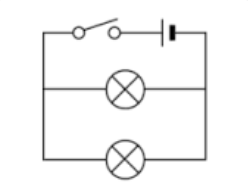
AnswerSince the current in both bulbs is not same but they have same potential so they are connected in parallel.
View full question & answer→MCQ 1441 Mark
For making standard resistance, wire of following material is used:
AnswerManganin is used to make standard resistors because
They have high value of resistivity.
Temperature coefficient of resistance is less.
They are least affected by temperature.
View full question & answer→MCQ 1451 Mark
Nichrome or Manganin is widely used in wire bound standard resistors because of their:
- A
Temperature independent resistivity.
- ✓
Very weak temperature dependent resistivity.
- C
Strong dependence of resistivity with temperature.
- D
AnswerCorrect option: B. Very weak temperature dependent resistivity.
View full question & answer→MCQ 1461 Mark
Two non ideal batteries are connected in series. Consider the following statements
$(A)$ The equivalent emf is larger than either of the two emfs.
$(B)$ The equivalent internal resistance is smaller than either of the two internal resistances.
- A
Both $A$ and $B$ are correct.
- ✓
$A$ is correct but $B$ is wrong.
- C
$B$ is correct but $A$ is wrong.
- D
Both $A$ and $B$ wrong.
AnswerCorrect option: B. $A$ is correct but $B$ is wrong.
If we add two non ideal batteries in series then.
so in case $(a)$ the equivalent $e.m.f.$ may be larger than either of two $e.m.f.$, but in case $(b)$ the equivalent $e.m.f.$ may be smaller than either of two $e.m.f.$
In series total resistance is always greater than individual resistance, whether batteries are connected in any way
[i.e. either according to case $(a)$ or case $(b)].$
View full question & answer→MCQ 1471 Mark
For measuring voltage of any circuit, potentiometer is preferred to voltmeter because:
- A
The potentiometer is cheap and easy to handle.
- B
Calibration in the voltmeter is sometimes wrong.
- ✓
The potentiometer almost draws no current during measurement.
- D
Range of the voltmeter is not as wide as that of the potentiometer.
AnswerCorrect option: C. The potentiometer almost draws no current during measurement.
View full question & answer→MCQ 1481 Mark
Predict the effect of length of conductor on drift velocity of electrons.
- A
Drift velocity varies linearly with the length of conductor.
- B
Drift velocity does not depend on the length of conductor.
- C
Drift velocity increases with the increasing length of conductor.
- ✓
Drift velocity decreases with the increasing length of conductor.
AnswerCorrect option: D. Drift velocity decreases with the increasing length of conductor.
The drift velocity of electrons decreases when the length of the conductor is increased.
Drift velocity $=\frac{\text{Potentialdifference}}{\text{(numberofelectrons×chargeofelectron×lengthofconductor×density).}}$
View full question & answer→MCQ 1491 Mark
In the absence of an electric field, the mean velocity of free electrons in a conductor at absolute temperature $(T)$ is:
- ✓
- B
Independent of $T.$
- C
Proportional to $T.$
- D
Proportional to $T2.$
View full question & answer→MCQ 1501 Mark
In a wheatstone bridge in the battery and galvanometer are interchanged then the deflection in galvanometer will:
- A
Change in previous direction.
- ✓
- C
Change in opposite direction.
- D
View full question & answer→