Questions

(Each question 2 marks)

Take a timed test

32 questions · self-marked practice — reveal the answer and mark yourself.

Question 12 Marks
Solve the inequality: $7 \leq \frac{(3 x+11)}{2} \leq 11$
Answer
We have $7 \leqslant \frac{{(3x + 11)}}{2} \leqslant 11$
$ \Rightarrow 14 \leqslant 3x + 11 \leqslant 22 \Rightarrow 3 \leqslant 3x \leqslant 11$
$ \Rightarrow 1 \leqslant x \leqslant \frac{{11}}{3}$
View full question & answer
Question 22 Marks
Solve the inequality: $-12<4-\frac{3 x}{-5} \leq 2$
Answer
Given inequality is; $-12<4-\frac{3 x}{-5} \leq 2$
$\Rightarrow-12<4-\frac{3 x}{-5} \leq 2$
$\Rightarrow$ - 12 - 4 < 4 - $\frac{3 x}{-5}$ - 4 $\le$ 2 - 4 [subtracting by 4]
$\Rightarrow-16<\frac{-3 x}{-5} \leq-2$
$\Rightarrow-16<\frac{3 x}{5} \leq-2$
Multiplying the inequality by 5.
$\Rightarrow-16 \times 5<\frac{3 x}{5} \times 5 \leq-2 \times 5$
$\Rightarrow$ -80 < 3x $\le$ -10
$\Rightarrow-\frac{80}{3}<x \leq-\frac{10}{3}$
$\therefore$ all real numbers x greater than $-\frac{80}{3}$ but less than or equal to $-\frac{10}{3}$ are a solution of given equality.
x $\in$ ($-\frac{80}{3},-\frac{10}{3}$]
View full question & answer
Question 32 Marks
Solve the inequality: $-15<\frac{3(x-2)}{5} \leq 0$
Answer
We have $ - 15 < \frac{{3(x - 2)}}{5} \leqslant 0$
$ \Rightarrow - 75 < 3(x - 2) \leqslant 0$$ \Rightarrow - 25 < x - 2 \leqslant 0$
$ \Rightarrow - 23 < x \leqslant 2$
View full question & answer
Question 42 Marks
Solve the inequality: $-3 \leq 4-\frac{7 x}{2} \leq 18$
Answer
Given inequality $-3 \leq 4-\frac{7 x}{2} \leq 18$
$\Rightarrow-3 \leq 4-\frac{7 x}{2} \leq 18$
$\Rightarrow-3-4 \leq 4-\frac{7 x}{2}-4 \leq 18-4$
$\Rightarrow-7 \leq-\frac{7 x}{2} \leq 14$
Multiplying the inequality by -2.
$\Rightarrow$ (-7) $\times$ (-2) $\geq-\frac{7 x}{2} \times(-2) \geq 14 \times$ (-2)
$\Rightarrow$ 14 $\ge$ 7x $\ge$ -28
$\Rightarrow$ -28 $\le$ 7x $\le$ 14
Dividing the inequality by 7
$\Rightarrow$ -4 $\le$ x $\le$ 2
$\therefore$ all real numbers x greater than or equal to -4 but less than or equal to 2 are the solution of given equality.
x $\in$ [-4, 2] solution set =[-4,2]
View full question & answer
Question 52 Marks
Solve the inequality: $6 \leq- 3(2x - 4) < 12$
Answer
We have $6 \leqslant - 3(2x - 4) < 12$
$ \Rightarrow 2 \geqslant (2x - 4) > - 4 \Rightarrow 2 \geqslant 2x > 0$
$ \Rightarrow 1 \geqslant x > 0 \Rightarrow 0 < x \leqslant 1$
View full question & answer
Question 62 Marks
Solve the inequality: 2 $\le$ 3x – 4 $\le$ 5
Answer
Given inequality 2 $\le$ 3x – 4 $\le$ 5
$\Rightarrow$ 2 $\le$ 3x – 4 $\le$ 5
$\Rightarrow$ 2 + 4 $\le$ 3x – 4 + 4 $\le$ 5 + 4
$\Rightarrow$ 6 $\le$ 3x $\le$ 9
$\Rightarrow$ 6/3 $\le$ 3x/3 $\le$ 9/3
$\Rightarrow$ 2 $\le$ x $\le$ 3
$\therefore$ all real numbers x greater than or equal to 2 but less than or equal to 3 are a solution of given equality.
x $\in$ [2, 3] solution set = [2,3]
View full question & answer
Question 72 Marks
Solve the inequality $x+\frac{x}{2}+\frac{x}{3}<11$ for real x.
Answer
Here $x + \frac{x}{2} + \frac{x}{3} < 11$
$ \Rightarrow \frac{{6x + 3x + 2x}}{6} < 11$
$ \Rightarrow \frac{{11x}}{6} < 11$
Multiplying both sides by 6, we have
11x < 66
Dividing both sides by 11, we have
x < 6
Thus the solution set is $\left( { - \infty ,6} \right)$
View full question & answer
Question 82 Marks
Solve the inequality 3 (2 – x) $\ge$ 2 (1 – x) for real x.
Answer
Here $3(2 - x) \geqslant 2(1 - x)$
$ \Rightarrow 6 - 3x \geqslant 2 - 2x$
$ \Rightarrow - 3x + 2x \geqslant 2 - 6$
$ \Rightarrow - x \leqslant - 4$
Dividing both sides by -1, we have
$\frac{{ - x}}{{ - 1}} < \frac{{ - 4}}{{ - 1}} \Rightarrow x \leqslant 4$
Thus the solution set is $\left( { - \infty ,4} \right]$.
View full question & answer
Question 92 Marks
Solve the inequality 3(x – 1) $\leq$ 2 (x – 3) for real x.
Answer
It is given in the question that,
3(x – 1) $\leq$ 2 (x – 3)
$\Rightarrow$ 3x – 3 $\leq$ 2x – 6
$\Rightarrow$ 3x – 3+ 3 $\leq$ 2x – 6+ 3
$\Rightarrow$ 3x $\leq$ 2x – 3
$\Rightarrow$ 3x – 2x $\leq$ 2x – 3 – 2x
$\Rightarrow$ x $\leq$ -3
$\therefore$ The solutions of the given inequality are defined by all the real numbers less than or equal to -3.
Thus, the solutions set to the given inequality are (-$\infty $, - 3]
View full question & answer
Question 112 Marks
Solve the inequality 4x + 3 < 5x + 7 for real x.
Answer
Here 4x + 3 < 5x +7, 4x - 5x < 7 - 3
$ \Rightarrow - x < 4$
Dividing both sides by -1, we have
$\frac{{ - x}}{{ - 1}} > \frac{4}{{ - 1}}$$ \Rightarrow x > - 4$
Thus the solution set is $( - 4,\infty )$
View full question & answer
Question 122 Marks
Solve the inequality $\frac{(2 x-1)}{3} \geq \frac{(3 x-2)}{4}-\frac{(2-x)}{5}$ for real x.
Answer
Here $\frac{{(2x - 1)}}{3} \geqslant \frac{{(3x - 2)}}{4} - \frac{{(2 - x)}}{5}$
$ \Rightarrow \frac{{2x}}{3} - \frac{1}{3} \geqslant \frac{{3x}}{4} - \frac{2}{4} - \frac{2}{5} + \frac{x}{5}$
$ \Rightarrow \frac{{2x}}{3} - \frac{3x}{4}-\frac{x}{5}\geqslant \ \frac{-2}{4} - \frac{2}{5} + \frac{1}{3}$
$ \Rightarrow \frac{{40x - 45x - 12x}}{{60}} \geqslant \frac{{ - 30 - 24 + 20}}{{60}}$
$ \Rightarrow \frac{{ - 17x}}{{60}} \geqslant \frac{{ - 34}}{{60}}$
Multiplying both sides by 60, we have
$ - 17x \geqslant - 34$
Dividing both sides by -17, we have
$\frac{{ - 17x}}{{ - 17}} \leqslant \frac{{ - 34}}{{ - 17}}$
$ \Rightarrow x \leqslant 2$
Thus the solution set is $\left( { - \infty ,2} \right]$
View full question & answer
Question 132 Marks
Solve the inequality $\frac{x}{4}<\frac{(5 x-2)}{3}-\frac{(7 x-3)}{5}$ for real x.
Answer
Here $\frac{x}{4} < \frac{{(5x - 2)}}{3} - \frac{{(7x - 3)}}{5}$
$ \Rightarrow \frac{x}{4} < \frac{{5x}}{3} - \frac{2}{3} - \frac{{7x}}{5} + \frac{3}{5}$ $ \Rightarrow \frac{{15x - 100x + 84x}}{{60}} < \frac{{ - 10 + 9}}{{15}}$
$ \Rightarrow \frac{{ - x}}{{60}} < \frac{{ - 1}}{{15}}$
Multiplying both sides by 60, we have
-x < -4
Dividing both sides by -1, we have
x > 4
Thus the solution set is $(4,\infty )$
View full question & answer
Question 142 Marks
Solve the inequality 37 – (3x + 5) $\ge$ 9x – 8 (x – 3) for real x.
Answer
Here $37 - (3x + 5) \geqslant 9x - 8(x - 3)$
$ \Rightarrow 37 - 3x - 5 \geqslant 9x - 8x + 24$
$ \Rightarrow 32 - 3x \geqslant x + 24$
$ \Rightarrow - 3x - x \geqslant 24 - 32$
$ \Rightarrow - 4x \geqslant - 8$
Dividing both sides by -4, we have
$\frac{{ - 4x}}{{ - 4}} \leqslant \frac{{ - 8}}{{ - 4}}$
$ \Rightarrow x \leqslant 2$
Thus the solution set is $\left( { - \infty ,2} \right]$
View full question & answer
Question 152 Marks
Solve the inequality 2 (2x + 3) – 10 < 6 (x – 2) for real x.
Answer
Here 2(2x + 3) - 10 < 6(x - 2)
$ \Rightarrow 4x + 6 - 10 < 6x - 12$
$ \Rightarrow 4x - 4 < 6x - 12$
$ \Rightarrow 4x - 6x < - 12 + 4$
$ \Rightarrow - 2x < - 8$
Dividing both sides by -2, we have
$\frac{{ - 2x}}{{ - 2}} > \frac{{ - 8}}{{ - 2}}$
$ \Rightarrow x > 4$
Thus the solution set is $(4,\infty )$
View full question & answer
Question 162 Marks
Solve the inequality $\frac{1}{2}\left(\frac{3 x}{5}+4\right) \geq \frac{1}{3}(x-6)$ for real x.
Answer
Here $\frac{1}{2}\left( {\frac{{3x}}{5} + 4} \right) \geqslant \frac{1}{3}(x - 6)$
$ \Rightarrow \frac{{3x}}{{10}} + 2 \geqslant \frac{x}{3} - 2$
$ \Rightarrow \frac{{3x}}{{10}} - \frac{x}{3} \geqslant - 2 - 2$
$ \Rightarrow \frac{{9x - 10x}}{{30}} \geqslant - 4$
$ \Rightarrow \frac{{ - x}}{{30}} \geqslant - 4$
Multiplying both sides by 30, we have
$ - x \geqslant - 120$
Dividing both sides by -1, we have
$x \leqslant 120$
Thus the solution set is $\left[ { - \infty ,120} \right]$
View full question & answer
Question 172 Marks
Solve the inequality $\frac{3(x-2)}{5} \leq \frac{5(2-x)}{3}$ for real x.
Answer
Here $\frac{{3(x - 2)}}{5} \leqslant \frac{{5(2 - x)}}{3}$
$ \Rightarrow \frac{{3x - 6}}{5} \leqslant \frac{{10 - 5x}}{3}$
$ \Rightarrow \frac{{3x}}{5} - \frac{6}{5} \leqslant \frac{{10}}{3} - \frac{{5x}}{3}$
$ \Rightarrow \frac{{3x}}{5} + \frac{{5x}}{3} \leqslant \frac{{10}}{3} + \frac{6}{5}$
$ \Rightarrow \frac{{9x + 25x}}{{15}} \leqslant \frac{{50 + 18}}{{15}}$
$ \Rightarrow \frac{{34x}}{{15}} \leqslant \frac{{68}}{{15}}$
Multiplying both sides by 15, we have
$34x \leqslant 68$
Dividing both sides by 34, we have
$x \leqslant 2$
Thus the solution set is $\left( { - \infty ,2} \right]$
View full question & answer
Question 182 Marks
Solve the inequality $\frac{x}{3}>\frac{x}{2}+1$ for real x.
Answer
Here $\frac{x}{3} > \frac{x}{2} + 1$
$ \Rightarrow \frac{x}{3} - \frac{x}{2} > 1$
$ \Rightarrow \frac{{2x - 3x}}{6} > 1$
$ \Rightarrow \frac{{ - x}}{6} > 1$
Multiplying both sides by 6, we have
-x > 6
Dividing both sides by -1, we have x < -6
Thus the solution set is $( - \infty , - 6)$
View full question & answer
Question 192 Marks
Solve 3x + 2y > 6 graphically.
Answer

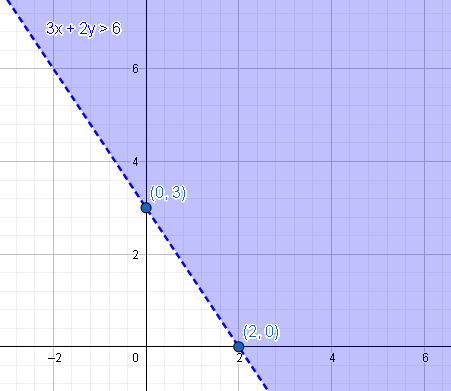
Graph of 3x + 2y = 6 is given as a dotted line in the figure.

This line divides the XY-plane into two half-planes I and II. We select a point (not on the line), say (0, 0), which lies in one of the half-planes and determine if this point satisfies the given inequality or not. we note that
3 (0) + 2 (0) > 6
$\Rightarrow$ 0 > 6, which is not true.
Hence, half-plane I is not the region of the given inequality. Clearly, any point on the line does not satisfy the given strict inequality. In other words, the shaded half-plane II excluding the points on the line is the solution region of the inequality. 

View full question & answer
Question 202 Marks
Find all pairs of consecutive odd natural number, both of which are larger than 10, such that their sum is less than 40.
Answer
Let x be the smaller of the two consecutive odd natural numbers. Then the other odd integer is x+2.
It is given that both the natural number are greater than 10 and their sum is less than 40.
$\therefore$ x > 10 and, x + x + 2 < 40
$\Rightarrow$ x > 10 and 2x < 38
$\Rightarrow$ x > 10 and x <19
$\Rightarrow$ 10 < x < 19
$\Rightarrow$ x = 11,13,15,17 [$\because$ x is an odd number]
Hence, the required pairs of odd natural number are (11, 13), (13, 15), (15, 17) and (17, 19).
View full question & answer
Question 212 Marks
The marks obtained by a student of Class XI in first and second terminal examinations are 62 and 48, respectively. Find the minimum marks he should get in the annual examination to have an average of at least 60 marks.
Answer
Let x be the marks obtained by student in the annual examination.
Average = $\frac{62+48+x}{3} \geq 60$
$\Rightarrow$ $\frac{62+48+x}{3} \geq 60$
$\Rightarrow$ 110 + x $\ge$ 60
$\Rightarrow$ x $\ge$ 70
Thus, the student must obtain a minimum of 70 marks to get an average of at least 60 marks.
View full question & answer
Question 222 Marks
Solve $\frac{3 x-4}{2} \geq \frac{x+1}{4}-1$. Show the graph of the solution on number line.
Answer
We have
$\frac{3 x-4}{2} \geq \frac{x+1}{4}-1$
$\Rightarrow$ $\frac{3 x-4}{2} \geq \frac{x-3}{4}$
$\Rightarrow$ 2 (3x – 4) $\ge$ (x – 3)
$\Rightarrow$ 6x – 8 $\ge$ x – 3
$\Rightarrow$ 5x $\ge$ 5
$\Rightarrow$ x $\ge$ 1
The graphical representation of solutions is given in the figure

View full question & answer
Question 232 Marks
Solve 7x + 3 < 5x + 9. Show the graph of the solutions on number line.
Answer
We have 7x + 3 < 5x + 9
$\Rightarrow$ 7x + 3 - 3 < 5x + 9 - 3
$\Rightarrow$ 7x < 5x + 6
$\Rightarrow$ 2x < 6
$\Rightarrow$ x < 3
The graphical representation of the solutions are given in the figure

View full question & answer
Question 242 Marks
Solve $\frac{5-2 x}{3} \leq \frac{x}{6}-5$.
Answer
We have
$\frac{5-2 x}{3} \leq \frac{x}{6}-5$
$\Rightarrow$ 2 (5 – 2x) $\leq$ x – 30
$\Rightarrow$ 10 – 4x $\leq$ x – 30
$\Rightarrow$ – 5x $\leq$ – 40,
$\Rightarrow$ x $\ge$ 8
i.e., x $\in$ [8, $\infty$).
Hence, Solution set = [8, $\infty$).
View full question & answer
Question 252 Marks
Solve 4x + 3 < 6x +7.
Answer
We have,
4x + 3 < 6x + 7
$\Rightarrow$ 4x + 3 - 3 < 6x + 7 - 3
$\Rightarrow$ 4x < 6x + 4
$\Rightarrow$ 4x – 6x < 6x + 4 – 6x
$\Rightarrow$ – 2x < 4 or x > – 2
i.e., all the real numbers which are greater than –2, are the solutions of the given inequality.
Hence, the solution set is (–2, $\infty$).
View full question & answer
Question 262 Marks
Solve - 5 $\leq \frac{5-3 x}{2} \leq$ 8.
Answer
We have - 5 $\leq \frac{5-3 x}{2} \leq 8$
$\Rightarrow$ –10 $\le$ 5 – 3x $\le$ 16
$\Rightarrow$ –10 - 5 $\le$ 5 – 3x - 5 $\le$ 16 -5
$\Rightarrow$ – 15 $\le$ – 3x $\le$ 11
$\Rightarrow$ 5 $\ge$ x $\ge$ - $\frac{11}{3}$
which can be written as $\frac{-11}{3} \leq x \leq$ 5
$\Rightarrow$ x $\in$ [ - $\frac{11}{3}$, 5]
View full question & answer
Question 272 Marks
Solve – 8 $\le$ 5x – 3 < 7.
Answer
Given that, – 8 $\le$ 5x –3 < 7
$\Rightarrow$ – 8+3 $\le$ 5x –3+3< 7+3
$\Rightarrow$ –5 $\le$ 5x < 10
$\Rightarrow$ –1 $\le$ x < 2
$\Rightarrow$ x $\in$ [-1,2)
View full question & answer
Question 282 Marks
Solve the following system of inequalities graphically
  1. x + 2y $\le$ 8
  2. 2x + y $\le$ 8
  3. x $\ge$ 0
  4. y $\ge$ 0
Answer
Given, x + 2y $\le$ 8 ... (1)
2x + y $\le$ 8... (2)
x $\ge$ 0 ... (3)
y $\ge$ 0 ... (4)
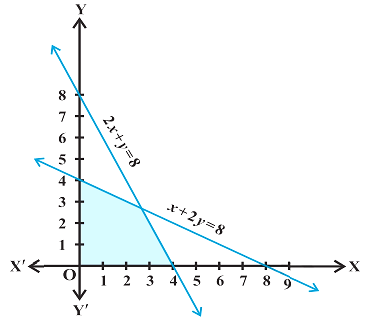
We draw the graphs of the lines x + 2y = 8 and 2x + y = 8.
The inequality (1) and (2) represent the region below the two lines, including the point on the respective lines.
Since x $\ge$ 0, y $\ge$ 0, every point in the shaded region in the first quadrant represent a solution of the given system of inequalities

View full question & answer
Question 292 Marks
Solve the following system of inequalities
  1. 8x + 3y $\le$ 100
  2. x $\ge$ 0
  3. y $\ge$ 0
Answer
Given, 8x + 3y $\leq$ 100 ..... (1)
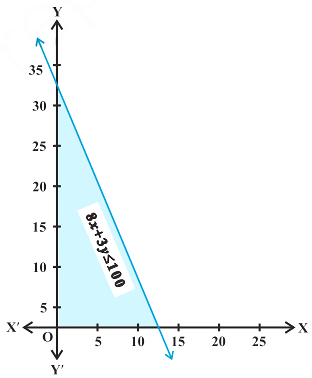
We draw the graph of the line
8x + 3y = 100
The inequality 8x + 3y ≤ 100 represents the shaded region below the line, including the points on the line 8x +3y =100

Since, x $\ge$ 0, y $\ge$ 0, every point in the shaded region in the first quadrant, including the points on the line and the axes, represents the solution of the given system of inequalities.
View full question & answer
Question 302 Marks
Solve the following system of linear inequalities graphically.
  1. x + y ≥ 5
  2. x - y $\le$ 3
Answer
Given,
x + y $\geq$ 5..... (1)
x - y $\leq$ 3..... (2)
The graph of linear equation
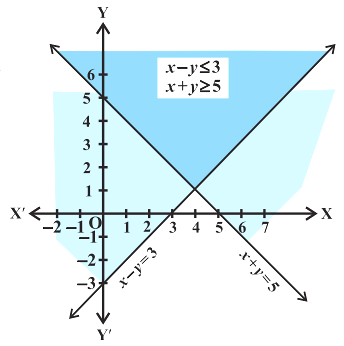
x + y = 5 is drawn in the figure

We note that the solution of inequality (1) is represented by the shaded region above the line x + y = 5, including the points on the line.
On the same set of axes, we draw the graph of the equation x – y = 3 as shown in the figure. Then we note that inequality (2) represents the shaded region above the line x – y = 3, including the points on the line.
Clearly, the double shaded region, common to the above two shaded regions is the required solution region of the given system of inequalities.
View full question & answer
Question 312 Marks
Solve y < 2 graphically.
Answer
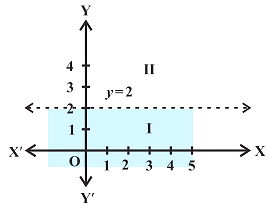
Graph of y = 2 is given in the figure

Line y = 2 divides XY-plane in two half. plane I and plane $\parallel$ Let us select a point, (0, 0) in lower half-plane I and putting y = 0 in the given inequality, we see that
1 × 0 < 2 or 0 < 2 which is true.
Thus, the solution region is the shaded region below the line y = 2.
Hence, every point below the line (excluding all the points on the line) determines the solution of the given inequality.

View full question & answer
Question 322 Marks
Solve 3x - 6 $\geq$ 0 graphically in two dimensional plane.
Answer

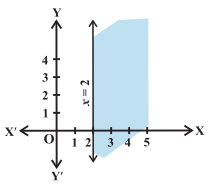
Graph of 3x – 6 = 0 is given in the Fig.
We select a point, say (0, 0) and substituting it in ṁgiven inequality, we see that:
3 (0) - 6 $\geq$ 0 or -6 $\geq$ 0 which is false.
Thus, the solution region is the shaded region on the right hand side of the line x = 2

View full question & answer