Questions

(Each question 2 marks)

Take a timed test

55 questions · self-marked practice — reveal the answer and mark yourself.

Question 12 Marks
Find the value of p so that three lines 3x + y - 2 = 0, px + 2y - 3 = 0 and 2x - y - 3 = 0 may intersect at one point.
Answer
The equation of lines are
3x + y - 2 = 0, px + 2y - 3 = 0 and 2x - y - 3 = 0.
We know that three lines are concurrent if
${a_3}({b_1}{c_2} - {b_2}{c_1}) + {b_3}({c_1}{a_2} - {c_2}{a_1})$$ + {c_3}({a_1}{b_2} - {a_2}{b_1}) = 0$
$\therefore 2[1 \times ( - 3) - 2 \times ( - 2)] + ( - 1)[ - 2$$ \times p - ( - 3) \times 3] + ( - 3)[3 \times 2 - p \times 1] = 0$
$ \Rightarrow 2[ - 3 + 4] - 1[ - 2p + 9] - 3[6 - p] = 0$
$ \Rightarrow 2 + 2p - 9 - 18 + 3p = 0$
$ \Rightarrow 5p - 25 = 0 \Rightarrow p = 5$.
View full question & answer
Question 22 Marks
Find the equation of the line parallel to y-axis and drawn through the point of intersection of the lines x - 7y + 5 = 0 and 3x + y = 0
Answer
Point of intersection of lines x - 7y + 5 = 0 and 3x + y = 0 obtained by solving these equations has coordinates.
$\therefore x = \frac{{ - 5}}{{22}}$ and $y = \frac{{15}}{{22}}$.
Since the required line is parallel to y-axis, so the equation of required line is
$x = \frac{{ - 5}}{{22}}$.
View full question & answer
Question 32 Marks
What are the points on the y-axis whose distance from the line $\frac{x}{3} + \frac{y}{4} = 1$ is 4 units.
Answer
Let point on y-axis be (0, y).
The given equation of line is $\frac{x}{3} + \frac{y}{4} = 1$.
$ \Rightarrow 4x + 3y = 12$ $ \Rightarrow 4x + 3y - 12 = 0$
Now perpendicular distance from point (0, y) to line 4x + 3y - 12 = 0 is
$\left| {\frac{{4 \times 0 + 3y - 12}}{{\sqrt {{{(4)}^2} + {{(3)}^2}} }}} \right| = \left| {\frac{{3y - 12}}{{\sqrt {25} }}} \right| = \left| {\frac{{3y - 12}}{5}} \right|$
It is given that
$\left| {\frac{{3y - 12}}{5}} \right| = 4 \Rightarrow \left| {\frac{{3y - 12}}{5}} \right| = \pm 4$
When $\frac{{3y - 12}}{5} = 4$ $ \Rightarrow 3y - 12 = 20 \Rightarrow y = \frac{{32}}{3}$
When $\frac{{3y - 12}}{5} = - 4$$ \Rightarrow 3y - 12 = - 20 \Rightarrow y = \frac{{ - 8}}{3}$
Thus required points are $\left( {0,\frac{{32}}{3}} \right)$ and $\left( {0,\frac{{ - 8}}{3}} \right)$.
View full question & answer
Question 42 Marks
Find the values of $\theta $ and p, if the equation $x\cos \theta + y\sin \theta = p$ is the normal form of the line $\sqrt 3 x + y + 2 = 0$
Answer
Here $\sqrt 3 x + y + 2 = 0$
$ \Rightarrow \sqrt 3 x + y = - 2 \Rightarrow - \sqrt 3 x - y = 2$
Dividing both sides by $\sqrt {{{( - \sqrt 3 )}^2} + {{( - 1)}^2}} = 2$, we have
$\frac{{ - \sqrt 3 }}{2}x - \frac{1}{2}y = 1$
Put $\cos \alpha = \frac{{ - \sqrt 3 }}{2}$ and $\sin \alpha= \frac{{ - 1}}{2}$
$ \Rightarrow \alpha $ lies in 3rd quadrant
$\therefore \cos \alpha = \frac{{ - \sqrt 3 }}{2} = - \cos 30^\circ $ = cos (180° + 30° )
$ \Rightarrow \alpha = 210^\circ $
$\therefore $ Equation of line in normal form is
$x\cos \frac{{7\pi }}{6} + y\sin \frac{{7\pi }}{6} = 1$
Comparing it with x cos $\alpha + y\ sin \alpha = p$, we have
$\alpha = \frac{{7\pi }}{6}$ and p = 1
View full question & answer
Question 52 Marks
Find the angles between the lines $\sqrt 3 x + y = 1$ and $x + \sqrt 3 y = 1$
Answer
We have $\sqrt 3 x + y = 1$
$\Rightarrow y = - \sqrt 3 x + 1$
$\therefore {m_1} = - \sqrt 3$
Also $x + \sqrt 3 y = 1$
$\Rightarrow \sqrt 3 y = - x + 1$
$\Rightarrow y = \frac{{ - 1}}{{\sqrt 3 }}x + \frac{1}{{\sqrt 3 }}$
$\therefore {m_2} = \frac{{ - 1}}{{\sqrt 3 }}$
Let $\theta$ be the angle between the lines. Then,
$\tan \theta = \left| {\frac{{ - \sqrt 3 + \frac{1}{{\sqrt 3 }}}}{{1 + ( - \sqrt 3 )\left( {\frac{{ - 1}}{{\sqrt 3 }}} \right)}}} \right| = \left| {\frac{{\frac{{ - 3 + 1}}{{\sqrt 3 }}}}{{1 + 1}}} \right|$$= \left| {\frac{{ - 2}}{{\sqrt 3 }} \times \frac{1}{2}} \right| = \left| {\frac{{ - 1}}{{\sqrt 3 }}} \right| = \frac{1}{{\sqrt 3 }}$
$\tan \theta = \tan 30^\circ$ and $\tan (180^\circ - 30^\circ )$
$\Rightarrow \theta = 30^\circ$ and 150°
View full question & answer
Question 62 Marks
Find the equation of the line perpendicular to the line x - 7y + 5 = 0 and having x intercept 3.
Answer
Equation of any line which is perpendicular to the line
x - 7y + 5 = 0 is 7x + y + k = 0
Since this line passes through point (3, 0)
$\therefore 7 \times 3 + 0 + k = 0 \Rightarrow $ k = -21
Thus equation of required line is 7x + y - 21 = 0
View full question & answer
Question 72 Marks
Find the distance between parallel lines. l(x + y) + p = 0 and l(x + y) - r = 0
Answer
We have the equation,
$\mathrm{l} x+\mathrm{l} y+\mathrm{p}=0$
$\text { and } \mathrm{l} x+\mathrm{l} y-\mathrm{r}=0$
$\text { where } \mathrm{a}=1, \mathrm{~b}=1, \mathrm{c}_1=\mathrm{p} \text { and } \mathrm{c}_2=-\mathrm{r}$
$\therefore$ The distance between two parallel lines
d = $\frac{{\left| {{c_1} - {c_2}} \right|}}{{\sqrt {{a^2} + {b^2}} }}$
$\Rightarrow \frac{{\left| {p + r} \right|}}{{\sqrt {{1^2} + {1^2}} }}$
$\Rightarrow \frac{1}{{\sqrt 2 }}\left| {\frac{{p + r}}{1}} \right|$ units
View full question & answer
Question 82 Marks
Find the distance between parallel lines. 15x + 8y - 34 = 0 and 15 x + 8y + 31 = 0
Answer
The given equations are
15x + 8y - 34 = 0
and 15 x + 8y + 31 = 0
where $a = 15, b = 8, c_1 = -34$ and $c_2 = 31$
$\therefore$ The distance between two parallel lines
$d = \frac{{\left| {{c_1} - {c_2}} \right|}}{{\sqrt {{a^2} + {b^2}} }}$
$\Rightarrow \frac{{\left| { - 34 - 31} \right|}}{{\sqrt {{{(15)}^2} + {{(8)}^2}} }}$
$\Rightarrow$ $\frac{{65}}{{17}}$ units
View full question & answer
Question 92 Marks
Find the distance of the point (-1, 1) from the line 12 (x + 6) = 5(y - 2).
Answer
Here given line is 12(x + 6) = 5(y - 2)
$\Rightarrow$ 12x + 72 = 5y - 10 $\Rightarrow$ 12x - 5y + 82 = 0
$\therefore$ Perpendicular distance of the point (-1, 1) from the line 12x - 5y + 82 = 0 is
$\left| {\frac{{12( - 1) - 5(1) + 82}}{{\sqrt {{{(12)}^2} + {{( - 5)}^2}} }}} \right| = \left| {\frac{{ - 12 - 5 + 82}}{{\sqrt {144 + 25} }}} \right| = \left| {\frac{{65}}{{13}}} \right|$ = 5 units.
View full question & answer
Question 102 Marks
Reduce the equation x - y = 4 into normal form. Find their perpendicular distance from the origin and angle between perpendicular and the positive X-axis.
Answer
Here x - y = 4
Dividing both sides by $\sqrt {{{(1)}^2} + {{( - 1)}^2}} = \sqrt 2$ we have
$\frac{x}{{\sqrt 2 }} - \frac{y}{{\sqrt 2 }} = \frac{4}{{\sqrt 2 }} \Rightarrow \frac{1}{{\sqrt 2 }}x - \frac{1}{{\sqrt 2 }}y = 2\sqrt 2$
Put $\cos \alpha = \frac{1}{{\sqrt 2 }}$ and $\sin \alpha = \frac{{ - 1}}{{\sqrt 2 }}$
$\Rightarrow \alpha$ lies in IVth quadrant.
$\therefore \cos \alpha = \frac{1}{{\sqrt 2 }} = \cos \left( {2\pi - \frac{\pi }{4}} \right) \Rightarrow \alpha = \frac{{7\pi }}{4}$
$\therefore$ Equation of line in normal form is
$x\cos \frac{{7\pi }}{4} + y\sin \frac{{7\pi }}{4} = 2\sqrt 2$
Comparing it with $x\cos \alpha + y\sin \alpha = p$, we have
$\alpha = \frac{{7\pi }}{4}$ and $p = 2\sqrt 2$
View full question & answer
Question 112 Marks
Reduce the equation y - 2 = 0 into normal form. Find their perpendicular distance from the origin and angle between perpendicular and the positive X-axis.
Answer
Here y - 2 = 0
$\Rightarrow$ y = 2 $\Rightarrow$ 0x + y = 2
Dividing both sides by $\sqrt {{{(0)}^2} + {{(1)}^2}} = 1$ we have
0x + y = 2
Put $\cos \alpha = 0$ and $\sin \alpha = 1$
$\Rightarrow \alpha = \frac{\pi }{2}$
$\therefore$ Equation of line in normal form is
$x\cos \frac{\pi }{2} + y\sin \frac{\pi }{2} = 2$
Comparing it with $x\cos \alpha + y\sin a = p,$ we have
$\alpha = \frac{\pi }{2}$ and p = 2
View full question & answer
Question 122 Marks
Reduce the equation $x-\sqrt{3} y+8=0$ into normal form. Find the perpendicular distance from the origin and angle between the perpendicular and the positive X-axis.
Answer
Any equation of the form ax + by + c = 0 can be converted into normal form (x cos$\alpha$ + y sin$\alpha$ = p) dividing each term by $\sqrt{a^{2}+b^{2}}$ i.e.,
$\frac{a}{\sqrt{a^{2}+b^{2}}} x+\frac{b}{\sqrt{a^{2}+b^{2}}} y=\frac{c}{\sqrt{a^{2}+b^{2}}}$
Given equation of line is
$x-\sqrt{3} y+8=0$
$\Rightarrow \quad x-\sqrt{3} y=-8$
$\Rightarrow \quad-x+\sqrt{3} y=8$ ...(ii)
Now, divide by $\sqrt{(\text { coefficient of } x)^{2}+(\text { coefficient of } y)^{2}}$ = $\sqrt{(-1)^{2}+(\sqrt{3})^{2}}=\sqrt{1+3}=2,$ we get
$-\frac{1}{2} x+\frac{\sqrt{3}}{2} y=\frac{8}{2}$
$\Rightarrow-\cos 60^{\circ} x+\sin 60^{\circ} y=4[\because$ convert in form of $x \cos \alpha+y \sin \alpha=p]$
[ $\because \cos x$ is negative and $\sin x$ is positive, it is possible in second quadrant]
$\Rightarrow x \cos \left(180^{\circ}-60^{\circ}\right)+y \sin \left(180^{\circ}-60^{\circ}\right)=4$
$\Rightarrow x \cos 120^{\circ}+y \sin 120^{\circ}=4$
${\left[\because \cos \left(180^{\circ}-\theta\right)=-\sin \theta \text { and } \sin \left(180^{\circ}-\theta\right)=\cos \theta\right]}$
On comparing with $x \cos \alpha+y \sin \alpha=p$, we get
$\alpha=120^{\circ}, p=4$
View full question & answer
Question 132 Marks
Reduce the given equation into the intercept form and find the intercept on the axis. 3 y + 2 = 0
Answer
Here 3 y + 2 = 0
$\Rightarrow 3y = - 2$
$ \Rightarrow \frac{{3y}}{{ - 2}} = 1 \Rightarrow \frac{{0x}}{{ - 2}} + \frac{{3y}}{{ - 2}} = 1 \Rightarrow \frac{{0x}}{{ - 2}} + \frac{y}{{\frac{{ - 2}}{3}}} = 1$
which is required intercept form.
Comparing it with $\frac{x}{a} + \frac{y}{b} = 1$ we have
a = 0 and b = -2/3.
View full question & answer
Question 142 Marks
Reduce the given equation into the intercept form and find the intercept on the axis. 4x - 3y = 6
Answer
Here 4x - 3y = 6
$\Rightarrow \frac{{4x}}{6} - \frac{{3y}}{6} = 1 \Rightarrow \frac{{2x}}{3} - \frac{y}{2} = 1]$$\Rightarrow \frac{x}{{\frac{3}{2}}} + \frac{y}{{ - 2}} = 1$
which is required intercept form,
Comparing it with $\frac{x}{a} + \frac{y}{b} = 1$, we have
$a = \frac{3}{2}$ and b = -2
View full question & answer
Question 152 Marks
Reduce the given equation into the intercept form and find the intercept on the axis.
3x + 2y - 12 = 0
Answer
Here 3x + 2y - 12 = 0
$\Rightarrow$ 3x + 2y = 12
$\Rightarrow \frac{{3x}}{{12}} + \frac{{2y}}{{12}} = 1 \Rightarrow \frac{x}{4} + \frac{y}{6} = 1$
which is required intercept form.
Comparing it with $\frac{x}{a} + \frac{y}{b} = 1$, we have
a = 4 and b = 6
View full question & answer
Question 162 Marks
Find the equation of the right bisector of the line segment joining the points (3, 4) and (-1, 2).
Answer
Mid point of the line segment joining the points (3, 4) and (-1, 2) is $\left( {\frac{{3 - 1}}{2},\frac{{4 + 2}}{2}} \right)$ i.e. (1, 3).
Slope of the line joining points (3, 4) and (-1, 2)
$= \frac{{2 - 4}}{{ - 1 - 3}} = \frac{{ - 2}}{{ - 4}} = \frac{1}{2}$
$\therefore$ Slope of the required line is -2.
Thus the required line passes through point (1, 3) having slope -2.
$\therefore$ Equation of required line is y - 3 = -2(x - 1) $\Rightarrow$ y - 3 = -2x + 2 $\Rightarrow$ 2x + y - 5 = 0.
View full question & answer
Question 172 Marks
Prove that the line through the point $\left(x_1, y_1\right)$ and parallel to the line $A x+B y+C=0$ is $A\left(x-x_1\right)+B\left(y-y_1\right)=0$.
Answer
Equation of the line parallel to line $A x+B y+C=0$ is $A x+B y+K=0 \ldots$ (i)
Since line (i) passes through ( $\mathrm{x}_1, \mathrm{y}_1$ )
$A x_1+B y_1+K=0 \ldots \text { (ii) }$
Subtracting (ii) from (i), we have
$A\left(x-x_1\right)+B\left(y-y_1\right)=0$
View full question & answer
Question 182 Marks
The line through the points (h, 3) and (4, 1) intersects the line 7x - 9y - 19 = 0 at right angle. Find the value of h.
Answer
Slope of the line passing through the points (h, 3) and (4, 1) is
$= \frac{{1 - 3}}{{4 - h}} = \frac{{ - 2}}{{4 - h}}$
Also slope of the line 7x - 9y - 19 = 0 is $\frac{7}{9}$
Since two lines are perpendicular to each other
$\therefore \frac{{ - 2}}{{4 - h}} \times \frac{7}{9} = - 1 \Rightarrow \frac{{ - 14}}{{36 - 9h}} = - 1$ $\Rightarrow$ -14 = -36 + 9h
$\Rightarrow$ 9h = 36 - 14 $\Rightarrow h = \frac{{22}}{9}$
View full question & answer
Question 192 Marks
Find the equation of the line which satisfy the given condition:
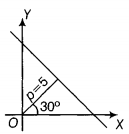
Perpendicular distance from the origin is 5 units and the angle made by the perpendicular with the positive X-axis is $30^{\circ}$.
Answer
Here, p = 5  and $\alpha$ = $30^o$

So, equation of line in normal form is
x cos$\alpha$ + y sin$\alpha$ = p
$\therefore x \cos 30^{\circ}+y \sin 30^{\circ}=5$
$\Rightarrow \quad \frac{\sqrt{3}}{2} x+\frac{1}{2} y=5$
$\Rightarrow \quad \sqrt{3} x+y=10$
View full question & answer
Question 202 Marks
Find the equation of the line which satisfy the given condition:
The line passing through the points (-1, 1) and (2, - 4).
Answer
Given points are $A(x_1, y_1) = (-1, 1)$ and $B(x_2, y_2) = (2, -4)$, then equation of line AB is
$y-y_{1}=\frac{y_{2}-y_{1}}{x_{2}-x_{1}}\left(x-x_{1}\right)$
$\Rightarrow \quad y-1=\frac{-4-1}{2+1}(x+1)$$\left[\because x_{1}=-1, y_{1}=1, x_{2}=2, y_{2}=-4\right]$
$\Rightarrow \quad y-1=\frac{-5}{3}(x+1) \Rightarrow 3 y-3=-5 x-5$
$\Rightarrow$ 5x + 3y + 2 = 0
View full question & answer
Question 212 Marks
Find the equation of the line which satisfy the given condition:
The line intersecting the y-axis at a distance of 2 units above the origin and making an angle of 30° with positive direction of the x-axis.
Answer
Here m = tan 30° = $\frac{1}{{\sqrt 3 }}$ and c = 2
Putting these values in y = mx + c, we have
$y = \frac{1}{{\sqrt 3 }}x + 2 \Rightarrow x - \sqrt 3 y + 2\sqrt 3 = 0$
View full question & answer
Question 222 Marks
Find the equation of the line which satisfy the given condition:
The line intersecting the X-axis at a distance of 3 units to the left of origin with slope -2.
Answer
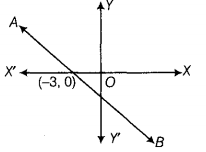
Given, the line intersecting the $X$-axis to the left of the origin. It means it intersect the negative $X$-axis. Clearly, line $A B$ passes through the point $(-3,0)$ and $m=-2$.
Equation of line in point slope from is
$y-y_1=m\left(x-x_1\right) \Rightarrow y-0=-2(x+3)$
$\Rightarrow y=-2 x-6$
$\Rightarrow 2 x+y+6=0$

View full question & answer
Question 232 Marks
Find the equation of the line which satisfy the given conditions:
Passing through $(2,2 \sqrt{3})$ and inclined with the x-axis at an angle of $75^o$.
Answer
It is given that the point $=(2,2 \sqrt{ } 3)$ and angle $\theta=75^{\circ}$
Equation of line: $\left(y-y_1\right)=m\left(x-x_1\right)$
where, $\mathrm{m}=$ slope of line $=\tan \theta$ and $\left(\mathrm{x}_1, \mathrm{y}_1\right)$ are the points through which line passes
$\therefore \mathrm{m}=\tan 75^{\circ}$
$75^{\circ}=45^{\circ}+30^{\circ}$ Applying the formula: $\tan (A+B)=\frac{\tan A+\tan B}{1-\tan A \cdot \tan B}$
$\tan \left(45^{\circ}+30^{\circ}\right)=\frac{\tan 45^{\circ}+\tan 30^{\circ}}{1-\tan 45^{\circ} \cdot \tan 30^{\circ}}=\frac{1+\frac{1}{\sqrt{3}}}{1-\frac{1}{\sqrt{3}}}$
$\tan 75^{\circ}=\frac{\sqrt{3}+1}{\sqrt{3}-1}$
Rationalizing we obtaintan $75^{\circ}=\frac{3+1+2 \sqrt{3}}{3-1}=2+\sqrt{3}$
We know that the point ( $x, y$ ) lies on the line with slope $m$ through the fixed point ( $x_1, y_1$ ), if and only if, its coordinates satisfy the equation $\mathrm{y}-\mathrm{y}_1=\mathrm{m}\left(\mathrm{x}-\mathrm{x}_1\right)$
$\therefore y-2 \sqrt{3}=(2+\sqrt{3})(x-2)$
$\Rightarrow y-2 \sqrt{3}=2 x-4+\sqrt{3} x-2 \sqrt{3}$
$\Rightarrow y=2 x-4+\sqrt{3} x$
$\Rightarrow(2+\sqrt{3}) x-y-4=0$
Therefore, the equation of the line is $(2+\sqrt{3}) x-y-4=0$.
View full question & answer
Question 242 Marks
Find the equation of the line which satisfy the given condition:
Passing through (0, 0) with slope m.
Answer
Given point $=(0,0)$ and slope $=\mathrm{m}$
We know that the point ( $x, y$ ) lies on the line with slope $m$ through the fixed point ( $x_0, y_0$ ), if and only if, its coordinates satisfy the equation $\mathrm{y}-\mathrm{y}_0=\mathrm{m}\left(\mathrm{x}-\mathrm{x}_0\right)$
$\therefore y-0=m(x-0)$
$\Rightarrow y=m x$
$\Rightarrow y-m x=0$
Therefore, the required equation of the line is $y-m x=0$.
View full question & answer
Question 252 Marks
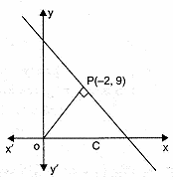
The perpendicular from the origin to a line meets it at the point (-2, 9), find the equation of the line.
Answer
Slope of line $OP = \frac{{9 - 0}}{{ - 2 - 0}} = \frac{{ - 9}}{2}$
Since the required line is perpendicular to OP,

$\therefore$ Slope of required line $ = \frac{2}{9}$
The required line passing through point (-2, 9) having slope $\frac{2}{9}$.
So equation of required line is
$y - 9 = \frac{2}{9}(x + 2) \Rightarrow$ 9y - 81 = 2 x + 4
$\Rightarrow$ 2x - 9y + 85 = 0
View full question & answer
Question 262 Marks
Find the equation of a line that cuts off equal intercepts on the coordinate axis and passes through the point (2, 3).
Answer
Let equal intercepts on the coordinate axis be a and the line passes through point (2, 3).
$\therefore \frac{2}{a} + \frac{3}{a} = 1 \Rightarrow $ a = 5
Thus equation of required line is
$\frac{x}{5} + \frac{y}{5} = 1 \Rightarrow$ x + y = 5
View full question & answer
Question 272 Marks
Find the equation of the line passing through (-3, 5) and perpendicular to the line through the points (2, 5) and (-3, 6).
Answer
Let A (2, 5) and B(-3, 6) be any two points.
$\therefore$ Slope of AB $= \frac{{6 - 5}}{{ - 3 - 2}} = - \frac{1}{5}$
Since the required line is perpendicular to AB.
$\therefore$ Slope of required line m = 5.
Now the required line passing through point (-3, 5) having slope 5
$\therefore$ y - 5 = 5(x + 3) $\Rightarrow$ y - 5 = 5x + 15
$\Rightarrow$ 5x - y + 20 = 0
View full question & answer
Question 282 Marks
Without using distance formula, show that the points (-2, -1), (4, 0), (3, 3) and (-3, 2) are the vertices of a parallelogram.
Answer
Let A(-2, -1), B (4, 0), C (3, 3) and D(-3, 2) be vertices of a quadrilateral ABCD.
$\therefore$ Slope of AB $ = \frac{{0 - ( - 1)}}{{4 - ( - 2)}} = \frac{1}{6}$
Slope of BC $= \frac{{3 - 0}}{{3 - 4}} = \frac{3}{{ - 1}} = - 3$
Slope of DC $= \frac{{3 - 2}}{{3 - ( - 3)}} = \frac{1}{6}$
Slope of AD $= \frac{{2 - ( - 1)}}{{ - 3 - ( - 2)}} = \frac{3}{{ - 1}} = - 3$
$\therefore$ Slope of AB = Slope of DC $\Rightarrow$ AB|| DC
And Slope of BC = Slope of AD $\Rightarrow$ BC || AD
Thus ABCD is a parallelogram
View full question & answer
Question 292 Marks
Find the value of x for which the points (x, -1)(2, 1) and (4, 5) are collinear.
Answer
Let A(x, -1), B (2, 1) and C (4, 5) be three collinear points.
$\therefore$ Slope of AB $= \frac{{1 - ( - 1)}}{{2 - x}} = \frac{{1 + 1}}{{2 - x}} = \frac{2}{{2 - x}}$
Slope of BC = $\frac{{5 - 1}}{{4 - 2}} = \frac{4}{2} = 2$
Since points A,Band C are collinear therefore slope of AB=slope of BC
2/2-x=2
Hence x=2
View full question & answer
Question 302 Marks
Find the slope of the line, which makes an angle of 30° with the positive direction of y-axis measured anticlockwise.
Answer
The line makes an angle of $30^{\circ}$ with the positive direction of $y$-axis.
Now the line makes an angle of $(90+30)^{\circ}=120^{\circ}$ with the positive direction $x$-axis.
$\therefore$ Slope of the line $=\tan 120^{\circ}=\tan (90+30)$
$=-\cot 30^{\circ}=-\sqrt{3}$
View full question & answer
Question 312 Marks
Without using the Pythagoras theorem, show that the points (4, 4), (3, 5) and C(-1, -1) are the vertices of a right angled triangle.
Answer
Let A (4, 4), B (3, 5) and C(-1, -1) be three vertices of a $\Delta {\rm A}{\rm B}C$.
$\therefore$ Slope of AB $ = \frac{{5 - 4}}{{3 - 4}} = \frac{1}{{ - 1}} = - 1$
$\therefore$ Slope of BC $= \frac{{ - 1 - 5}}{{ - 1 - 3}} = \frac{{ - 6}}{{ - 4}} = \frac{3}{2}$
$\therefore$ Slope of AC $ = \frac{{ - 1 - 4}}{{ - 1 - 4}} = \frac{{ - 5}}{{ - 5}} = 1$
Now slope of AB $\times$ slope of AC = -1$\times$1 = -1
This shows thatAB$\bot$AC. Thus $\Delta {\rm A}{\rm B}C$ is right angled at point A.
View full question & answer
Question 322 Marks
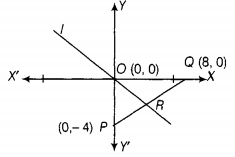
Find the slope of a line, which passes through the origin and mid-point of the line segment joining the points P(0, - 4) and B(8, 0).
Answer
If two points are given, then slope m = $\frac{y_{2}-y_{1}}{x_{2}-x_{1}}$
Given points are P (0, -4) and Q (8, 0).
$\therefore x_1 = 0, y_1 = -4, x_2 = 8, y_2 = 0$
These points plotted in XY - plane are given below.
Mid-point of PQ is R

$R=\left(\frac{x_{1}+x_{2}}{2}, \frac{y_{1}+y_{2}}{2}\right)=\left(\frac{0+8}{2}, \frac{-4+0}{2}\right)=(4,-2)$
$\therefore \text { Slope of } O R=\frac{y_{2}-y_{1}}{x_{2}-x_{1}}=\frac{-2-0}{4-0}=\frac{-2}{4}=-\frac{1}{2}$ 
$\left[{\because x_{1}=0, y_{1}=0,} \ {x_{2}=4, y_{2}=-2}\right]$
View full question & answer
Question 332 Marks
Find a point on the x-axis, which is equidistant from the points (7, 6) and (3, 4).
Answer
Let P(x, 0) be any point on the x-axis which is equidistant from Q(7, 6) and R (3, 4).
Then $PQ = \sqrt {{{(x - 7)}^2} + {{(0 - 6)}^2}}$ $= \sqrt {{x^2} - 14x + 49 + 36}$
$ = \sqrt {{x^2} - 14x + 85}$
$PR = \sqrt {{{(x - 3)}^2} + {{(0 - 4)}^2}} = \sqrt {{x^2} - 6x + 9 + 16}$
$= \sqrt {{x^2} - 6x + 25}$
Since PQ = PR
$\therefore \sqrt {{x^2} - 14x + 85} = \sqrt {{x^2} - 6x + 25}$
Squaring both sides, we have
$x^2 - 14x + 85 = x^2 - 6x + 25$
$\Rightarrow$ -14x + 6x = 25 - 85 $\Rightarrow$ 8x = -60
$\Rightarrow x = \frac{{15}}{2}$
Thus coordinates of point on the x-axis is $\left( {\frac{{15}}{2},0} \right)$.
View full question & answer
Question 342 Marks
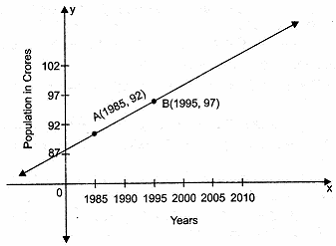
Consider the following population and year graph, find the slope of the line AB and using it, find what will be the population in the year 2010?

Answer
The points on the line are A(1985, 92) and B(1995, 97)
$\therefore$ Slope of AB $= \frac{{97 - 92}}{{1995 - 1985}} = \frac{5}{{10}} = \frac{1}{2}$
Let the population in year 2010 be x crores.
Then C (2010, x) lies on the line
$\therefore$ Slope of BC $= \frac{{y - 97}}{{2010 - 1995}} = \frac{{y - 97}}{{15}}$
Since points A, B and C lie on a line.
$\therefore$ Slopes of AB = Slope of BC
$\therefore \frac{1}{2} = \frac{{y - 97}}{{15}} \Rightarrow$ 15 = 2y - 194
$\Rightarrow$ 2y = 209 $\Rightarrow y = \frac{{209}}{2}$= 104.5
Thus population in 2010 will be 104.5 crores.
View full question & answer
Question 352 Marks
If three points (h, 0), (a, b) and (0, k) lies on a line, show that $\frac{a}{h} + \frac{b}{k} = 1$
Answer
Let A(h, 0), B (a, b) and C (0, k) be three points lie on a line.
$\therefore$ Slope of AB $= \frac{{b - 0}}{{a - h}} = \frac{b}{{a - h}}$
Slope of BC $= \frac{{k - b}}{{0 - a}} = \frac{{b - k}}{a}$
Slope of AB = Slope of BC (given)
$\therefore \frac{b}{{a - h}} = \frac{{b - k}}{a} \Rightarrow$ ab = ab - ak - bh + hk
$\Rightarrow$ ak + bh = hk
Dividing both sides by hk
$\frac{{ak}}{{hk}} + \frac{{bh}}{{hk}} = 1 \Rightarrow \frac{a}{h} + \frac{b}{k} = 1$.
View full question & answer
Question 362 Marks
A line passes through $(x_1, y_1)$ and $(h, k)$. If slope of the line is m, show that $k - {y_1} = m(h - {x_1})$.
Answer
Let $A(x_1, y_1)$ and $B(h, k)$ be two points.
$\therefore$ Slope of AB $= \frac{{k - {y_1}}}{{h - {x_1}}}$
Slope of AB = m (given)
$\therefore m = \frac{{k - {y_1}}}{{h - {x_1}}} \Rightarrow k - {y_1} = m(h - {x_1})$
View full question & answer
Question 372 Marks
Find the angle between the x-axis and the line joining the points (3, -1) and (4, -2).
Answer
Let A(3, -1) and B(4, -2) be two points. Let Q be the angle which AB makes with positive direction of x-axis.
$\therefore$ Slope of AB = $\tan \theta$
Also Slope of AB $= \frac{{ - 2( - 1)}}{{4 - 3}} = \frac{{ - 1}}{1} = - 1$
Now $\tan \theta = - 1 = - \tan 45^\circ = \tan (180 - 45)^\circ$
$\Rightarrow \theta = 135^\circ$
View full question & answer
Question 382 Marks
Write the equation of the lines for which tan $\theta=\frac{1}{2}$, where θ is the inclination of the line and x-intercept is 4.
Answer
Here, we have m = tan θ = $\frac{1}{2}$ and d = 4.
the equation of the line is y = m(x – d)
$y=\frac{1}{2}(x-4) \text { or } 2 y-x+4=0$
which is the required equation.
View full question & answer
Question 392 Marks
Write the equation of the lines for which tan $\theta=\frac{1}{2}$, where θ is the inclination of the line and y-intercept is $-\frac{3}{2}$
Answer
Here, slope of the line is m = tan θ = $\frac{1}{2}$ and y - intercept c =$-\frac{3}{2}$
the equation of the line is y = mx +c
$y=\frac{1}{2} x-\frac{3}{2} \text { or } 2 y-x+3=0$
which is the required equation.
View full question & answer
Question 402 Marks
Find the equation of the line through (– 2, 3) with slope – 4.
Answer
Here $m = – 4$ and given point $(x_0 , y_0)$ is $(– 2, 3)$.
By slope-intercept form formula, then we have
$m=\frac{y-y_{0}}{x-x_{0}}, \text { i.e., } y-y_{0}=m\left(x-x_{0}\right)$
$y – 3 = – 4 (x + 2) or 4x + y + 5 = 0.$
which is the required equation.
View full question & answer
Question 412 Marks
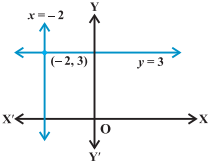
Find the equations of the lines parallel to y axis and passing through (– 2, 3).
Answer
Position of the lines is shown in Fig 10.12.
They-coordinate of every point on the line parallel to the x-axis is 3, thus, the equation of the line parallel to the x-axis and passing through (– 2, 3) is y = 3.
Similarly, also the equation of the line parallel to the y-axis and passing through (– 2, 3) is x = – 2.

View full question & answer
Question 422 Marks
Line through the points (-2, 6) and (4, 8) is perpendicular to the line through the points (8, 12) and (x, 24). Find the value of x.
Answer
Slope of the line through the points (-2, 6) and (4, 8) is
$m_{1}=\frac{8-6}{4-(-2)}=\frac{2}{6}=\frac{1}{3}$
Slope of the line through the points (8, 12) and (x, 24) is
$m_{2}=\frac{24-12}{x-8}=\frac{12}{x-8}$
Since, two lines are perpendicular,
$\therefore m_1m_2$ = -1 $\Rightarrow \frac{1}{3} \times \frac{12}{x-8}=-1$
$\Rightarrow$ 4 = -(x - 8) $\Rightarrow$ x = 4
View full question & answer
Question 432 Marks
Show that the area of the triangle formed by the lines $y = m_1 x + c_1 , y = m_2x + c_2$ and $x = 0$ is $\frac{\left(c_{1}-c_{2}\right)^{2}}{2\left|m_{1}-m_{2}\right|}$
Answer
Given lines are
$y=m_1 x+c_1 \ldots \text { (1) }$
$y=m_2 x+c_2 \ldots \text { (2) }$
$x=0 \ldots \text { (3) }$
We know that line $y=m x+c$ meets the line $x=0$ ( $y$-axis) at the point $(0, c)$. Thus, two vertices of the triangle formed by lines (1) to (3) are $P\left(0, c_1\right)$ and $Q\left(0, c_2\right)$. Third vertex can be obtained by solving equations (1) and (2). Solving (1) and (2), we obtain
$x=\frac{\left(c_{2}-c_{1}\right)}{\left(m_{1}-m_{2}\right)} \text { and } y=\frac{\left(m_{1} c_{2}-m_{2} c_{1}\right)}{\left(m_{1}-m_{2}\right)}$
Thus, third vertex of the triangle is R $\left(\frac{\left(c_{2}-c_{1}\right)}{\left(m_{1}-m_{2}\right)}, \frac{\left(m_{1} c_{2}-m_{2} c_{1}\right)}{\left(m_{1}-m_{2}\right)}\right)$
Now, the area of the triangle is given
$=\frac{1}{2} | 0\left(\frac{m_{1} c_{2}-m_{2} c_{1}}{m_{1}-m_{2}}-c_{2}\right)+\frac{c_{2}-c_{1}}{m_{1}-m_{2}}\left(c_{2}-c_{1}\right)+0\left(c_{1}-\frac{m_{1} c_{2}-m_{2} c_{1}}{m_{1}-m_{2}}\right)|=\frac{\left(c_{2}-c_{1}\right)^{2}}{2\left|m_{1}-m_{2}\right|}$
View full question & answer
Question 442 Marks
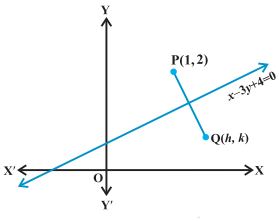
Assuming that straight lines work as the plane mirror for a point, find the image of the point (1, 2) in the line x – 3y + 4 = 0
Answer
Suppose Q (h, k) is the image of the point P (1, 2) in the line
x – 3y + 4 = 0 ... (1)


Thus,the line (1) is the perpendicular bisector of line segment PQ
Therefore,Slope of line PQ=$\frac{-1}{\text { Slope of line } x-3 y+4=0}$
so that $\frac{k-2}{h-1}=\frac{-1}{\frac{1}{3}}$ or 3h+k=5
and the mid-point of PQ, i.e., point $\left(\frac{h+1}{2}, \frac{k+2}{2}\right)$ will satisfy the equation (1) so that
$\frac{h+1}{2}-3\left(\frac{k+2}{2}\right)+4=0 \text { or } h-3 k=-3$ .........(3)
Solving (2) and (3), we obtain h=$\frac{6}{5}$ and k=$\frac{7}{5}$
Therefore, the image of the point (1, 2) in the line (1) is $\left(\frac{6}{5}, \frac{7}{5}\right)$

View full question & answer
Question 452 Marks
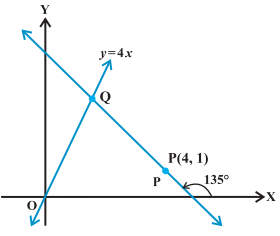
Find the distance of the line 4x – y = 0 from the point P (4, 1) measured along the line making an angle of 135° with the positive x-axis.
Answer

Given that the line is 4x – y = 0 ... (1)
In order to find the distance of the line (1) from the point P (4, 1) along another line, we have to find the point of intersection of both the lines.
For this purpose, we will first find the equation of the second line.
Slope of second line is tan 135° = –1.
Equation of the line with slope -1 through the point P (4, 1) is


y – 1 = – 1 (x – 4) or x + y – 5 = 0 ... (2)
Solving (1) and (2), we get x = 1 and y = 4 so that point of intersection of the two lines Q (1, 4).
Now, distance of line (1) from the point P (4, 1) along the line (2)
= the distance between the points P (4, 1) and Q (1, 4).
$=\sqrt{(1-4)^{2}+(4-1)^{2}}=3 \sqrt{2} \text { units. }$
Therefore, the required distance is $3 \sqrt{2}$ units.

View full question & answer
Question 462 Marks
If the lines 2x + y - 3 = 0, 5x + ky - 3 = 0, 3x - y - 2 = 0 are concurrent, find the value of k.
Answer
Given that three lines are concurrent, if they pass through a common point, i.e., point of intersection of any two lines lies on the third line. Here given lines are
2x + y – 3 = 0 ....(1)
5x + ky – 3 = 0 ....(2)
3x – y – 2 = 0 ... (3)
Solving (1) and (3) by cross-multiplication method, we get $\frac{x}{-2-3}=\frac{y}{-9+4}=\frac{1}{-2-3}$ or x = 1, y = 1
Therefore, the point of intersection of two lines is (1, 1).
Since the above three lines are concurrent, the point (1, 1) will satisfy equation (2) so that
5.1 + k.1 – 3 = 0
$\Rightarrow$ k = – 2
View full question & answer
Question 472 Marks
If the angle between two lines is $\frac{\pi}{4}$ and slope of one of the lines is $\frac{1}{2}$, then find the slope of the other line.
Answer
We know that, the acute angle $\theta$ between two lines with slopes $m_1$ and $m_2$ is given by
$\tan \theta=\left|\frac{m_{2}-m_{1}}{1+m_{1} m_{2}}\right|$ ...(i)
Let $m_{1}=\frac{1}{2}, m_2 = m$ and $ \theta=\frac{\pi}{4}$
Now, putting these values in Eq. (i). we get
$\frac{m-\frac{1}{2}}{1+\frac{1}{2} m}=1 $ or $ \frac{m-\frac{1}{2}}{1+\frac{1}{2} m}=-1$
$\Rightarrow m-\frac{1}{2}=1+\frac{1}{2} m $ or $m-\frac{1}{2}=-1-\frac{1}{2} m$
$\Rightarrow \left(1-\frac{1}{2}\right) m=1+\frac{1}{2} \text { or } m\left(1+\frac{1}{2}\right)=-1+\frac{1}{2}$
$\Rightarrow$ m = 3 or m = $-\frac {1}{3}$
View full question & answer
Question 482 Marks
Find the distance between the parallel lines 3x – 4y + 7 = 0 and 3x – 4y + 5 = 0
Answer
Here, $A=3, B=-4, C_1=7$ and $C_2=5$.
Hence, the required distance is $d=\frac{|7-5|}{\sqrt{3^{2}+(-4)^{2}}}=\frac{2}{5}$
View full question & answer
Question 492 Marks
Find the distance of the point (3, -5) from the line 3x - 4y - 26 = 0
Answer
According to the question,
Given line is 3x – 4y –26 = 0 ...(1)
Comparing (1) with general equation of line Ax + By + C = 0, we get
A = 3, B = – 4 and C = – 26.
Given point is $(x_{1,} y_1) = (3, –5)$. The distance of the given point from the given line is
$d=\frac{\left|\mathrm{A} x_{1}+\mathrm{B} y_{1}+\mathrm{C}\right|}{\sqrt{\mathrm{A}^{2}+\mathrm{B}^{2}}}=\frac{|3.3+(-4)(-5)-26|}{\sqrt{3^{2}+(-4)^{2}}}=\frac{3}{5}$
View full question & answer
Question 502 Marks
Find the equation of a line perpendicular to the line x - 2y + 3 = 0 and passing through the point (1, – 2).
Answer
Given line x - 2y + 3 = 0 can be written as
$y=\frac{1}{2} x+\frac{3}{2}$ ........(1)
Slope of the line (1) is $m_{1}=\frac{1}{2}$. Thus,slope of the line perpendicular to line (1) is
$m_{2}=-\frac{1}{m_{1}}=-2$
Equation of the line with slope – 2 and passing through the point (1, – 2) is
$y-(-2)=-2(x-1) \text { or } y=-2 x$
This is the required equition of line
View full question & answer
Question 512 Marks
Find the angle between the lines $y-\sqrt{3} x-5=0$ and $\sqrt{3} y-x+6=0$.
Answer
Given lines are
$y-\sqrt{3} x-5=0 \text { or } y=\sqrt{3} x+5$ .........(1)
and $\sqrt{3} y-x+6=0 \text { or } y=\frac{1}{\sqrt{3}} x-2 \sqrt{3}$......(2)
Slope of line (1) is $m_{1}=\sqrt{3}$ and slope of line (2) is $m_{2}=\frac{1}{\sqrt{3}}$
The acute angle (say) $\theta$ between two lines is given by
$\tan \theta=\left|\frac{m_{2}-m_{1}}{1+m_{1} m_{2}}\right|$......(3)
Substituting,the values of $m_1$ and $m_2$ in (3), we obtain
$\tan \theta=\left|\frac{\frac{1}{\sqrt{3}}-\sqrt{3}}{1+\sqrt{3} \times \frac{1}{\sqrt{3}}}\right|=\left|\frac{1-3}{2 \sqrt{3}}\right|=\frac{1}{\sqrt{3}}$
which gives $\theta$ = 30°.
Therefore,the angle between two lines is either 30°or 180° – 30° = 150°.
View full question & answer
Question 522 Marks
Reduce the equation $\sqrt{3} x+y-8=0$ into normal form. Find the values of p and ω
Answer
We have,
$\sqrt{3} x+y-8=0$ ... (1)
Dividing (1) by $\sqrt{(\sqrt{3})^{2}+(1)^{2}}=2$, we obtain
$\frac{\sqrt{3}}{2} x+\frac{1}{2} y=4$ or $\cos 30^{\circ} x+\sin 30^{\circ} y=4$ ....(2)
Comparing (2) with x cos $\omega$ + y sin $\omega$ = p, then we get p = 4 and $\omega$ = 30°.
View full question & answer
Question 532 Marks
The Fahrenheit temperature F and absolute temperature K satisfy a linear equation. Given that K = 273 when F = 32 and that K = 373 when F = 212. Express K in terms of F and find the value of F, when K = 0
Answer
Suppose that F along x-axis and K along y-axis, we have two points (32, 273) and (212, 373) in XY-plane. By two-point form, the point (F, K) satisfies the equation,then we get
$\mathrm{K}-273=\frac{373-273}{212-32}(\mathrm{F}-32)$ or $\mathrm{K}-273=\frac{100}{180}(\mathrm{F}-32)$
or $K=\frac{5}{9}(F-32)+273$ .......(1)
which is the required relation.
When K = 0, Equation (1) gives
$0=\frac{5}{9}(\mathrm{F}-32)+273$ or $\mathrm{F}-32=-\frac{273 \times 9}{5}=-491.4$ or F= -459.4
View full question & answer
Question 542 Marks
Find the equation of the line whose perpendicular distance from the origin is 4 units and the angle which the normal makes with positive direction of x-axis is 15°.
Answer
We are given that, p = 4 and ω = $15^{\circ}$
Now, $\cos 15^{\circ}=\frac{\sqrt{3}+1}{2 \sqrt{2}}$
and $\sin 15^{\circ}=\frac{\sqrt{3}-1}{2 \sqrt{2}}$
The equation of the line is x cos ω + y sin ω = p
$x \cos 15^{\circ}+y \sin 15^{\circ}$
or $\frac{\sqrt{3}+1}{2 \sqrt{2}} x+\frac{\sqrt{3}-1}{2 \sqrt{2}} y=4$
or $(\sqrt{3}+1) x+(\sqrt{3}-1) y=8 \sqrt{2}$
This is the required equation.
View full question & answer
Question 552 Marks
Find the equation of the line, which makes intercepts –3 and 2 on the x- and y-axes respectively.
Answer
Here a = –3 and b = 2.
We know that equation of the line is $\frac{x}{a}+\frac{y}{b}=1$
$\frac{x}{-3}+\frac{y}{2}=1$ or 2x - 3y + 6 = 0
View full question & answer